SGK - Tiếng Anh 10
0/0
minus
100%
plus
Ghi chú
setting
share
Nền
Đọc offline

Lưu sách trên máy

Đang kiểm tra...

list Mục lục
list Mục lục
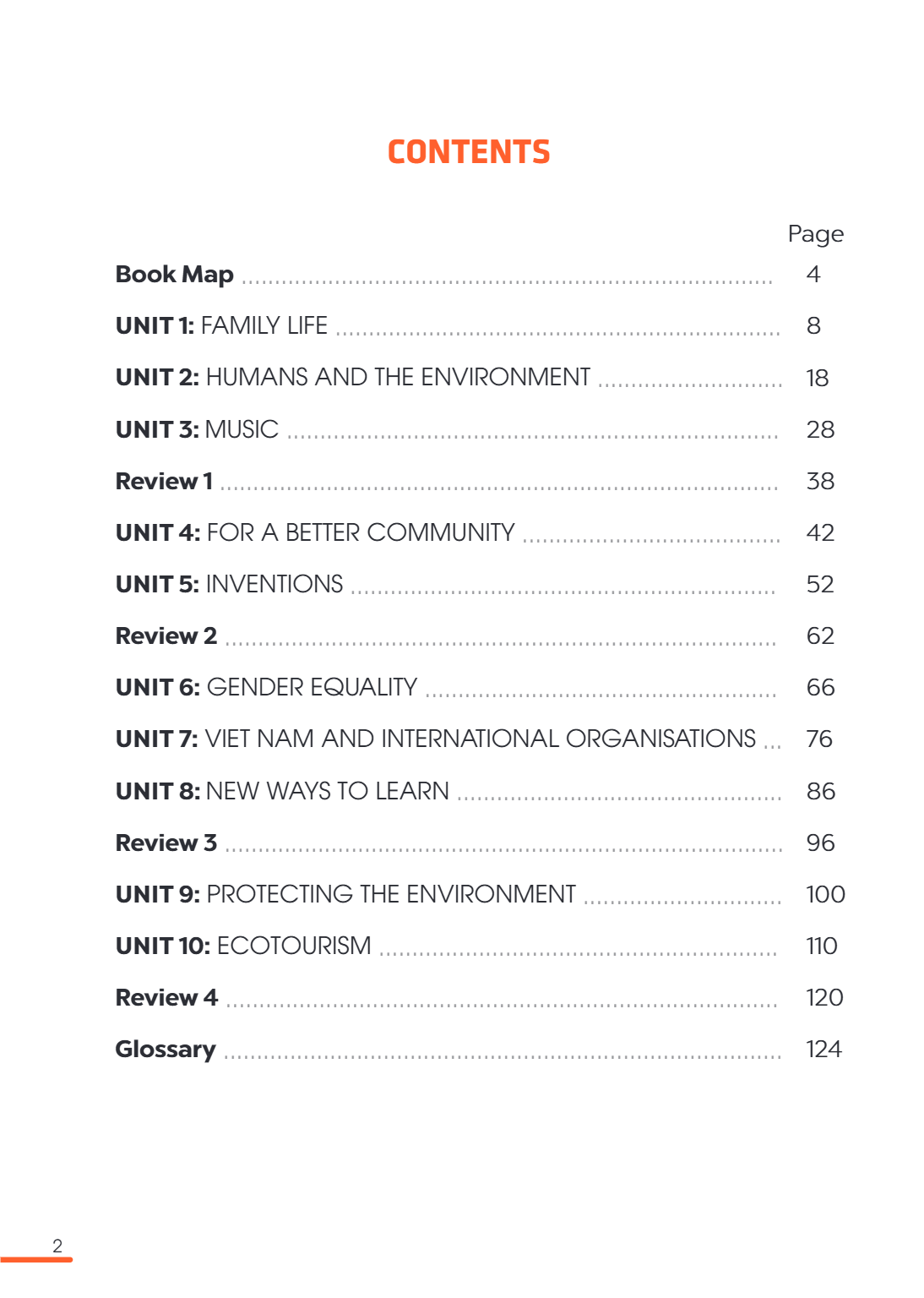
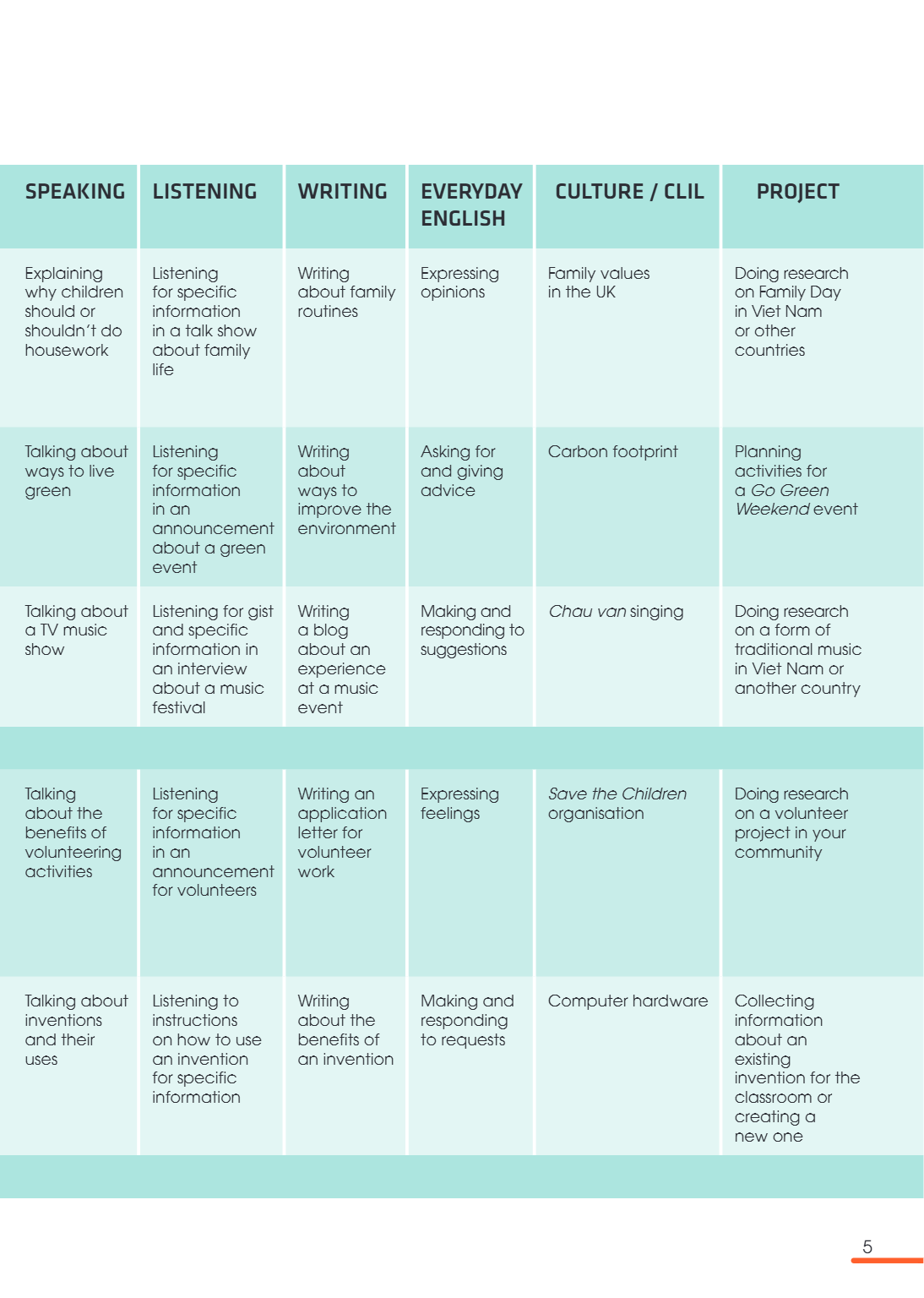
UNIT 1: FAMILY LIFE
Getting started
Vocabulary & Pronunciation
Grammar
Reading
Speaking
Listening
Writing
Communication & Culture/CLIL
Looking back
UNIT 2: HUMANS AND THE ENVIRONMENT
Getting started
Vocabulary & Pronunciation
Grammar
Reading
Speaking
Listening
Writing
Communication & Culture/CLIL
Looking back
UNIT 3: MUSIC
Getting started
Vocabulary & Pronunciation
Grammar
Reading
Speaking
Listening
Writing
Communication & Culture/CLIL
Looking back
REVIEW 1 & THE FIRST MID-TERM TESTS
Review 1
UNIT 4: FOR A BETTER COMMUNITY
Getting started
Vocabulary & Pronunciation
Grammar
Reading
Speaking
Listening
Writing
Communication & Culture/CLIL
Looking back
UNIT 5: INVENTIONS
Getting started
Vocabulary & Pronunciation
Grammar
Reading
Speaking
Listening
Writing
Communication & Culture/CLIL
Looking back
REVIEW 2 & THE FIRST END-OF-TERM TESTS
Review 2
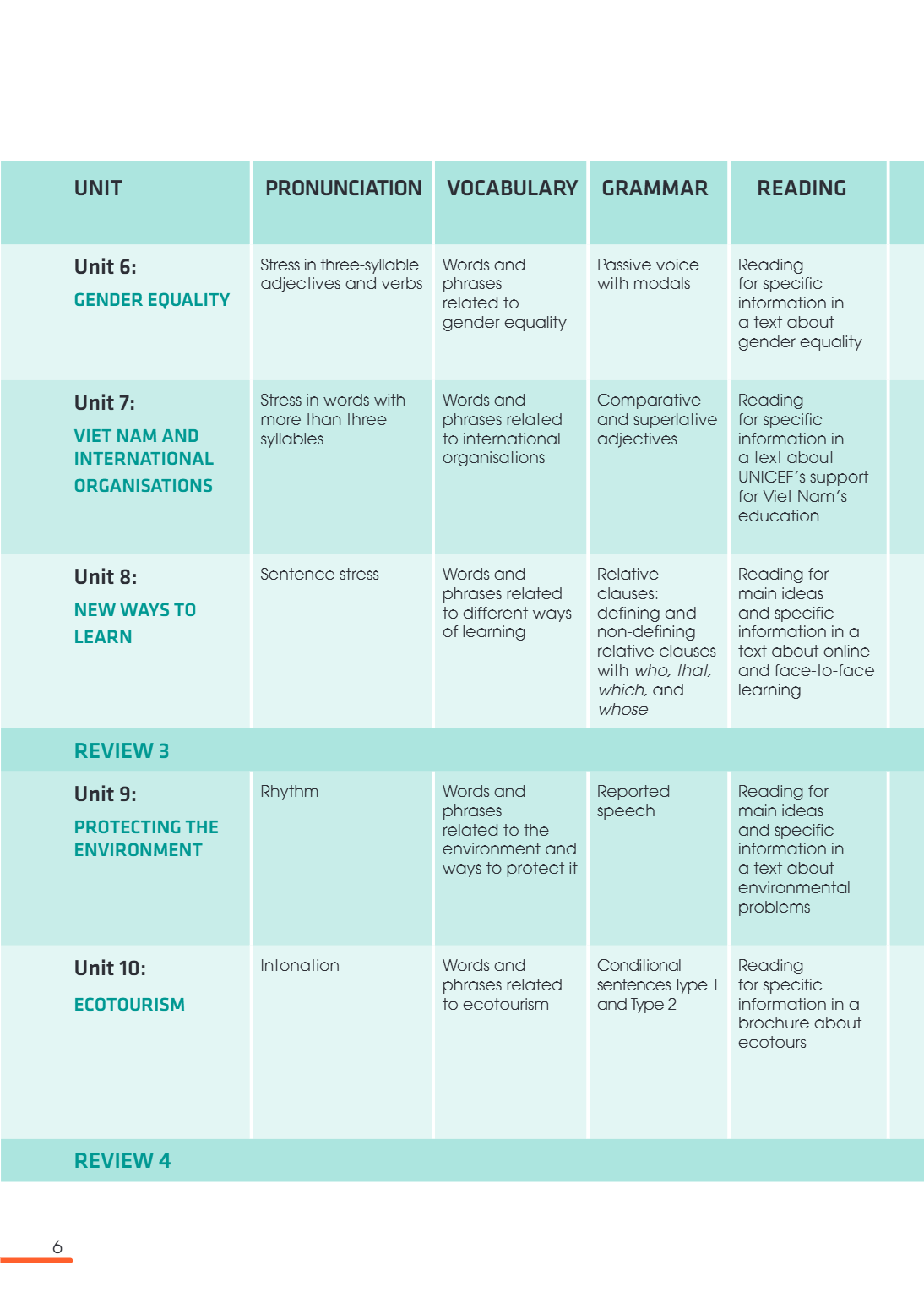
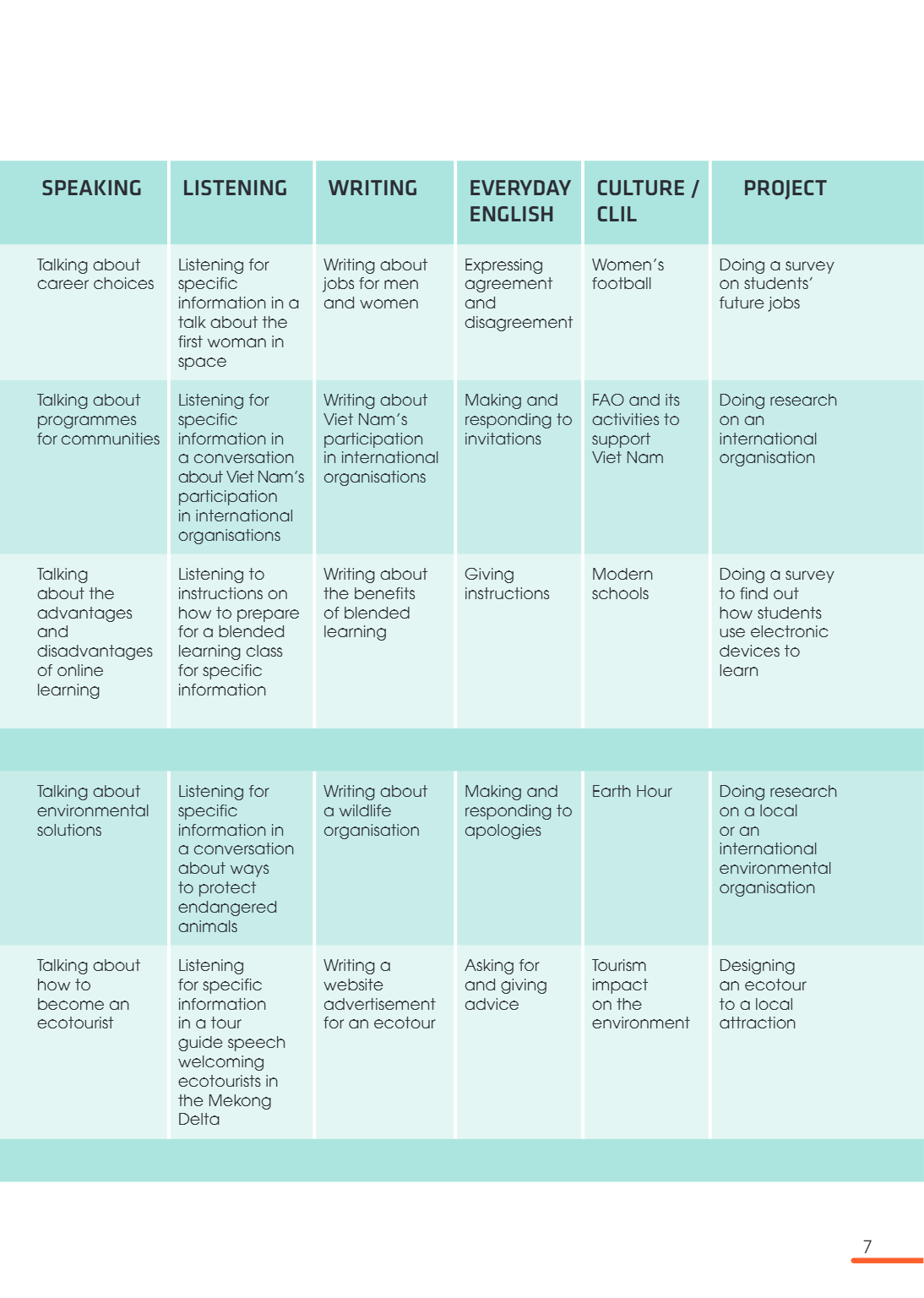
UNIT 6: GENDER EQUALITY
Getting started
Vocabulary & Pronunciation
Grammar
Reading
Speaking
Listening
Writing
Communication & Culture/CLIL
Looking back
UNIT 7: VIET NAM AND INTERNATIONAL ORGANISATIONS
Getting started
Vocabulary & Pronunciation
Grammar
Reading
Speaking
Listening
Writing
Communication & Culture/CLIL
Looking back
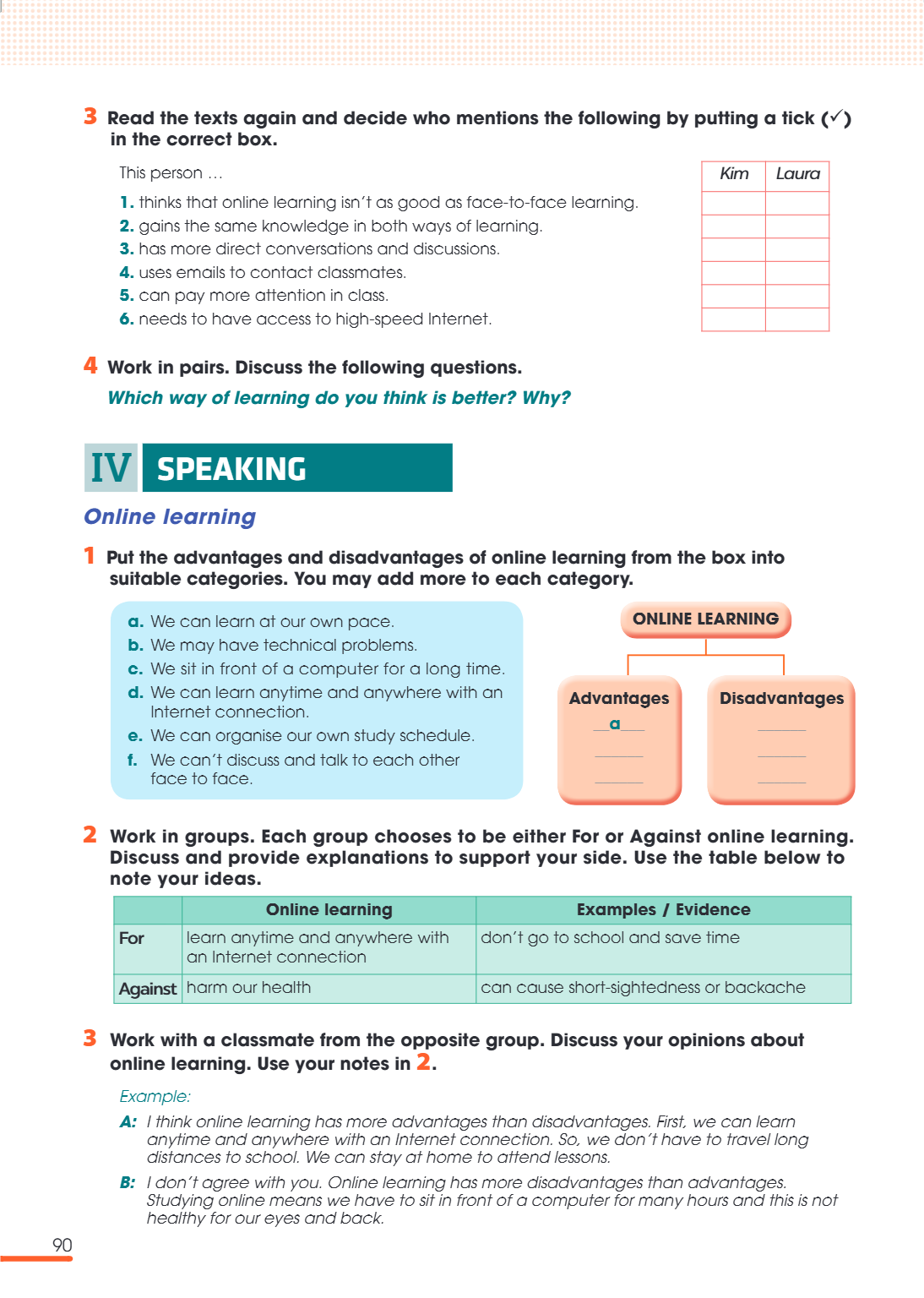
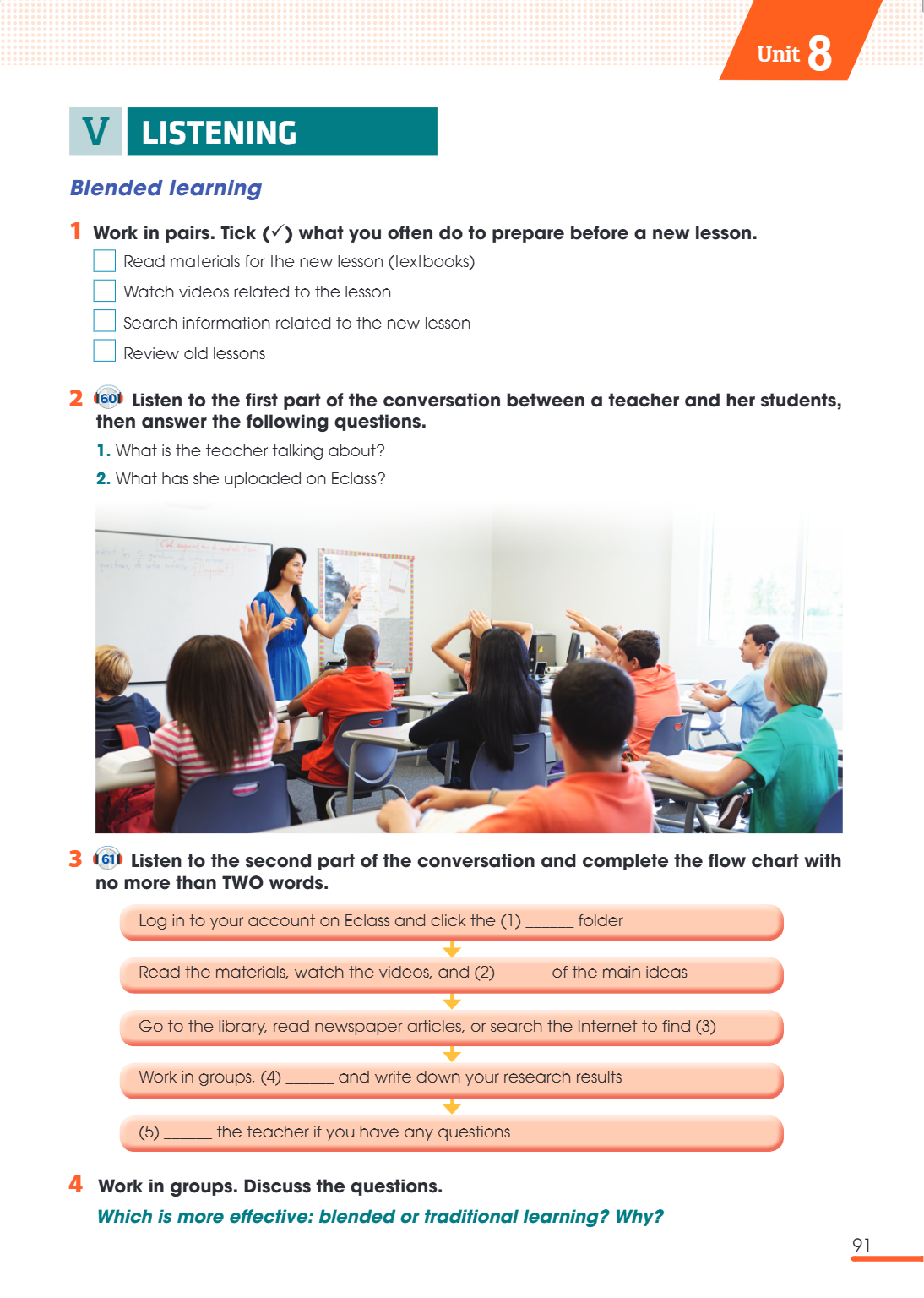
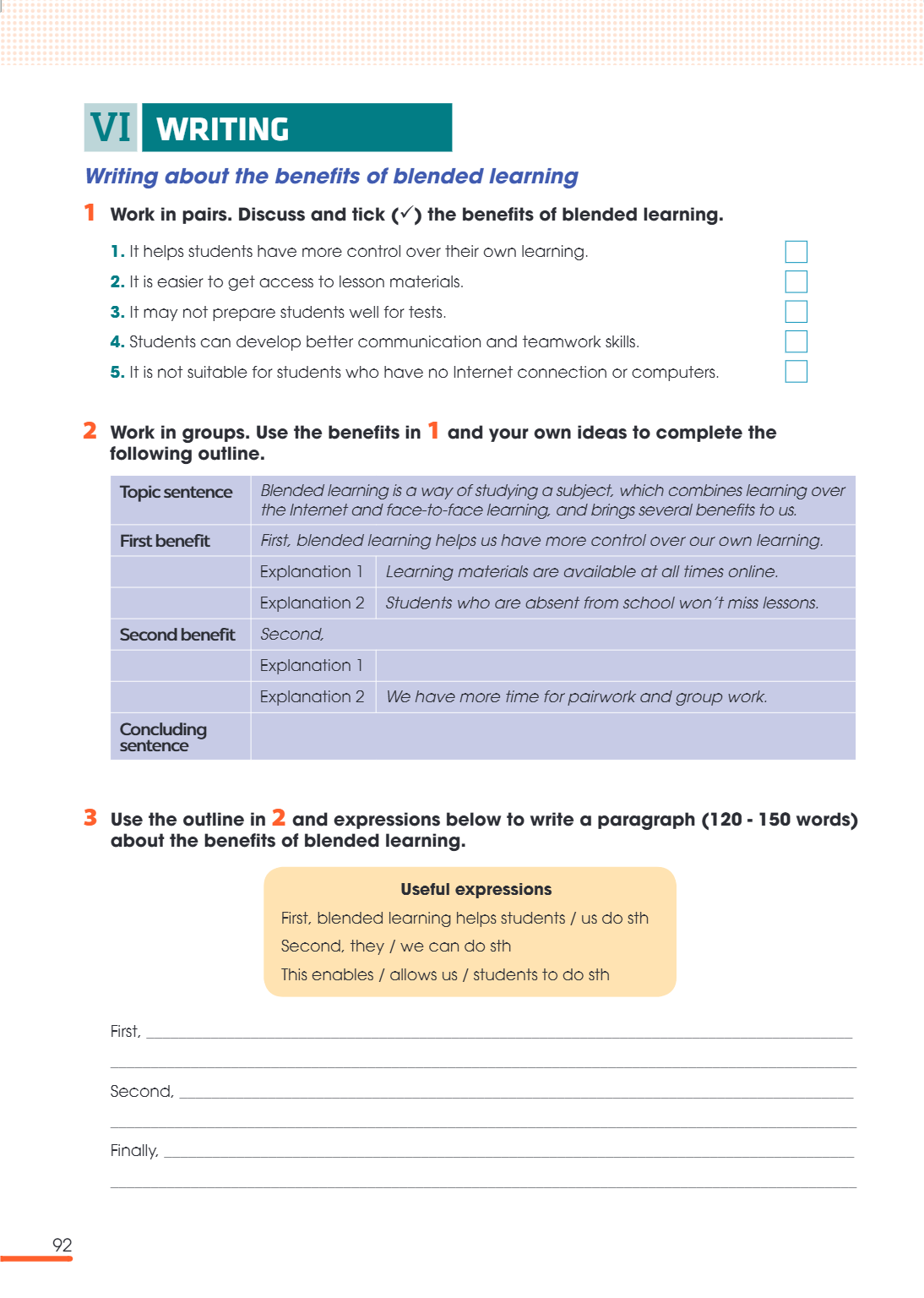
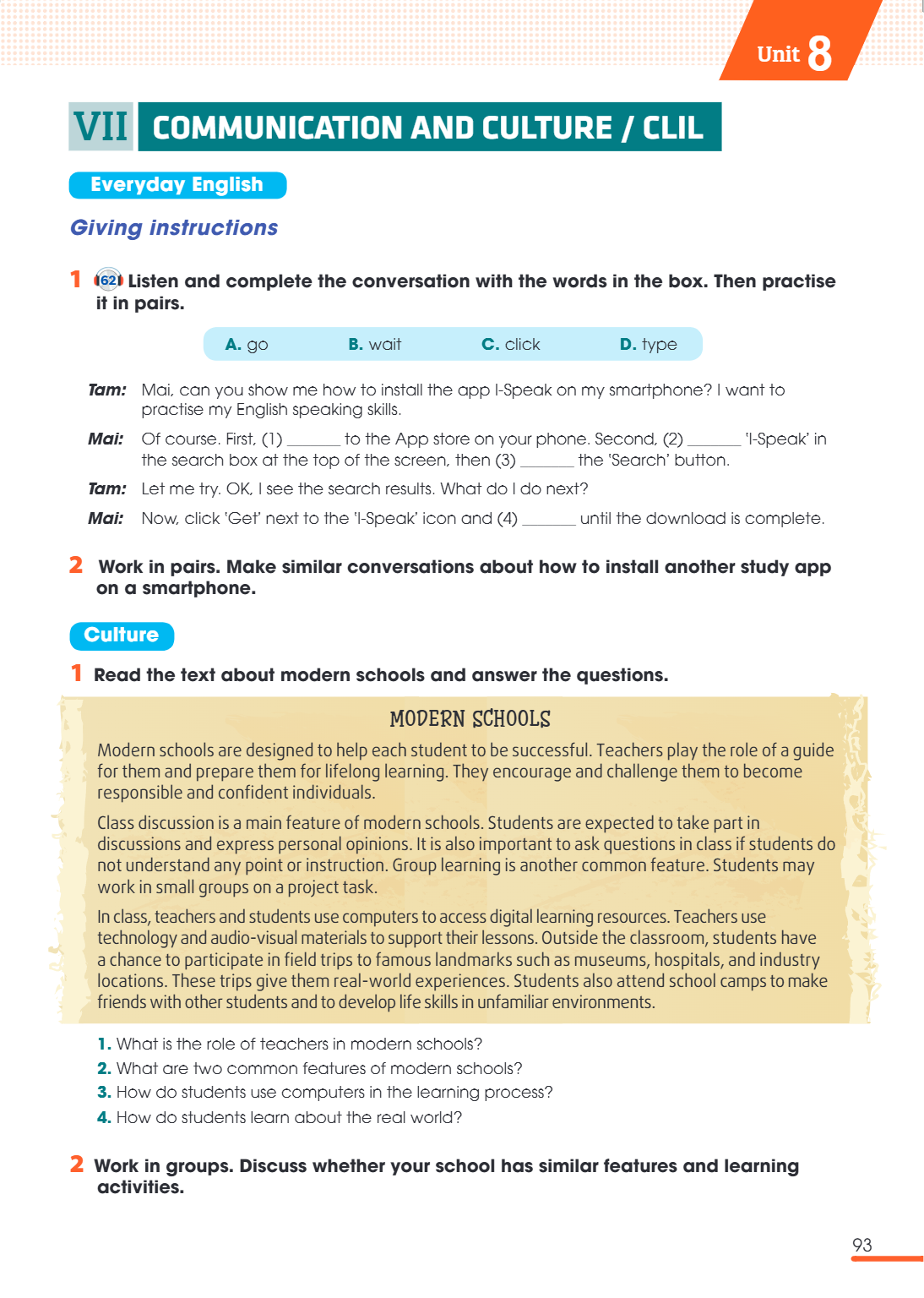
UNIT 8: NEW WAYS TO LEARN
Getting started
Vocabulary & Pronunciation
Grammar
Reading
Speaking
Listening
Writing
Communication & Culture/CLIL
Looking back
REVIEW 3 & THE SECOND MID-TERM TESTS
Review 3
UNIT 9: PROTECTING THE ENVIRONMENT
Getting started
Vocabulary & Pronunciation
Grammar
Reading
Speaking
Listening
Writing
Communication & Culture/CLIL
Looking back
UNIT 10: ECOTOURISM
Getting started
Vocabulary & Pronunciation
Grammar
Reading
Speaking
Listening
Writing
Communication & Culture/CLIL
Looking back
REVIEW 4 & THE SECOND END-OF-TERM TESTS
Review 4
Học liệu
Đang xem trang 0 Học liệu dưới đây tương ứng với nội dung bạn đang đọc
empty Không có học liệu bổ trợ
cover-first
page-1
Trang 1
Trang 2
Trang 3
Trang 4
Trang 5
Trang 6
Trang 7
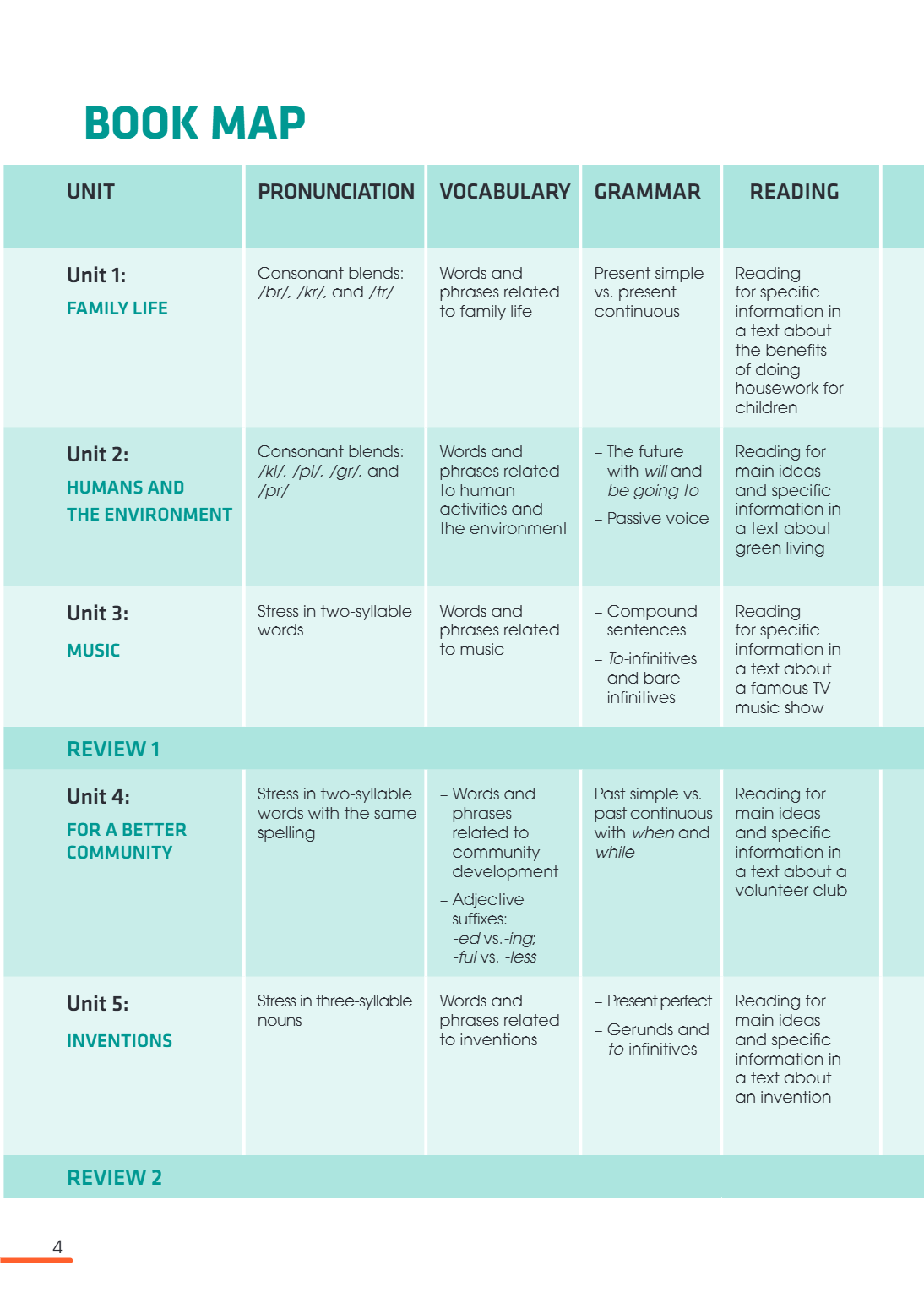
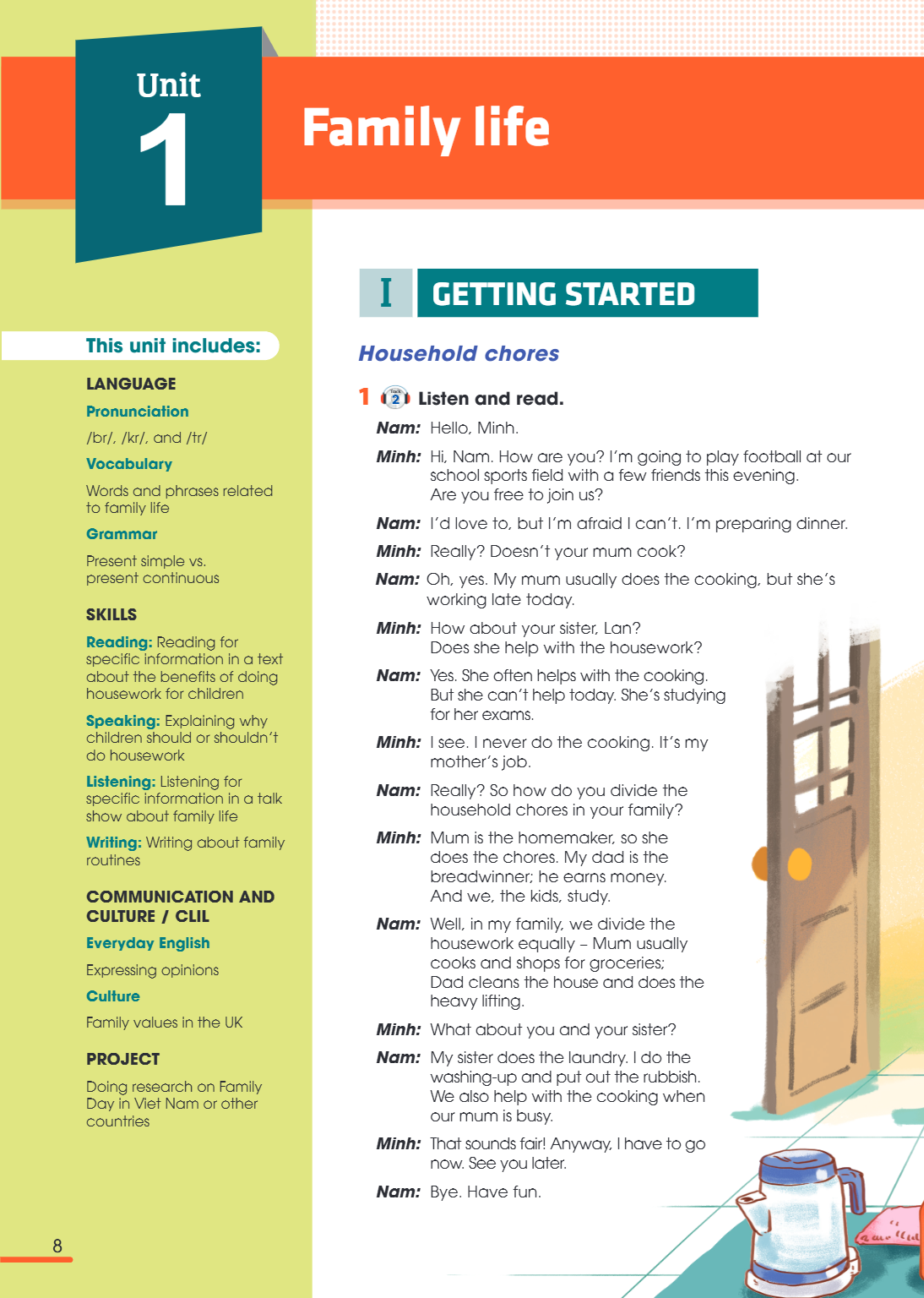
Unit 1. FAMILY LIFE This unit includes: LANGUAGE Pronunciation /br/, /kr/, and /tr/ Vocabulary Words and phrases related to family life Grammar Present simple v
Unit 1. FAMILY LIFE
This unit includes:
LANGUAGE
Pronunciation
/br/, /kr/, and /tr/
Vocabulary
Words and phrases related to family life
Grammar
Present simple vs. present continuous
SKILLS
Reading: Reading for specific information in a text about the benefits of doing housework for children
Speaking: Explaining why children should or shouldn't do housework
Listening: Listening for specific information in a talk show about family life
Writing: Writing about family routines
COMMUNICATION AND CULTURE / CLIL
Everyday English
Expressing opinions
Culture
Family values in the UK
PROJECT
Doing research on Family Day in Viet Nam or other countries
I GETTING STARTED
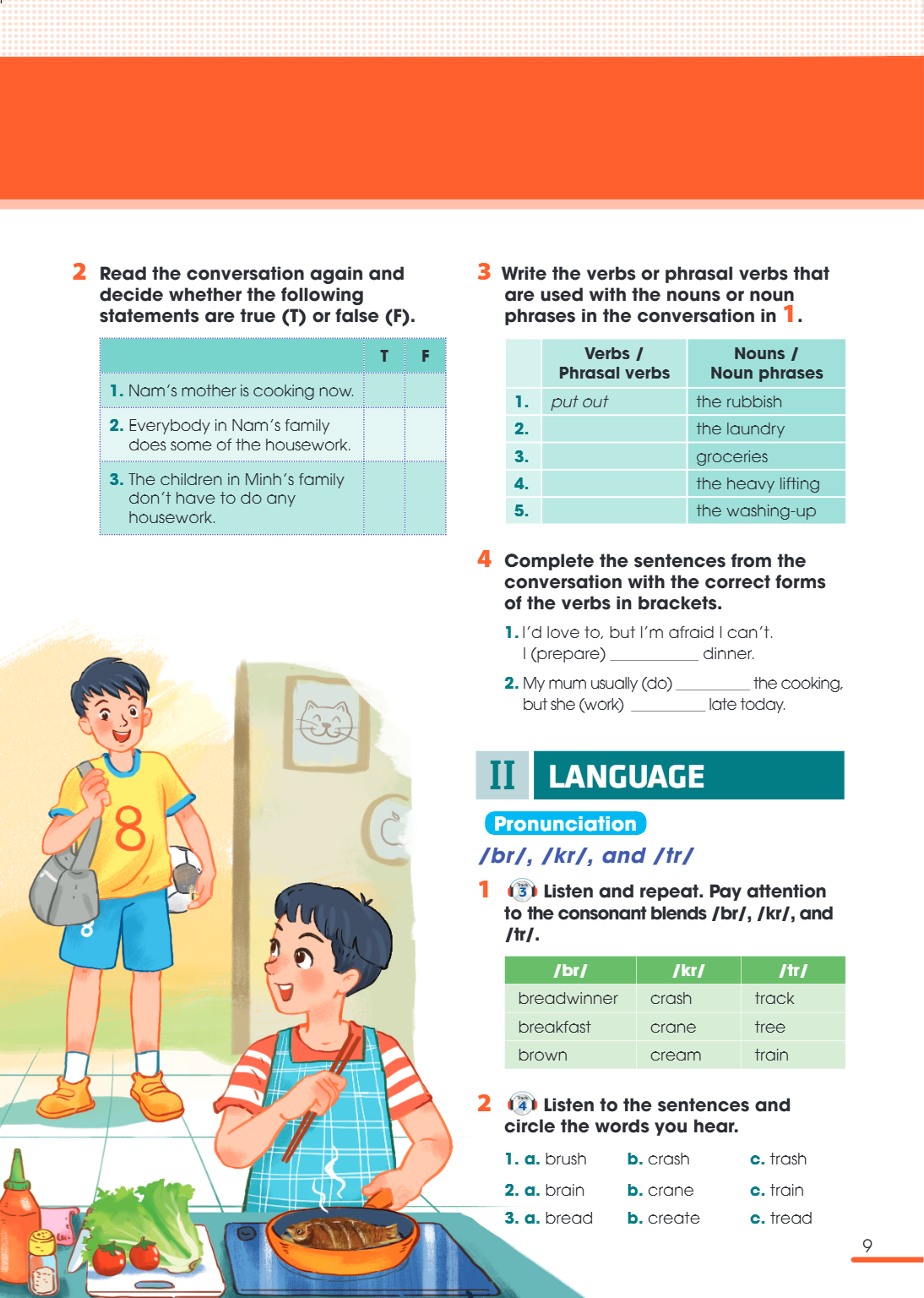
Household chores
1. Listen and read.
Nam: Hello, Minh.
Minh: Hi, Nam. How are you? I'm going to play football at our school sports field with a few friends this evening. Are you free to join us?
Nam: I'd love to, but I'm afraid I can't. I'm preparing dinner.
Minh: Really? Doesn't your mum cook?
Nam: Oh, yes. My mum usually does the cooking, but she's working late today.
Minh: How about your sister, Lan? Does she help with the housework?
Nam: Yes. She often helps with the cooking. But she can't help today. She's studying for her exams.
Minh: I see. I never do the cooking. It's my mother's job.
Nam: Really? So how do you divide the household chores in your family?
Minh: Mum is the homemaker, so she does the chores. My dad is the breadwinner; he earns money. And we, the kids, study.
Nam: Well, in my family, we divide the housework equally – Mum usually cooks and shops for groceries; Dad cleans the house and does the heavy lifting.
Minh: What about you and your sister?
Nam: My sister does the laundry. I do the washing-up and put out the rubbish. We also help with the cooking when our mum is busy.
Minh: That sounds fair! Anyway, I have to go now. See you later.
Nam: Bye. Have fun.
II LANGUAGE Pronunciation /br/, /kr/, and /tr/ 1. 🎧 Listen and repeat. Pay attention to the consonant blends /br/, /kr/, and /tr/. /br/, /kr/, /tr/ breadwinner,
II LANGUAGE
Pronunciation
/br/, /kr/, and /tr/
1. 🎧 Listen and repeat. Pay attention to the consonant blends /br/, /kr/, and /tr/.
/br/, /kr/, /tr/
breadwinner, crash, track
breakfast, crane, tree
brown, cream, train
2. 🎧 Listen to the sentences and circle the words you hear.
1. a. brush b. crash c. trash
2. a. brain b. crane c. train
3. a. bread b. create c. tread
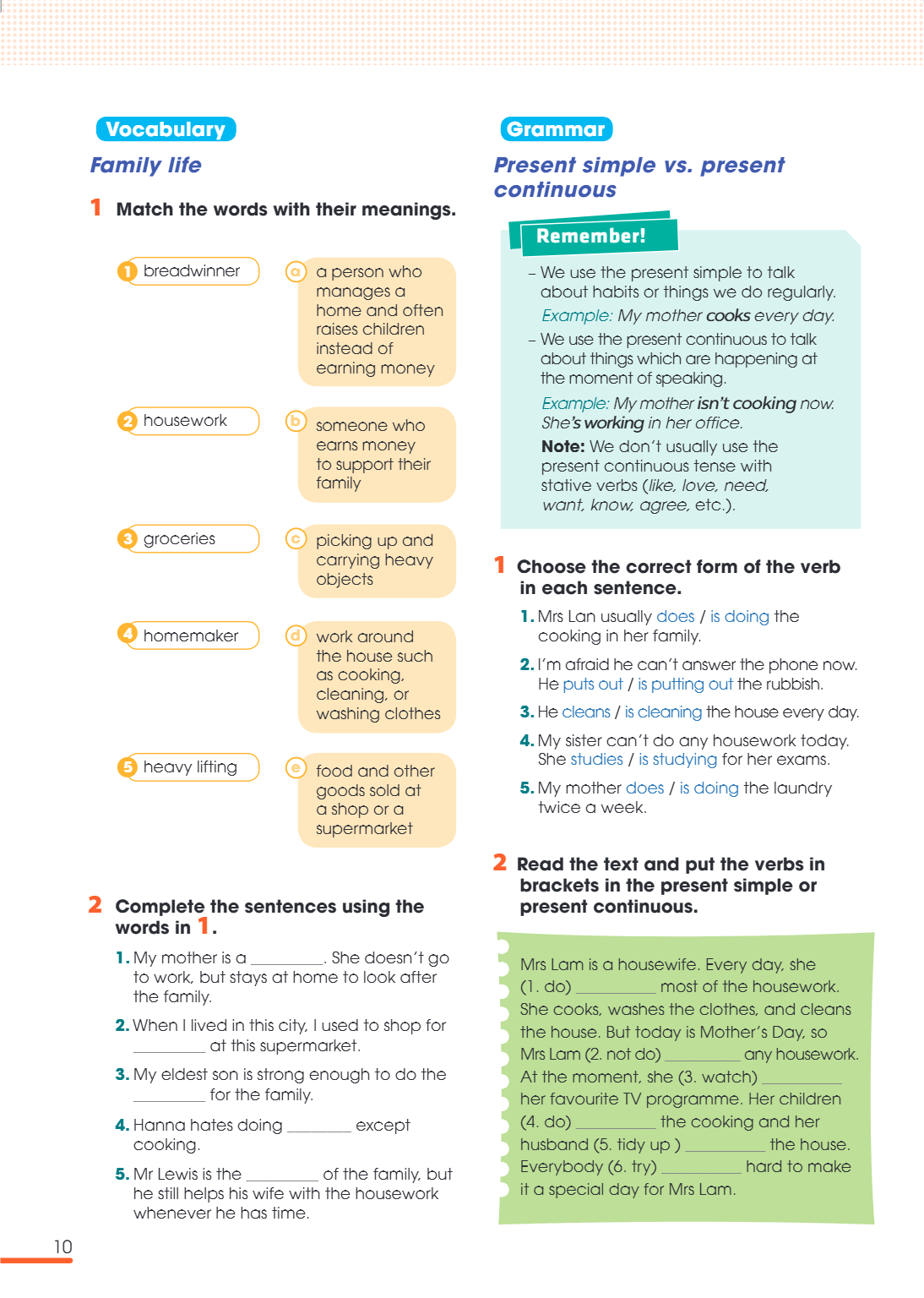
Grammar Present simple vs. present continuous Remember! – We use the present simple to talk about habits or things we do regularly. Example: My mother cooks eve
Grammar
Present simple vs. present continuous
Remember!
– We use the present simple to talk about habits or things we do regularly.
Example: My mother cooks every day.
– We use the present continuous to talk about things which are happening at the moment of speaking.
Example: My mother isn't cooking now. She's working in her office.
Note: We don't usually use the present continuous tense with stative verbs (like, love, need, want, know, agree, etc.).
1. Choose the correct form of the verb in each sentence.
1. Mrs Lan usually ==does== / ==is doing== the cooking in her family.
2. I'm afraid he can't answer the phone now. He ==puts out== / ==is putting out== the rubbish.
3. He ==cleans== / ==is cleaning== the house every day.
4. My sister can't do any housework today. She ==studies== / ==is studying== for her exams.
5. My mother ==does== / ==is doing== the laundry twice a week.
2. Read the text and put the verbs in brackets in the present simple or present continuous.
Mrs Lam is a housewife. Every day, she (1. do) ________ most of the housework. She cooks, washes the clothes, and cleans the house. But today is Mother's Day, so Mrs Lam (2. not do) ________ any housework. At the moment, she (3. watch) ________ her favourite TV programme. Her children (4. do) ________ the cooking and her husband (5. tidy up ) ________ the house. Everybody (6. try) ________ hard to make it a special day for Mrs Lam.
Unit1 III reading Benefits of doing housework 1 Work in pairs. Look at the picture and answer the questions. What is each person in the picture doing? 2. Do you
Unit1
III reading
Benefits of doing housework
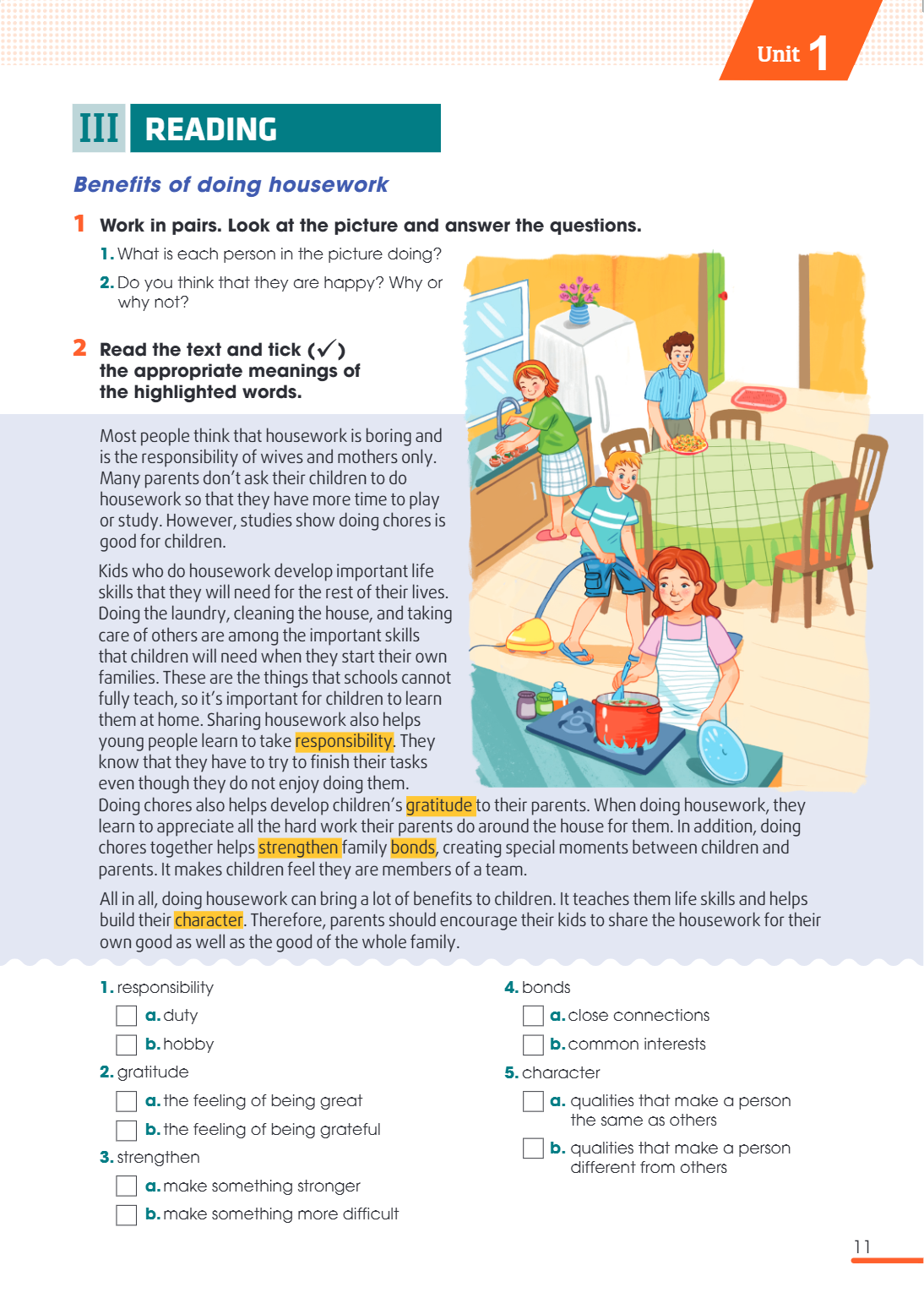
1 Work in pairs. Look at the picture and answer the questions.
What is each person in the picture doing?
2. Do you think that they are happy? Why or
why not?
2 Read the text and tick () the appropriate meanings of the highlighted words.
Most people think that housework is boring and is the responsibility of wives and mothers only. Many parents don't ask their children to do housework so that they have more time to play or study. However, studies show doing chores is good for children. Kids who do housework develop important life skills that they will need for the rest of their lives. Doing the laundry, cleaning the house, and taking care of others are among the important skills that children will need when they start their own families. These are the things that schools cannot fully teach, so it's important for children to learn them at home. Sharing housework also helps young people learn to take responsibility. They know that they have to try to finish their tasks even though they do not enjoy doing them. Doing chores also helps develop children's gratitude to their parents. When doing housework, they learn to appreciate all the hard work their parents do around the house for them. In addition, doing chores together helps strengthen family bonds, creating special moments between children and parents. It makes children feel they are members of a team. All in all, doing housework can bring a lot of benefits to children. It teaches them life skills and helps build their character. Therefore, parents should encourage their kids to share the housework for their own good as well as the good of the whole family.
1. responsibility 4.bonds
a.duty a.close connections b.hobby b.common interests 2.gratitude 5. character
a.the feeling of being great a. qualities that make a person
b.the feeling of being grateful the same as others
3.strengthen b. qualities that make a person a.make something stronger b.make something more difficult
different from others
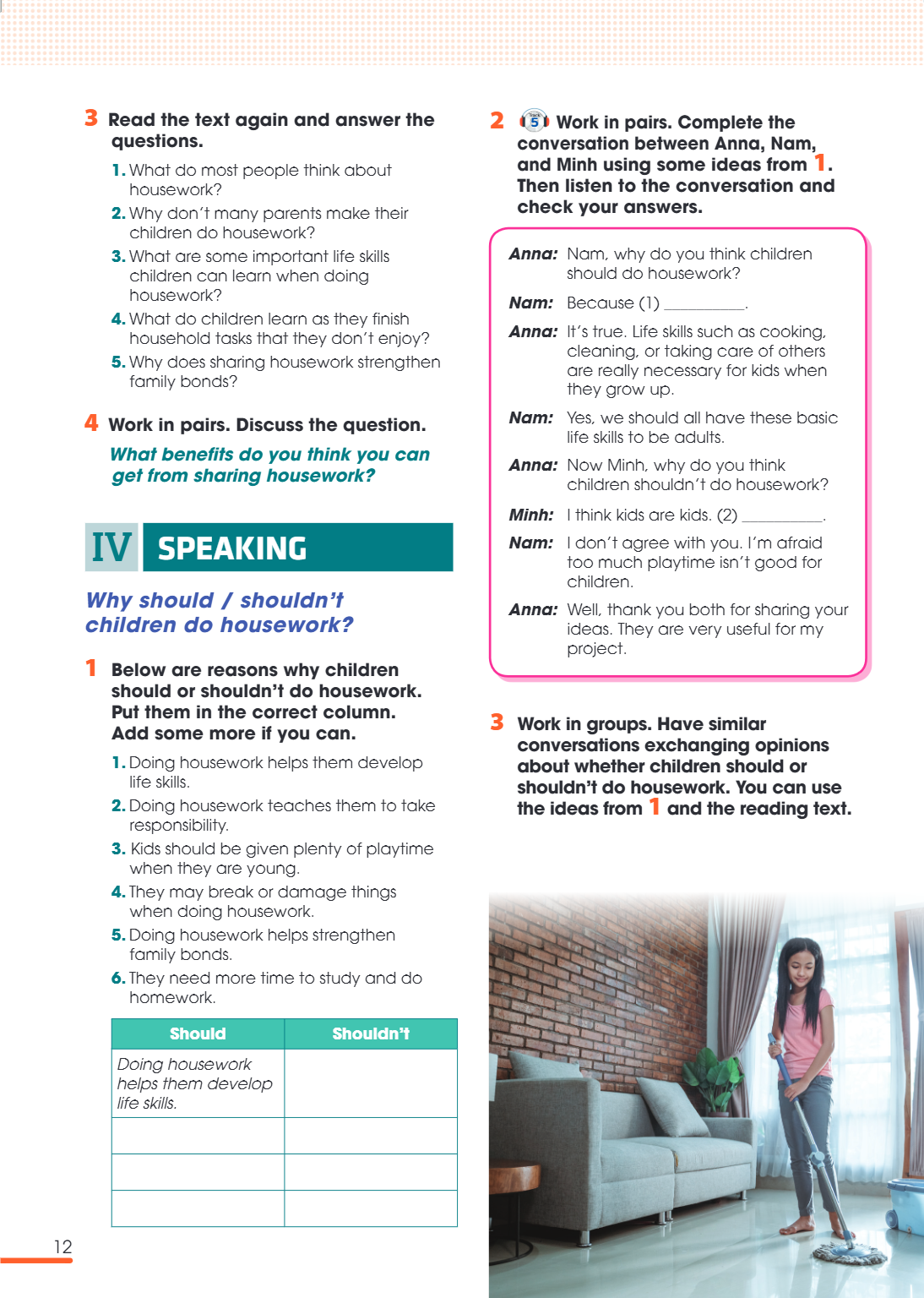
IV SPEAKING Why should / shouldn't children do housework? 1. Below are reasons why children should or shouldn't do housework. Put them in the correct column. Ad
IV SPEAKING
Why should / shouldn't children do housework?
1. Below are reasons why children should or shouldn't do housework. Put them in the correct column. Add some more if you can.
Doing housework helps them develop life skills.
Doing housework teaches them to take responsibility.
Kids should be given plenty of playtime when they are young.
They may break or damage things when doing housework.
Doing housework helps strengthen family bonds.
They need more time to study and do homework.
Should, Shouldn't
Doing housework helps them develop life skills.
2. Work in pairs. Complete the conversation between Anna, Nam, and Minh using some ideas from 1. Then listen to the conversation and check your answers.
Anna: Nam, why do you think children should do housework?
Nam: Because (1) ___________.
Anna: It's true. Life skills such as cooking, cleaning, or taking care of others are really necessary for kids when they grow up.
Nam: Yes, we should all have these basic life skills to be adults.
Anna: Now Minh, why do you think children shouldn't do housework?
Minh: I think kids are kids. (2) ___________.
Nam: I don't agree with you. I'm afraid too much playtime isn't good for children.
Anna: Well, thank you both for sharing your ideas. They are very useful for my project.
3. Work in groups. Have similar conversations exchanging opinions about whether children should or shouldn't do housework. You can use the ideas from 1 and the reading text.
Unit1 V listening Family support 1 Work in pairs. Look at the picture and answer the questions. 1. What can you see in the picture? What do you think the studen
Unit1
V listening
Family support
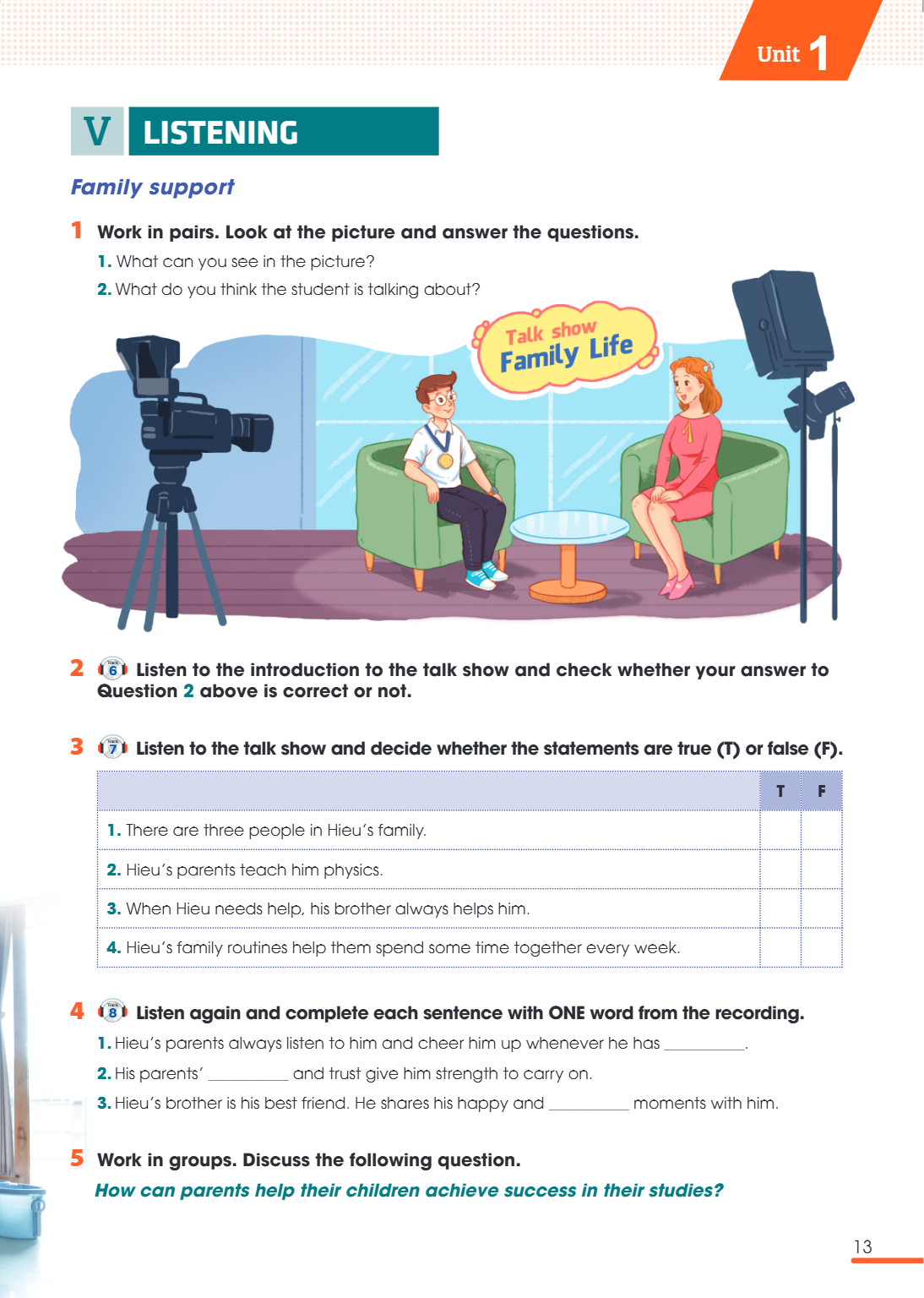
1 Work in pairs. Look at the picture and answer the questions.
1. What can you see in the picture?
What do you think the student is talking about?
2 Listen to the introduction to the talk show and check whether your answer to Question 2 above is correct or not.
Track 6
3 Listen to the talk show and decide whether the statements are true (T) or false (F).
Track 7
T F
There are three people in Hieu's family.
2. Hieu's parents teach him physics.
When Hieu needs help, his brother always helps him.
4. Hieu's family routines help them spend some time together every week.
4 Listen again and complete each sentence with ONE word from the recording.
Track 8
1.Hieu's parents always listen to him and cheer him up whenever he has __________. 2.His parents' __________ and trust give him strength to carry on. 3.Hieu's brother is his best friend. He shares his happy and __________ moments with him. 5 Work in groups. Discuss the following question.
How can parents help their children achieve success in their studies?
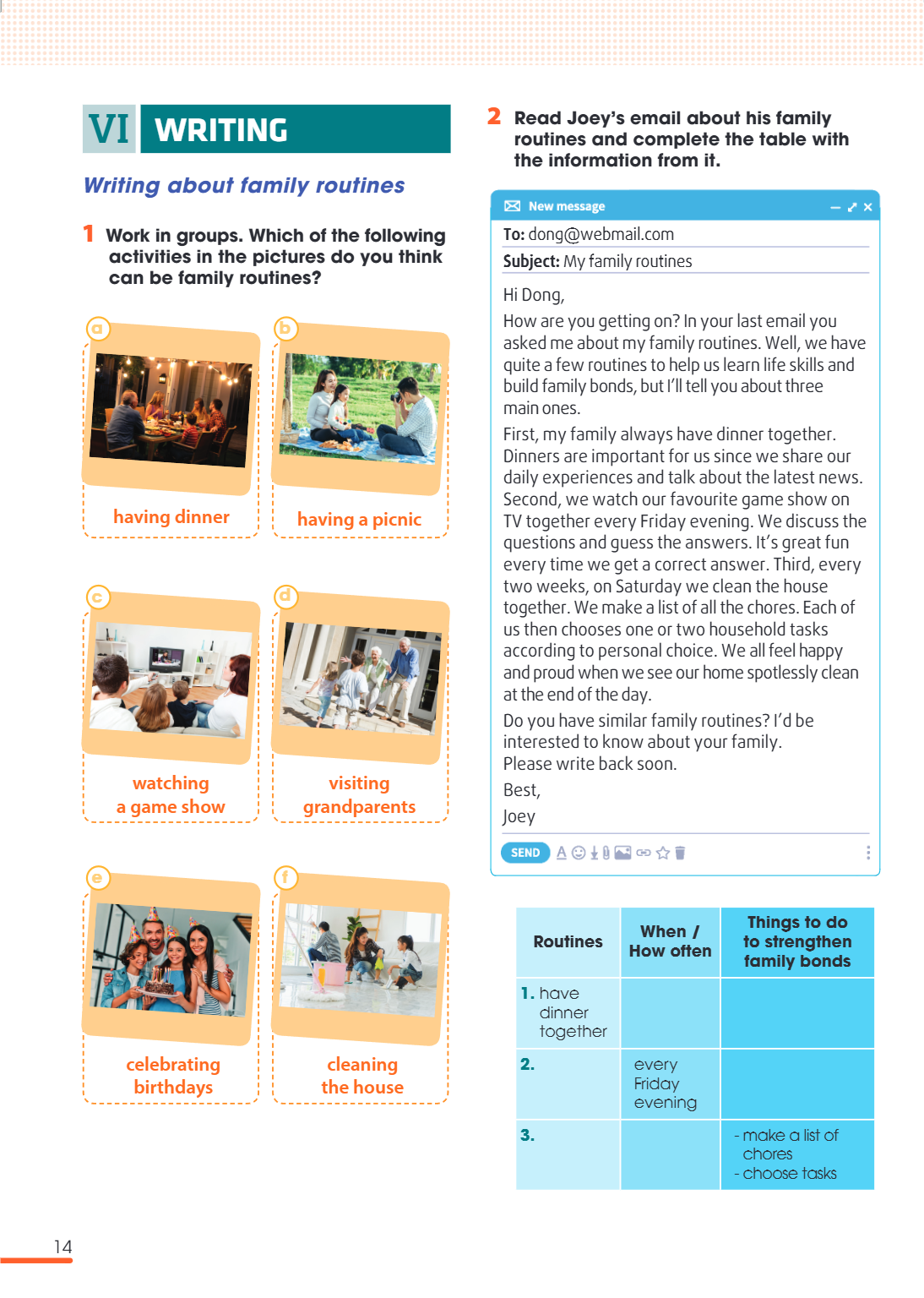
VI WRITING Writing about family routines 1. Work in groups. Which of the following activities in the pictures do you think can be family routines? a) having din
VI WRITING
Writing about family routines
1. Work in groups. Which of the following activities in the pictures do you think can be family routines?
a)
having dinner
b)
having a picnic
c)
watching a game show
d)
visiting grandparents
e)
celebrating birthdays
f)
cleaning the house
2. Read Joey's email about his family routines and complete the table with the information from it.
New message
To: dong@webmail.com
Subject: My family routines
Hi Dong,
How are you getting on? In your last email you asked me about my family routines. Well, we have quite a few routines to help us learn life skills and build family bonds, but I'll tell you about three main ones.
First, my family always have dinner together. Dinners are important for us since we share our daily experiences and talk about the latest news. Second, we watch our favourite game show on TV together every Friday evening. We discuss the questions and guess the answers. It's great fun every time we get a correct answer. Third, every two weeks, on Saturday we clean the house together. We make a list of all the chores. Each of us then chooses one or two household tasks according to personal choice. We all feel happy and proud when we see our home spotlessly clean at the end of the day.
Do you have similar family routines? I'd be interested to know about your family. Please write back soon.
Best,
Joey
SEND
Routines, When / How often, Things to do to strengthen family bonds
1. have dinner together
2., every Friday evening
3., - make a list of chores - choose tasks
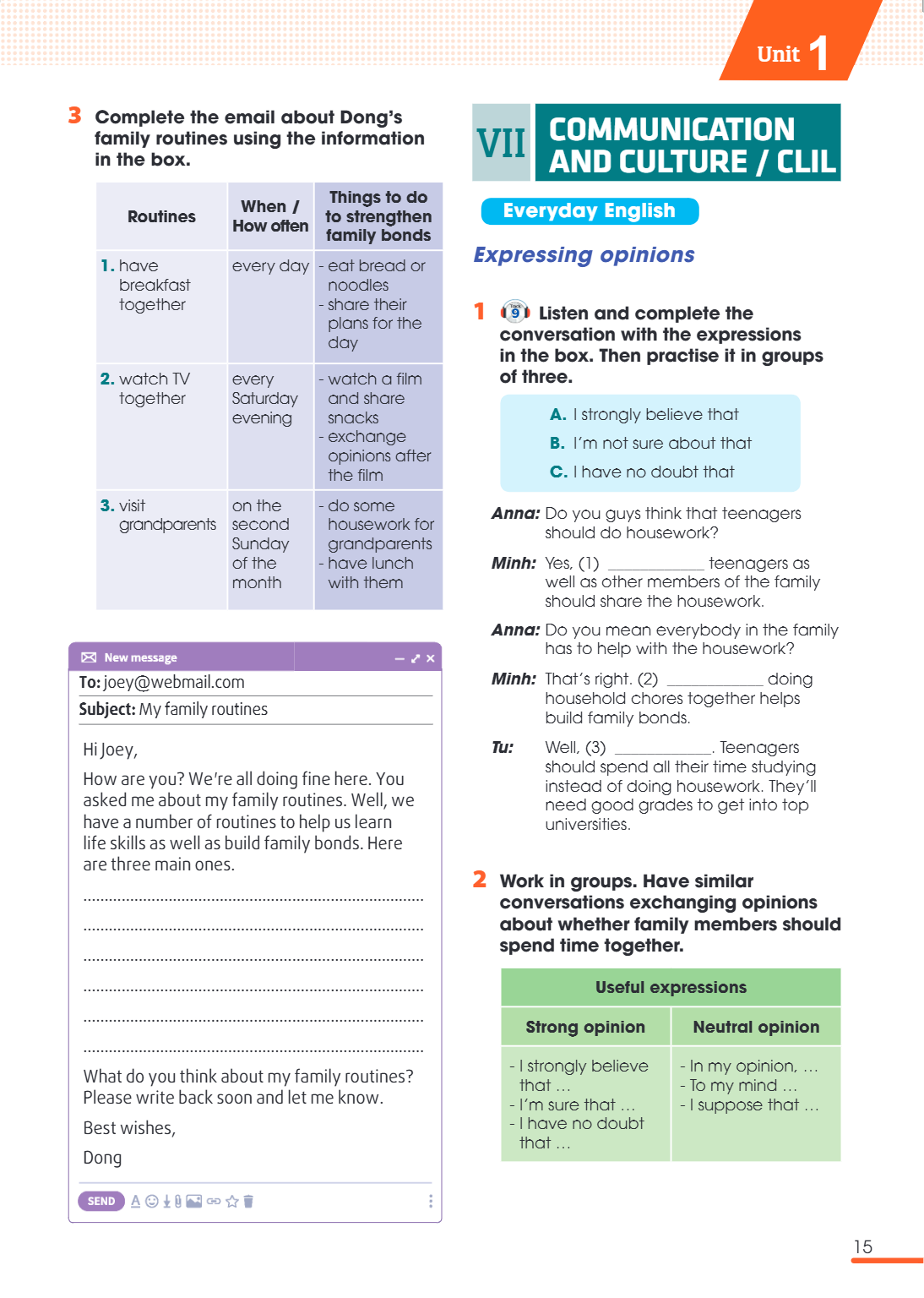
VII COMMUNICATION AND CULTURE / CLIL Everyday English Expressing opinions 1 Listen and complete the conversation with the expressions in the box. Then practise
VII COMMUNICATION AND CULTURE / CLIL
Everyday English
Expressing opinions
1 Listen and complete the conversation with the expressions in the box. Then practise it in groups of three.
A. I strongly believe that
B. I'm not sure about that
C. I have no doubt that
Anna: Do you guys think that teenagers should do housework?
Minh: Yes, (1) ____________ teenagers as well as other members of the family should share the housework.
Anna: Do you mean everybody in the family has to help with the housework?
Minh: That's right. (2) ____________ doing household chores together helps build family bonds.
Tu: Well, (3) ____________. Teenagers should spend all their time studying instead of doing housework. They'll need good grades to get into top universities.
2 Work in groups. Have similar conversations exchanging opinions about whether family members should spend time together.
Useful expressions
Strong opinion, Neutral opinion
- I strongly believe that ... - I'm sure that ... - I have no doubt that ..., - In my opinion, ... - To my mind ... - I suppose that ...
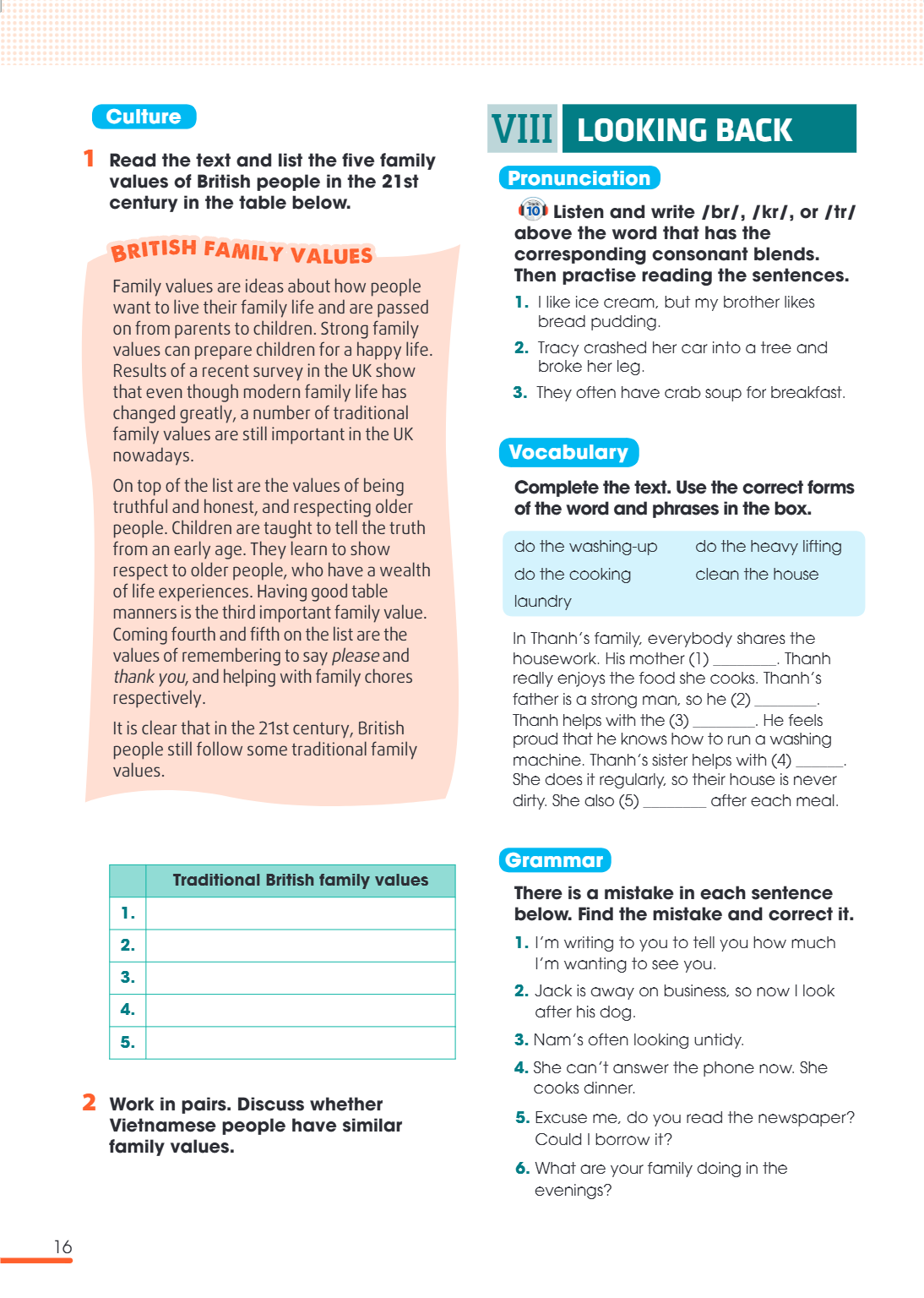
VIII. LOOKING BACK Culture 1 Read the text and list the five family values of British people in the 21st century in the table below. BRITISH FAMILY VALUES Famil
VIII. LOOKING BACK
Culture
1 Read the text and list the five family values of British people in the 21st century in the table below.
BRITISH FAMILY VALUES
Family values are ideas about how people want to live their family life and are passed on from parents to children. Strong family values can prepare children for a happy life. Results of a recent survey in the UK show that even though modern family life has changed greatly, a number of traditional family values are still important in the UK nowadays.
On top of the list are the values of being truthful and honest, and respecting older people. Children are taught to tell the truth from an early age. They learn to show respect to older people, who have a wealth of life experiences. Having good table manners is the third important family value. Coming fourth and fifth on the list are the values of remembering to say please and thank you, and helping with family chores respectively.
It is clear that in the 21st century, British people still follow some traditional family values.
Traditional British family values
1.
2.
3.
4.
5.
2 Work in pairs. Discuss whether Vietnamese people have similar family values.
Pronunciation
10 Listen and write /br/, /kr/, or /tr/ above the word that has the corresponding consonant blends. Then practise reading the sentences.
I like ice cream, but my brother likes bread pudding.
Tracy crashed her car into a tree and broke her leg.
They often have crab soup for breakfast.
Vocabulary
Complete the text. Use the correct forms of the word and phrases in the box.
do the washing-up do the heavy lifting
do the cooking clean the house
laundry
In Thanh's family, everybody shares the housework. His mother (1) ______. Thanh really enjoys the food she cooks. Thanh's father is a strong man, so he (2) ______. Thanh helps with the (3) ______. He feels proud that he knows how to run a washing machine. Thanh's sister helps with (4) ______. She does it regularly, so their house is never dirty. She also (5) ______ after each meal.
Grammar
There is a mistake in each sentence below. Find the mistake and correct it.
I'm writing to you to tell you how much I'm wanting to see you.
Jack is away on business, so now I look after his dog.
Nam's often looking untidy.
She can't answer the phone now. She cooks dinner.
Excuse me, do you read the newspaper? Could I borrow it?
What are your family doing in the evenings?
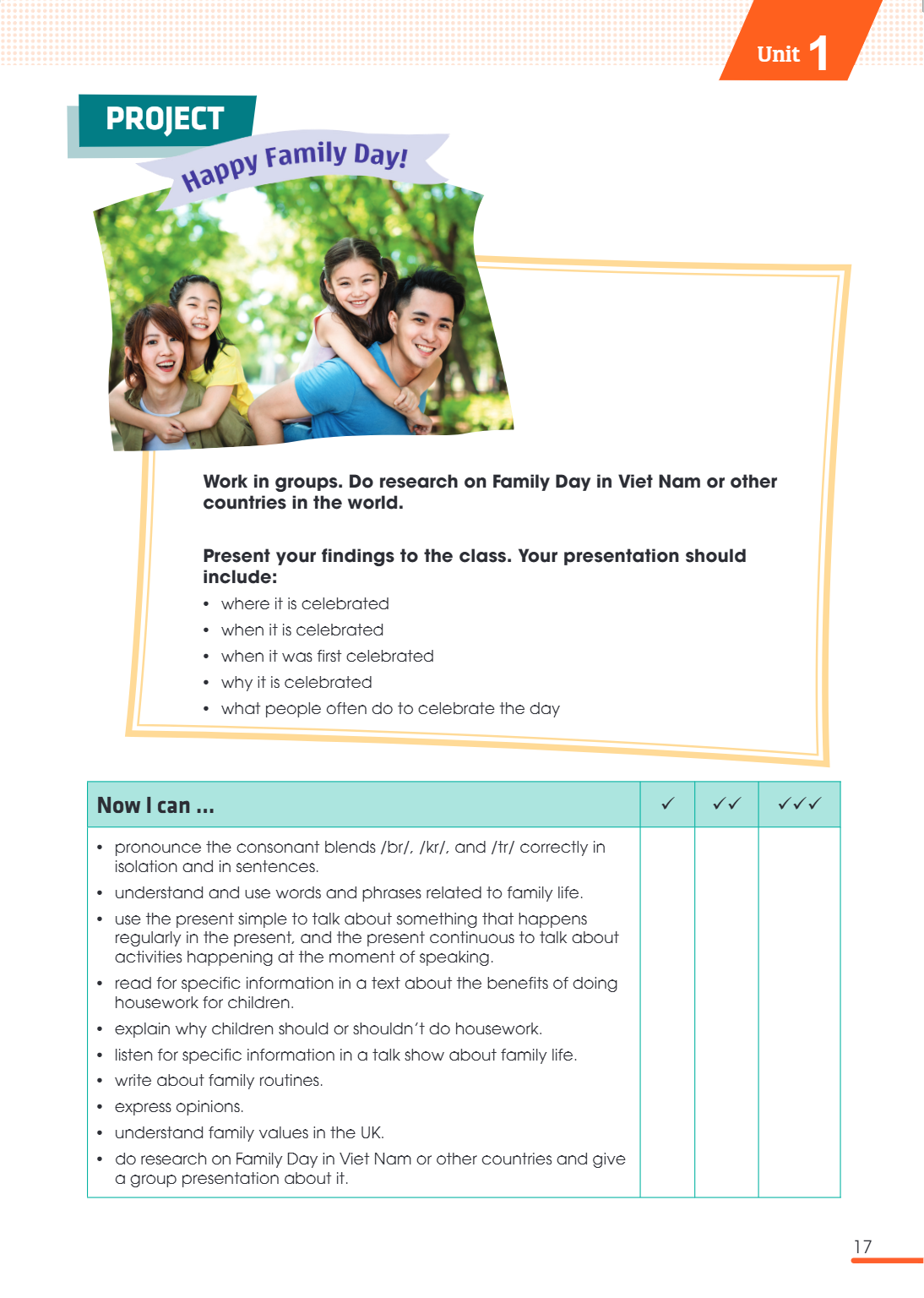
Unit1 Project Work in groups. Do research on Family Day in Viet Nam or other countries in the world. Present your findings to the class. Your presentation shoul
Unit1
Project
Work in groups. Do research on Family Day in Viet Nam or other countries in the world. Present your findings to the class. Your presentation should include:
where it is celebrated
when it is celebrated
when it was first celebrated
why it is celebrated
what people often do to celebrate the day
Now can ...   
I
pronounce the consonant blends /br/, /kr/, and /tr/ correctly in isolation and in sentences.
understand and use words and phrases related to family life.
use the present simple to talk about something that happens regularly in the present, and the present continuous to talk about activities happening at the moment of speaking.
read for specific information in a text about the benefits of doing housework for children.
explain why children should or shouldn't do housework.
listen for specific information in a talk show about family life.
write about family routines.
express opinions.
understand family values in the UK.
do research on Family Day in Viet Nam or other countries and give a group presentation about it.
Unit 2. HUMANS AND THE ENVIRONMENT This unit includes: LANGUAGE Pronunciation /k/ /pl/, /gr/, and /pr/ Vocabulary Words and phrases related to human activities
Unit 2. HUMANS AND THE ENVIRONMENT
This unit includes:
LANGUAGE
Pronunciation
/k/ /pl/, /gr/, and /pr/
Vocabulary
Words and phrases related to human activities and the environment
Grammar
The future with will and be going to
Passive voice
SKILLS
Reading: Reading for main ideas and specific information in a text about green living
Speaking: Talking about ways to live green
Listening: Listening for specific information in an announcement about a green event
Writing: Writing about ways to improve the environment
COMMUNICATION AND CULTURE / CLIL
Everyday English
Asking for and giving advice
CLIL
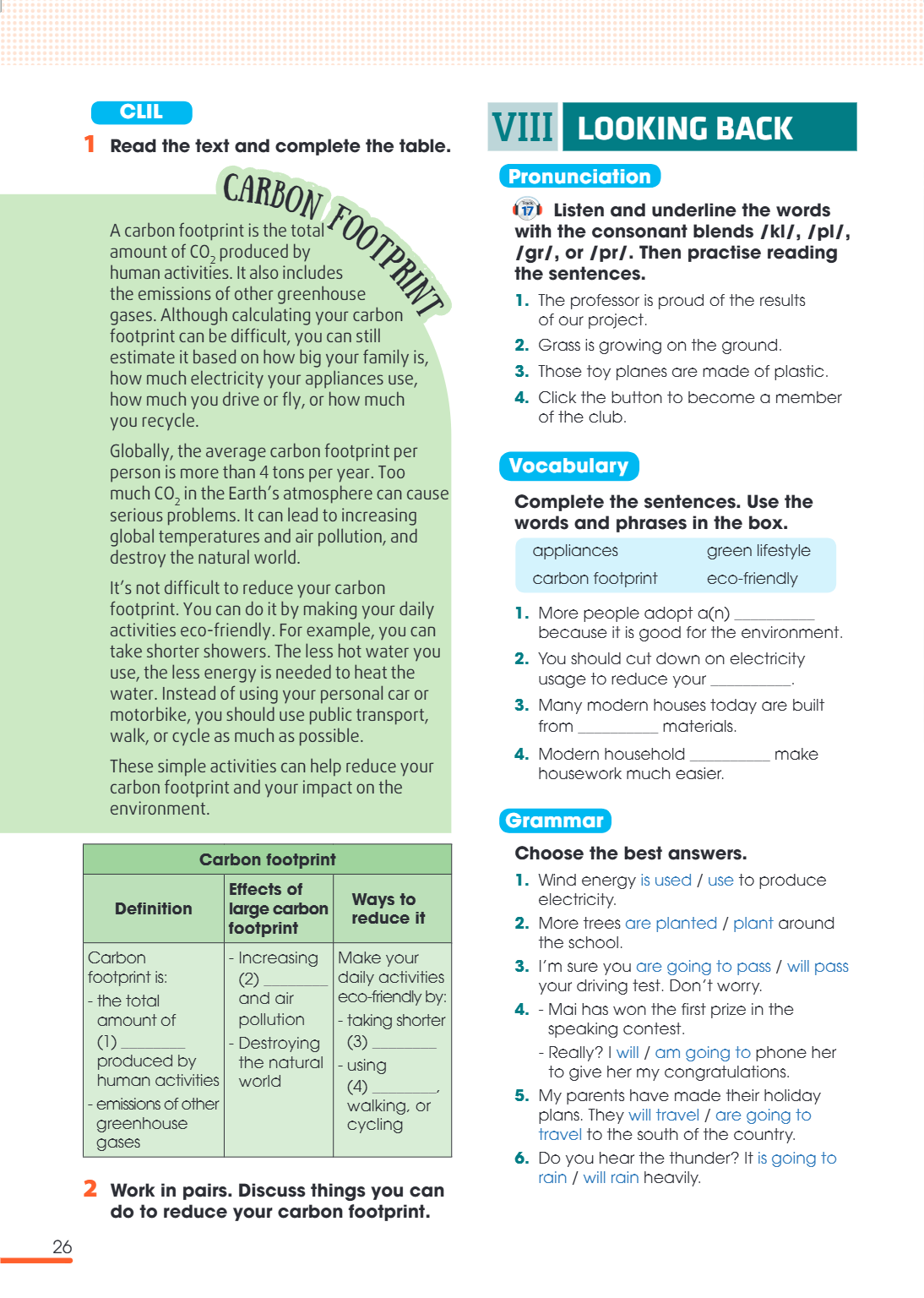
Carbon footprint
PROJECT
Planning activities for a Go Green Weekend event
I GETTING STARTED
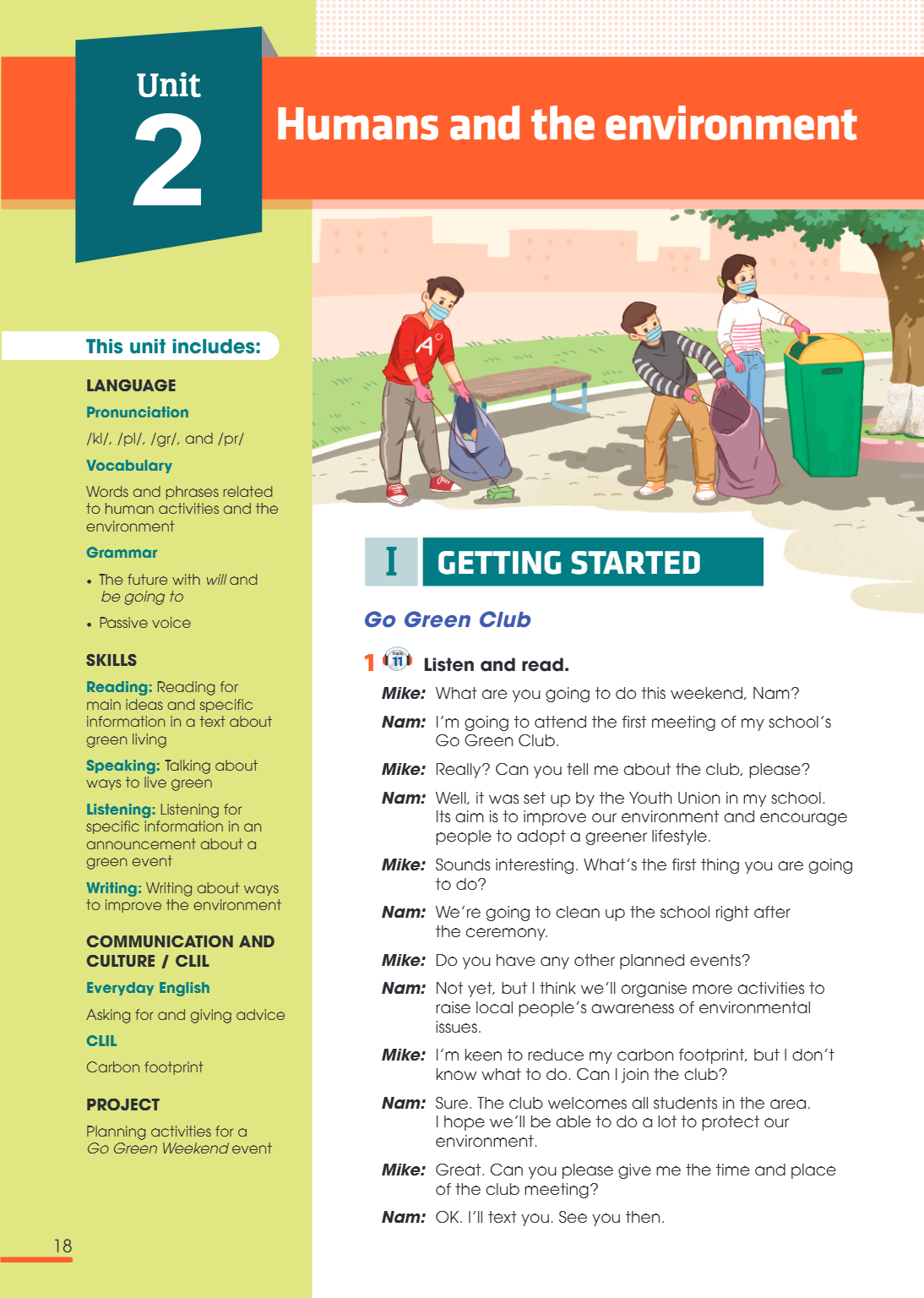
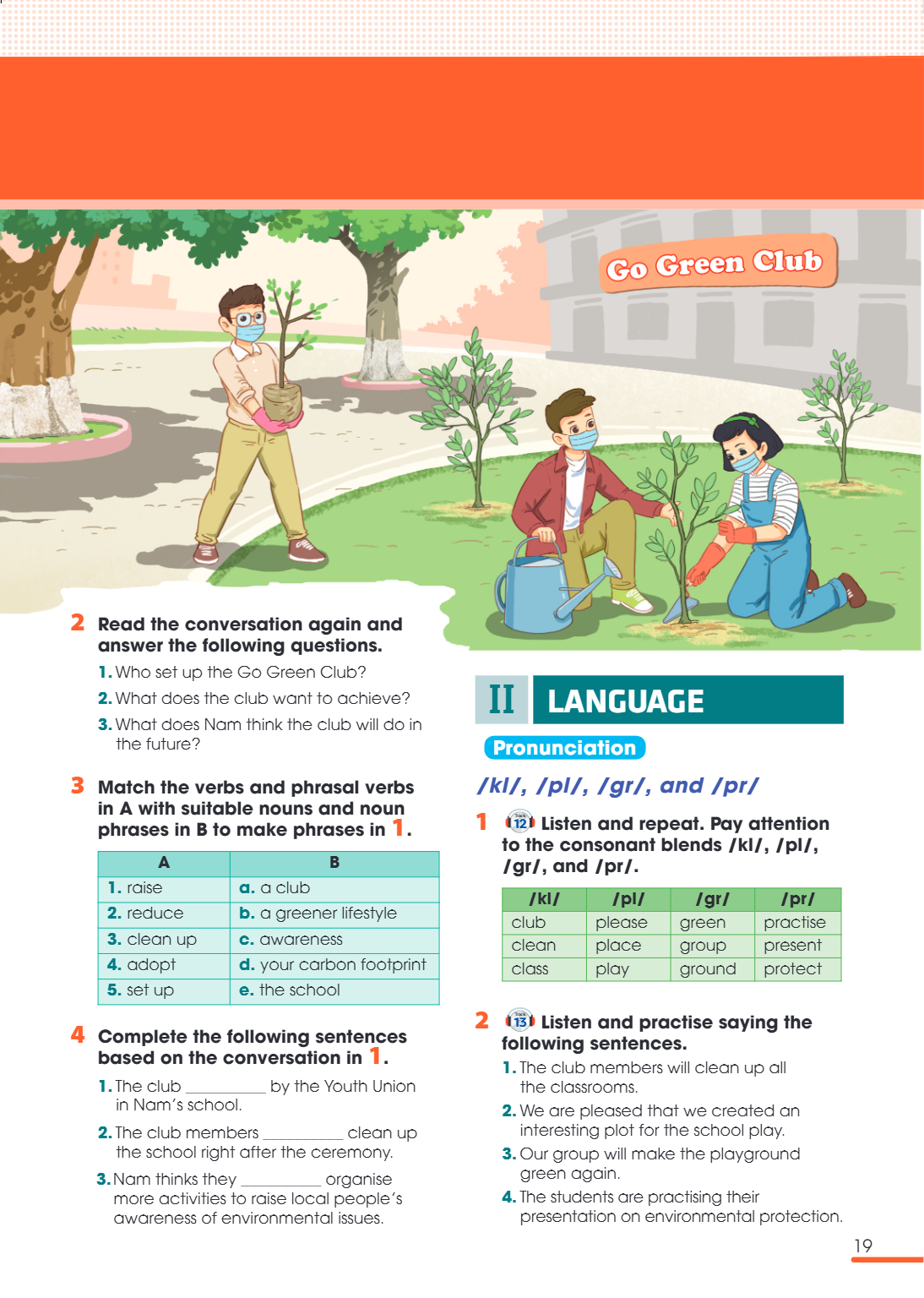
Go Green Club
1. Listen and read.
Mike: What are you going to do this weekend, Nam?
Nam: I'm going to attend the first meeting of my school's Go Green Club.
Mike: Really? Can you tell me about the club, please?
Nam: Well, it was set up by the Youth Union in my school. Its aim is to improve our environment and encourage people to adopt a greener lifestyle.
Mike: Sounds interesting. What's the first thing you are going to do?
Nam: We're going to clean up the school right after the ceremony.
Mike: Do you have any other planned events?
Nam: Not yet, but I think we'll organise more activities to raise local people's awareness of environmental issues.
Mike: I'm keen to reduce my carbon footprint, but I don't know what to do. Can I join the club?
Nam: Sure. The club welcomes all students in the area. I hope we'll be able to do a lot to protect our environment.
Mike: Great. Can you please give me the time and place of the club meeting?
Nam: OK. I'll text you. See you then.
II LANGUAGE Pronunciation /kl/, /pl/, /gr/, and /pr/ 1 Listen and repeat. Pay attention to the consonant blends /kl/, /pl/, /gr/, and /pr/. /kl/, /pl/, /gr/, /p
II LANGUAGE
Pronunciation
/kl/, /pl/, /gr/, and /pr/
1 Listen and repeat. Pay attention to the consonant blends /kl/, /pl/, /gr/, and /pr/.
/kl/, /pl/, /gr/, /pr/
club, please, green, practise
clean, place, group, present
class, play, ground, protect
2 Listen and practise saying the following sentences.
The club members will clean up all the classrooms.
We are pleased that we created an interesting plot for the school play.
Our group will make the playground green again.
The students are practising their presentation on environmental protection.
Grammar The future with will and be going to Remember! We use will and be going to to talk about future actions. We use will to talk about: - plans which are ma
Grammar The future with will and be going to
Remember!
We use will and be going to to talk about future actions. We use will to talk about: - plans which are made at the moment of
speaking. Example: This shirt looks beautiful. I will buy it. - predictions based on what we think or
believe about the future. Example: I think our team will win the competition.
Complete the following sentences with will or the correct forms of be going to.
don't think she __________ come tonight. She has to revise for her exam tomorrow.
I
We have already made the decision. We __________ buy a new house next month.
3. I'm sure she __________ pass the final exam.
Look at the sun. It __________ be a beautiful day.
forgot to phone Dad. __________ do it right after lunch.
I I
We use be going to to talk about: - plans which are made before the moment
of speaking. Example: I have made a reservation. We are going to have dinner at the Chinese restaurant nearby. - predictions based on what we see or know.
Example: Look at the dark clouds. It is going to rain soon.
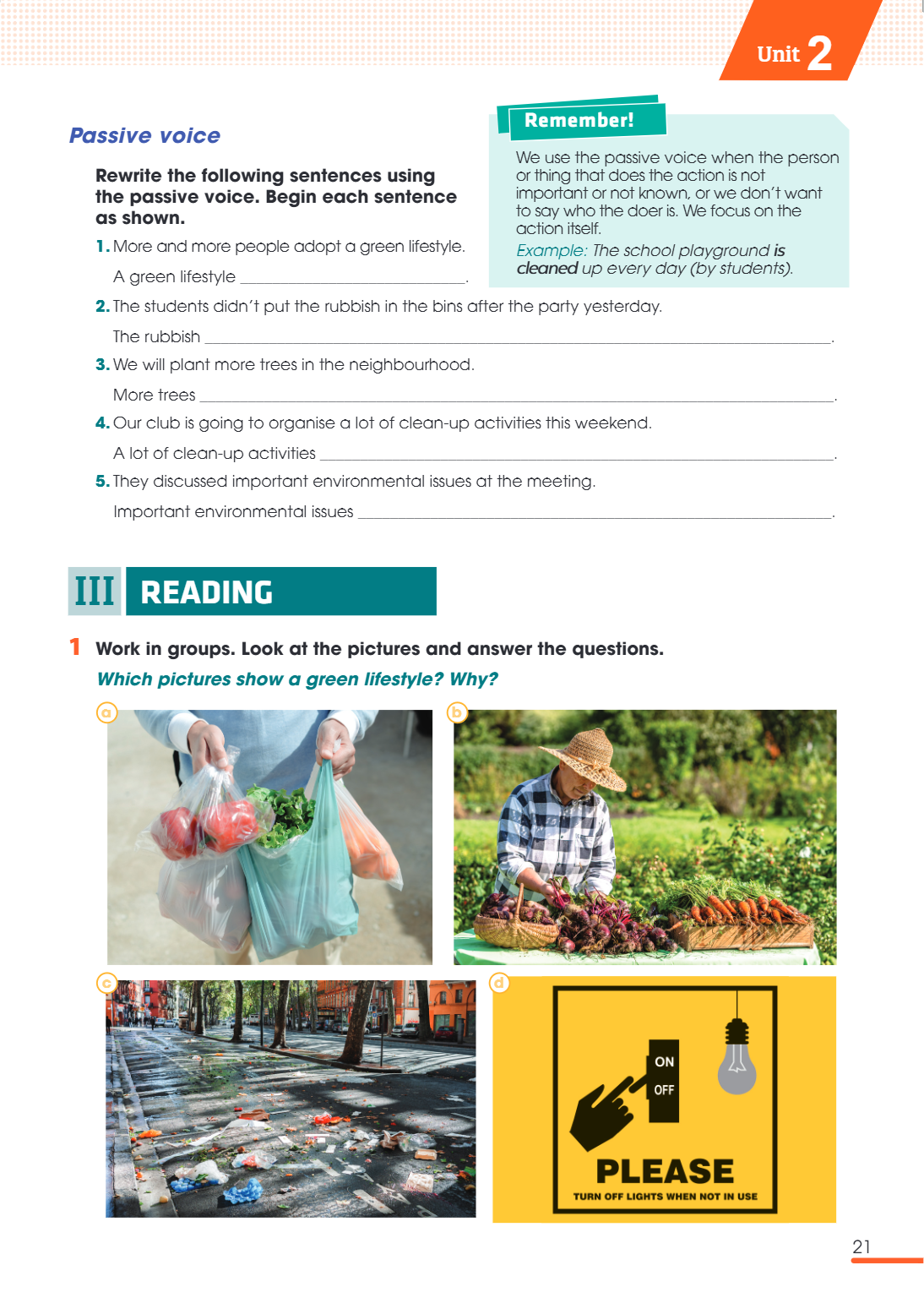
III READING 1 Work in groups. Look at the pictures and answer the questions. Which pictures show a green lifestyle? Why? a) b) c) d)
III READING
1 Work in groups. Look at the pictures and answer the questions.
Which pictures show a green lifestyle? Why?
a)
b)
c)
d)
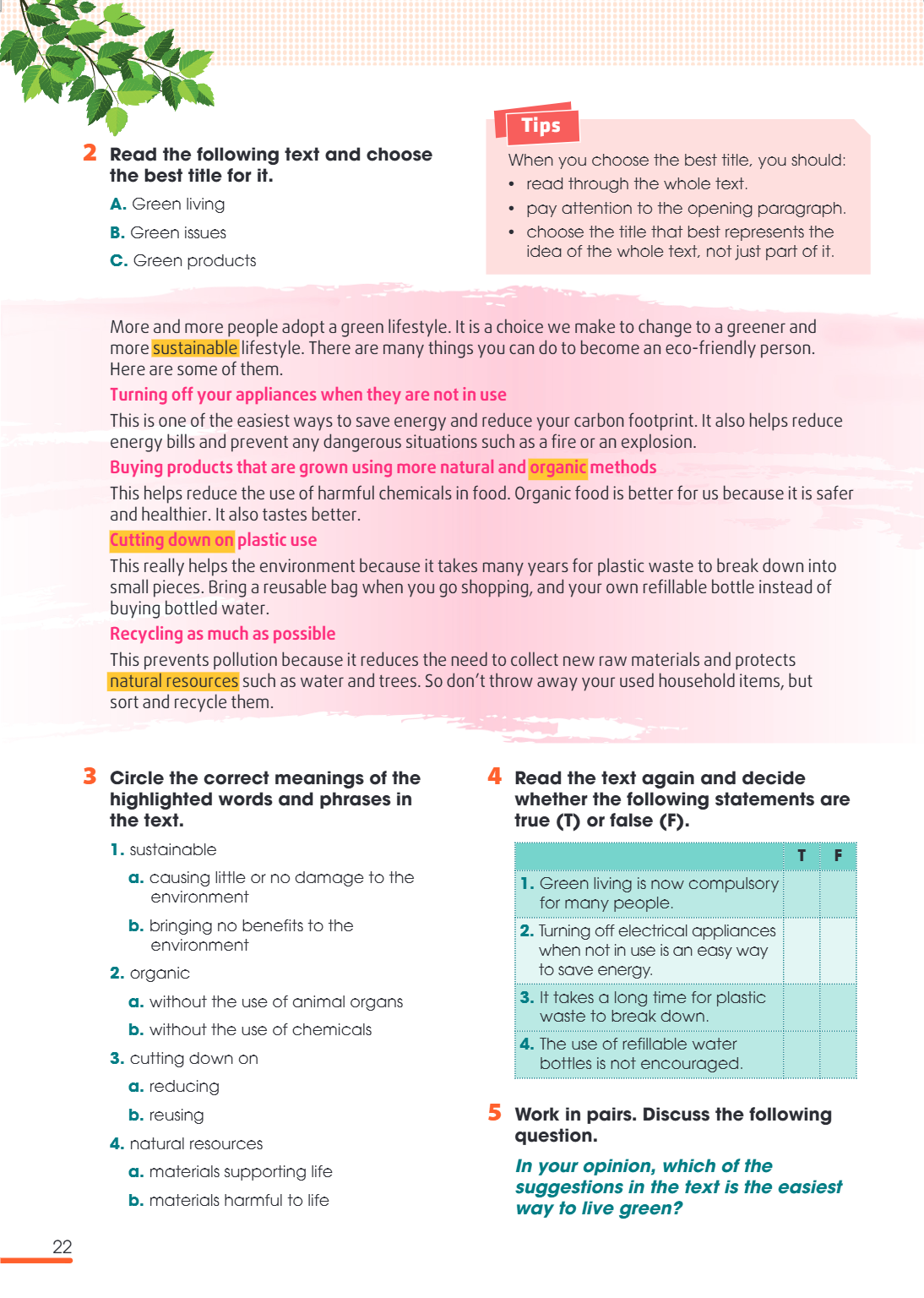
2 Read the following text and choose the best title for it. A. Green living B. Green issues C. Green products Tips When you choose the best title, you should: r
2 Read the following text and choose the best title for it.
A. Green living
B. Green issues
C. Green products
Tips
When you choose the best title, you should:
read through the whole text.
pay attention to the opening paragraph.
choose the title that best represents the idea of the whole text, not just part of it.
More and more people adopt a green lifestyle. It is a choice we make to change to a greener and more ==sustainable== lifestyle. There are many things you can do to become an eco-friendly person. Here are some of them.
Turning off your appliances when they are not in use
This is one of the easiest ways to save energy and reduce your carbon footprint. It also helps reduce energy bills and prevent any dangerous situations such as a fire or an explosion.
Buying products that are grown using more natural and ==organic== methods
This helps reduce the use of harmful chemicals in food. Organic food is better for us because it is safer and healthier. It also tastes better.
==Cutting down on== plastic use
This really helps the environment because it takes many years for plastic waste to break down into small pieces. Bring a reusable bag when you go shopping, and your own refillable bottle instead of buying bottled water.
Recycling as much as possible
This prevents pollution because it reduces the need to collect new raw materials and protects ==natural resources== such as water and trees. So don't throw away your used household items, but sort and recycle them.
3 Circle the correct meanings of the highlighted words and phrases in the text.
sustainable
a. causing little or no damage to the environment
b. bringing no benefits to the environment
organic
a. without the use of animal organs
b. without the use of chemicals
cutting down on
a. reducing
b. reusing
natural resources
a. materials supporting life
b. materials harmful to life
4 Read the text again and decide whether the following statements are true (T) or false (F).
T, F
1. Green living is now compulsory for many people.
2. Turning off electrical appliances when not in use is an easy way to save energy.
3. It takes a long time for plastic waste to break down.
4. The use of refillable water bottles is not encouraged.
5 Work in pairs. Discuss the following question.
In your opinion, which of the suggestions in the text is the easiest way to live green?
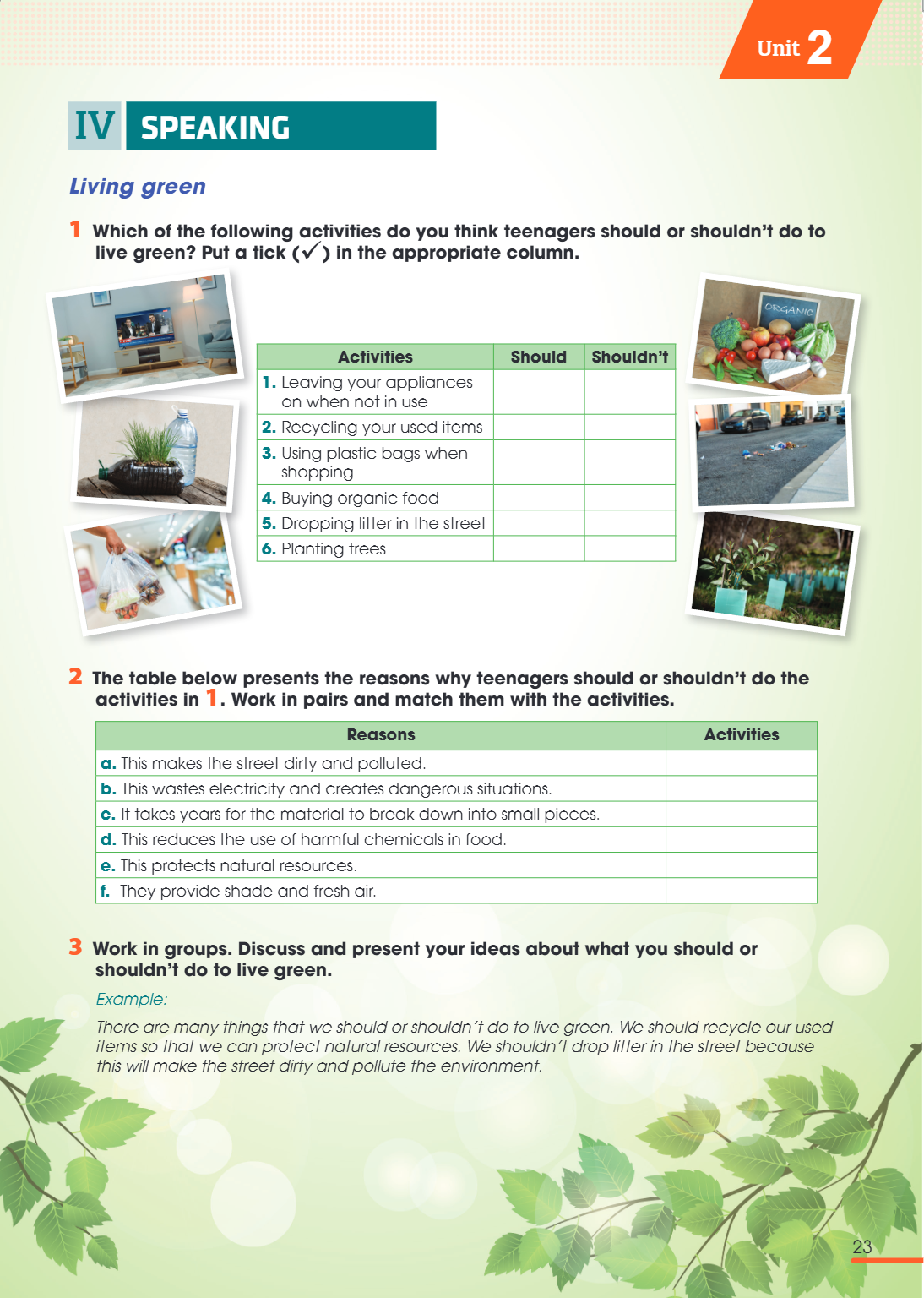
Unit22 IV speaking Living green 1 Which of the following activities do you think teenagers should or shouldn't do to live green? Put a tick () in the appropria
Unit22
IV speaking
Living green
1 Which of the following activities do you think teenagers should or shouldn't do to
live green? Put a tick () in the appropriate column.
Activities Should Shouldn't
Leaving your appliances
on when not in use
2. Recycling your used items
3. Using plastic bags when
shopping
4. Buying organic food
5. Dropping litter in the street
6. Planting trees
2 The table below presents the reasons why teenagers should or shouldn't do the Reasons Activities
activities in 1 . Work in pairs and match them with the activities.
a. This makes the street dirty and polluted.
b. This wastes electricity and creates dangerous situations.
c. It takes years for the material to break down into small pieces.
d. This reduces the use of harmful chemicals in food.
e. This protects natural resources.
f. They provide shade and fresh air.
3 Work in groups. Discuss and present your ideas about what you should or
shouldn't do to live green.
Example: There are many things that we should or shouldn't do to live green. We should recycle our used items so that we can protect natural resources. We shouldn't drop litter in the street because this will make the street dirty and pollute the environment.
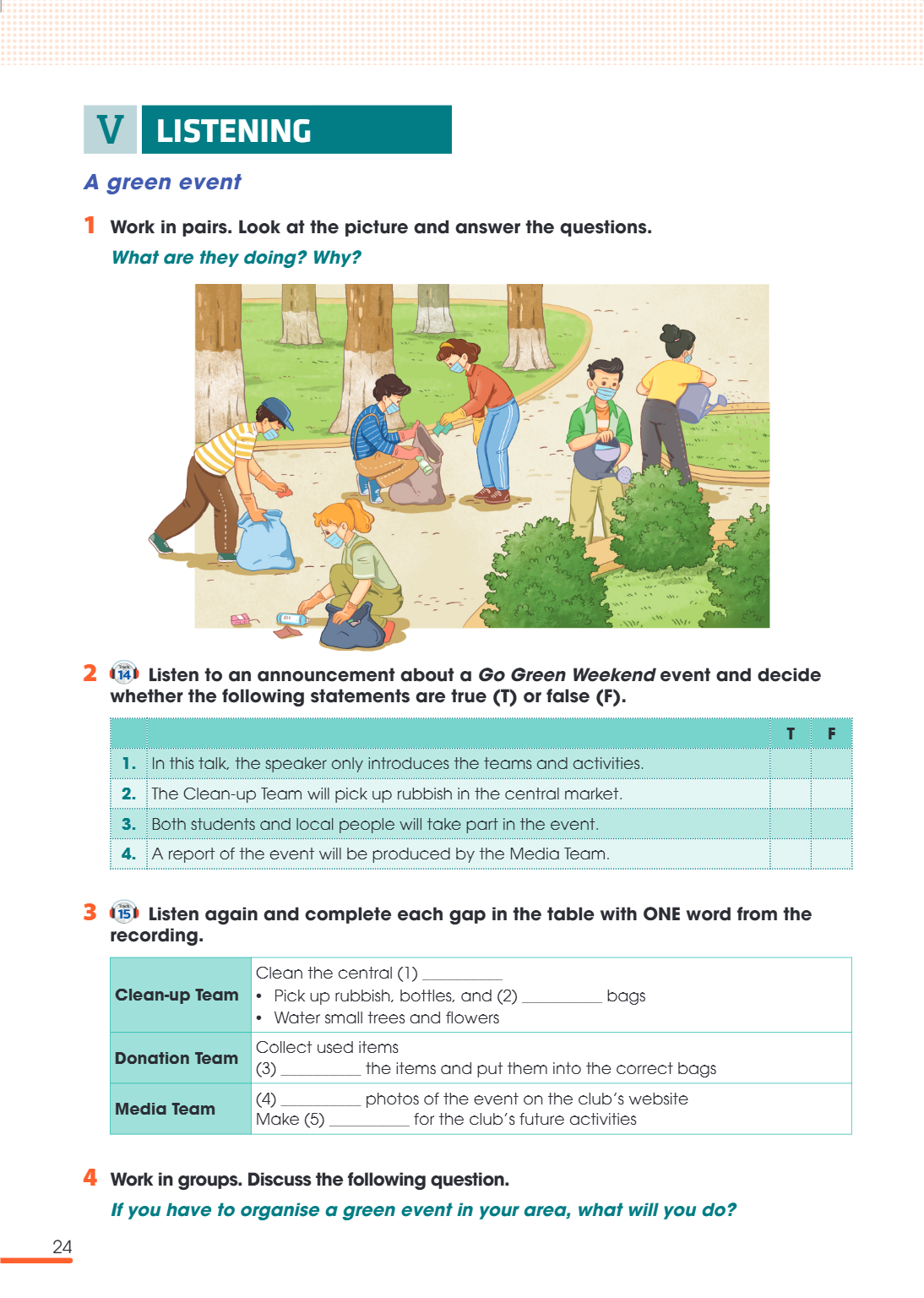
V. LISTENING A green event 1. Work in pairs. Look at the picture and answer the questions. What are they doing? Why? 2. Listen to an announcement about a Go Gre
V. LISTENING
A green event
1. Work in pairs. Look at the picture and answer the questions.
What are they doing? Why?
2. Listen to an announcement about a Go Green Weekend event and decide whether the following statements are true (T) or false (F).
T, F
1., In this talk, the speaker only introduces the teams and activities.
2., The Clean-up Team will pick up rubbish in the central market.
3., Both students and local people will take part in the event.
4., A report of the event will be produced by the Media Team.
3. Listen again and complete each gap in the table with ONE word from the recording.
Clean-up Team, Clean the central (1) _________ • Pick up rubbish, bottles, and (2) _________ bags • Water small trees and flowers
Donation Team, Collect used items (3) _________ the items and put them into the correct bags
Media Team, (4) _________ photos of the event on the club's website Make (5) _________ for the club's future activities
4. Work in groups. Discuss the following question.
If you have to organise a green event in your area, what will you do?
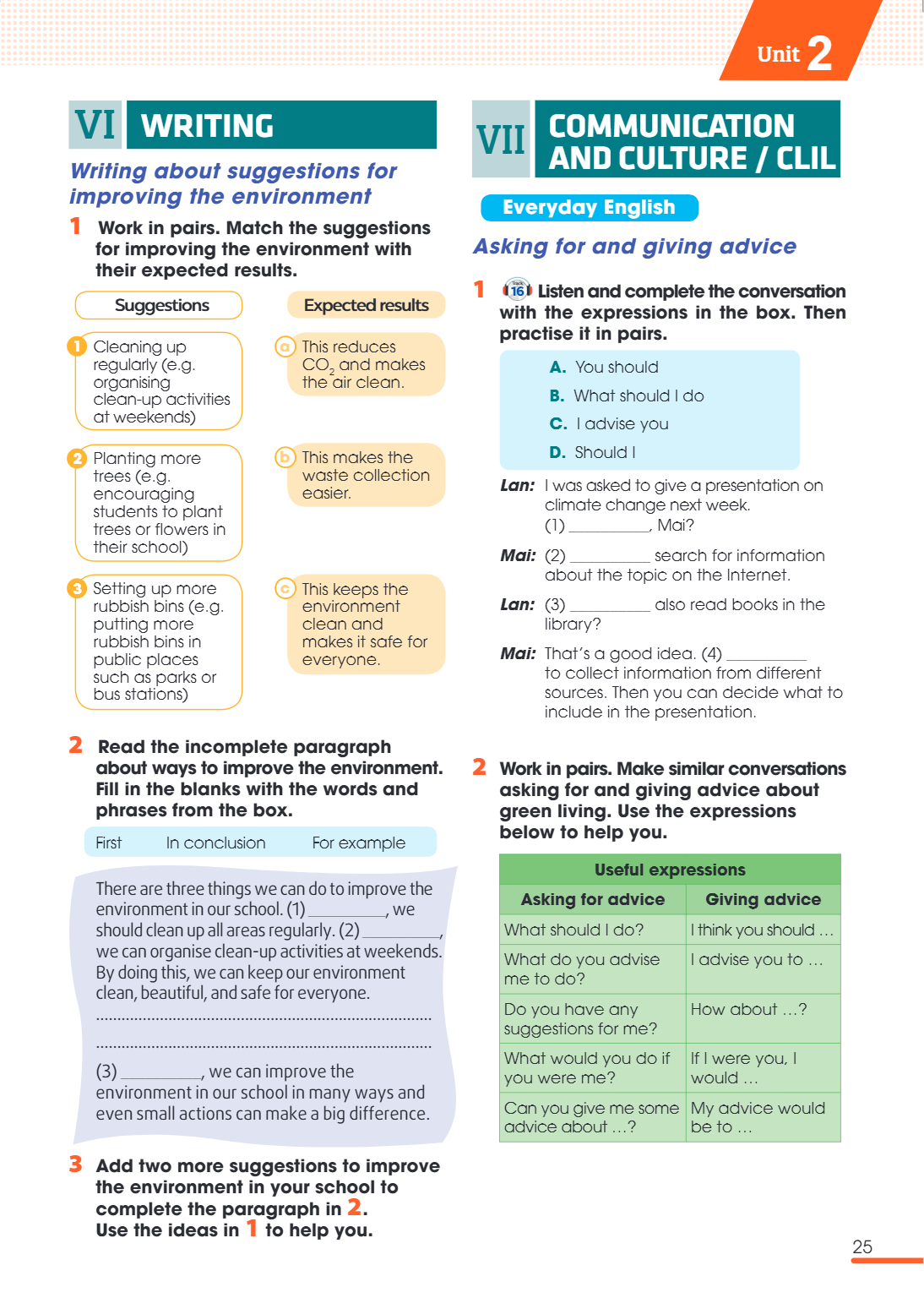
VI WRITING Writing about suggestions for improving the environment 1. Work in pairs. Match the suggestions for improving the environment with their expected res
VI WRITING
Writing about suggestions for improving the environment
1. Work in pairs. Match the suggestions for improving the environment with their expected results.
Suggestions, Expected results
1 Cleaning up regularly (e.g. organising clean-up activities at weekends), a This reduces CO$_2$ and makes the air clean.
2 Planting more trees (e.g. encouraging students to plant trees or flowers in their school), b This makes the waste collection easier.
3 Setting up more rubbish bins (e.g. putting more rubbish bins in public places such as parks or bus stations), c This keeps the environment clean and makes it safe for everyone.
2. Read the incomplete paragraph about ways to improve the environment. Fill in the blanks with the words and phrases from the box.
First In conclusion For example
There are three things we can do to improve the environment in our school. (1) __________, we should clean up all areas regularly. (2) __________, we can organise clean-up activities at weekends. By doing this, we can keep our environment clean, beautiful, and safe for everyone.
....................................................................................................
....................................................................................................
(3) __________, we can improve the environment in our school in many ways and even small actions can make a big difference.
3. Add two more suggestions to improve the environment in your school to complete the paragraph in 2. Use the ideas in 1 to help you.
VIII LOOKING BACK Pronunciation Listen and underline the words with the consonant blends /kl/, /pl/, /gr/, or /pr/. Then practise reading the sentences. The pro
VIII LOOKING BACK
Pronunciation
Listen and underline the words with the consonant blends /kl/, /pl/, /gr/, or /pr/. Then practise reading the sentences.
The professor is proud of the results of our project.
Grass is growing on the ground.
Those toy planes are made of plastic.
Click the button to become a member of the club.
Vocabulary
Complete the sentences. Use the words and phrases in the box.
appliances
carbon footprint
green lifestyle
eco-friendly
More people adopt a(n) ______ because it is good for the environment.
You should cut down on electricity usage to reduce your ______.
Many modern houses today are built from ______ materials.
Modern household ______ make housework much easier.
Grammar
Choose the best answers.
Wind energy ==is used== / ==use== to produce electricity.
More trees ==are planted== / ==plant== around the school.
I'm sure you ==are going to pass== / ==will pass== your driving test. Don't worry.
Mai has won the first prize in the speaking contest.
Really? I ==will== / ==am going to== phone her to give her my congratulations.
My parents have made their holiday plans. They ==will travel== / ==are going to travel== to the south of the country.
Do you hear the thunder? It ==is going to rain== / ==will rain== heavily.
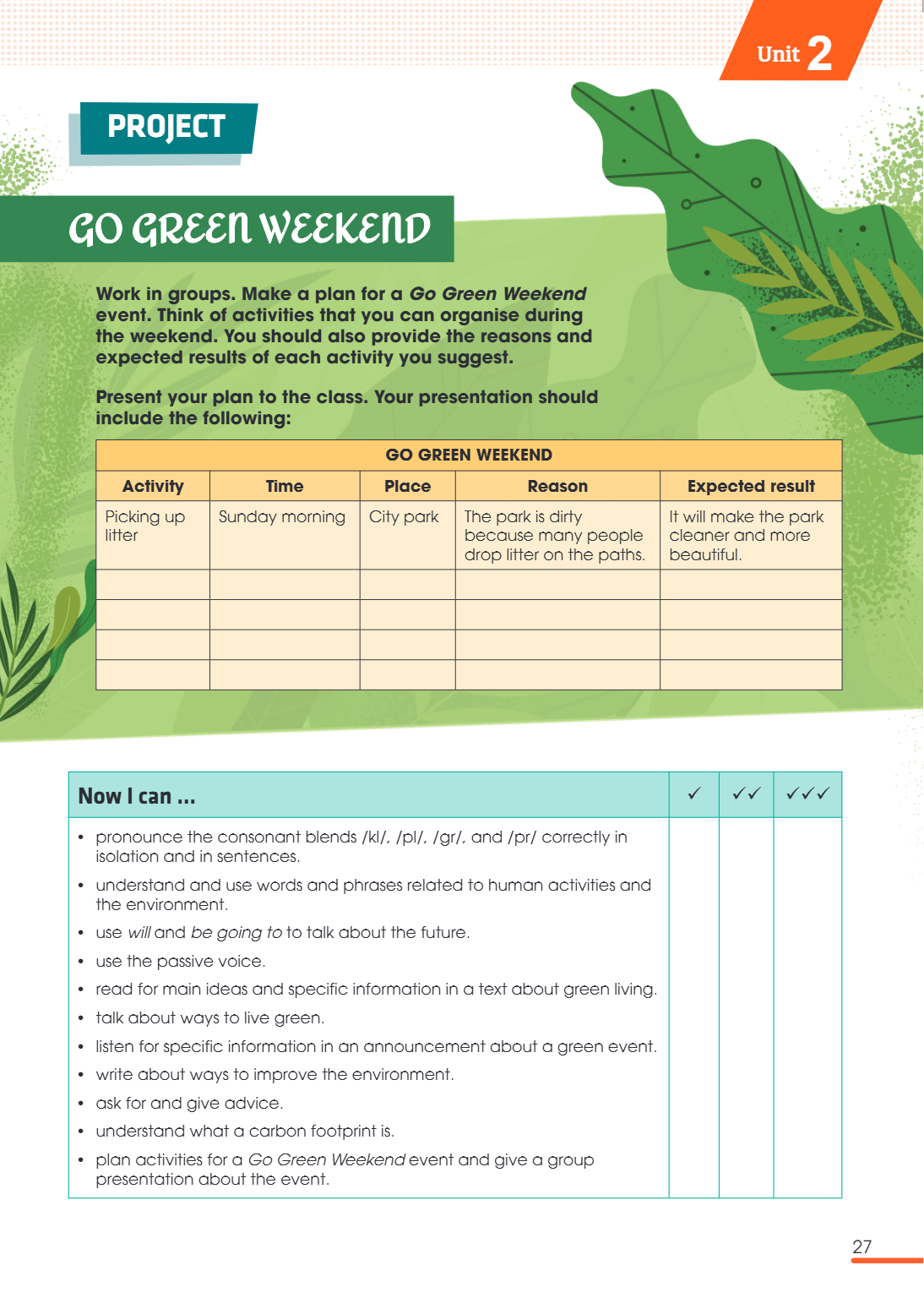
Unit 2. PROJECT GO GREEN WEEKEND Work in groups. Make a plan for a Go Green Weekend event. Think of activities that you can organise during the weekend. You sho
Unit 2. PROJECT
GO GREEN WEEKEND
Work in groups. Make a plan for a Go Green Weekend event. Think of activities that you can organise during the weekend. You should also provide the reasons and expected results of each activity you suggest.
Present your plan to the class. Your presentation should include the following:
GO GREEN WEEKEND
Activity, Time, Place, Reason, Expected result
Picking up litter, Sunday morning, City park, The park is dirty because many people drop litter on the paths., It will make the park cleaner and more beautiful.
Now I can ...
✓, ✓✓, ✓✓✓
• pronounce the consonant blends /kl/, /pl/, /gr/, and /pr/ correctly in isolation and in sentences.
• understand and use words and phrases related to human activities and the environment.
• use will and be going to to talk about the future.
• use the passive voice.
• read for main ideas and specific information in a text about green living.
• talk about ways to live green.
• listen for specific information in an announcement about a green event.
• write about ways to improve the environment.
• ask for and give advice.
• understand what a carbon footprint is.
• plan activities for a Go Green Weekend event and give a group presentation about the event.
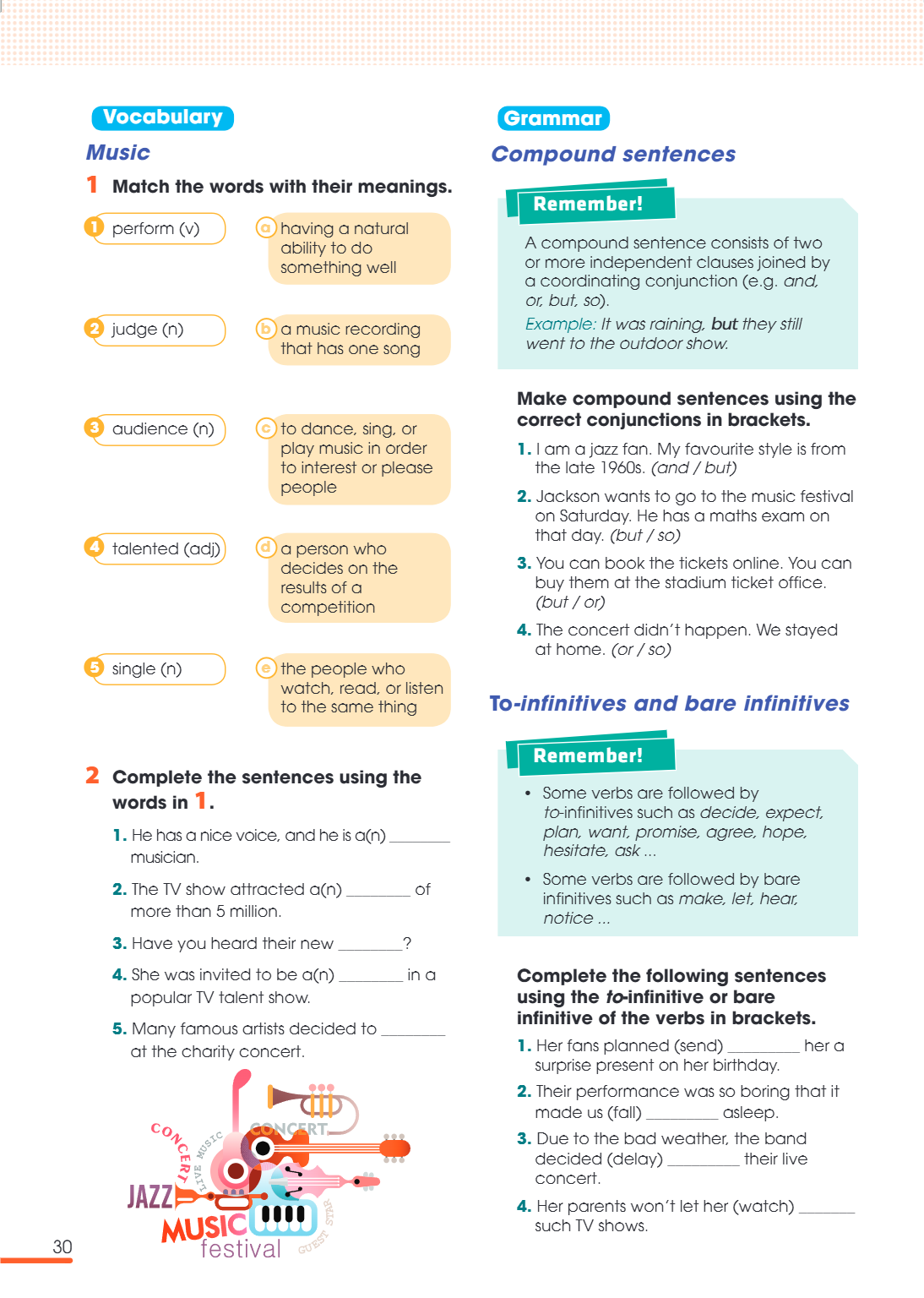
Unit 3. MUSIC This unit includes: LANGUAGE Pronunciation Stress in two-syllable words Vocabulary Words and phrases related to music Grammar Compound sentences T
Unit 3. MUSIC
This unit includes:
LANGUAGE
Pronunciation
Stress in two-syllable words
Vocabulary
Words and phrases related to music
Grammar
Compound sentences
To-infinitives and bare infinitives
SKILLS
Reading: Reading for specific information in a text about a famous TV music show
Speaking: Talking about a TV music show
Listening: Listening for gist and specific information in an interview about a music festival
Writing: Writing a blog about an experience at a music event
COMMUNICATION AND CULTURE / CLIL
Everyday English
Making and responding to suggestions
Culture
Chau van singing
PROJECT
Doing research on a form of traditional music in Viet Nam or another country
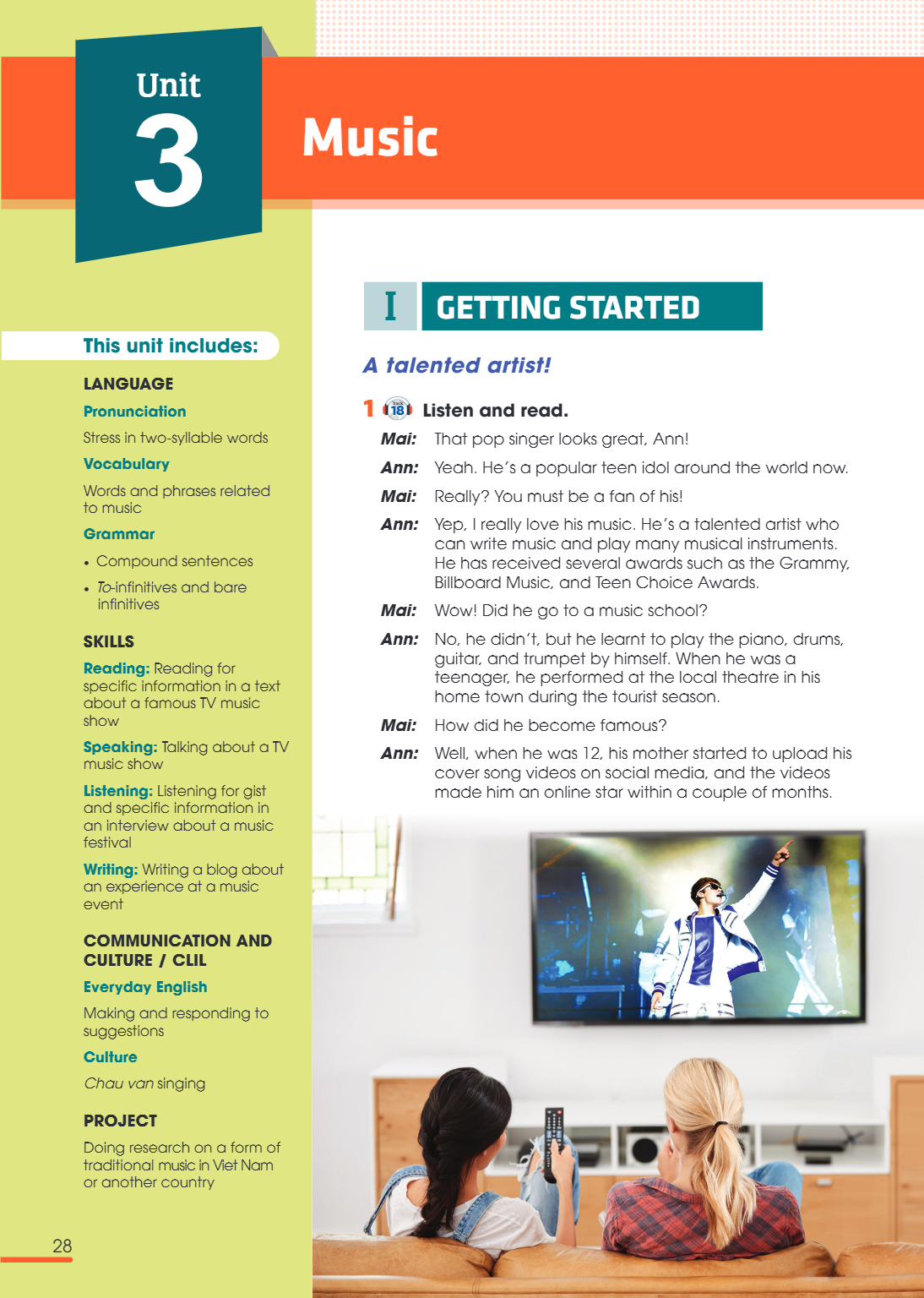
I GETTING STARTED
A talented artist!
1. (Track 18) Listen and read.
Mai: That pop singer looks great, Ann!
Ann: Yeah. He's a popular teen idol around the world now.
Mai: Really? You must be a fan of his!
Ann: Yep, I really love his music. He's a talented artist who can write music and play many musical instruments. He has received several awards such as the Grammy, Billboard Music, and Teen Choice Awards.
Mai: Wow! Did he go to a music school?
Ann: No, he didn't, but he learnt to play the piano, drums, guitar, and trumpet by himself. When he was a teenager, he performed at the local theatre in his home town during the tourist season.
Mai: How did he become famous?
Ann: Well, when he was 12, his mother started to upload his cover song videos on social media, and the videos made him an online star within a couple of months.
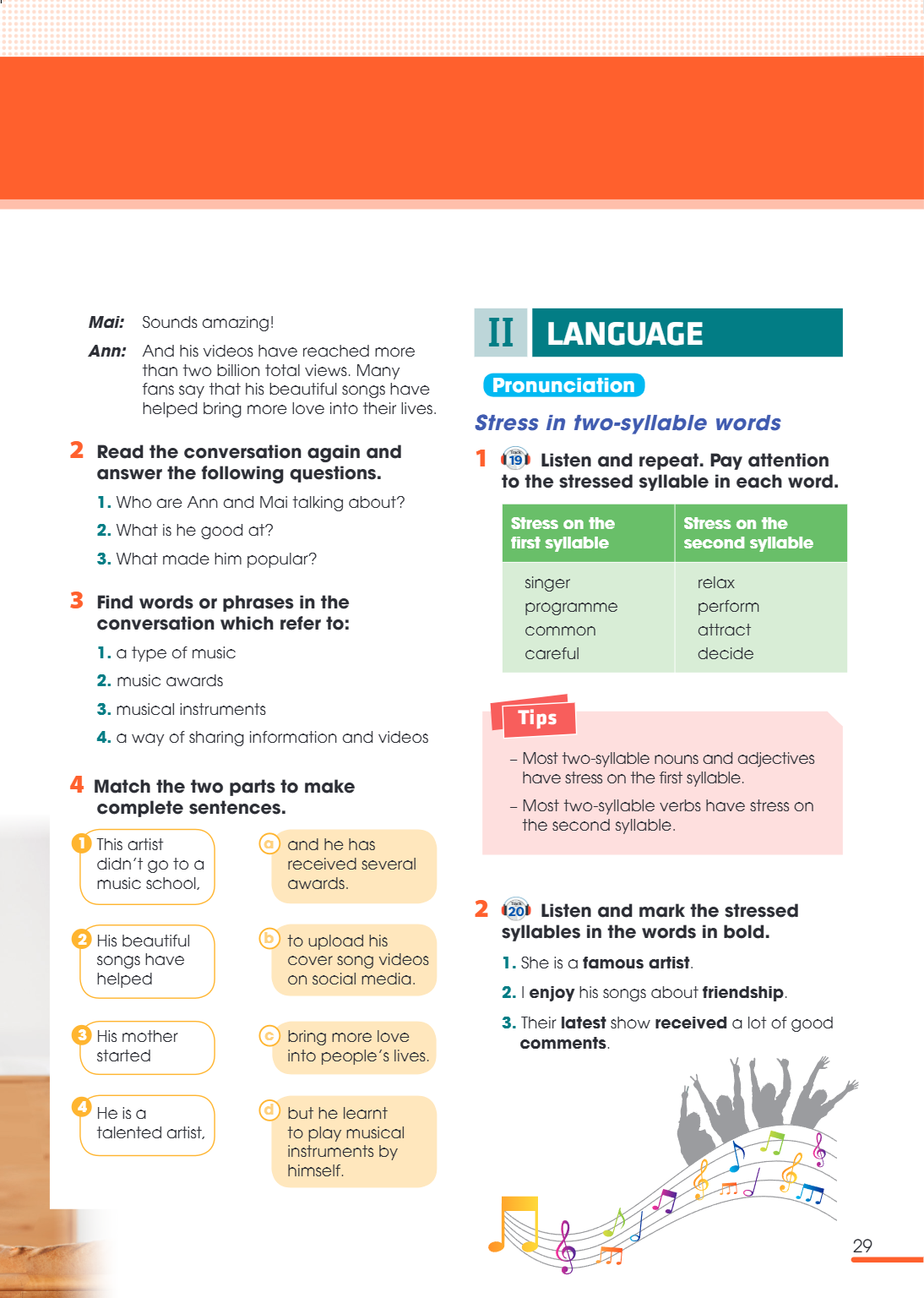
II LANGUAGE Pronunciation Stress in two-syllable words 1. Listen and repeat. Pay attention to the stressed syllable in each word. Stress on the first syllable,
II LANGUAGE
Pronunciation
Stress in two-syllable words
1. Listen and repeat. Pay attention to the stressed syllable in each word.
Stress on the first syllable, Stress on the second syllable
singer, relax
programme, perform
common, attract
careful, decide
Tips
Most two-syllable nouns and adjectives have stress on the first syllable.
Most two-syllable verbs have stress on the second syllable.
2. Listen and mark the stressed syllables in the words in bold.
She is a famous artist.
I enjoy his songs about friendship.
Their latest show received a lot of good comments.
Grammar Compound sentences Remember! A compound sentence consists of two or more independent clauses joined by a coordinating conjunction (e.g. and, or, but, so
Grammar
Compound sentences
Remember!
A compound sentence consists of two or more independent clauses joined by a coordinating conjunction (e.g. and, or, but, so).
Example: It was raining, but they still went to the outdoor show.
Make compound sentences using the correct conjunctions in brackets.
I am a jazz fan. My favourite style is from the late 1960s. (and / but)
Jackson wants to go to the music festival on Saturday. He has a maths exam on that day. (but / so)
You can book the tickets online. You can buy them at the stadium ticket office. (but / or)
The concert didn't happen. We stayed at home. (or / so)
To-infinitives and bare infinitives
Remember!
Some verbs are followed by to-infinitives such as decide, expect, plan, want, promise, agree, hope, hesitate, ask ...
Some verbs are followed by bare infinitives such as make, let, hear, notice ...
Complete the following sentences using the to-infinitive or bare infinitive of the verbs in brackets.
Her fans planned (send) ______ her a surprise present on her birthday.
Their performance was so boring that it made us (fall) ______ asleep.
Due to the bad weather, the band decided (delay) ______ their live concert.
Her parents won't let her (watch) ______ such TV shows.
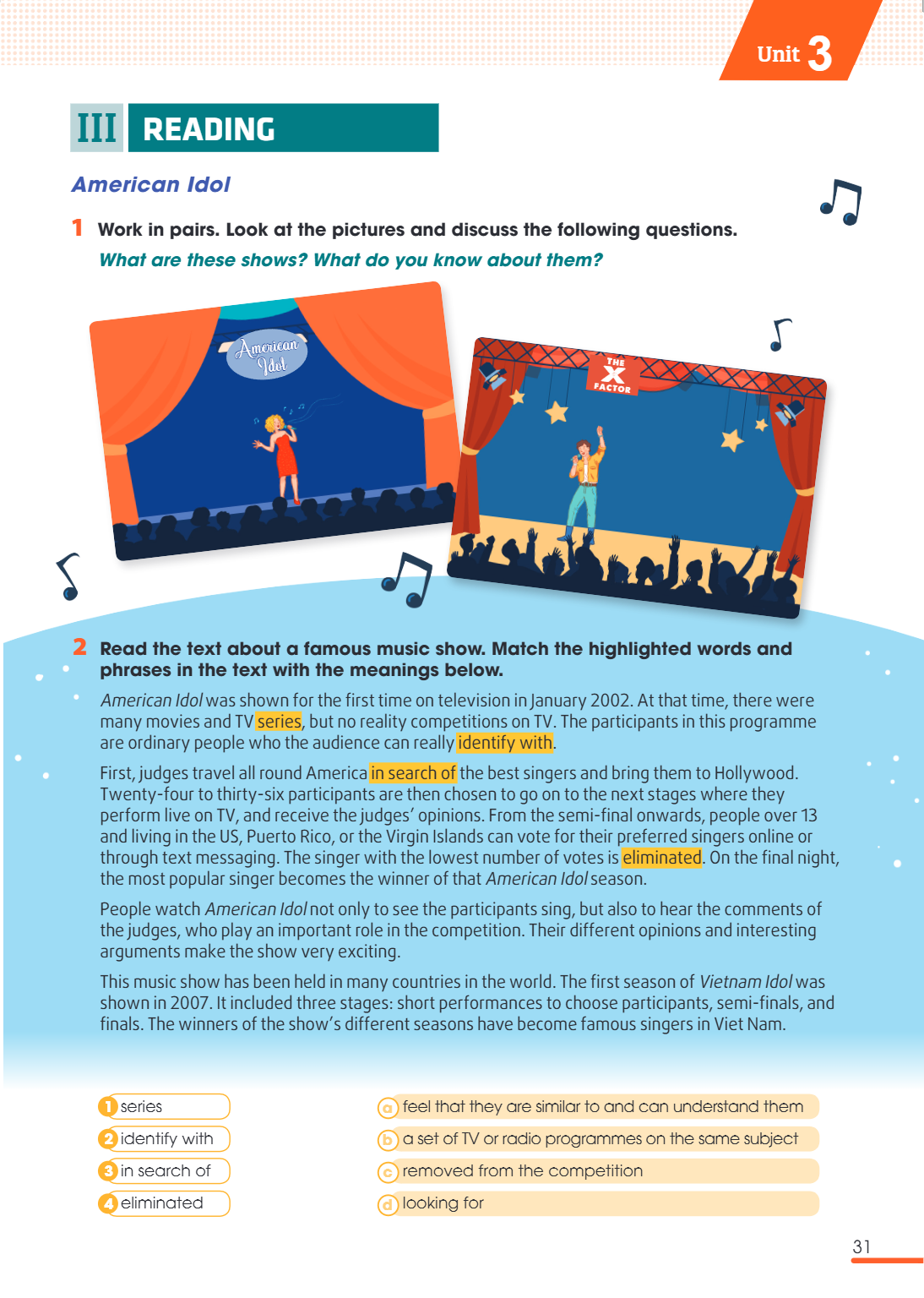
Unit 3 III READING American Idol 1. Work in pairs. Look at the pictures and discuss the following questions. What are these shows? What do you know about them?
Unit 3
III READING
American Idol
1. Work in pairs. Look at the pictures and discuss the following questions.
What are these shows? What do you know about them?
2. Read the text about a famous music show. Match the highlighted words and phrases in the text with the meanings below.
American Idol was shown for the first time on television in January 2002. At that time, there were many movies and TV ==series==, but no reality competitions on TV. The participants in this programme are ordinary people who the audience can really ==identify with==.
First, judges travel all round America ==in search of== the best singers and bring them to Hollywood. Twenty-four to thirty-six participants are then chosen to go on to the next stages where they perform live on TV, and receive the judges' opinions. From the semi-final onwards, people over 13 and living in the US, Puerto Rico, or the Virgin Islands can vote for their preferred singers online or through text messaging. The singer with the lowest number of votes is ==eliminated==. On the final night, the most popular singer becomes the winner of that American Idol season.
People watch American Idol not only to see the participants sing, but also to hear the comments of the judges, who play an important role in the competition. Their different opinions and interesting arguments make the show very exciting.
This music show has been held in many countries in the world. The first season of Vietnam Idol was shown in 2007. It included three stages: short performances to choose participants, semi-finals, and finals. The winners of the show's different seasons have become famous singers in Viet Nam.
1 series, a feel that they are similar to and can understand them
2 identify with, b a set of TV or radio programmes on the same subject
3 in search of, c removed from the competition
4 eliminated, d looking for
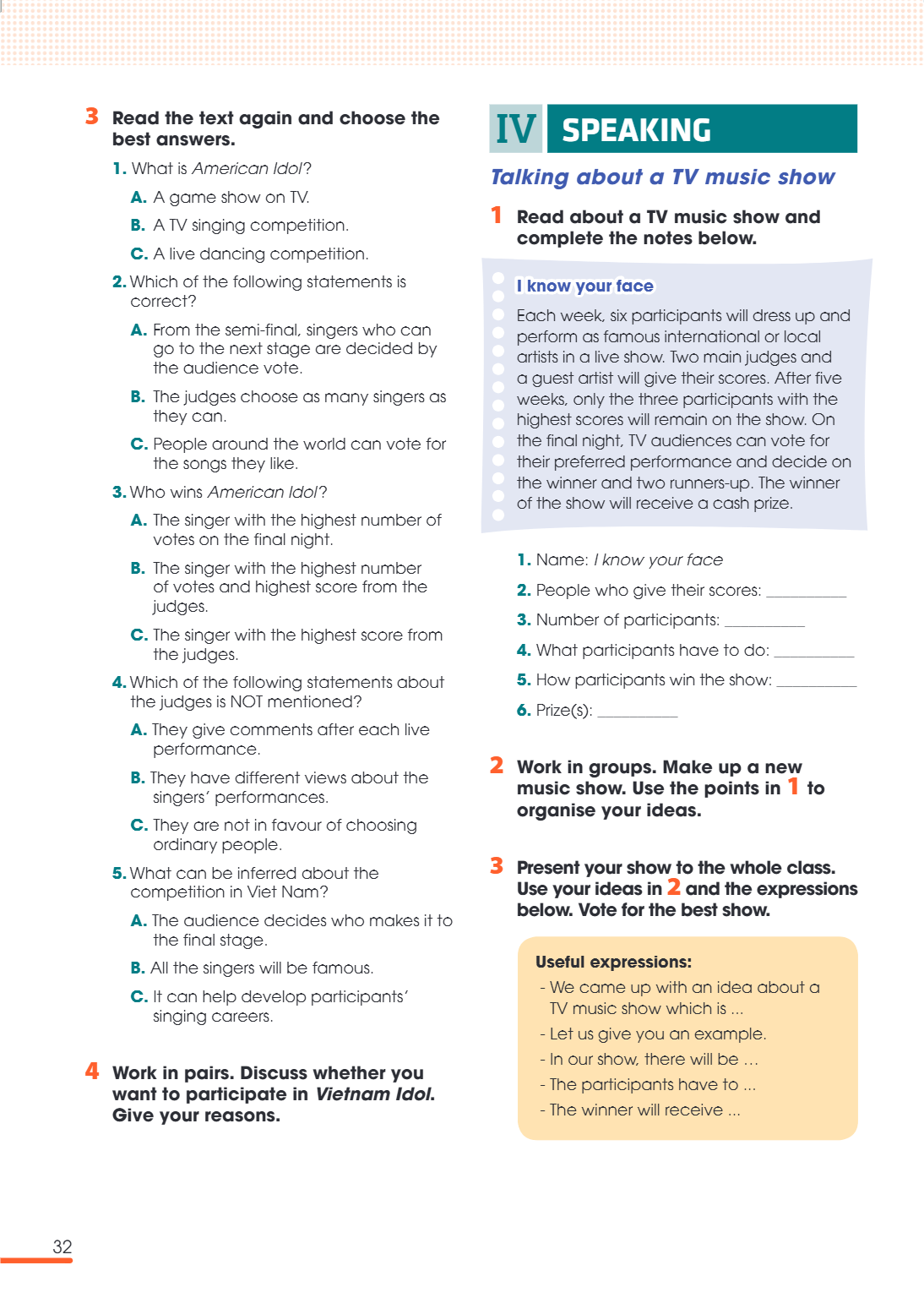
IV SPEAKING Talking about a TV music show 1. Read about a TV music show and complete the notes below. I know your face Each week, six participants will dress up
IV SPEAKING
Talking about a TV music show
1. Read about a TV music show and complete the notes below.
I know your face
Each week, six participants will dress up and perform as famous international or local artists in a live show. Two main judges and a guest artist will give their scores. After five weeks, only the three participants with the highest scores will remain on the show. On the final night, TV audiences can vote for their preferred performance and decide on the winner and two runners-up. The winner of the show will receive a cash prize.
Name: I know your face
People who give their scores: ________
Number of participants: ________
What participants have to do: ________
How participants win the show: ________
Prize(s): ________
2. Work in groups. Make up a new music show. Use the points in 1 to organise your ideas.
3. Present your show to the whole class. Use your ideas in 2 and the expressions below. Vote for the best show.
Useful expressions:
We came up with an idea about a TV music show which is ...
Let us give you an example.
In our show, there will be ...
The participants have to ...
The winner will receive ...
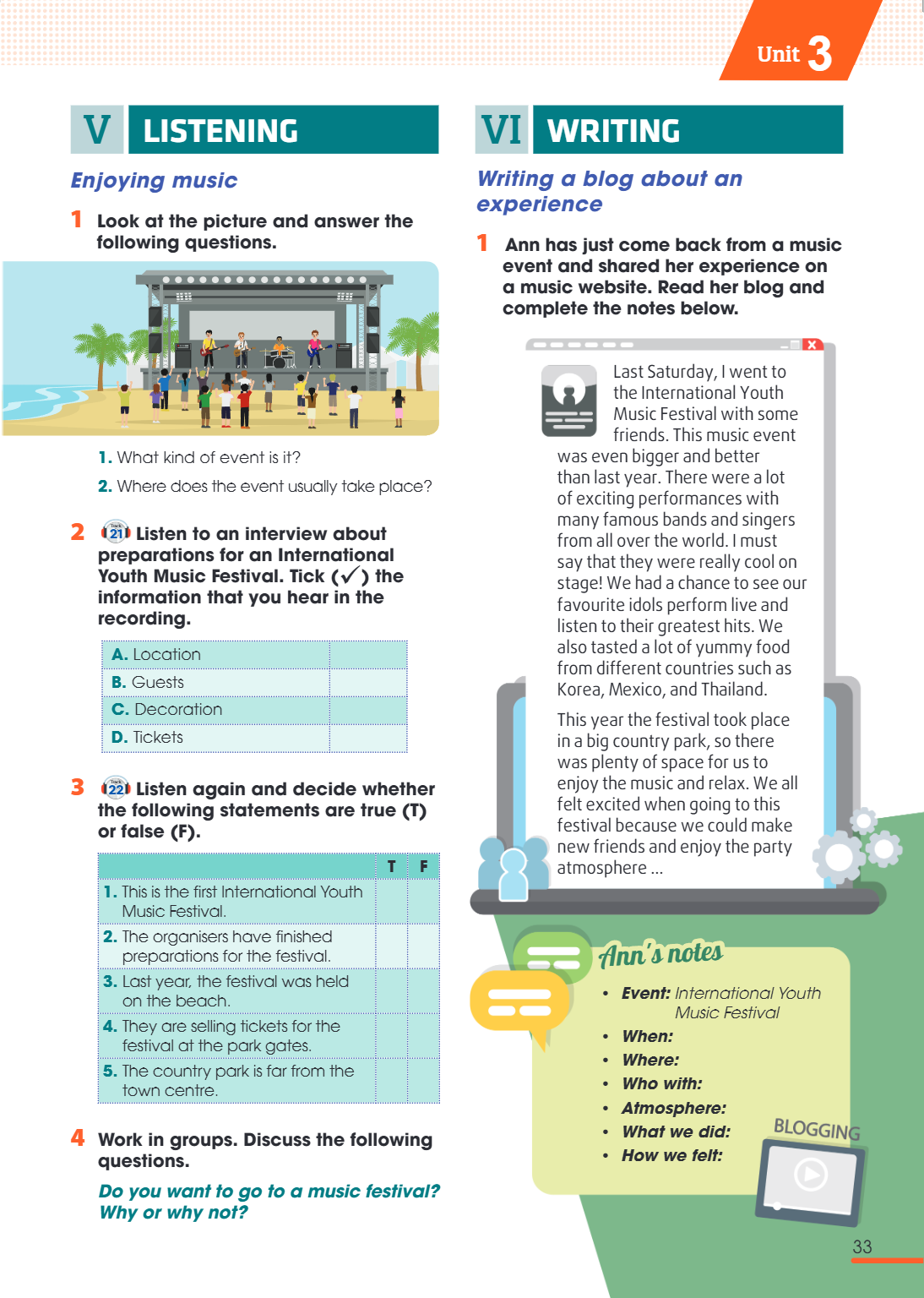
VI WRITING Writing a blog about an experience 1. Ann has just come back from a music event and shared her experience on a music website. Read her blog and compl
VI WRITING
Writing a blog about an experience
1. Ann has just come back from a music event and shared her experience on a music website. Read her blog and complete the notes below.
Last Saturday, I went to the International Youth Music Festival with some friends. This music event was even bigger and better than last year. There were a lot of exciting performances with many famous bands and singers from all over the world. I must say that they were really cool on stage! We had a chance to see our favourite idols perform live and listen to their greatest hits. We also tasted a lot of yummy food from different countries such as Korea, Mexico, and Thailand.
This year the festival took place in a big country park, so there was plenty of space for us to enjoy the music and relax. We all felt excited when going to this festival because we could make new friends and enjoy the party atmosphere ...
Ann's notes
Event: International Youth Music Festival
When: ____
Where: ____
Who with: ____
Atmosphere: ____
What we did: ____
How we felt: ____
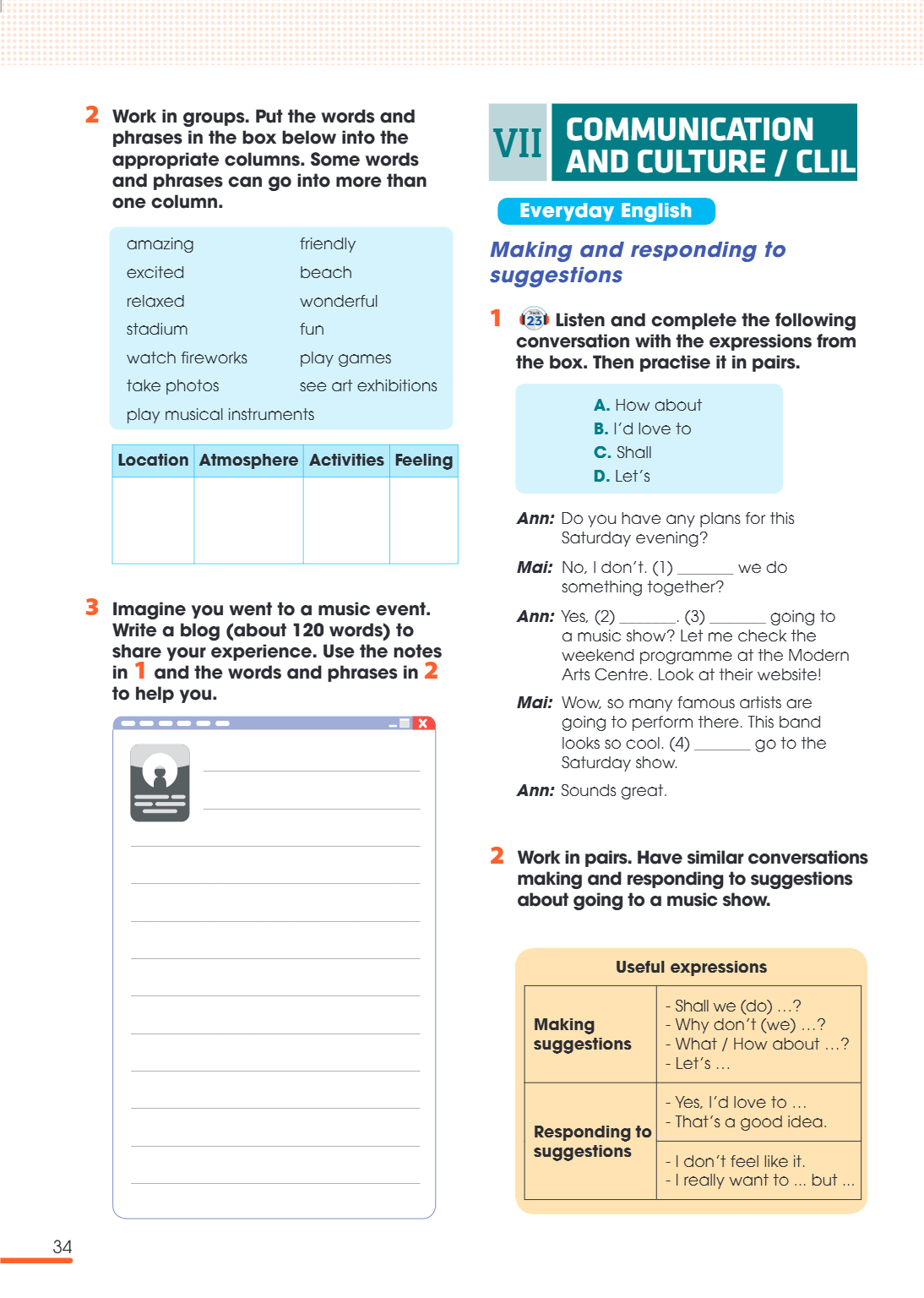
VII COMMUNICATION AND CULTURE / CLIL Everyday English Making and responding to suggestions 1. [Track 25] Listen and complete the following conversation with the
VII COMMUNICATION AND CULTURE / CLIL
Everyday English
Making and responding to suggestions
1. [Track 25] Listen and complete the following conversation with the expressions from the box. Then practise it in pairs.
A. How about
B. I'd love to
C. Shall
D. Let's
Ann: Do you have any plans for this Saturday evening?
Mai: No, I don't. (1) ______ we do something together?
Ann: Yes, (2) ______. (3) ______ going to a music show? Let me check the weekend programme at the Modern Arts Centre. Look at their website!
Mai: Wow, so many famous artists are going to perform there. This band looks so cool. (4) ______ go to the Saturday show.
Ann: Sounds great.
2. Work in pairs. Have similar conversations making and responding to suggestions about going to a music show.
Useful expressions
Making suggestions, - Shall we (do) ...? - Why don't (we) ...? - What / How about ...? - Let's ...
Responding to suggestions, - Yes, I'd love to ... - That's a good idea.
- I don't feel like it. - I really want to ... but ...
Unit3 Culture 1 Read the passage about chau van singing and complete the mind map below. Chau van singing and dancing. It started in the Northern Delta region o
Unit3
Culture
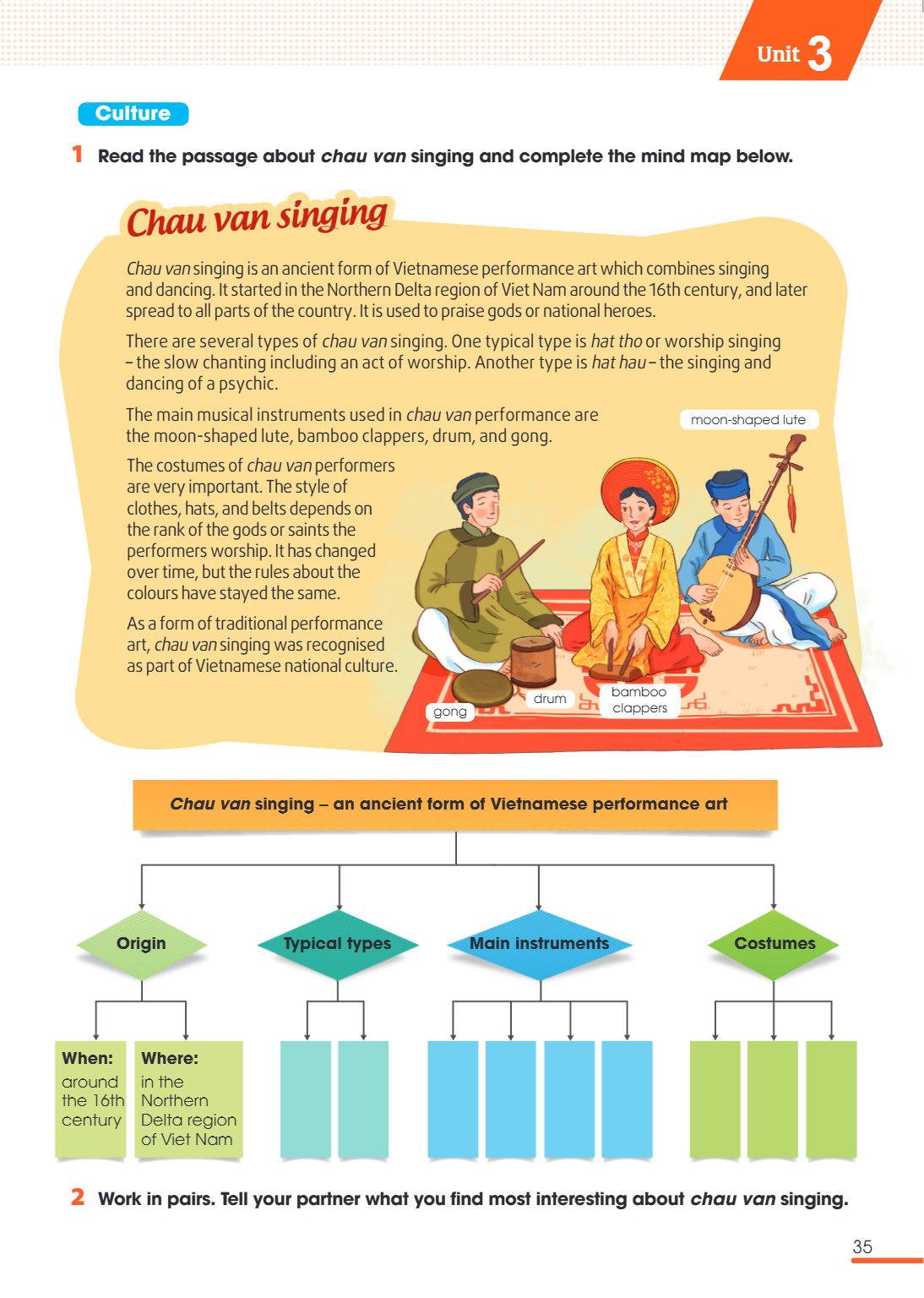
1 Read the passage about chau van singing and complete the mind map below.
Chau van singing
and dancing. It started in the Northern Delta region of Viet Nam around the 16th century, and later spread to all parts of the country. It is used to praise gods or national heroes. There are several types of chauvan singing. One typical type is hat thoor worship singing - the slow chanting including an act of worship. Another type is hat hau- the singing and dancing of a psychic.
The main musical instruments used in chauvan performance are moon-shaped lute the moon-shaped lute, bamboo clappers, drum, and gong. The costumes of chauvan performers are very important. The style of clothes, hats, and belts depends on the rank of the gods or saints the performers worship. It has changed over time, but the rules about the colours have stayed the same. As a form of traditional performance art, chauvansinging was recognised as part of Vietnamese national culture.
drum bamboo gong clappers
Chau van singing - an ancient form of Vietnamese performance art
Origin Typical types Main instruments Costumes
When: Where:
around in the the 16th Northern century Delta region
of Viet Nam
2 Work in pairs. Tell your partner what you find most interesting about chau van singing.
VIII Looking back Pronunciation Listen and mark the stressed syllables in the following words. Then read them out. Track perform concert final singer famous enj
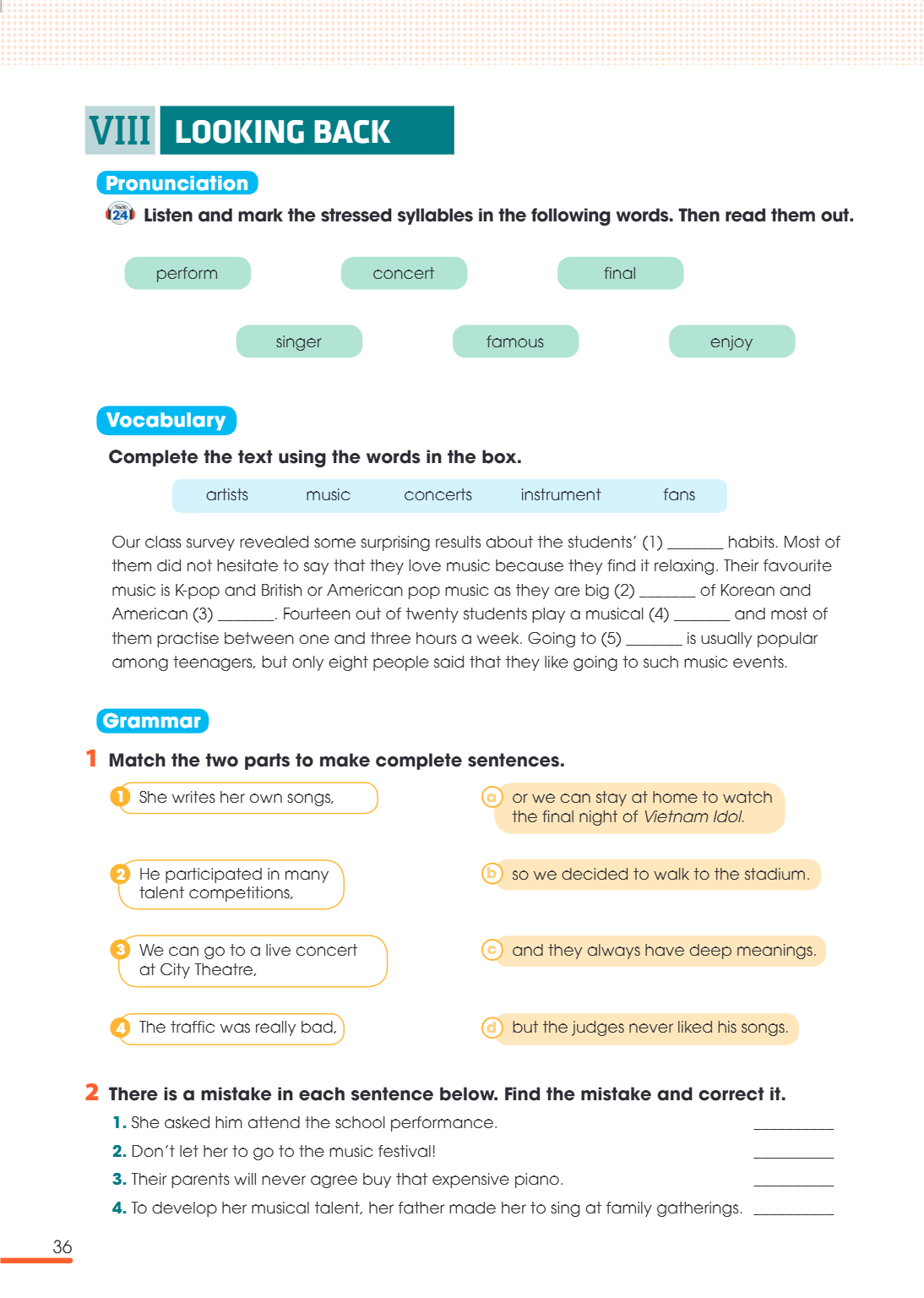
VIII Looking back
Pronunciation
Listen and mark the stressed syllables in the following words. Then read them out.
Track perform concert final
singer famous enjoy
Vocabulary
Complete the text using the words in the box.
artists music concerts instrument fans Our class survey revealed some surprising results about the students' (1) _______ habits. Most of them did not hesitate to say that they love music because they find it relaxing. Their favourite music is K-pop and British or American pop music as they are big (2) _______ of Korean and American (3) _______. Fourteen out of twenty students play a musical (4) _______ and most of them practise between one and three hours a week. Going to (5) _______ is usually popular among teenagers, but only eight people said that they like going to such music events.
Grammar
1 Match the two parts to make complete sentences.
1 She writes her own songs, a or we can stay at home to watch
the final night of Vietnam Idol.
2 He participated in many b so we decided to walk to the stadium.
talent competitions,
3 We can go to a live concert c and they always have deep meanings.
at City Theatre,
4 The traffic was really bad, d but the judges never liked his songs.
2 There is a mistake in each sentence below. Find the mistake and correct it.
She asked him attend the school performance. __________
Don't let her to go to the music festival! __________
Their parents will never agree buy that expensive piano. __________
To develop her musical talent, her father made her to sing at family gatherings. __________
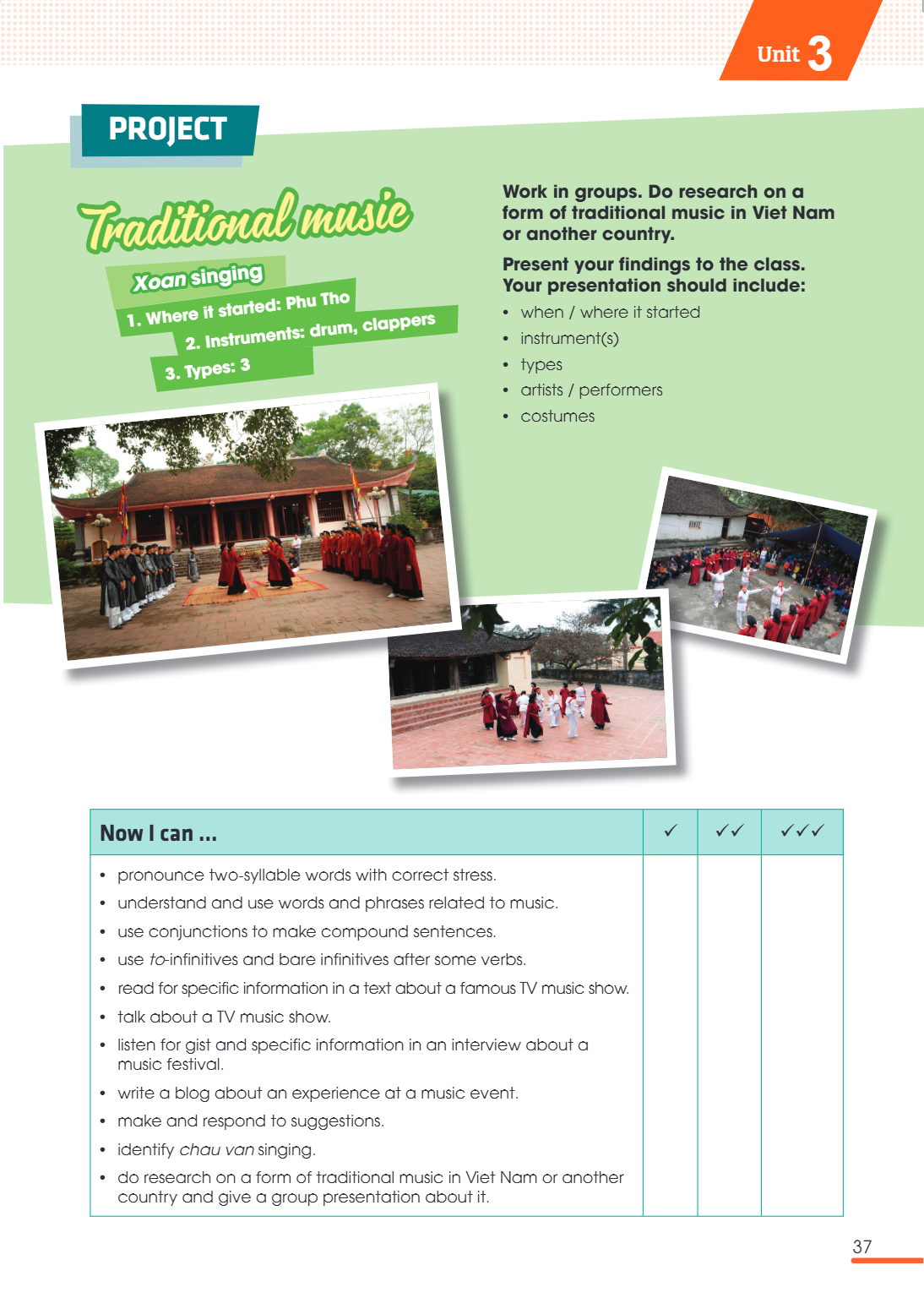
Unit 3 PROJECT Traditional music Xoan singing Where it started: Phu Tho Instruments: drum, clappers Types: 3 Work in groups. Do research on a form of traditiona
Unit 3
PROJECT
Traditional music
Xoan singing
Where it started: Phu Tho
Instruments: drum, clappers
Types: 3
Work in groups. Do research on a form of traditional music in Viet Nam or another country.
Present your findings to the class. Your presentation should include:
when / where it started
instrument(s)
types
artists / performers
costumes
Now I can ..., ✓, ✓✓, ✓✓✓
• pronounce two-syllable words with correct stress.
• understand and use words and phrases related to music.
• use conjunctions to make compound sentences.
• use to-infinitives and bare infinitives after some verbs.
• read for specific information in a text about a famous TV music show.
• talk about a TV music show.
• listen for gist and specific information in an interview about a music festival.
• write a blog about an experience at a music event.
• make and respond to suggestions.
• identify chau van singing.
• do research on a form of traditional music in Viet Nam or another country and give a group presentation about it.
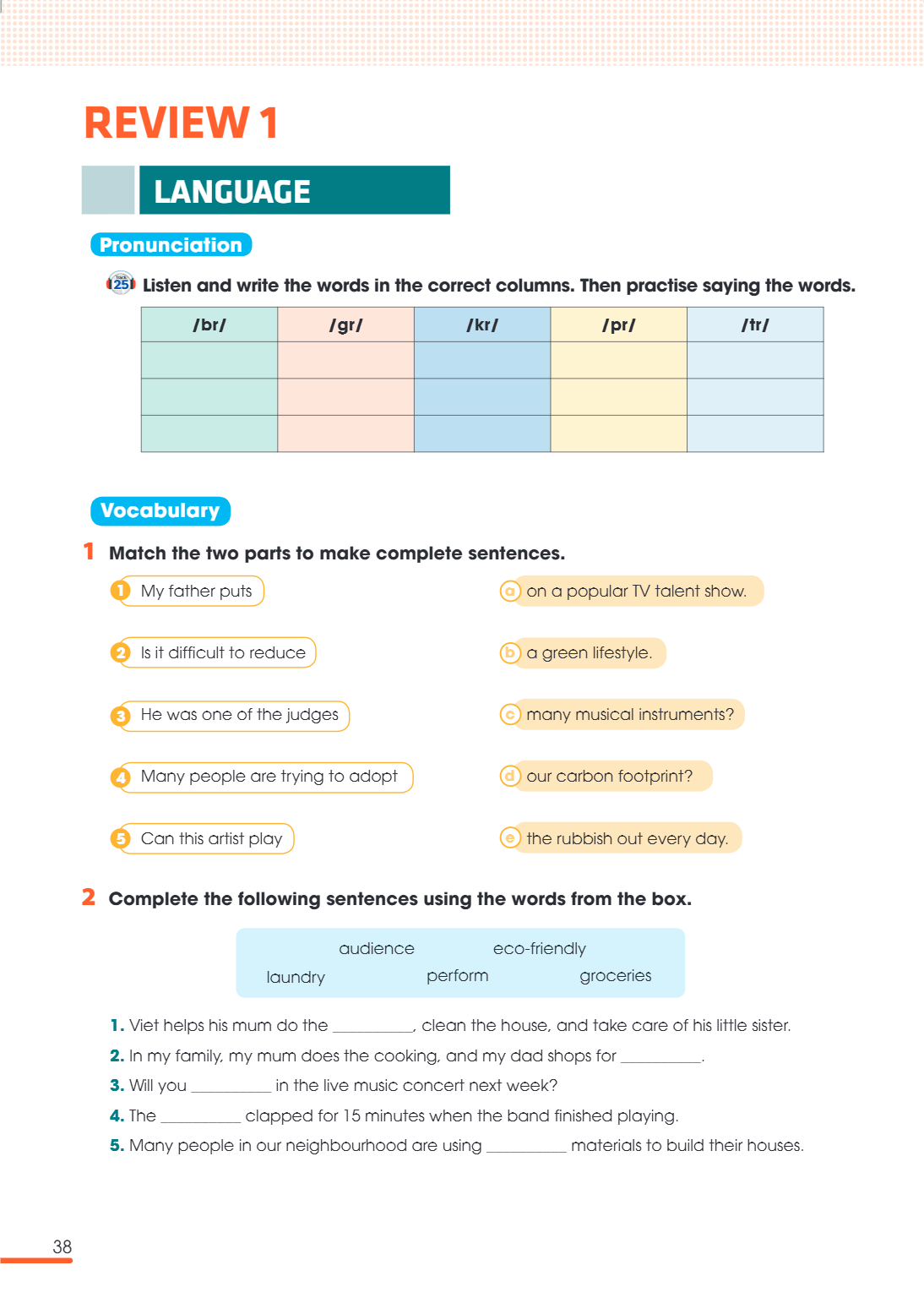
Review 1 LANGUAGE Pronunciation 25. Listen and write the words in the correct columns. Then practise saying the words. /br/, /gr/, /kr/, /pr/, /tr/ Vocabulary 1
Review 1
LANGUAGE
Pronunciation
25. Listen and write the words in the correct columns. Then practise saying the words.
/br/, /gr/, /kr/, /pr/, /tr/
Vocabulary
1. Match the two parts to make complete sentences.
1, My father puts, a, on a popular TV talent show.
2, Is it difficult to reduce, b, a green lifestyle.
3, He was one of the judges, c, many musical instruments?
4, Many people are trying to adopt, d, our carbon footprint?
5, Can this artist play, e, the rubbish out every day.
2. Complete the following sentences using the words from the box.
audience eco-friendly laundry perform groceries
Viet helps his mum do the ________, clean the house, and take care of his little sister.
In my family, my mum does the cooking, and my dad shops for ________.
Will you ________ in the live music concert next week?
The ________ clapped for 15 minutes when the band finished playing.
Many people in our neighbourhood are using ________ materials to build their houses.
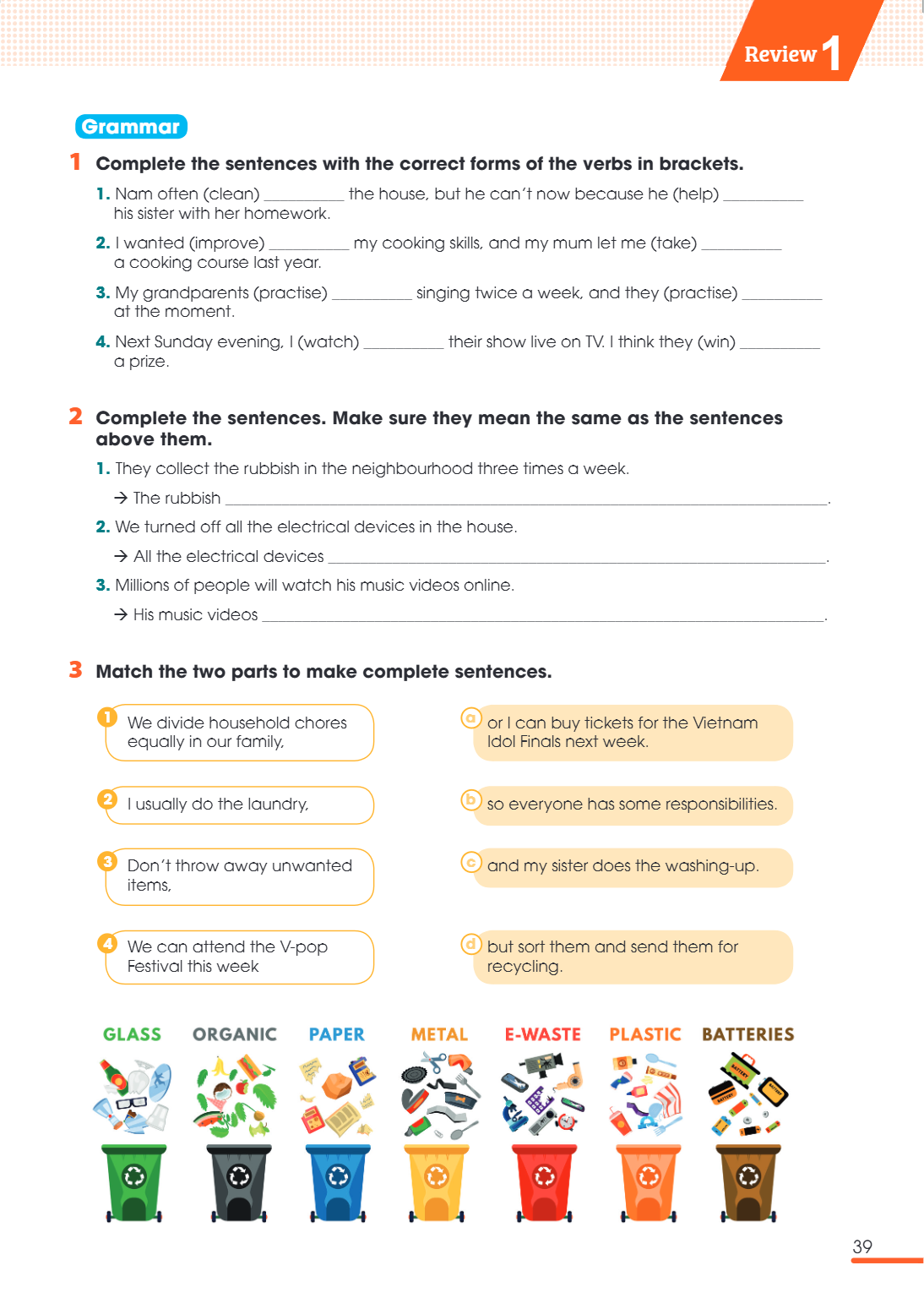
Review1 Grammar 1 Complete the sentences with the correct forms of the verbs in brackets. Nam often (clean) __________ the house, but he can't now because he (h
Review1
Grammar
1 Complete the sentences with the correct forms of the verbs in brackets.
Nam often (clean) __________ the house, but he can't now because he (help) __________
his sister with her homework.
wanted (improve) __________ my cooking skills, and my mum let me (take) __________
I
a cooking course last year.
My grandparents (practise) __________ singing twice a week, and they (practise) __________
at the moment.
Next Sunday evening, (watch) __________ their show live on TV. think they (win) __________
I I
a prize.
2 Complete the sentences. Make sure they mean the same as the sentences
above them.
They collect the rubbish in the neighbourhood three times a week.
 The rubbish ___________________________________________________________________________.
2. We turned off all the electrical devices in the house.
 All the electrical devices ______________________________________________________________.
3. Millions of people will watch his music videos online.
 His music videos ______________________________________________________________________.
3 Match the two parts to make complete sentences.
1 We divide household chores a or can buy tickets for the Vietnam
I
equally in our family, Idol Finals next week. 2 usually do the laundry, b so everyone has some responsibilities.
I
3 Don't throw away unwanted c and my sister does the washing-up.
items,
4 We can attend the V-pop d but sort them and send them for
Festival this week recycling.
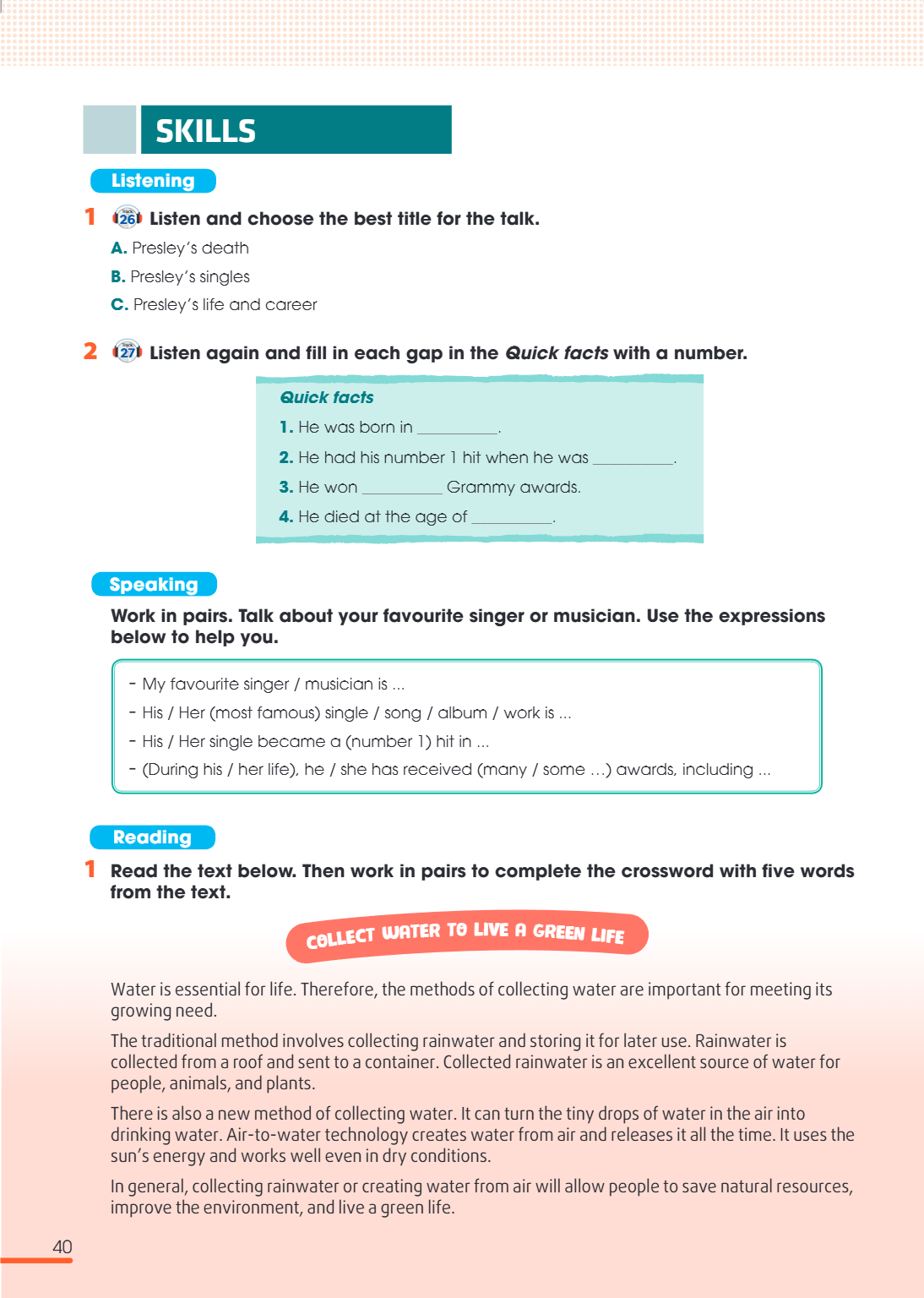
skills Listening 1 Listen and choose the best title for the talk. Track A. Presley's death B. Presley's singles C. Presley's life and career 2 Listen again and
skills
Listening 1 Listen and choose the best title for the talk.
Track
A. Presley's death
B. Presley's singles
C. Presley's life and career
2 Listen again and fill in each gap in the Quick facts with a number.
Track
Quick facts
1. He was born in __________.
2. He had his number 1 hit when he was __________.
3. He won __________ Grammy awards.
4. He died at the age of __________.
Speaking below to help you.
Work in pairs. Talk about your favourite singer or musician. Use the expressions
My favourite singer / musician is ... - His / Her (most famous) single / song / album / work is ... - His / Her single became a (number 1) hit in ... - (During his / her life), he / she has received (many / some …) awards, including ...
Reading from the text.
1 Read the text below. Then work in pairs to complete the crossword with five words
Water is essential for life. Therefore, the methods of collecting water are important for meeting its growing need. The traditional method involves collecting rainwater and storing it for later use. Rainwater is collected from a roof and sent to a container. Collected rainwater is an excellent source of water for people, animals, and plants. There is also a new method of collecting water. It can turn the tiny drops of water in the air into drinking water. Air-to-water technology creates water from air and releases it all the time. It uses the sun's energy and works well even in dry conditions. In general, collecting rainwater or creating water from air will allow people to save natural resources, improve the environment, and live a green life.
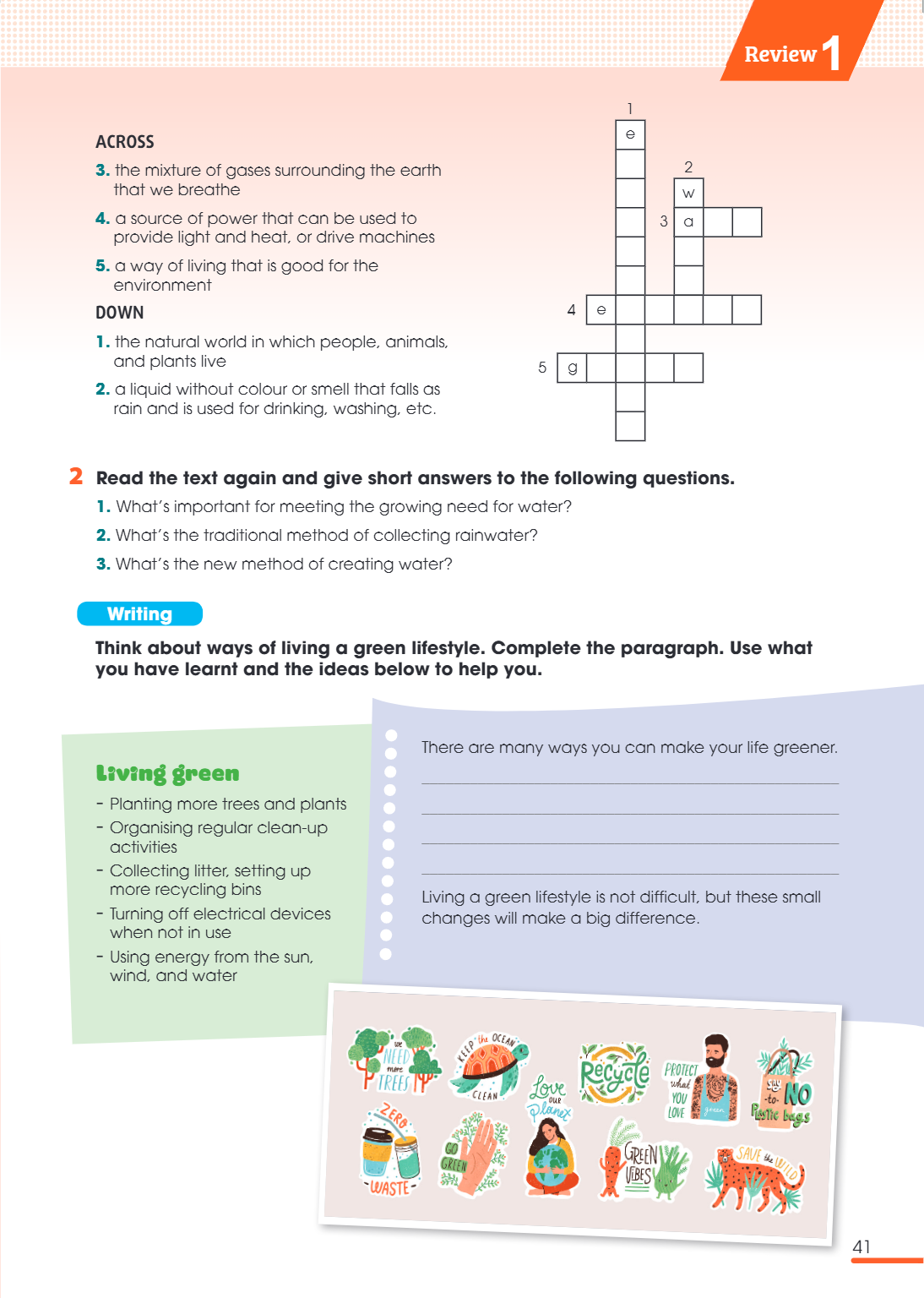
Review1 ACROSS e the mixture of gases surrounding the earth 2 that we breathe w a source of power that can be used to 3 a provide light and heat, or drive machi
Review1
ACROSS e
the mixture of gases surrounding the earth 2 that we breathe w
a source of power that can be used to 3 a provide light and heat, or drive machines
5. a way of living that is good for the
environment DOWN 4 e
1. the natural world in which people, animals,
and plants live 5 g
2. a liquid without colour or smell that falls as
rain and is used for drinking, washing, etc.
2 Read the text again and give short answers to the following questions.
1. What's important for meeting the growing need for water?
2. What's the traditional method of collecting rainwater?
3. What's the new method of creating water?
Writing you have learnt and the ideas below to help you.
Think about ways of living a green lifestyle. Complete the paragraph. Use what
Living green
Planting more trees and plants - Organising regular clean-up
activities - Collecting litter, setting up
more recycling bins - Turning off electrical devices
when not in use - Using energy from the sun,
wind, and water
There are many ways you can make your life greener.
Living a green lifestyle is not difficult, but these small changes will make a big difference.
Unit 4. FOR A BETTER COMMUNITY This unit includes: LANGUAGE Pronunciation Stress in two-syllable words with the same spelling Vocabulary Words and phrases relat
Unit 4. FOR A BETTER COMMUNITY
This unit includes:
LANGUAGE
Pronunciation
Stress in two-syllable words with the same spelling
Vocabulary
Words and phrases related to community development;
Adjective suffixes: -ed vs. -ing; -ful vs. -less
Grammar
Past simple vs. past continuous with when and while
SKILLS
Reading: Reading for main ideas and specific information in a text about a volunteer club
Speaking: Talking about the benefits of volunteering activities
Listening: Listening for specific information in an announcement for volunteers
Writing: Writing an application letter for volunteer work
COMMUNICATION AND CULTURE / CLIL
Everyday English
Expressing feelings
Culture
Save the Children organisation
PROJECT
Doing research on a volunteer project in your community
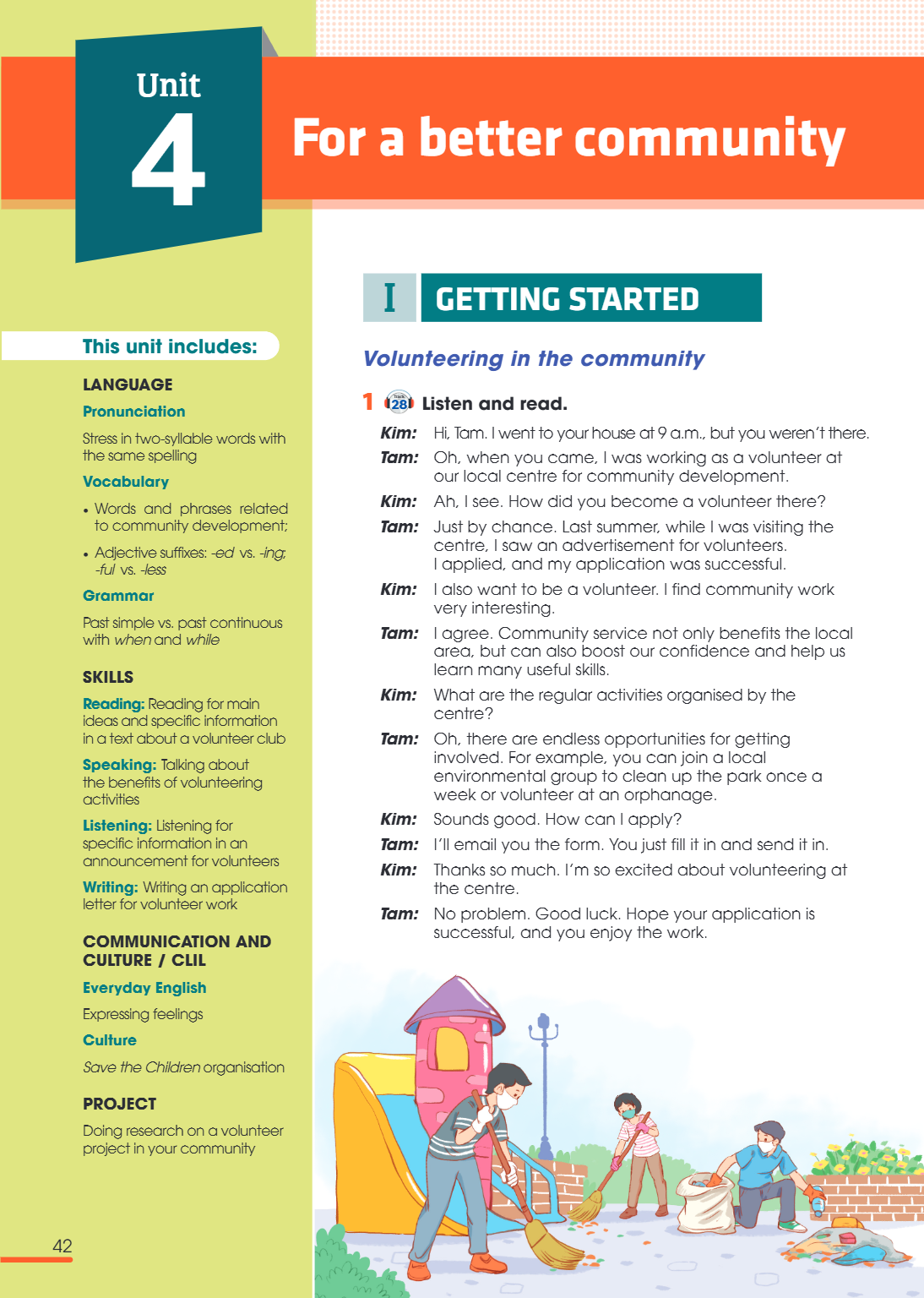
I GETTING STARTED
Volunteering in the community
1. Listen and read.
Kim: Hi, Tam. I went to your house at 9 a.m., but you weren't there.
Tam: Oh, when you came, I was working as a volunteer at our local centre for community development.
Kim: Ah, I see. How did you become a volunteer there?
Tam: Just by chance. Last summer, while I was visiting the centre, I saw an advertisement for volunteers. I applied, and my application was successful.
Kim: I also want to be a volunteer. I find community work very interesting.
Tam: I agree. Community service not only benefits the local area, but can also boost our confidence and help us learn many useful skills.
Kim: What are the regular activities organised by the centre?
Tam: Oh, there are endless opportunities for getting involved. For example, you can join a local environmental group to clean up the park once a week or volunteer at an orphanage.
Kim: Sounds good. How can I apply?
Tam: I'll email you the form. You just fill it in and send it in.
Kim: Thanks so much. I'm so excited about volunteering at the centre.
Tam: No problem. Good luck. Hope your application is successful, and you enjoy the work.
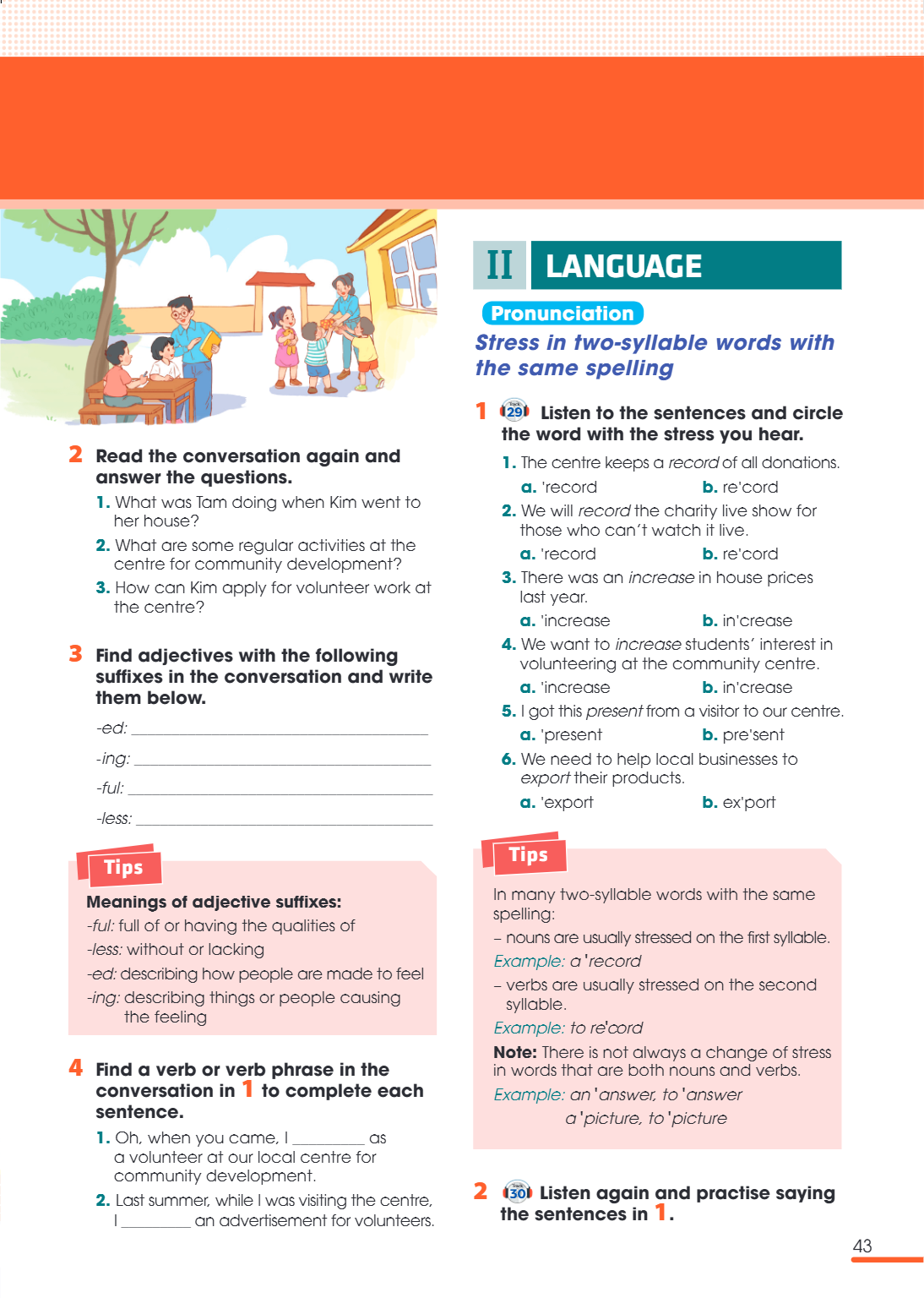
II very language helpful. Laptops (3) changed our Pronunciation lives since their invention, but smart Stress in two-syllable have also words with (4) the same
II very language helpful. Laptops
(3) changed our Pronunciation lives since their invention, but smart
Stress in two-syllable have also words with
(4)
the same spelling
as well. For
Listen to it's the sentences (5) and circle
Track
the word apps with the stress you hear.
1. The centre keeps a record of all donations.
a. 'record communicate b. re'cord
2. We will record the charity live show for
last year. II volunteering at the community centre.
got this present from a visitor to our centre.
I
a. 'export syllable in b. ex'port word.
invention computer holiday century
Tips
In many two-syllable words with the same all the words with the spelling:
to cross the
nouns are usually stressed on the first syllable. listen and check your answers, and Example: a 'record pronounce words in pairs. - verbs are usually stressed on the second
syllable. Example: to re'cord Note: There is not always a change of stress in words that are both nouns and verbs. family Example: an 'answer, to 'answer Africa
computer a 'picture, to 'picture afternoon
Listen again and practise saying the sentences in 1 .
Track
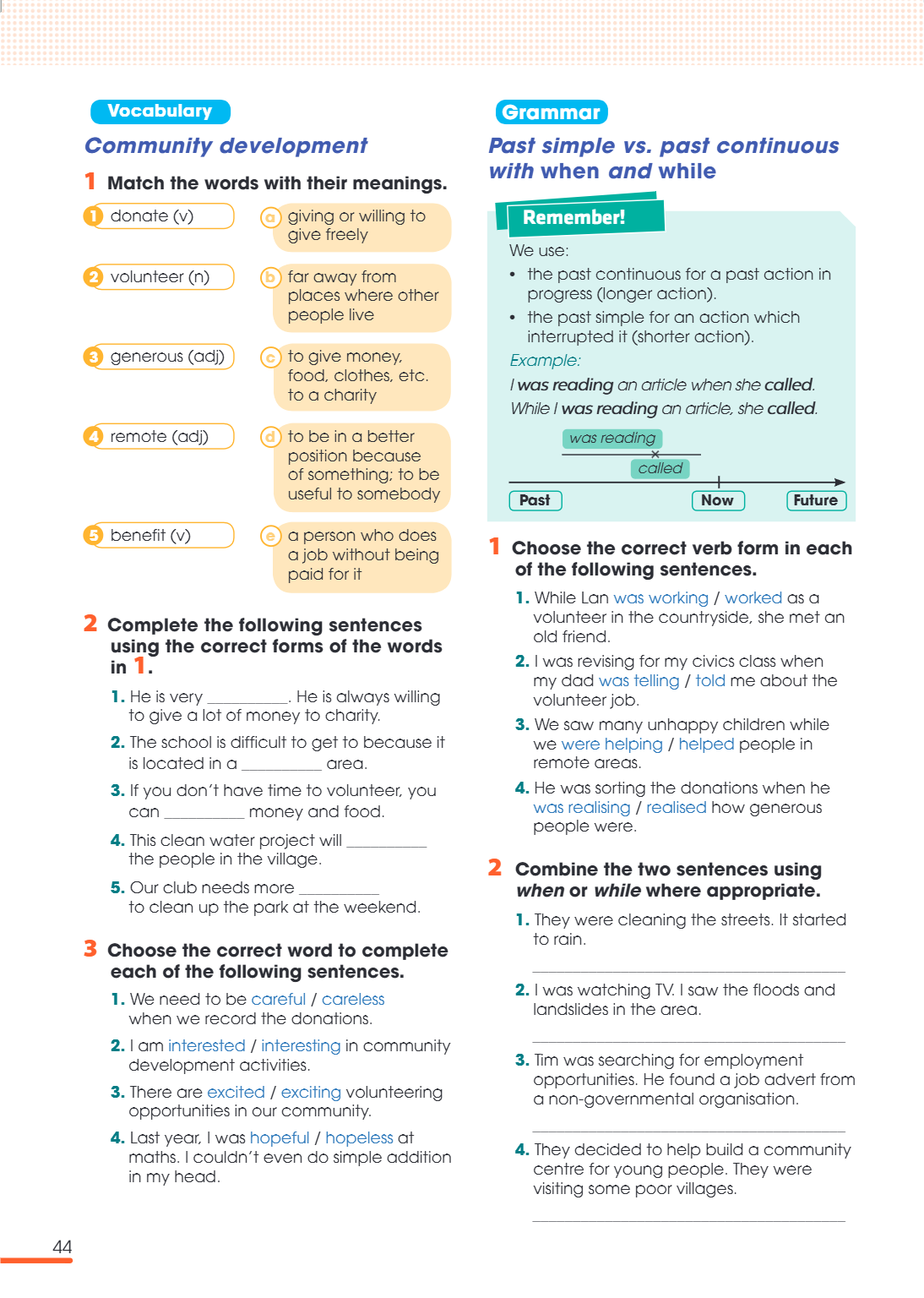
Grammar Past simple vs. past continuous with when and while Remember! We use: the past continuous for a past action in progress (longer action). the past simple
Grammar
Past simple vs. past continuous with when and while
Remember!
We use:
the past continuous for a past action in progress (longer action).
the past simple for an action which interrupted it (shorter action).
Example:
I ==was reading== an article ==when== she ==called==.
While I ==was reading== an article, she ==called==.
[Timeline graphic showing "was reading" as a long line, "called" interrupting it, with markers for Past, Now, Future]
1 Choose the correct verb form in each of the following sentences.
While Lan ==was working / worked== as a volunteer in the countryside, she met an old friend.
I was revising for my civics class when my dad ==was telling / told== me about the volunteer job.
We saw many unhappy children while we ==were helping / helped== people in remote areas.
He was sorting the donations when he ==was realising / realised== how generous people were.
2 Combine the two sentences using when or while where appropriate.
They were cleaning the streets. It started to rain.
I was watching TV. I saw the floods and landslides in the area.
Tim was searching for employment opportunities. He found a job advert from a non-governmental organisation.
They decided to help build a community centre for young people. They were visiting some poor villages.
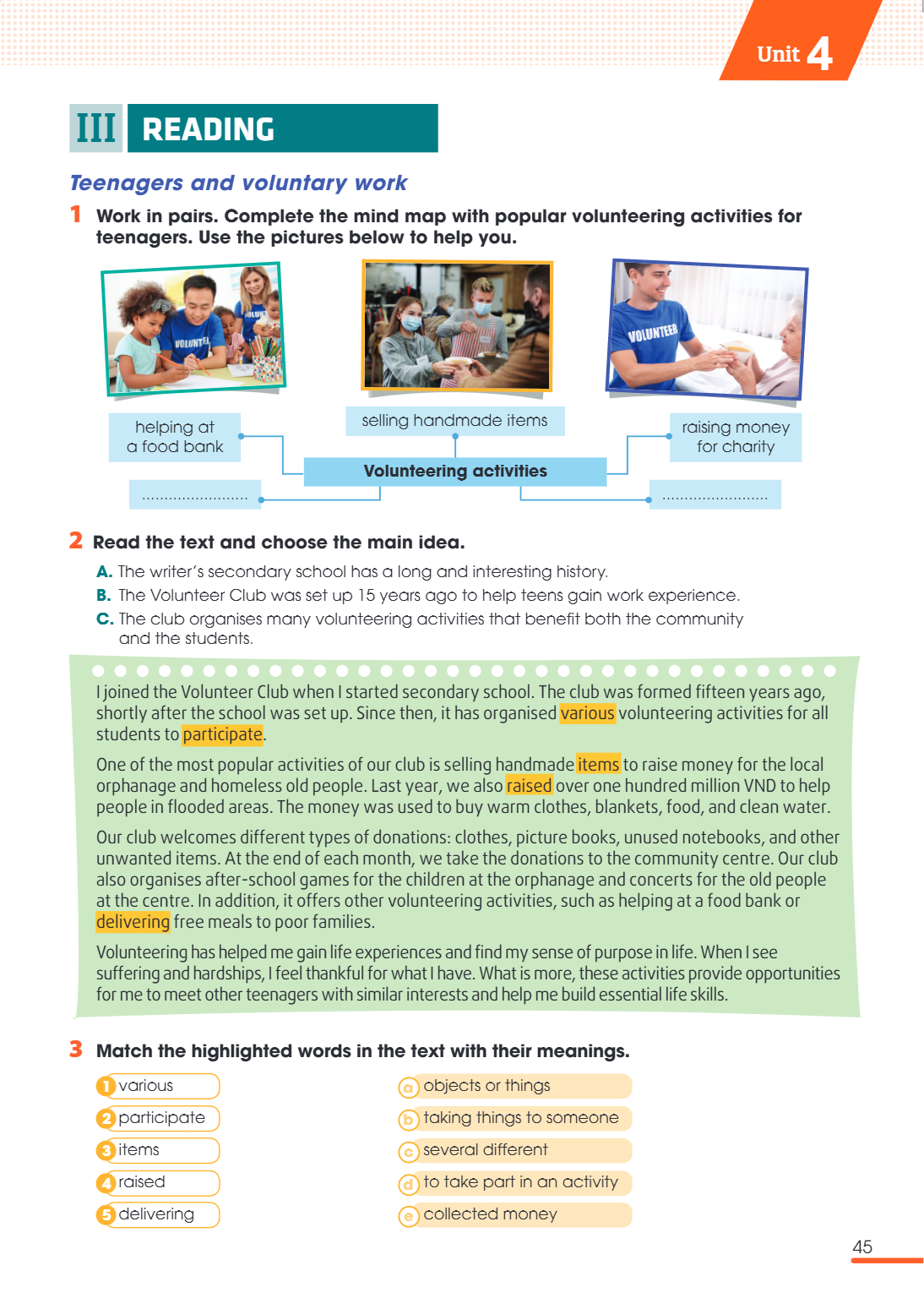
Unit4 III reading Teenagers and voluntary work 1 Work in pairs. Complete the mind map with popular volunteering activities for teenagers. Use the pictures below
Unit4
III reading
Teenagers and voluntary work
1 Work in pairs. Complete the mind map with popular volunteering activities for
teenagers. Use the pictures below to help you.
helping at selling handmade items raising money a food bank for charity
Volunteering activities 2 Read the text and choose the main idea.
........................ ........................
A. The writer's secondary school has a long and interesting history.
B. The Volunteer Club was set up 15 years ago to help teens gain work experience.
C. The club organises many volunteering activities that benefit both the community
and the students. I joined the Volunteer Club when I started secondary school. The club was formed fifteen years ago, shortly after the school was set up. Since then, it has organised various volunteering activities for all students to participate. One of the most popular activities of our club is selling handmade items to raise money for the local orphanage and homeless old people. Last year, we also raised over one hundred million VND to help people in flooded areas. The money was used to buy warm clothes, blankets, food, and clean water. Our club welcomes different types of donations: clothes, picture books, unused notebooks, and other unwanted items. At the end of each month, we take the donations to the community centre. Our club also organises after-school games for the children at the orphanage and concerts for the old people at the centre. In addition, it offers other volunteering activities, such as helping at a food bank or delivering free meals to poor families. Volunteering has helped me gain life experiences and find my sense of purpose in life. When I see suffering and hardships, I feel thankful for what I have. What is more, these activities provide opportunities for me to meet other teenagers with similar interests and help me build essential life skills.
3 Match the highlighted words in the text with their meanings.
1 various, a objects or things
2 participate, b taking things to someone
3 items, c several different
4 raised, d to take part in an activity
5 delivering, e collected money
IV SPEAKING Benefits of volunteering activities 1. Look at the following benefits of volunteering activities. Choose the THREE most important benefits. Coming i
IV SPEAKING
Benefits of volunteering activities
1. Look at the following benefits of volunteering activities. Choose the THREE most important benefits.
Coming into contact with other teenagers with similar interests
Improving essential life skills, such as skills that will get you a job, or time management skills
Appreciating the good things in life and being positive
Helping teenagers find a sense of purpose in life
Gaining life experiences
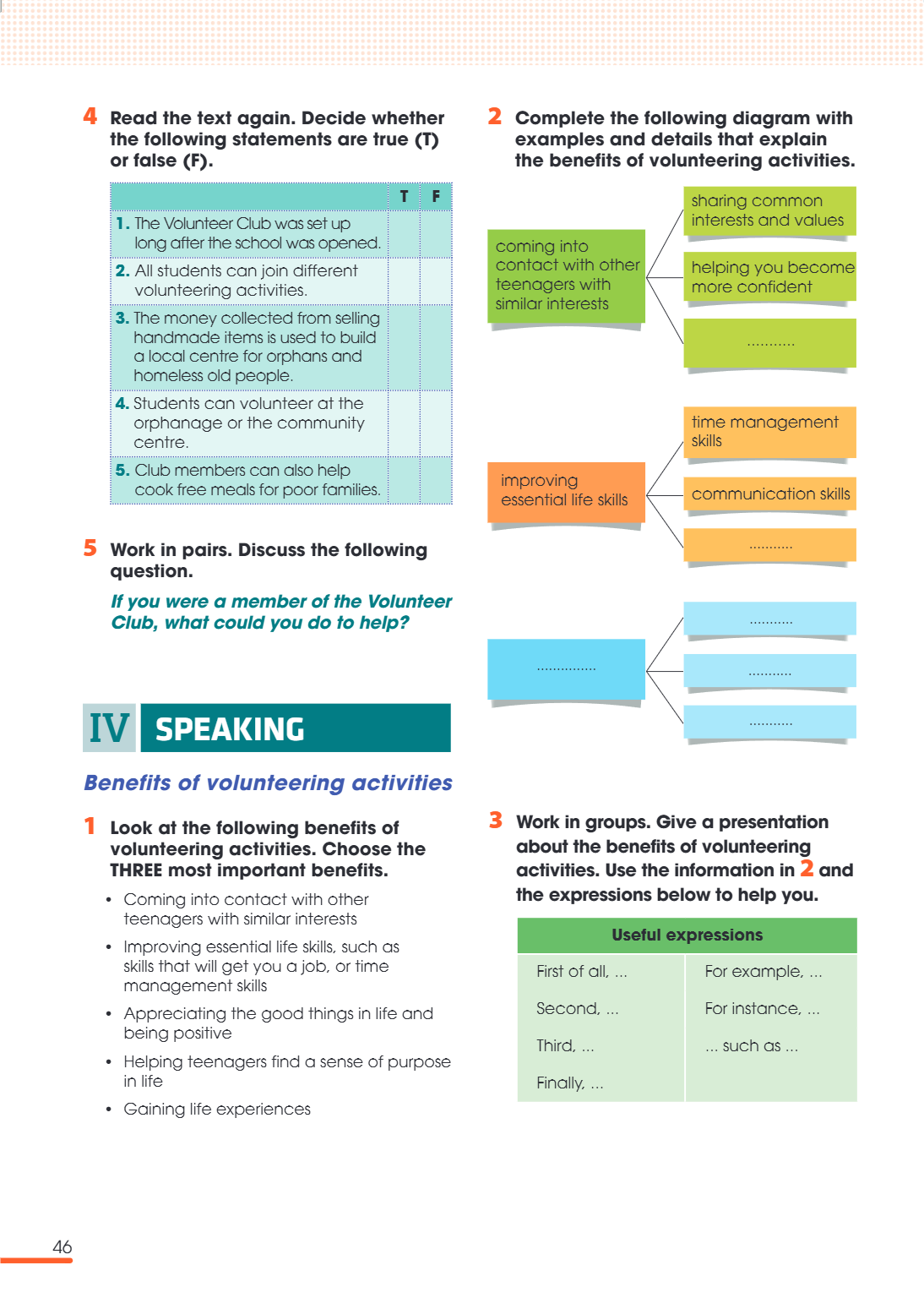
2. Complete the following diagram with examples and details that explain the benefits of volunteering activities.
coming into contact with other teenagers with similar interests
sharing common interests and values
helping you become more confident
............
improving essential life skills
time management skills
communication skills
............
................
............
............
............
3. Work in groups. Give a presentation about the benefits of volunteering activities. Use the information in 2 and the expressions below to help you.
Useful expressions
First of all, ..., For example, ...
Second, ..., For instance, ...
Third, ..., ... such as ...
Finally, ...
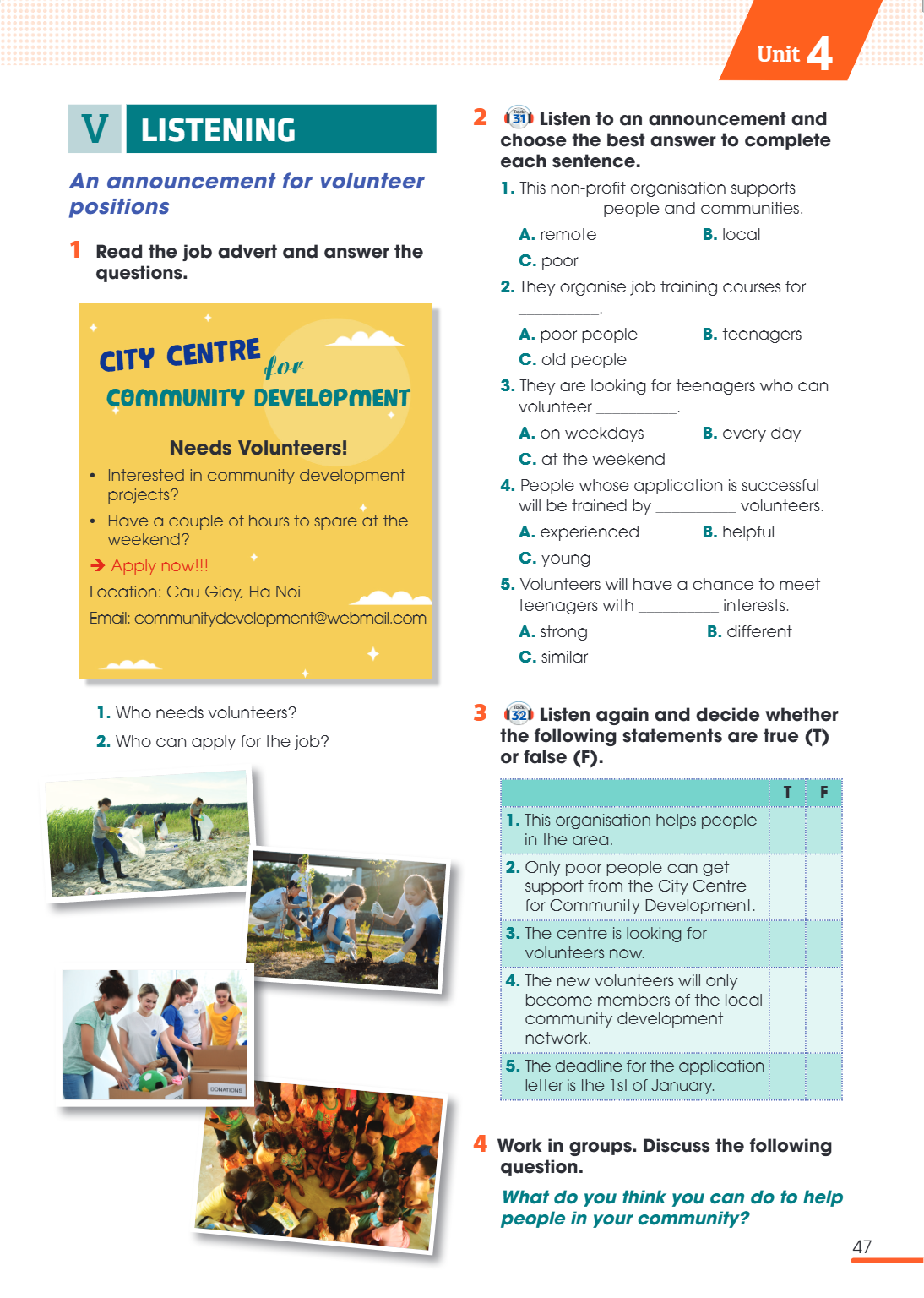
Unit 4. V LISTENING An announcement for volunteer positions 1. Read the job advert and answer the questions. CITY CENTRE for COMMUNITY DEVELOPMENT Needs Volunte
Unit 4.
V LISTENING
An announcement for volunteer positions
1. Read the job advert and answer the questions.
CITY CENTRE for COMMUNITY DEVELOPMENT
Needs Volunteers!
• Interested in community development projects?
• Have a couple of hours to spare at the weekend?
➜ Apply now!!!
Location: Cau Giay, Ha Noi
Email: communitydevelopment@webmail.com
1. Who needs volunteers?
2. Who can apply for the job?
2. Listen to an announcement and choose the best answer to complete each sentence.
1. This non-profit organisation supports ______ people and communities.
A. remote
B. local
C. poor
2. They organise job training courses for ______.
A. poor people
B. teenagers
C. old people
3. They are looking for teenagers who can volunteer ______.
A. on weekdays
B. every day
C. at the weekend
4. People whose application is successful will be trained by ______ volunteers.
A. experienced
B. helpful
C. young
5. Volunteers will have a chance to meet teenagers with ______ interests.
A. strong
B. different
C. similar
3. Listen again and decide whether the following statements are true (T) or false (F).
T, F
1. This organisation helps people in the area.
2. Only poor people can get support from the City Centre for Community Development.
3. The centre is looking for volunteers now.
4. The new volunteers will only become members of the local community development network.
5. The deadline for the application letter is the 1st of January.
4. Work in groups. Discuss the following question.
What do you think you can do to help people in your community?
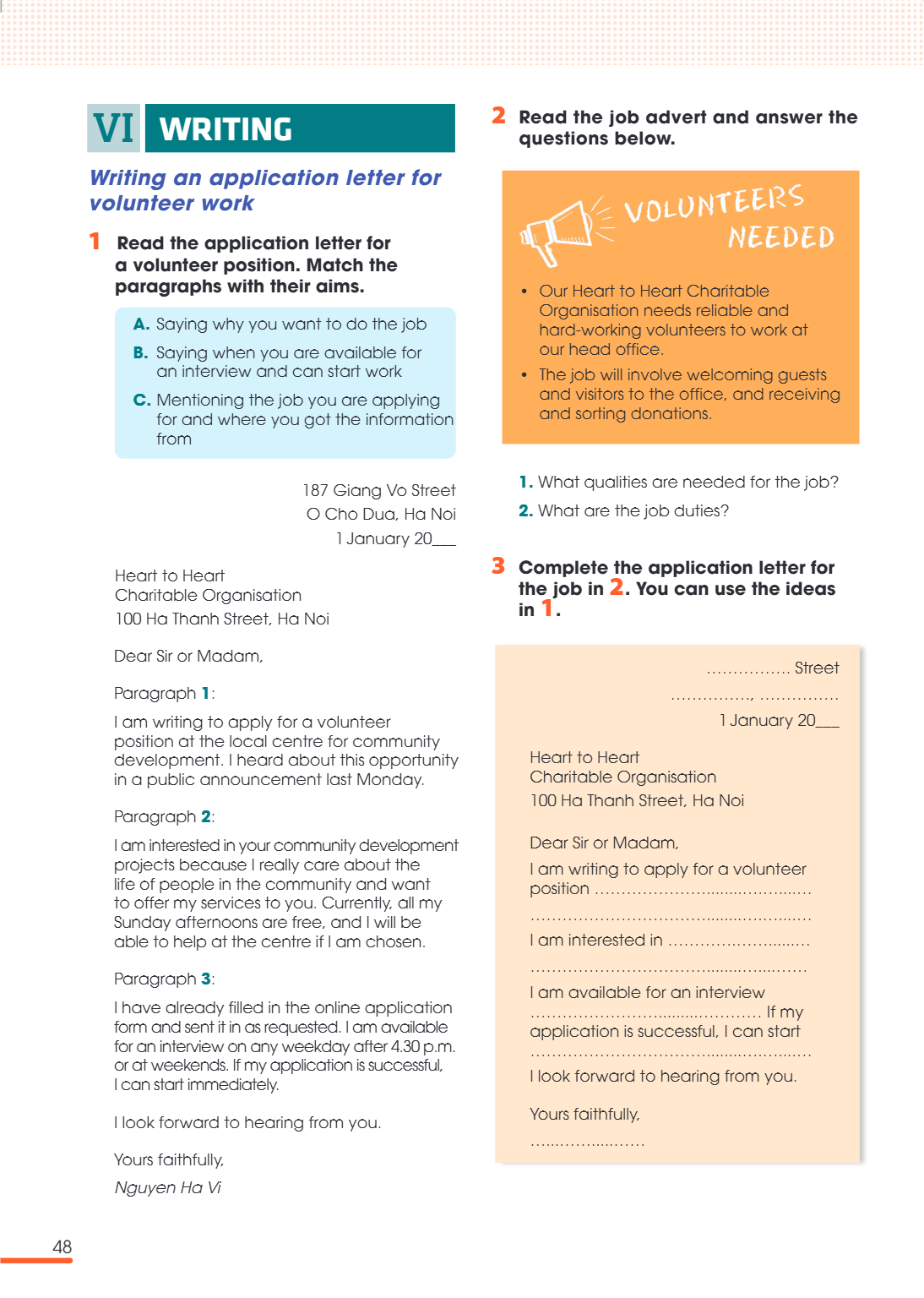
VI WRITING Writing an application letter for volunteer work 1. Read the application letter for a volunteer position. Match the paragraphs with their aims. A. Sa
VI WRITING
Writing an application letter for volunteer work
1. Read the application letter for a volunteer position. Match the paragraphs with their aims.
A. Saying why you want to do the job
B. Saying when you are available for an interview and can start work
C. Mentioning the job you are applying for and where you got the information from
187 Giang Vo Street
O Cho Dua, Ha Noi
1 January 20___
Heart to Heart
Charitable Organisation
100 Ha Thanh Street, Ha Noi
Dear Sir or Madam,
Paragraph 1:
I am writing to apply for a volunteer position at the local centre for community development. I heard about this opportunity in a public announcement last Monday.
Paragraph 2:
I am interested in your community development projects because I really care about the life of people in the community and want to offer my services to you. Currently, all my Sunday afternoons are free, and I will be able to help at the centre if I am chosen.
Paragraph 3:
I have already filled in the online application form and sent it in as requested. I am available for an interview on any weekday after 4.30 p.m. or at weekends. If my application is successful, I can start immediately.
I look forward to hearing from you.
Yours faithfully,
Nguyen Ha Vi
2. Read the job advert and answer the questions below.
VOLUNTEERS NEEDED
Our Heart to Heart Charitable Organisation needs reliable and hard-working volunteers to work at our head office.
The job will involve welcoming guests and visitors to the office, and receiving and sorting donations.
What qualities are needed for the job?
What are the job duties?
3. Complete the application letter for the job in 2. You can use the ideas in 1.
.................... Street
.................., ..............
1 January 20___
Heart to Heart
Charitable Organisation
100 Ha Thanh Street, Ha Noi
Dear Sir or Madam,
I am writing to apply for a volunteer position ...............................................................
I am interested in ............................................................................................................
I am available for an interview ............................................................... If my application is successful, I can start ...............................................................
I look forward to hearing from you.
Yours faithfully,
........................
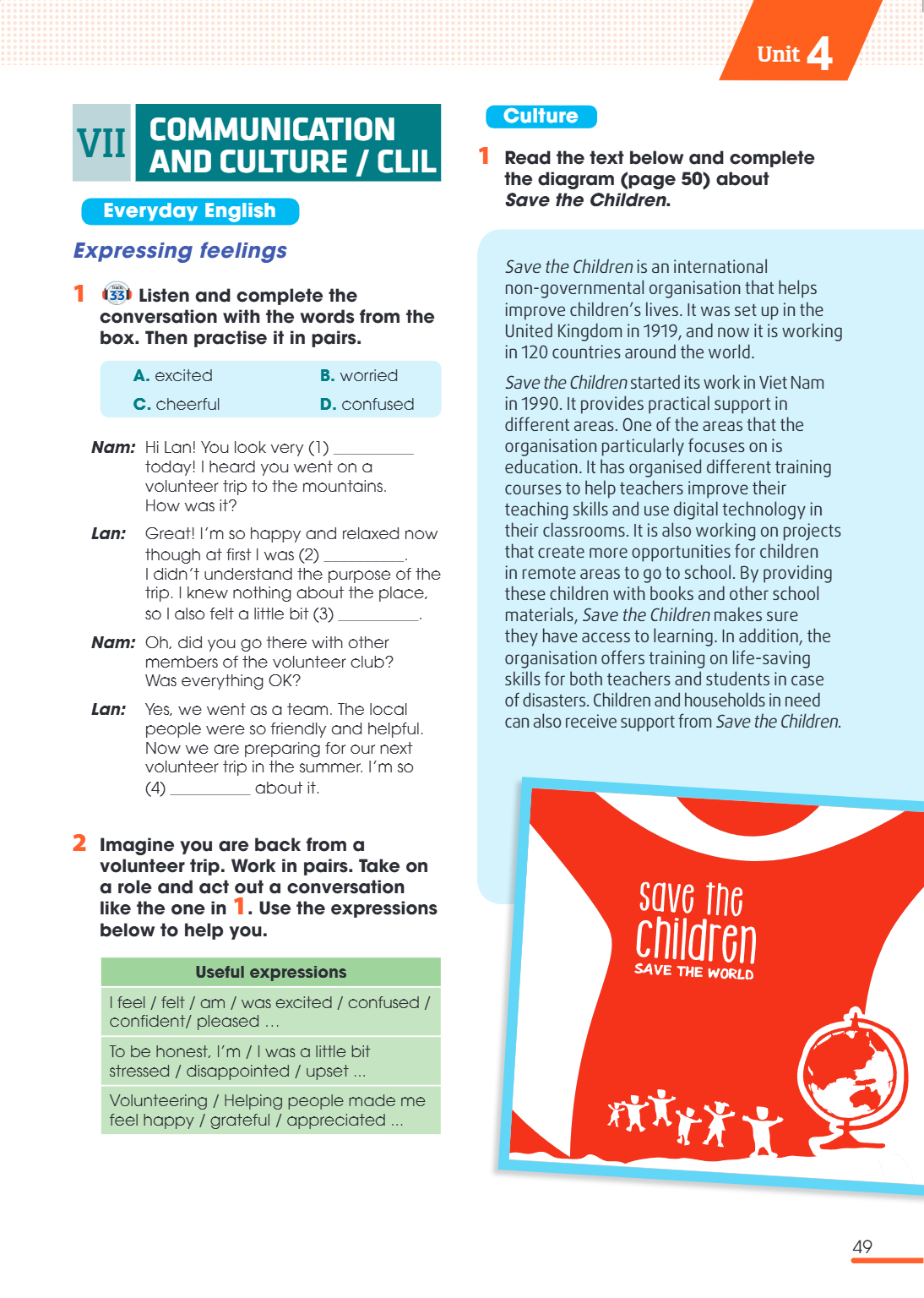
VII Communication and culture / CLIL Everyday English Expressing feelings 1 Listen and complete the conversation with the words from the Track box. Then practis
VII Communication
and culture / CLIL
Everyday English Expressing feelings
1 Listen and complete the conversation with the words from the
Track
box. Then practise it in pairs.
A. excited B. worried
C. cheerful D. confused Nam: Hi Lan! You look very (1) __________
today! heard you went on a
I
volunteer trip to the mountains. How was it? Lan: Great! I'm so happy and relaxed now
though at first was (2) __________.
I
didn't understand the purpose of the
I
trip. knew nothing about the place,
I
so also felt a little bit (3) __________.
I
Nam: Oh, did you go there with other
members of the volunteer club? Was everything OK? Lan: Yes, we went as a team. The local
people were so friendly and helpful. Now we are preparing for our next volunteer trip in the summer. I'm so (4) __________ about it.
2 Imagine you are back from a a role and act out a conversation below to help you.
volunteer trip. Work in pairs. Take on like the one in 1 . Use the expressions
Useful expressions
feel / felt / am / was excited / confused /
I
confident/ pleased …
To be honest, I'm / was a little bit
I
stressed / disappointed / upset ...
Volunteering / Helping people made me feel happy / grateful / appreciated ...
Unit4
Culture
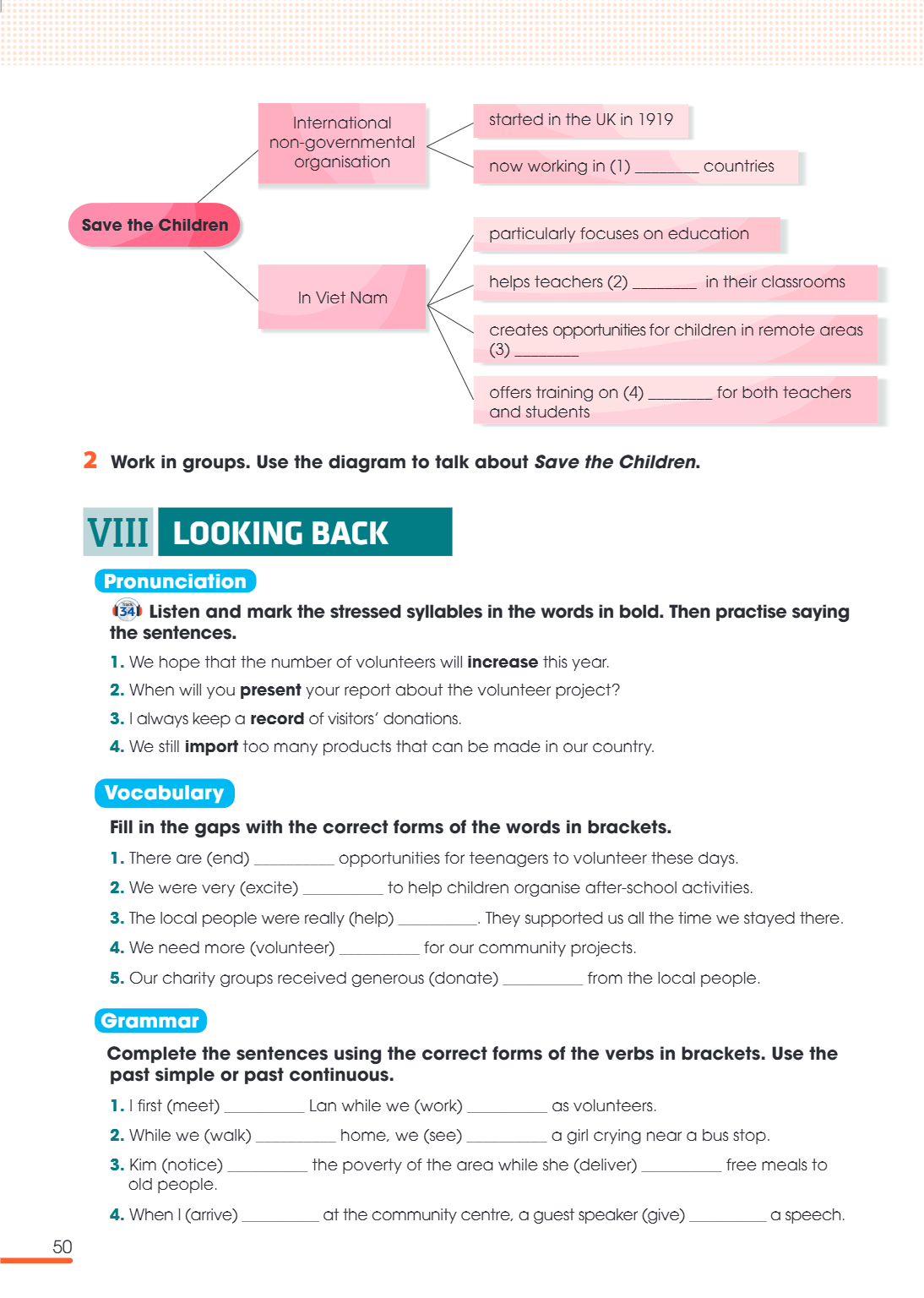
Read the text below and complete the diagram (page 50) about Save the Children.
non-governmental organisation that helps improve children's lives. It was set up in the United Kingdom in 1919, and now it is working in 120 countries around the world. in 1990. It provides practical support in different areas. One of the areas that the organisation particularly focuses on is education. It has organised different training courses to help teachers improve their teaching skills and use digital technology in their classrooms. It is also working on projects that create more opportunities for children in remote areas to go to school. By providing these children with books and other school materials, SavetheChildren makes sure they have access to learning. In addition, the organisation offers training on life-saving skills for both teachers and students in case of disasters. Children and households in need can also receive support from SavetheChildren.
VIII Looking back Pronunciation Listen and mark the stressed syllables in the words in bold. Then practise saying Track the sentences. We hope that the number o
VIII Looking back
Pronunciation
Listen and mark the stressed syllables in the words in bold. Then practise saying
Track
the sentences.
We hope that the number of volunteers will increase this year.
When will you present your report about the volunteer project?
always keep a record of visitors' donations.
I
4. We still import too many products that can be made in our country.
Vocabulary
Fill in the gaps with the correct forms of the words in brackets.
There are (end) __________ opportunities for teenagers to volunteer these days.
We were very (excite) __________ to help children organise after-school activities.
The local people were really (help) __________. They supported us all the time we stayed there.
We need more (volunteer) __________ for our community projects.
Our charity groups received generous (donate) __________ from the local people.
Grammar
Complete the sentences using the correct forms of the verbs in brackets. Use the past simple or past continuous.
first (meet) __________ Lan while we (work) __________ as volunteers.
I
While we (walk) __________ home, we (see) __________ a girl crying near a bus stop.
Kim (notice) __________ the poverty of the area while she (deliver) __________ free meals to
old people.
When (arrive) __________ at the community centre, a guest speaker (give) __________ a speech.
I
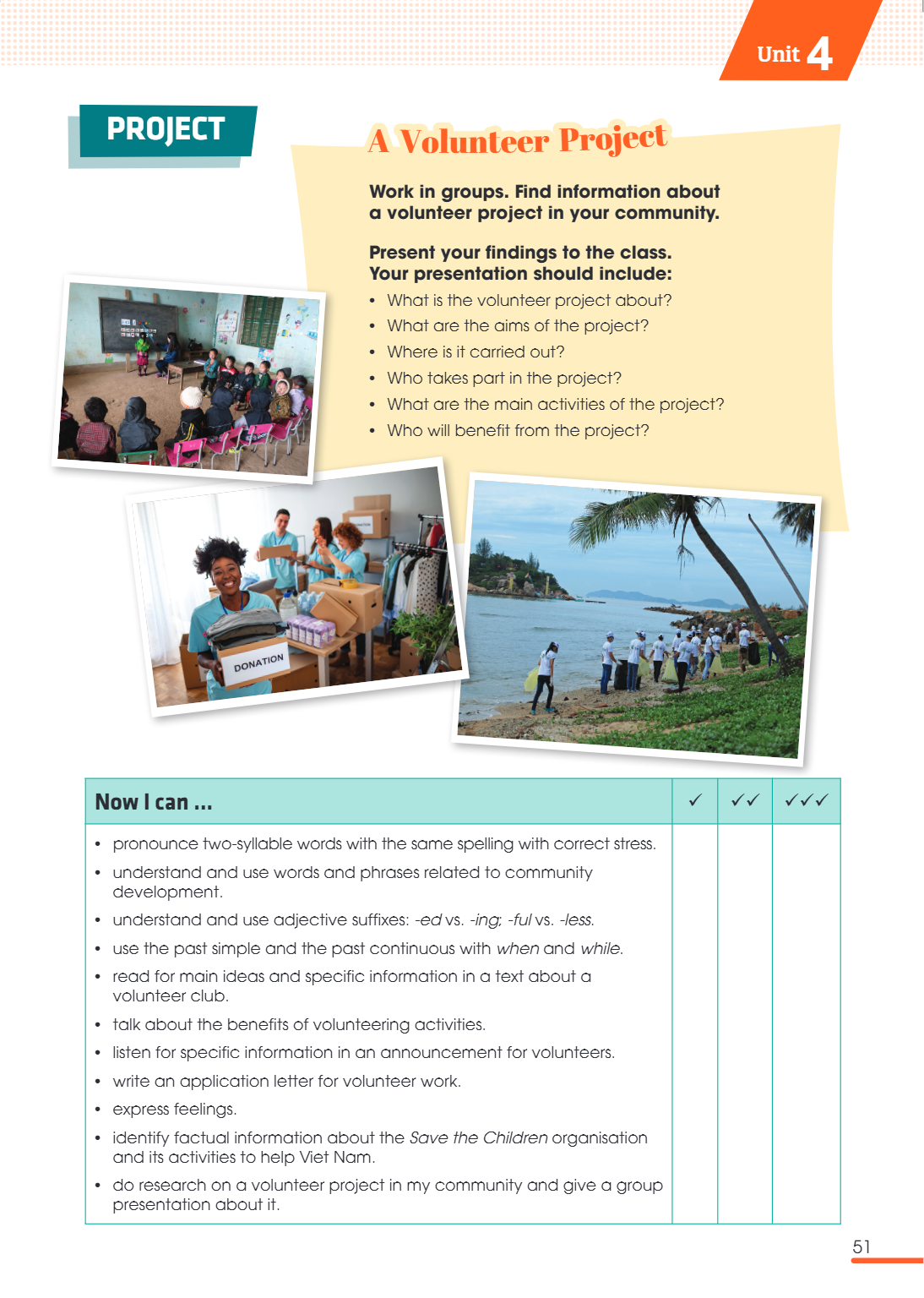
Project Volunteer Project Now can ...    I pronounce two-syllable words with the same spelling with correct stress. understand and use words and phrases r
Project Volunteer Project
Now can ...   
I
pronounce two-syllable words with the same spelling with correct stress.
understand and use words and phrases related to community development.
understand and use adjective suffixes: -ed vs. -ing; -ful vs. -less.
use the past simple and the past continuous with when and while.
read for main ideas and specific information in a text about a volunteer club.
talk about the benefits of volunteering activities.
listen for specific information in an announcement for volunteers.
write an application letter for volunteer work.
express feelings.
identify factual information about the Save the Children organisation and its activities to help Viet Nam.
do research on a volunteer project in my community and give a group presentation about it.
Unit4
A
Work in groups. Find information about a volunteer project in your community. Present your findings to the class.
Your presentation should include:
What is the volunteer project about?
What are the aims of the project?
Where is it carried out?
Who takes part in the project?
What are the main activities of the project?
Who will benefit from the project?
Unit 5. INVENTIONS This unit includes: LANGUAGE Pronunciation Stress in three-syllable nouns Vocabulary Words and phrases related to inventions Grammar Present
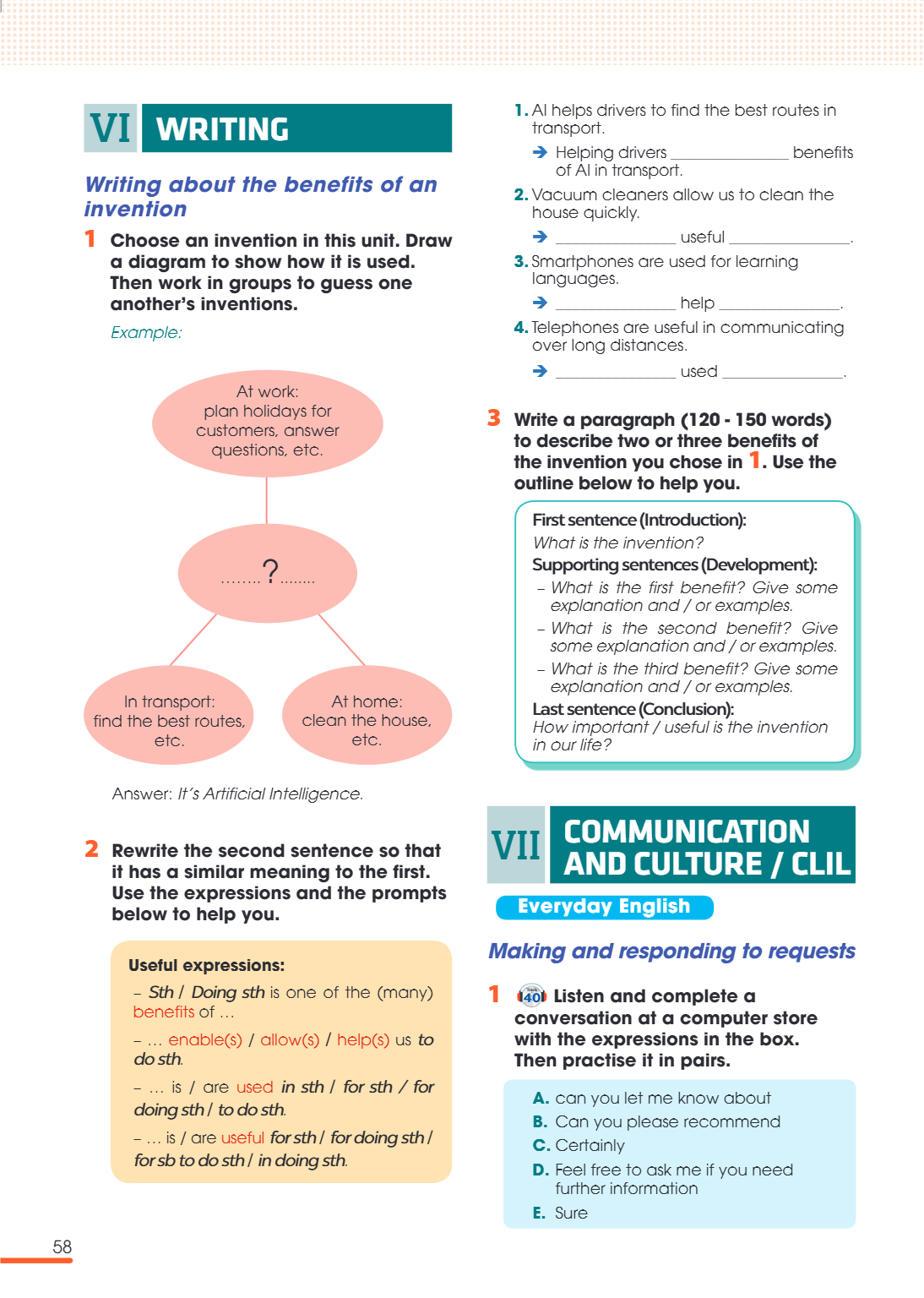
Unit 5. INVENTIONS
This unit includes:
LANGUAGE
Pronunciation
Stress in three-syllable nouns
Vocabulary
Words and phrases related to inventions
Grammar
Present perfect
Gerunds and to-infinitives
SKILLS
Reading: Reading for main ideas and specific information in a text about an invention
Speaking: Talking about inventions and their uses
Listening: Listening to instructions on how to use an invention for specific information
Writing: Writing about the benefits of an invention
COMMUNICATION AND CULTURE / CLIL
Everyday English
Making and responding to requests
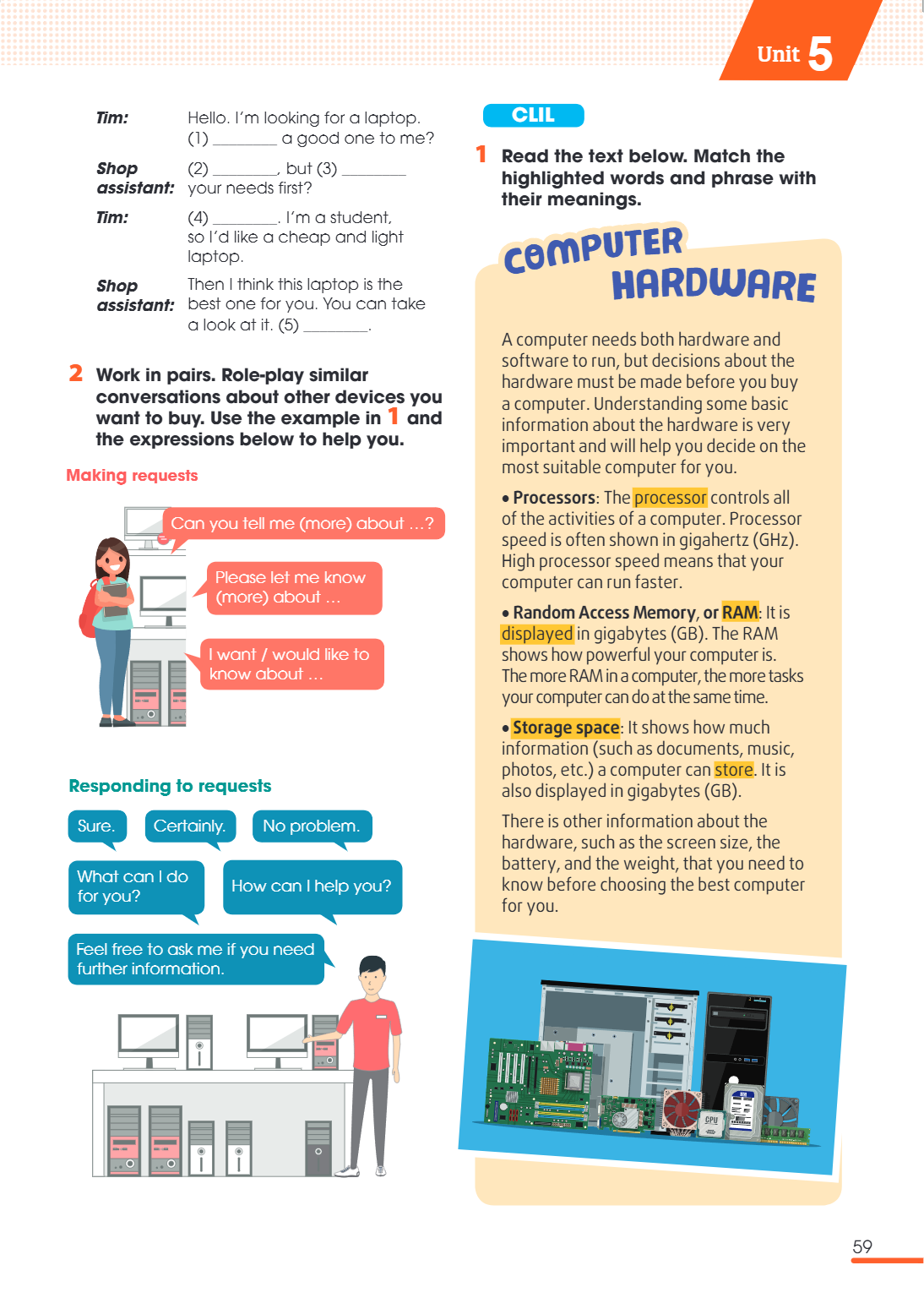
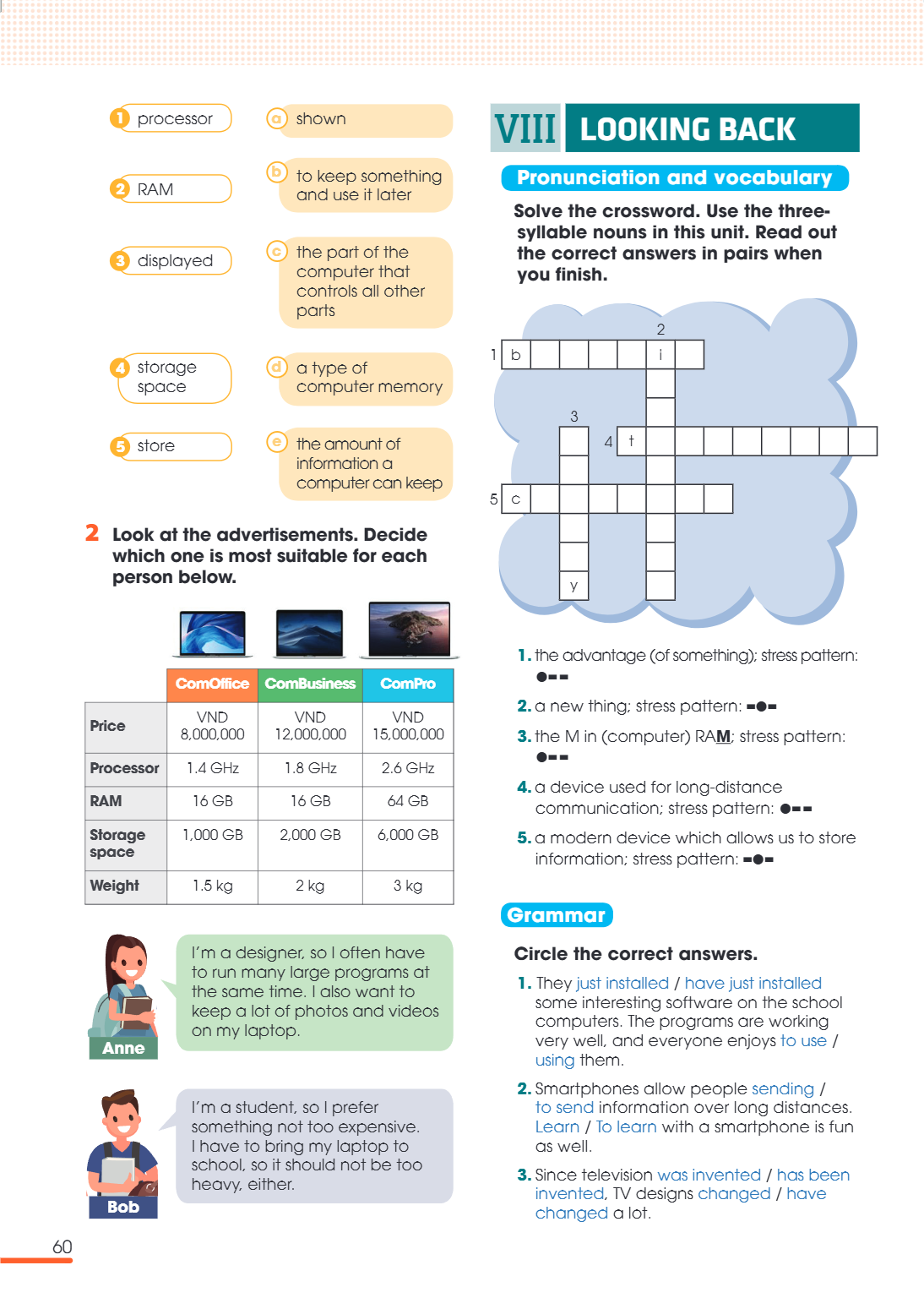
CLIL
Computer hardware
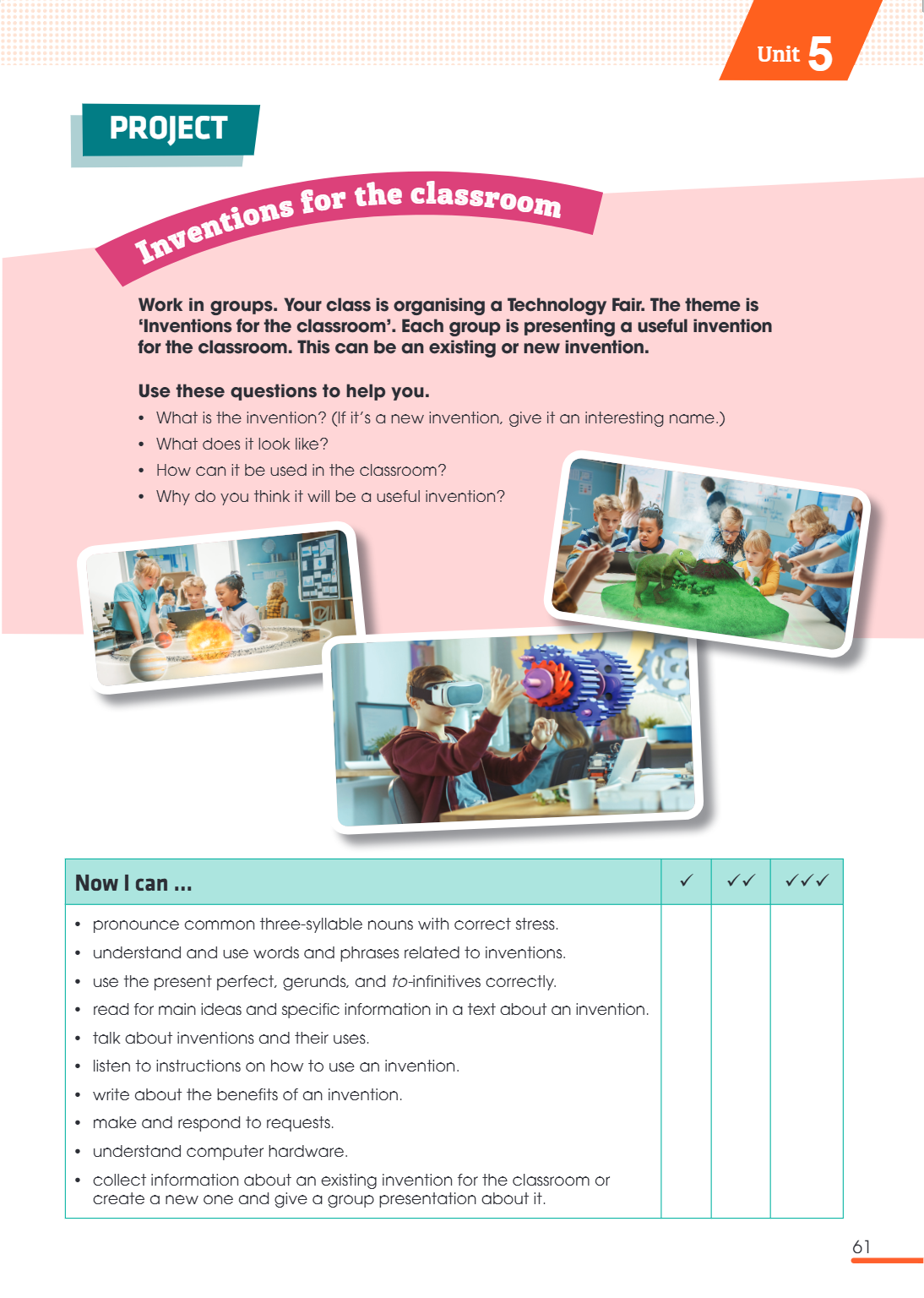
PROJECT
Collecting information about an existing invention for the classroom or creating a new one
I GETTING STARTED
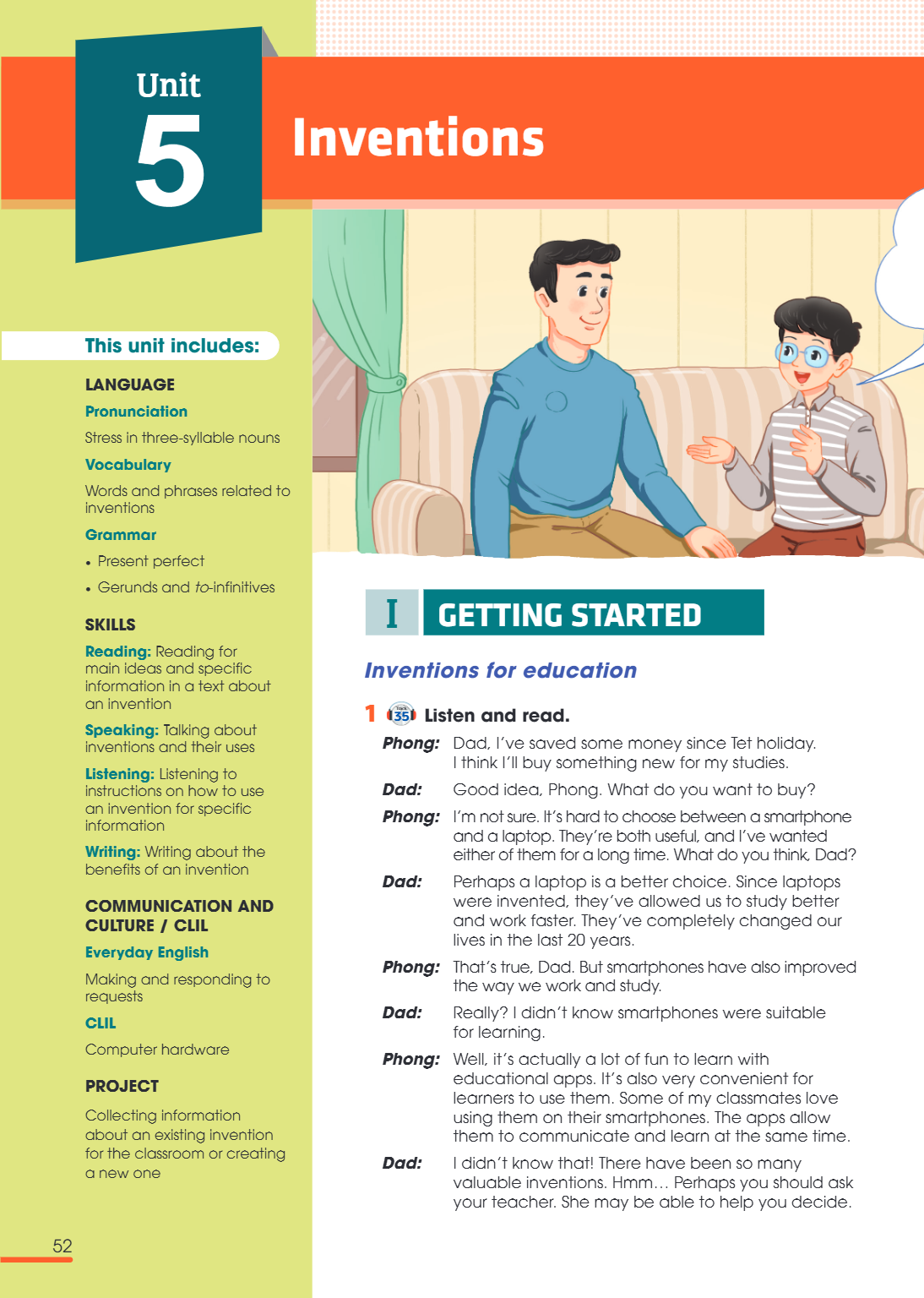
Inventions for education
1. Listen and read.
Phong: Dad, I’ve saved some money since Tet holiday. I think I’ll buy something new for my studies.
Dad: Good idea, Phong. What do you want to buy?
Phong: I’m not sure. It’s hard to choose between a smartphone and a laptop. They’re both useful, and I’ve wanted either of them for a long time. What do you think, Dad?
Dad: Perhaps a laptop is a better choice. Since laptops were invented, they’ve allowed us to study better and work faster. They’ve completely changed our lives in the last 20 years.
Phong: That’s true, Dad. But smartphones have also improved the way we work and study.
Dad: Really? I didn’t know smartphones were suitable for learning.
Phong: Well, it’s actually a lot of fun to learn with educational apps. It’s also very convenient for learners to use them. Some of my classmates love using them on their smartphones. The apps allow them to communicate and learn at the same time.
Dad: I didn’t know that! There have been so many valuable inventions. Hmm... Perhaps you should ask your teacher. She may be able to help you decide.
II LANGUAGE Pronunciation Stress in three-syllable nouns 1. 36 Listen and repeat. Pay attention to the stressed syllable in each word. invention computer holida
II LANGUAGE
Pronunciation
Stress in three-syllable nouns
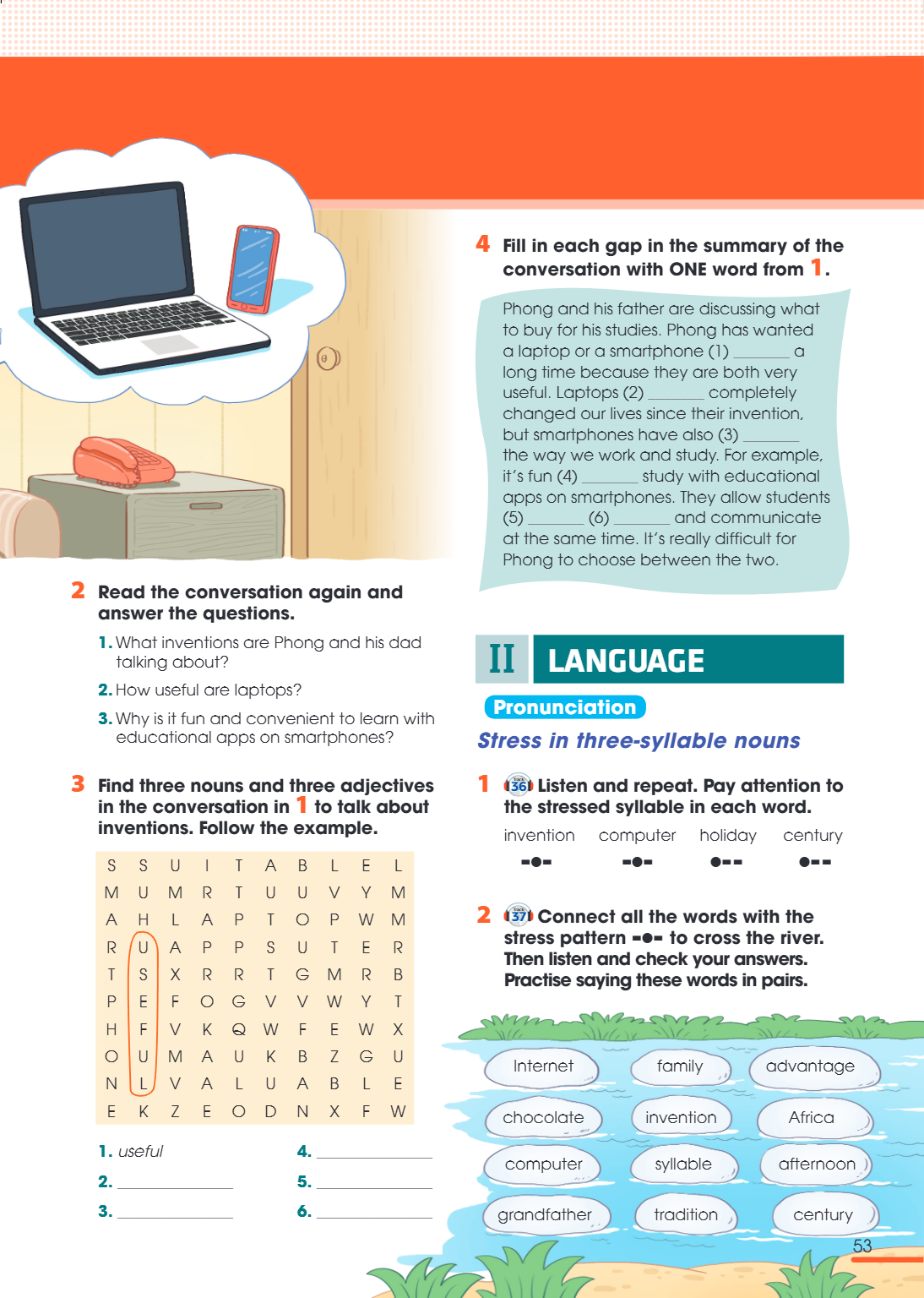
1. 36 Listen and repeat. Pay attention to the stressed syllable in each word.
invention computer holiday century
-●- -●- ●-- ●--
2. 37 Connect all the words with the stress pattern -●- to cross the river. Then listen and check your answers. Practise saying these words in pairs.
Internet family advantage
chocolate invention Africa
computer syllable afternoon
grandfather tradition century
Grammar Present perfect Remember! We use the present perfect (have / has + past participle) to talk about: something that happened in the past, but is still tru
Grammar
Present perfect
Remember!
We use the present perfect (have / has + past participle) to talk about:
something that happened in the past, but is still true or important now.
Example: I have lost my key. Now I can't open the door.
something that started in the past, and is still happening now (often used with since or for).
Example: They have lived here for a year.
something that was completed in the very recent past (often used with just or recently).
Example: He has just finished his homework.
Circle the correct answers.
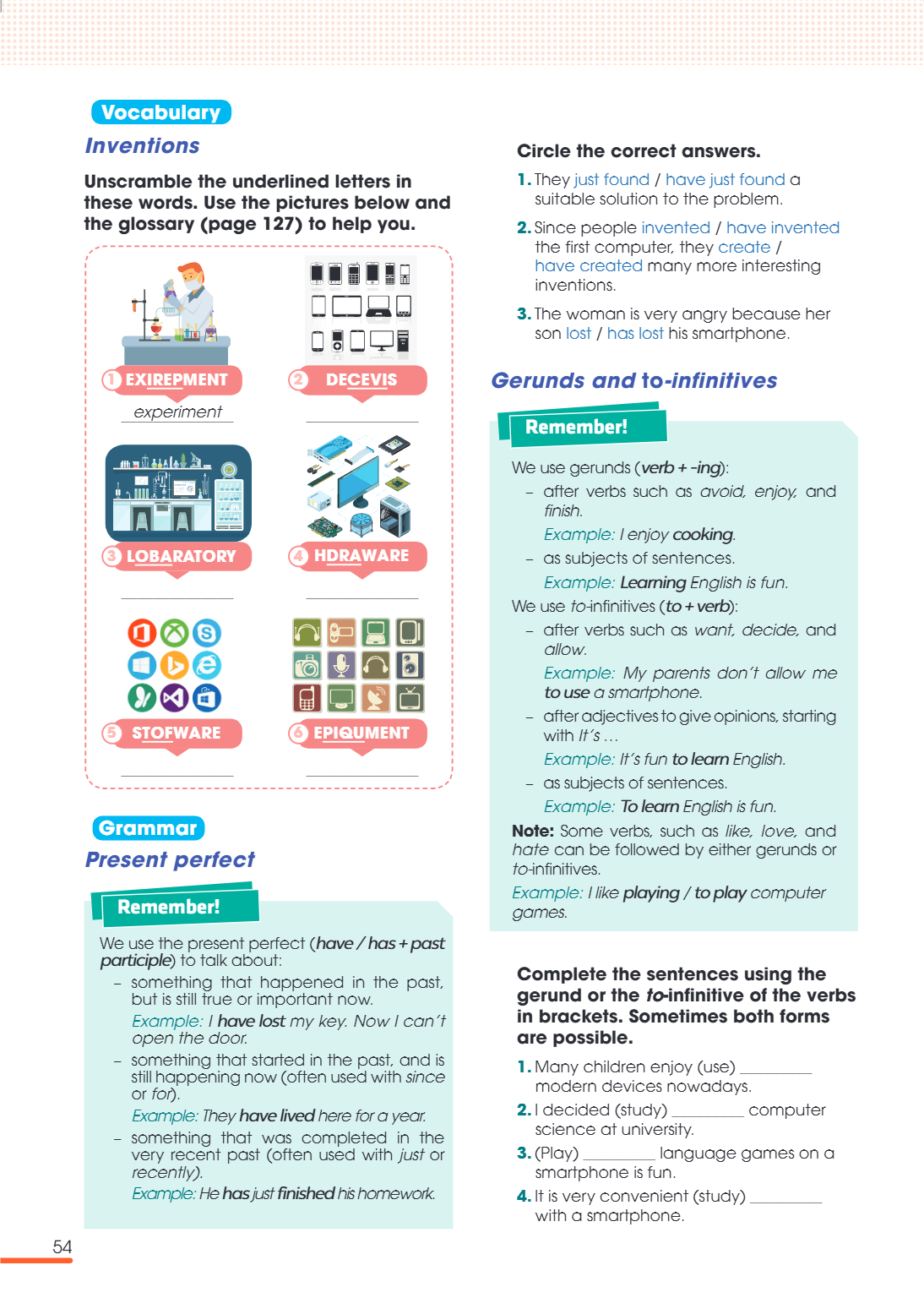
1. They ==just found== / ==have just found== a suitable solution to the problem.
2. Since people ==invented== / ==have invented== the first computer, they ==create== / ==have created== many more interesting inventions.
3. The woman is very angry because her son ==lost== / ==has lost== his smartphone.
Gerunds and to-infinitives
Remember!
We use gerunds (verb + -ing):
after verbs such as avoid, enjoy, and finish.
Example: I enjoy cooking.
as subjects of sentences.
Example: Learning English is fun.
We use to-infinitives (to + verb):
after verbs such as want, decide, and allow.
Example: My parents don't allow me to use a smartphone.
after adjectives to give opinions, starting with It's ...
Example: It's fun to learn English.
as subjects of sentences.
Example: To learn English is fun.
Note: Some verbs, such as like, love, and hate can be followed by either gerunds or to-infinitives.
Example: I like playing / to play computer games.
Complete the sentences using the gerund or the to-infinitive of the verbs in brackets. Sometimes both forms are possible.
1. Many children enjoy (use) _______ modern devices nowadays.
2. I decided (study) _______ computer science at university.
3. (Play) _______ language games on a smartphone is fun.
4. It is very convenient (study) _______ with a smartphone.
Unit5 III reading Artificial intelligence 1 Look at the pictures of Asimo and Sophia and discuss the questions below in pairs. What do you think they can do? 2
Unit5
III reading
Artificial intelligence
1 Look at the pictures of Asimo and Sophia and discuss the questions below in pairs.
What do you think they can do?
2 Read the text below and choose the best title for it.
A. AI development over time
B. Robots: The best AI inventions
C. AI in use today
D. AI in education Asimo in 2000 In 2000, Asimo, a robot created by Honda, amazed everyone by just walking down the stairs. Twenty years later, a robot named Sophia can even communicate with people by using human language and expressing emotions. However, robots are just one example of Artificial Intelligence (AI) - the study and development of machines that can copy human intelligence. Nowadays, AI has been applied to various areas of life. At home, devices such as vacuum cleaners can now use AI to measure the room size and recognise any furniture. They can then decide on the most effective way to clean the house. In transport, AI can be used on many smartphones to collect information about traffic. This can then help drivers find the most suitable route. Travelling has become much more convenient thanks to AI. At work, the uses of AI are even more useful and exciting. Computer programs, such as AI software or chatbots, can help customers plan their holidays, book flights and hotels, and answer questions. AI is one of the most important inventions of the 21st century. It has completely changed our daily work and life.
3 Read the text again and match the 4 Decide whether the following statements
pictures with the uses of AI. are true (T) or false (F).
T F
Sophia can show emotions
when talking to humans. 3 2. AI helps to make machines 1 that think and act like humans.
2 3. AI is one of the most important
inventions of the 20th century.
a b c
Work in groups and discuss how
Uses of Uses of Uses of AI
AI AI AI
at home at work in transport can be used in schools. Then share
your ideas with the class.
IV SPEAKING Inventions and how they are used 1. Work in pairs. Talk about the uses of these inventions. Use the expressions below to help you. Inventions, Main
IV SPEAKING
Inventions and how they are used
1. Work in pairs. Talk about the uses of these inventions. Use the expressions below to help you.
Inventions, Main uses
1 the Internet, communicate over long distances
2 e-readers, store and read texts from the Internet
3 robots, do difficult or dangerous tasks effectively
4 3D printing, make three dimensional objects
5 driverless cars, travel around without a person in control
Useful expressions:
– ... help(s) / allow(s) us to do sth.
Example: The Internet helps us to communicate over long distances.
– We / People (can) use sth to do / for sth.
Example: People can use the Internet to communicate over long distances.
– ... is / are used for sth / doing sth.
Example: The Internet is used for communication / communicating over long distances.
2. Work in groups. Talk more about one of the inventions in 1. Use the outline below to help you prepare a presentation.
Talking about an invention
Introduction:
What is it?
Development:
– What are its uses? What are some examples?
– Have you ever used it? When / Where / How (often) do you use it?
Conclusion:
– How important is it in our daily life?
– Do you like using it?
3. Present your ideas to the whole class. Then vote for the most interesting group presentation.
Unit5 V listening Listen again. Put a tick () next to Track the correct way and a cross () next to the wrong way to use RoboVacuum. RoboVacuum 1 Complete the
Unit5
V listening Listen again. Put a tick () next to
Track
the correct way and a cross () next to the wrong way to use RoboVacuum.
RoboVacuum
1 Complete the sentences with the 1 words in the box.
button charge stain
1. Press the _________ to start the device.
There is a dirty _________ on your 50 minutes smartphone. Wipe it away. 2
3. You need to _________ your mobile
phone. The battery is very low.
2 Listen to a conversation about
Track
RoboVacuum. Fill in each gap in the 5 hours
3
diagram below with ONE word.
To clean the whole (1) _______________
To remove dirty (2) ____________
To start or (3) ___________ the device
Tips
When labelling a diagram, you should:
study the diagram carefully. - predict the answer in each blank
(e.g. What kind of information is it? Is this a noun, a verb, or an adjective?). - listen for key words.
double-check your answers (e.g. spelling, Example: I want my RoboVacuum to have
grammar, the number of words). a Timer button on the top. First, you press it.
What other buttons do you want RoboVacuum to have? Add them to the picture below and tell your friends about them.
Then, you set the time by pressing the minutes and seconds buttons on the right.
VI WRITING Writing about the benefits of an invention 1. Choose an invention in this unit. Draw a diagram to show how it is used. Then work in groups to guess o
VI WRITING
Writing about the benefits of an invention
1. Choose an invention in this unit. Draw a diagram to show how it is used. Then work in groups to guess one another's inventions.
Example:
At work:
plan holidays for customers, answer questions, etc.
?
In transport:
find the best routes, etc.
At home:
clean the house, etc.
Answer: It's Artificial Intelligence.
2. Rewrite the second sentence so that it has a similar meaning to the first. Use the expressions and the prompts below to help you.
Useful expressions:
Sth / Doing sth is one of the (many) ==benefits== of ...
... ==enable(s)== / ==allow(s)== / ==help(s)== us to do sth.
... is / are ==used== in sth / for sth / for doing sth / to do sth.
... is / are ==useful== for sth / for doing sth / for sb to do sth / in doing sth.
1. AI helps drivers to find the best routes in transport.
→ Helping drivers ________________ ==benefits== of AI in transport.
2. Vacuum cleaners allow us to clean the house quickly.
→ ________________ ==useful== ________________.
3. Smartphones are used for learning languages.
→ ________________ ==help== ________________.
4. Telephones are useful in communicating over long distances.
→ ________________ ==used== ________________.
3. Write a paragraph (120 - 150 words) to describe two or three benefits of the invention you chose in 1. Use the outline below to help you.
First sentence (Introduction):
What is the invention?
Supporting sentences (Development):
What is the first benefit? Give some explanation and / or examples.
What is the second benefit? Give some explanation and / or examples.
What is the third benefit? Give some explanation and / or examples.
Last sentence (Conclusion):
How important / useful is the invention in our life?
Unit 5. Tim: Hello. I'm looking for a laptop. (1) _______ a good one to me? Shop assistant: (2) _______, but (3) _______ your needs first? Tim: (4) _______. I'm
Unit 5.
Tim: Hello. I'm looking for a laptop. (1) _______ a good one to me?
Shop assistant: (2) _______, but (3) _______ your needs first?
Tim: (4) _______. I'm a student, so I'd like a cheap and light laptop.
Shop assistant: Then I think this laptop is the best one for you. You can take a look at it. (5) _______.
2. Work in pairs. Role-play similar conversations about other devices you want to buy. Use the example in 1 and the expressions below to help you.
Making requests
Can you tell me (more) about ...?
Please let me know (more) about ...
I want / would like to know about ...
Responding to requests
Sure.
Certainly.
No problem.
What can I do for you?
How can I help you?
Feel free to ask me if you need further information.
CLIL
1. Read the text below. Match the highlighted words and phrase with their meanings.
COMPUTER HARDWARE
A computer needs both hardware and software to run, but decisions about the hardware must be made before you buy a computer. Understanding some basic information about the hardware is very important and will help you decide on the most suitable computer for you.
• Processors: The ==processor== controls all of the activities of a computer. Processor speed is often shown in gigahertz (GHz). High processor speed means that your computer can run faster.
• Random Access Memory, or ==RAM==: It is ==displayed== in gigabytes (GB). The RAM shows how powerful your computer is. The more RAM in a computer, the more tasks your computer can do at the same time.
• ==Storage space==: It shows how much information (such as documents, music, photos, etc.) a computer can ==store==. It is also displayed in gigabytes (GB).
There is other information about the hardware, such as the screen size, the battery, and the weight, that you need to know before choosing the best computer for you.
VIII LOOKING BACK Pronunciation and vocabulary Solve the crossword. Use the three-syllable nouns in this unit. Read out the correct answers in pairs when you fi
VIII LOOKING BACK
Pronunciation and vocabulary
Solve the crossword. Use the three-syllable nouns in this unit. Read out the correct answers in pairs when you finish.
the advantage (of something); stress pattern: ●--
a new thing; stress pattern: -●-
the M in (computer) RAM; stress pattern: ●--
a device used for long-distance communication; stress pattern: ●--
a modern device which allows us to store information; stress pattern: -●-
Grammar
Circle the correct answers.
They just installed / have just installed some interesting software on the school computers. The programs are working very well, and everyone enjoys to use / using them.
Smartphones allow people sending / to send information over long distances. Learn / To learn with a smartphone is fun as well.
Since television was invented / has been invented, TV designs changed / have changed a lot.
Unit5 Project Work in groups. Your class is organising a Technology Fair. The theme is `Inventions for the classroom'. Each group is presenting a useful inventi
Unit5
Project
Work in groups. Your class is organising a Technology Fair. The theme is `Inventions for the classroom'. Each group is presenting a useful invention for the classroom. This can be an existing or new invention. Use these questions to help you.
What is the invention? (If it's a new invention, give it an interesting name.)
What does it look like?
How can it be used in the classroom?
Why do you think it will be a useful invention?
Now can ...   
I
pronounce common three-syllable nouns with correct stress.
understand and use words and phrases related to inventions.
use the present perfect, gerunds, and to-infinitives correctly.
read for main ideas and specific information in a text about an invention.
talk about inventions and their uses.
listen to instructions on how to use an invention.
write about the benefits of an invention.
make and respond to requests.
understand computer hardware.
collect information about an existing invention for the classroom or create a new one and give a group presentation about it.
Review 2 LANGUAGE Pronunciation 1 Escape the maze by connecting all the words with stress on the FIRST syllable. Follow the example. Then listen to check your a
Review 2
LANGUAGE
Pronunciation
1 Escape the maze by connecting all the words with stress on the FIRST syllable. Follow the example. Then listen to check your answers. Practise saying the words.
Start
increase (n) invention (n) advantage (n) charity (n)
↓
memory (n) present (n) increase (v) telephone (n)
present (v) Internet (n) holiday (n) benefit (n)
Finish
Vocabulary
1 What are the missing letters? Complete the sentences using the pictures to help you. The first word is done for you.
Example:
Smartphones allow us to get access to the Internet anywhere.
1. Modern de______ have changed the way we commu______.
2. To help poor people, you can don______ money to a charity. You can also become a vo______ in your community.
Review2 2 Complete the sentences using these words. There are some extra ones. useful useless interested interesting careful careless Many _______________ inven
Review2
2 Complete the sentences using these words. There are some extra ones.
useful useless interested
interesting careful careless
Many _______________ inventions in the world are the results of hard work and _______________ experiments.
Things such as old clothes or toys seem _______________, but you can donate them to charity.
Some poor people may be _______________ in them.
Grammar Read the text and circle the correct answers.
The invention or discovery of something is not always the result of careful experiments. Sometimes, luck can help scientists (1) finding / find new things. Below are some famous examples.
Gravity: (2) Discover / Discovering the law of gravity is probably the most
famous example. Isaac Newton (3) sat / was sitting under an apple tree when an apple (4) fell / was falling on his head. He realised that something made apples fall straight to the ground. That was gravity!
Penicillin: Alexander Fleming came back from his
holiday. He (5) was cleaning / cleaned his laboratory when he (6) discovered / was discovering something at the window. That was penicillin! Since then, doctors (7) used / have used penicillin around the world to save millions of lives.
Popsicles: In 1905, 11-year-old Frank Epperson decided (8) to make / making
himself a soft drink. When he finished (9) make / making the drink,
he left it outside with the wooden stick inside it. That night, the drink froze in cold weather and thanks to this ʽaccidentʼ, popsicles were later invented!
skills Listening 1 Listen and choose the best title for the talk. Track A. Smart home technology B. The popularity of smart homes C. The future of smart homes 2
skills
Listening
1 Listen and choose the best title for the talk.
Track
A. Smart home technology
B. The popularity of smart homes
C. The future of smart homes
2 . Track Listen again and fill in each blank with ONE word
43
You can use your (1) ____________ to open and close doors and windows.
The (3) ____________ rings when someone breaks into the house.
Speaking help us? Use the expressions you learnt in Unit 5 to help you.
Work in groups. What other features should a smart home have? How will they
… (will) help(s) / allow(s) / enable(s) us to do sth. - … is / are used to do sth / for sth / for doing sth.
Example: I think a smart home should have a smart heating system that is controlled from a mobile phone. This will allow us to save energy and money.
(2) ____________ can turn on and off without human control.
Smart homes
Temperature, lights, and (4) ____________ at home can be controlled from a distance.
Reading
1 Read the text. Match the highlighted words with their meanings.
There are two types of community service. The first one is a kind of punishment. For example, people who litter may be forced to clean up the streets. In this case, they may not feel happy about the work. The second type of community service is voluntary. This means people are willing, or pleased to do the work. For instance, people may volunteer to build houses for poor people, or raise money for children in mountainous areas. However, it does not mean that volunteering is always a selfless act because volunteers may also benefit from the volunteering activities. For example, they may volunteer to meet new people, to develop social skills, or to ʽfind themselvesʼ (learn what they truly want in life). In general, people may volunteer not just to help others, but also to help themselves.
Review2 Words, Meanings 1. voluntary, a. caring more about other people 2. willing, b. ready to do something 3. selfless, c. done without being forced to do it
Review2
Words, Meanings
1. voluntary, a. caring more about other people
2. willing, b. ready to do something
3. selfless, c. done without being forced to do it
2 Read the text again and choose the best answers.
1. Which is the best title for this text?
A. Community service as a punishment.
B. Types of community service and the benefits of volunteering.
C. Social skills in volunteering.
2. According to the text, what is a benefit of volunteering?
A. Developing better English language skills.
B. Meeting richer people.
C. Better understanding of what you want in life.
3. What can be inferred from the text?
A. Volunteers think about their needs as well as the needs of others.
B. Volunteers are selfless people who never expect anything in return.
C. People mainly volunteer to gain benefits.
Writing Complete this application letter for a volunteer job by writing a short paragraph. You may use the ideas below to help you.
fond of reading love helping others love meeting new people develop social skills
Dear Sir or Madam, am writing to apply for the volunteer job. believe can help your
I I I
organisation collect books for poor children. am very interested in the job because ……...………………………………
I
………………………………………………………………………………………… ………………………………………………………………………………………… ………………………………………………………………………………………… look forward to hearing from you.
I
Yours faithfully, ……………………..
Unit 6. GENDER EQUALITY This unit includes: LANGUAGE Pronunciation Stress in three-syllable adjectives and verbs Vocabulary Words and phrases related to gender
Unit 6. GENDER EQUALITY
This unit includes:
LANGUAGE
Pronunciation
Stress in three-syllable adjectives and verbs
Vocabulary
Words and phrases related to gender equality
Grammar
Passive voice with modals
SKILLS
Reading: Reading for specific information in a text about gender equality
Speaking: Talking about career choices
Listening: Listening for specific information in a talk about the first woman in space
Writing: Writing about jobs for men and women
COMMUNICATION AND CULTURE / CLIL
Everyday English
Expressing agreement and disagreement
CLIL
Women's football
PROJECT
Doing a survey on students' future jobs
I GETTING STARTED
Equal job opportunities
1 🔊 Listen and read.
At an international summer camp: Lan is talking with Mark and Linda about jobs.
Lan: It's great to have another week full of activities and trips at the camp.
Mark: Oh, yeah. I like the trip to the kindergarten most. The kids were adorable and the teachers were great. I think I'll be a kindergarten teacher.
Lan: That's fantastic. My cousin works at a kindergarten and the children love being in his class. By the way, what do you want to be in the future, Linda?
Linda: Oh, I've always wanted to be a surgeon, so I'll go to medical school. What about you, Lan?
Lan: Me? My dream is to become an airline pilot. That's why I'm focusing on maths and physics, and exercising more to improve my fitness.
Linda: Cool! I hope your dream will come true. In some countries girls may not be allowed to be pilots.
Lan: That's true, Linda. We're lucky to live in a country where boys and girls are encouraged to do the jobs they want.
Mark: I couldn't agree more. Girls mustn't be kept home in today's world. Boys and girls should be treated equally and given the same job opportunities.
II very language helpful. Laptops (3) changed our Pronunciation lives since their invention, but smart Stress in three-syllable have also (4) our adjectives and
II very language helpful. Laptops
(3) changed our Pronunciation lives since their invention, but smart
Stress in three-syllable have also (4) our adjectives and and verbs as . For
Listen example, and it's repeat. Pay attention
45
to the with stressed syllable in each word.
Three-syllable students (7) Three-syllable
adjectives communicate verbs
ex'pensive, 'organise
fan'tastic at the same'benefit., It's really
'medical for Phong to, de'velop .
'opposite, en'courage
46 Listen and mark the stressed syllables in the words in bold.
We'll celebrate her success with a party.
2. They hope to discover new ways to
promote gender equality.
3. The job requires both physical and
mental in strength. nouns
4. Equal opportunities in education bring . Pay attention
the stressed important changes syllable in society. each word.
Vocabulary computer holiday century
Gender equality
Match the words with their meanings. Connect all
stress pattern to cross the river. Then
1 equal (adj) and check
pronounce these
of the kindergarten (n)
2 1.
treat (v) chocolate 4 surgeon (n)
grandfather gender (n)
a school for children
aged three to five
b to deal with or behave
towards somebody in a certain way
c a doctor who does
operations in a hospital Africa
d the fact of being male
or female century
e having the same rights,
opportunities, etc. as other people
Grammar Passive voice with modals Remember! Modal verbs can Rule Modal + Example: Engineers, could may might must ought to should Active voice Passive voice ver
Grammar Passive voice with modals
Remember!
Modal verbs can Rule Modal + Example: Engineers, could may might must ought to should Active voice Passive voice verb Modal + be + past participle may build a new bridge. A new bridge may be built (by engineers).
1 Choose the best answers.
Some people still think married women shouldn't allow / shouldn't be allowed to work.
Both men and women can work / can be worked as surgeons.
Cooking classes may offer / may be offered to all students.
My sister could join / could be joined the air force. She wants to be a fighter pilot.
5. All the food must prepare / must be prepared before the guests arrive.
2 Rewrite the following sentences using the passive voice.
1. They may complete the report on gender equality by April.
 The report _____________________________________________________________________________.
2. Businesses can create more jobs for girls and women.
 More jobs _____________________________________________________________________________.
3. They must provide all girls with access to education.
 All girls ________________________________________________________________________________.
4. Governments should improve education in rural areas.
 Education ____________________________________________________________________________.
5. They ought to give men and women equal rights.
 Men and women ______________________________________________________________________.
Unit6 III reading For an equal world 1 Match the sentences with the pictures. 1. Men often earn more than women for doing the same job. 2. A child mother takes
Unit6
III reading
For an equal world
1 Match the sentences with the pictures.
1. Men often earn more than women for doing the same job.
2. A child mother takes care of her small kids.
b
Some women are unable to read or write.
c
a
2 Read the text and circle the correct meanings of the highlighted words and phrases.
Gender equality has been greatly promoted around the world. However, there are still many challenges that women face. First of all, there are still girls who are forced to get married before the age of 18. In many places, parents may see child marriage as a way to protect their daughters from violence. However, many of these young girls become victims of domestic violence. Child marriage also carries serious health risks as young girls are not physically developed to give birth. Secondly, more than half of the world's uneducated people are women. This means fewer girls than boys go to school or stay long at school. Girls who receive an education are less likely to marry young. They can also have better job skills and can earn higher salaries. Education gives girls the opportunity to have a better life and give back to their communities.
Thirdly, women are often paid less than men. In other words, women have to work longer than men to earn the same amount of money. Differences in career choices might be one reason. Women tend to become nurses, secretaries, or shop assistants, which are low-paying jobs, while men choose high-paying careers as surgeons, airline pilots, or engineers. Women are still not equal to men in today's society, and governments, organisations and individuals must work together to achieve gender equality.
IV SPEAKING Career choices 1 Work in pairs. Decide which jobs are traditionally done by men or women. Use the expressions given to help you. Jobs, Men, Women 1.
IV SPEAKING
Career choices
1 Work in pairs. Decide which jobs are traditionally done by men or women. Use the expressions given to help you.
Jobs, Men, Women
1. Surgeons
2. Shop assistants
3. Nurses
4. Airline pilots
5. Firefighters
6. Kindergarten teachers
7. Engineers
8. Secretaries
Useful expressions:
I think / I believe (that) ...
There are many more male (surgeons) than female (surgeons).
Men / Women traditionally work as (firefighters) ...
(Nursing) jobs are done by men / women.
The (nurse's) job is traditionally done by men / women.
2 Work in pairs. Discuss why the jobs mentioned in 1 are traditionally done by men or women. Use the ideas below to help you.
Suggested ideas
- Good physical strength - Good communication skills - Ability to work well under pressure - Being kind, gentle and caring, - Ability to work long hours - Good persuasion skills - Flexible working schedule - More time to take care of their families
Example:
The surgeon's job is traditionally done by men because women often can't work long hours as they need to take care of their families.
V listening The first woman in space 1 Work in pairs. Look at the picture and tell your partner what this woman's job is. 2 Listen to a talk about Valentina Ter
V listening
The first woman in space
1 Work in pairs. Look at the picture and tell your partner what this woman's job is.
2 Listen to a talk about Valentina Tereshkova. Choose the best answer to
47
complete each sentence.
Valentina Tereshkova joined a local flying club and became a talented parachutist while she
was ________.
A. working as a factory worker B. training to be a cosmonaut
2. Tereshkova and ________ other women were chosen for the Soviet space programme.
A. three B. four
Tereshkova joined the Soviet Air Force and became ________ after completing her training
and passing an examination.
A. an Air Force officer B. the first female pilot
She travelled into space in Vostok 6 and successfully returned to earth on ________. A. 16 June, 1963 B. 19 June, 1963
After the flight, Tereshkova received many awards, and ________. A. travelled in space again B. completed her university degree 3 Listen again and give short answers to the following questions.
48
1. When was Tereshkova born?
2. How old was she when she started working?
3. When did she join the Soviet space programme?
4. At what age did she travel into space?
5. How many days did she spend in space?
4 Work in groups. Discuss the following questions.
Do you want to be a cosmonaut? Why or why not?
VI writing Writing about jobs for men and women 1 Choose suitable information from the box below to complete the table. The surgeon's job Main responsibilities
VI writing
Writing about jobs for men and women
1 Choose suitable information from the box below to complete the table.
The surgeon's job
Main responsibilities Main qualities
A. Performing operations on patients
B. Medical knowledge
C. Physical and mental strength
D. Welcoming and serving customers
E. Good persuasion skills
F. Making important decisions about patients' health and safety
G. Excellent eyesight and skilful hands
H. Good teamwork and communication skills
2 Work in pairs. Do you think both men and women can do the surgeon's job well?
Give reasons. Use the ideas below to help you.
Men and women have the same abilities to learn and apply medical knowledge. - Women can be as mentally strong as men. - men and women can perform long and tiring operations. - both men and women can make great surgeons.
3 Write a paragraph (120 - 150 words) about the surgeon's job. Use these guiding
questions to help you.
Is the job traditionally done by men or women?
What are the main responsibilities of the job?
Give details. - What qualities do people need for the job?
Give details or / and explanations. - Can both men and women do it? Give reasons. - Will people benefit from having both male and
female surgeons?
Unit 6. VII COMMUNICATION AND CULTURE / CLIL Everyday English Expressing agreement and disagreement 1. Listen and complete the conversation with the expressions
Unit 6.
VII COMMUNICATION AND CULTURE / CLIL
Everyday English
Expressing agreement and disagreement
1. Listen and complete the conversation with the expressions from the box. Then practise it in pairs.
A. I'm afraid I disagree, B. Absolutely
C. You're right, D. I'm sorry, but
Mum: Mai, Dad and I would like you to be a shop assistant.
Mai: (1)__________ that's not possible. I want to go to medical school and become a surgeon.
Mum: (2)__________. It's not easy to be a surgeon.
Mai: (3)__________. But I'm sure I can.
Mum: Besides medical knowledge, a surgeon must have physical and mental strength. Most surgeons are also men ...
Mai: (4)__________. That's why we need more women surgeons. We can be as good as men.
2. Work in pairs. Have similar conversations expressing agreement and disagreement about other jobs. Use the expressions below to help you.
Useful expressions
Agreement, Disagreement
• You're right. • I couldn't agree more. • Absolutely., • That's not true. • I'm afraid I disagree. • I'm sorry, but ...
CLIL
1. Read the text and fill the timeline about women's football.
WOMEN'S FOOTBALL
It is commonly thought that football is a sport for men. In fact, it is a sport for women, too. The first recorded football matches between women took place in the 1890s in Scotland and England. Women's football became very popular during the First World War when women started working in the factories. In 1921, however, the Football Association (FA) decided that the game was not suitable for women.
The ban lasted for 50 years until it was finally lifted in 1971. In the same year, France and the Netherlands played the first official women's international football match. However, it took 20 years for the first FIFA Women's World Cup to happen in 1991 in Asia. Since then, the competition has been held every four years.
Nowadays, like men's football, women's football is becoming more and more popular. Women's professional football has developed significantly and the Women's World Cup has drawn worldwide interests.
1. __________, 2. __________, 3. __________, 4. __________, 5. __________
First recorded matches, FA's ban start, FA's ban lift, First official women's international football match, First FIFA Women's World Cup
VIII LOOKING BACK Pronunciation 50 Listen and mark the stressed syllables in the words in bold. The surgeon’s job is quite difficult. Soviet cosmonauts learnt h
VIII LOOKING BACK
Pronunciation
50 Listen and mark the stressed syllables in the words in bold.
The surgeon’s job is quite difficult.
Soviet cosmonauts learnt how to parachute to safety.
I’m proud of my sister. She’s studying at a medical school.
We need to continue fighting for equal rights.
Vocabulary
Do the crossword. Use the words you have learnt in this unit.
[Crossword grid with numbered slots 1-5]
A ________ teacher works with small children to prepare them for school.
Job adverts should not mention their ideal candidate’s ________.
A very experienced ________ was able to rebuild his nose after the accident.
Boys and girls should have ________ opportunities in education.
Parents should not ________ boys differently from girls.
Grammar
Each of the following sentences has a mistake. Underline it and write the correct word(s) in the space given.
One paragraph about gender equality ought to write by each student. ________
Action to stop domestic violence must take immediately. ________
Should all people be provide with equal access to information? ________
Young girls mustn’t force into marriage. ________
Can men and women given equal opportunities in the workplace? ________
Unit6 Project Students' future jobs Work in groups. Choose any class in your school and do a survey to find out: the number of boys and girls. how many of them
Unit6
Project
Students' future jobs
Work in groups. Choose any class in your school and do a survey to find out:
the number of boys and girls.
how many of them would like to work as surgeons, airline pilots, nurses and shop assistants, or do other jobs in the future.
Class:
Number of Surgeons Airline Nurses Shop Others students pilots assistants
_______ boys _______ girls
Report your results to the class. Which of the jobs is the least popular among the boys and which one the least popular among the girls? Give possible reasons.
Now can ...   
I
pronounce three-syllable adjectives and verbs with correct stress.
understand and use words and phrases related to gender equality.
use the passive voice with modals.
read for specific information in a text about gender equality.
talk about career choices.
listen for specific information in a talk about the first woman in space.
write about jobs for men and women.
express agreement and disagreement.
learn about women's football.
do a survey on students' future jobs and report survey results.
Unit 7. VIET NAM AND INTERNATIONAL ORGANISATIONS This unit includes: LANGUAGE Pronunciation Stress in words with more than three syllables Vocabulary Words and
Unit 7. VIET NAM AND INTERNATIONAL ORGANISATIONS
This unit includes:
LANGUAGE
Pronunciation
Stress in words with more than three syllables
Vocabulary
Words and phrases related to international organisations
Grammar
Comparative and superlative adjectives
SKILLS
Reading: Reading for specific information in a text about UNICEF's support for Viet Nam's education
Speaking: Talking about programmes for communities
Listening: Listening for specific information in a conversation about Viet Nam's participation in international organisations
Writing: Writing about Viet Nam's participation in international organisations
COMMUNICATION AND CULTURE / CLIL
Everyday English
Making and responding to invitations
Culture
FAO and its activities to support Viet Nam
PROJECT
Doing research on an international organisation
I GETTING STARTED
Viet Nam and international organisations
1. Listen and read.
DO YOU KNOW ...?
A. The United Nations (UN) was created in 1945. It is an organisation of most of the world's countries. Its main goal is world peace. It also works to reduce poverty and improve people's lives in other ways. Viet Nam joined the organisation in 1977. Since then, our country has become more active and has participated in many UN activities including peacekeeping.
The United Nations
B. UNICEF was formed in 1946. It works in over 190 countries to help improve health and education of children. It particularly aims to support the most disadvantaged children all over the world. UNICEF's aim in Viet Nam is to protect children and make sure they are healthy, educated, and safe from harm.
United Nations Children's Fund
C. UNDP was formed in 1965 as part of the UN. It provides technical support, expert advice, and training to help people in developing countries have a better life. In Viet Nam, UNDP works closely with the government to reduce poverty and improve people's lives.
United Nations Development Programme
II LANGUAGE Pronunciation Stress in words with more than three syllables 1 (52) Listen and repeat. Pay attention to the syllable with the primary stress. ,appli
II LANGUAGE
Pronunciation
Stress in words with more than three syllables
1 (52) Listen and repeat. Pay attention to the syllable with the primary stress.
,appli'cation
com,muni'cation
,eco'nomic
,expla'nation
,popu'lation
,inde'pendent
,possi'bility
par,tici'pation
Tips
Some long words have a secondary stress which is much weaker than the primary stress.
Example: ,eco'nomic
In dictionaries, primary stress is marked with a raised vertical line and secondary stress is marked with a lowered vertical line at the beginning of the stressed syllable.
2 (53) Listen and mark the primary stress in the words in bold. Then practise saying the sentences.
Viet Nam is a member of different international organisations.
Our responsibility is to help the most disadvantaged children.
This organisation aims to promote environmental protection.
UNICEF aims to create educational opportunities for all children.
Grammar Comparative and superlative adjectives Remember! We use comparative adjectives to: compare a person or thing with another person or thing. show changes.
Grammar
Comparative and superlative adjectives
Remember!
We use comparative adjectives to:
compare a person or thing with another person or thing.
show changes.
Example:
The European markets are usually more competitive than the Asian markets.
The Asian markets are less competitive than the European markets.
Example:
Since then, our country has become more active.
We use superlatives to compare a person or thing with the whole group of which that person or thing is a member.
Example:
This trade organisation includes two of the largest economies in the world: the United States and China.
UNICEF supports the most disadvantaged children all over the world.
1. Choose the correct answers.
WTO rules make trade ==the easiest / easier== for smaller member countries.
This job offer is ==more attractive / the most attractive== than the previous one.
Because of poorly designed packaging, our products are ==less competitive / the least competitive== than foreign products.
Over the past few years, Viet Nam has become one of ==more popular / the most popular== destinations for foreign visitors in Southeast Asia.
2. Write another sentence using the word(s) in brackets. Make sure it has the same meaning as the previous one.
Example:
The ASEAN markets are less competitive than the EU markets. (more competitive)
→ The EU markets are more competitive than the ASEAN markets.
No place is more popular with foreign visitors than this city. (the most popular)
→ ____________________________________________________
In many supermarkets, imported goods are not as expensive as locally produced goods. (cheaper)
→ ____________________________________________________
No international organisation is larger than the United Nations. (the largest)
→ ____________________________________________________
In the past, our country wasn't as active on the international stage as it is today. (more active)
→ ____________________________________________________
Unit 7. III READING UNICEF's support for Viet Nam's education 1 Work in pairs. Which of the following do you think UNICEF does to support Viet Nam's education?
Unit 7.
III READING
UNICEF's support for Viet Nam's education
1 Work in pairs. Which of the following do you think UNICEF does to support Viet Nam's education?
a. Providing opportunities for all children to attend school and learn.
b. Finding jobs for out-of-school children.
c. Giving disadvantaged teenagers a chance to continue their education.
d. Helping teenagers learn necessary skills for the job market.
2 Read the text and circle the correct meanings of the highlighted words.
Since UNICEF set up an office in 1975 in Viet Nam, it has run projects in various fields to provide the highest possible support for children in our country. The organisation particularly aims to ==create== opportunities for all children in Viet Nam to attend school, learn, and succeed. The following programmes help achieve the UNICEF's education aims for Viet Nam.
Education for Disadvantaged Young People
UNICEF helps disadvantaged teenagers continue their education by offering them job training and career advice. They are also taught ==essential== skills for the job market.
Providing Education Opportunities for Children with Disabilities
This programme gives children with disabilities a chance to get access to and benefit from a quality education. It also helps promote equal participation in society and a culture in which people ==respect== each other.
Improving Learning Achievements
This is another ==practical== programme supported by UNICEF. The aim is to better prepare children for the challenges in the future. UNICEF helps Viet Nam in joining regional educational programmes to improve children's learning achievements. When they leave school, they should have the necessary skills and knowledge to work in a fast-changing world.
create
a. make something happen
b. increase something
c. refuse something
essential
a. usual
b. necessary
c. successful
respect
a. have a good opinion of somebody
b. look down on somebody
c. get on well with somebody
practical
a. connected with organisations
b. connected with ideas
c. connected with real situations
IV SPEAKING Programmes for communities 1 Complete the conversation about a UNICEF programme with the sentences in the box. Then practise it in pairs. A: What is
IV SPEAKING
Programmes for communities
1 Complete the conversation about a UNICEF programme with the sentences in the box. Then practise it in pairs.
A: What is the name of the programme?
B: (1) ________________
A: What does this programme focus on?
B: (2) ________________
A: What are the activities of this programme?
B: (3) ________________
a. It offers young people job training and career advice. It also teaches them essential skills for the job market.
b. It is Education for Disadvantaged Young People.
c. It focuses on helping disadvantaged teenagers continue their education.
2 Work in pairs. Student A looks at the table below. Student B looks at the table on page 85. Ask each other the questions in 1 to complete your table.
Student A
UNICEF Programme, UNDP Project
What / name?, Vaccines for Children, ____
What / focus on?, protecting children with life-saving vaccines, ____
What / activities?, – educating people about the benefits of vaccines – vaccinating as many children as possible, ____
Example:
A: What is the name of the UNDP project?
B: It's ...
V listening Viet Nam's participation in international organisations 1 Work in pairs. Discuss which of the following statements are true about Viet Nam's foreign
V listening
Viet Nam's participation in international organisations
1 Work in pairs. Discuss which of the following statements are true about Viet Nam's
foreign relations.
Viet Nam is a member of different international organisations.
Viet Nam is willing to develop friendly relations with other countries.
Viet Nam only wants to form relations with its neighbours.
Viet Nam has become more active in the international community. 2 Listen to a conversation about Viet Nam's foreign relations. Decide whether
54
the following statements are true (T) or false (F).
T F
Viet Nam is a member of more than 60 international organisations.
Viet Nam has relations with 650 non-governmental organisations.
Viet Nam is more active in international activities than in regional ones.
Viet Nam has been selected as the first training centre for international
peacekeeping activities in Southeast Asia.
3 Listen to the conversation again and complete each sentence with no more than TWO words from the recording.
55
1. Viet Nam is currently a member of different ___________ organisations.
2. Viet Nam is a ___________ of many countries in the international community.
3. Viet Nam has sent officers to ___________ in the UN's peacekeeping activities.
4. Developing foreign relations has helped Viet Nam gain many ___________ benefits.
VI WRITING Writing about Viet Nam's participation in international organisations 1 Complete the following sentences. Use the words in the box. cultural | open t
VI WRITING
Writing about Viet Nam's participation in international organisations
1 Complete the following sentences. Use the words in the box.
cultural | open to | popular
experiencing | easier | international
1. Our country has become one of the most ________ destinations for foreign tourists in the region.
2. Various ________ exchanges help visitors know more about our country.
3. Greater educational opportunities abroad are now ________ Vietnamese students.
4. It is also ________ for Vietnamese people to travel abroad.
5. Viet Nam's colleges and universities can also accept ________ students.
6. Vietnamese people have a better chance of ________ different cultures.
2 Complete the following diagram. Use the ideas in 1 and your own ideas.
Benefits for Viet Nam as a member of international organisations
A. promote its culture and get to know other cultures
a. ________
b. ________
B. create more educational opportunities for both Vietnamese and foreign students
c. ________
d. ________
C. ________
e. ________
f. ________
3 Write a paragraph (120 - 150 words) about the benefits for Viet Nam as a member of international organisations. Use the information in the diagram in 2.
Viet Nam has gained three main benefits since it joined different international organisations.
First, ________
Second, ________
Finally, ________
Unit 7. COMMUNICATION AND CULTURE / CLIL Everyday English Making and responding to invitations 1. 🎧 Listen and complete the conversations with the expressions i
Unit 7. COMMUNICATION AND CULTURE / CLIL
Everyday English
Making and responding to invitations
1. 🎧 Listen and complete the conversations with the expressions in the box. Then practise them in pairs.
A. Yes, I'd love to, B. I'm sorry, but I can't
C. Do you want to join me, D. Let's go to see it
Nam: Lan, there'll be a talk about international organisations in my school on Sunday morning. (1) ________?
Lan: (2) ________. Can you meet me outside the school gate?
Nam: OK, see you at 8 a.m. on Sunday then.
Lan: Yeah, I'll be there on time. Bye.
Lan: Nam, there's an art exhibition near my school. (3) ________ this afternoon.
Nam: Oh, (4) ________. I have to visit my grandparents today.
Lan: Never mind. Another time, perhaps.
2. You want to invite a friend to join you in an activity. Work in pairs. Make similar conversations like the ones in 1. Use the useful expressions below to help you.
Making invitations, Responding to invitations
Accepting an invitation, Declining an invitation
Informal • Do you want to ...? • Do you feel like ...? • Let's go to ... Formal • Would you like to ...? • Would you care to ...?, Informal • Sure. I'll be there. • Yes, I'd love to. Formal • I would be delighted. • Thank you very much for inviting me., Informal • I'm sorry, but I can't. • Sorry, maybe next time. Formal • Oh, I'd love to, but ... • That's very kind of you, but ...
VIII LOOKING BACK Pronunciation 1 Listen and mark the primary stress in the words in bold. Then practise saying the sentences. WWF is the world's largest non-pr
VIII LOOKING BACK
Pronunciation
1 Listen and mark the primary stress in the words in bold. Then practise saying the sentences.
WWF is the world's largest non-profit environmental organisation.
Viet Nam has become a more active participant in the international community.
Japan is the biggest financial provider to this economic organisation.
UNICEF helps disadvantaged teenagers continue their education.
There are more educational opportunities for Vietnamese students now.
Vocabulary
Complete the text with the correct forms of the verbs in the box.
aim, enter, promote
commit, welcome
As a member of various international organisations, Viet Nam can (1) ______ into relations with other countries in the international community. Our country (2) ______ to work closely with these organisations to achieve their aims.
As Viet Nam (3) ______ to develop its economy, it (4) ______ foreign investors. Viet Nam also creates good conditions for both international and local businesses. This will help (5) ______ our economic growth.
Unit 7. Grammar Write another sentence using the word(s) in brackets. Make sure it has the same meaning as the previous one. Viet Nam wasn't as attractive to fo
Unit 7.
Grammar
Write another sentence using the word(s) in brackets. Make sure it has the same meaning as the previous one.
Viet Nam wasn't as attractive to foreign tourists as it is nowadays. (more attractive)
→ ____
The United Nations is the largest international organisation. (larger)
→ ____
The international market wasn't as competitive as it is now. (more competitive)
→ ____
No other country is a bigger financial provider to this organisation than Japan. (the biggest)
→ ____
PROJECT
An international organisation
Work in groups. Do research on an international organisation and present your findings to the class.
Your presentation should include:
What is the name of the international organisation?
When and where was it formed?
How many member countries does it have? Is Viet Nam a member of this organisation?
What are the organisation's aims?
What are the current activities / projects of this organisation?
What has this organisation done to help Viet Nam?
IV Speaking, Activity 2
Student B
UNICEF Programme, UNDP Project
What / name?, ______, Poverty Reduction
What / focus on?, ______, reducing poverty and developing economy in disadvantaged areas
What / activities?, ______, - providing technical support - helping develop solutions to local issues
Now I can ...
✓, ✓✓, ✓✓✓
pronounce words with more than three syllables with correct stress.
understand and use words and phrases related to international organisations.
use comparative and superlative adjectives.
read for specific information in a text about UNICEF's support for Viet Nam's education.
talk about programmes for communities.
listen for specific information in a conversation about Viet Nam's participation in international organisations.
write about Viet Nam's participation in international organisations.
make and respond to invitations.
learn about FAO and its activities to support Viet Nam.
do research on an international organisation and give a group presentation about it.
Unit 8. NEW WAYS TO LEARN This unit includes: LANGUAGE Pronunciation Sentence stress Vocabulary Words and phrases related to different ways of learning Grammar
Unit 8. NEW WAYS TO LEARN
This unit includes:
LANGUAGE
Pronunciation
Sentence stress
Vocabulary
Words and phrases related to different ways of learning
Grammar
Relative clauses: defining and non-defining relative clauses with who, that, which, and whose
SKILLS
Reading: Reading for main ideas and specific information in a text about online and face-to-face learning
Speaking: Talking about the advantages and disadvantages of online learning
Listening: Listening to instructions on how to prepare for a blended learning class for specific information
Writing: Writing about the benefits of blended learning
COMMUNICATION AND CULTURE / CLIL
Everyday English
Giving instructions
Culture
Modern schools
PROJECT
Doing a survey to find out how students use electronic devices to learn
I GETTING STARTED
New learning activities
1. Listen and read.
Long: Hi, Nick. What are you doing?
Nick: I'm watching the video that my geography teacher uploaded on Eclass.
Long: Really? What is it about?
Nick: It's about global warming. My teacher asked us to watch the video and find more information about this topic.
Long: So, is watching the video part of your homework?
Nick: Yes, then next week, we'll work in groups and discuss the topic in class.
Long: Sounds interesting. You can watch the video many times and also search for more information at home.
Nick: You're right. I'm not good at taking notes in class, you know. So I prefer this way of learning. It gives me a chance to discuss with my classmates, who may have original ideas on the topic.
Long: Does your teacher often ask you to prepare materials at home and discuss in class, Nick?
Nick: Yes, she does. We're doing a lot of projects that help us understand the lessons better. This way of studying, which gives us more control over our own learning, is quite useful.
Long: You're lucky. My teachers use very traditional methods of teaching at my school. I wish I could try these new learning activities.
II LANGUAGE Pronunciation Sentence stress 1 🎧 Listen and repeat. Pay attention to the stressed words in bold in the sentences. We should 'finish the 'project fo
II LANGUAGE
Pronunciation
Sentence stress
1 🎧 Listen and repeat. Pay attention to the stressed words in bold in the sentences.
We should 'finish the 'project for our 'history 'class.
'Peter is re'vising for his e'xam 'next 'week.
'Students will 'spend more 'time 'working with 'other 'classmates.
I 'like to 'watch 'videos that 'help me 'learn 'new 'things.
I have in'stalled some 'apps on my 'phone.
Tips
Sentence stress is the emphasis on certain words in a sentence. We usually stress content words such as main verbs, nouns, adjectives, and adverbs.
Example: I 'll 'go to the 'cinema on 'Friday.
2 Read and underline the stressed words in the sentences. Then practise reading them.
Our teacher often gives us videos to watch at home.
I never read books on my tablet at night.
It is a new way of learning and students really like it.
You can find a lot of useful tips on this website.
They should make an outline for their presentation.
Grammar Relative clauses 1. Match the two parts to make complete sentences. 1. Mr Smith was talking to the students, a. that explains how to use voice recorders
Grammar
Relative clauses
1. Match the two parts to make complete sentences.
1. Mr Smith was talking to the students, a. that explains how to use voice recorders.
2. The film which we saw yesterday, b. is Laura.
3. The speaker, who will share new learning activities in our workshop,, c. which is in the middle of Viet Nam.
4. We often go to Da Nang,, d. whose presentations were really impressive.
5. My cousin gave me an instruction book, e. was quite interesting.
Remember!
A relative clause gives more information about a person or thing by defining the noun before it. It usually begins with a relative pronoun: who, that, which, or whose.
There are two types of relative clauses:
A defining relative clause gives essential information about the person or thing mentioned.
Example: The man who visited us yesterday is a famous doctor.
A non-defining relative clause gives extra information about the person or thing mentioned. It is often placed between commas.
Example: My uncle, who visited us yesterday, is a famous doctor.
2. Join the following sentences. Use who, that, which, or whose. Add commas where necessary.
My brother teaches me how to use a laptop. He is good at computers.
→ My brother ____________________.
Peter is a friend of mine. His sister is taking an online maths course.
→ Peter ____________________.
Lan has read the book. I lent her the book.
→ Lan ____________________.
The boy has designed this invention. He is only 10 years old.
→ The boy ____________________.
That app is easy to use. It can help improve your English pronunciation.
→ That app ____________________.
III reading a 1 Work in pairs. Look at the photos and answer the questions. 1. How do the students learn in each photo? 2. Are you familiar with these ways of b
III reading a
1 Work in pairs. Look at the photos and answer the questions.
1. How do the students learn in each photo?
2. Are you familiar with these ways of b
learning?
2 Read the texts. What are the two students talking about? Choose the correct answer.
A. Ways of helping students.
B. Ways of learning.
C. How to enjoy learning. Kim
I think face-to-face learning is better than
online learning because I can communicate with teachers and other classmates immediately and directly when I have
questions. In class, I can work in groups and discuss with friends. This helps me understand the lessons better. When I have a problem, I can ask for answers or help immediately. I can't do this in online classes. I have to email my teachers and wait for their reply. Learning in a traditional classroom also has fewer distractions than learning online. My teachers have many strategies to keep us focused on the lessons. I really enjoy my lessons and learn a lot.
Laura
I think online learning has more advantages
than disadvantages. My school is trying to change from face-to-face to blended learning, so sometimes we have online classes. I don't have to go to school, but I don't feel I'm missing any lessons by taking online classes. Furthermore, I think I learn online as much as
I learn in a traditional class. I can't talk to my
teacher and classmates, but I can email them at any time. I also have an online discussion board where I can exchange comments and ideas about my projects with my classmates. The only disadvantage is I really need to have a fast internet connection.
IV SPEAKING Online learning 1. Put the advantages and disadvantages of online learning from the box into suitable categories. You may add more to each category.
IV SPEAKING
Online learning
1. Put the advantages and disadvantages of online learning from the box into suitable categories. You may add more to each category.
a. We can learn at our own pace.
b. We may have technical problems.
c. We sit in front of a computer for a long time.
d. We can learn anytime and anywhere with an Internet connection.
e. We can organise our own study schedule.
f. We can't discuss and talk to each other face to face.
ONLINE LEARNING
Advantages
==a==
Disadvantages
2. Work in groups. Each group chooses to be either For or Against online learning. Discuss and provide explanations to support your side. Use the table below to note your ideas.
Online learning, Examples / Evidence
For, learn anytime and anywhere with an Internet connection, don't go to school and save time
Against, harm our health, can cause short-sightedness or backache
3. Work with a classmate from the opposite group. Discuss your opinions about online learning. Use your notes in 2.
Example:
A: I think online learning has more advantages than disadvantages. First, we can learn anytime and anywhere with an Internet connection. So, we don't have to travel long distances to school. We can stay at home to attend lessons.
B: I don't agree with you. Online learning has more disadvantages than advantages. Studying online means we have to sit in front of a computer for many hours and this is not healthy for our eyes and back.
Unit8 V listening Blended learning 1 Work in pairs. Tick () what you often do to prepare before a new lesson. Read materials for the new lesson (textbooks) Wat
Unit8
V listening
Blended learning
1 Work in pairs. Tick () what you often do to prepare before a new lesson.
Read materials for the new lesson (textbooks) Watch videos related to the lesson Search information related to the new lesson Review old lessons
2 Listen to the first part of the conversation between a teacher and her students,
60
then answer the following questions.
What is the teacher talking about?
What has she uploaded on Eclass?
3 Listen to the second part of the conversation and complete the flow chart with no more than TWO words.
61
Log in to your account on Eclass and click the (1) ______ folder Read the materials, watch the videos, and (2) ______ of the main ideas Go to the library, read newspaper articles, or search the Internet to find (3) ______ Work in groups, (4) ______ and write down your research results (5) ______ the teacher if you have any questions
4 Work in groups. Discuss the questions.
Which is more effective: blended or traditional learning? Why?
VI writing Writing about the benefits of blended learning 1 Work in pairs. Discuss and tick () the benefits of blended learning. 1. It helps students have more
VI writing
Writing about the benefits of blended learning
1 Work in pairs. Discuss and tick () the benefits of blended learning.
1. It helps students have more control over their own learning.
2. It is easier to get access to lesson materials.
3. It may not prepare students well for tests.
4. Students can develop better communication and teamwork skills.
5. It is not suitable for students who have no Internet connection or computers.
2 Work in groups. Use the benefits in 1 and your own ideas to complete the
following outline.
Topic sentence, Blended learning is a way of studying a subject, which combines learning over the Internet and face-to-face learning, and brings several benefits to us.
First benefit, First, blended learning helps us have more control over our own learning. Explanation 1 Learning materials are available at all times online. Explanation 2 Students who are absent from school won't miss lessons.
Second benefit Second,
Explanation 1
Explanation 2 We have more time for pairwork and group work.
Concluding sentence
3 Use the outline in 2 and expressions below to write a paragraph (120 - 150 words)
about the benefits of blended learning.
Useful expressions
First, blended learning helps students / us do sth Second, they / we can do sth This enables / allows us / students to do sth
First, ________________________________________________________________________________________
Second, ____________________________________________________________________________________
Finally, ______________________________________________________________________________________
Unit8 VII Communication and culture / clil Everyday English Giving instructions 1 Listen and complete the conversation with the words in the box. Then practise
Unit8
VII Communication and culture / clil
Everyday English Giving instructions
1 Listen and complete the conversation with the words in the box. Then practise it in pairs.
62
A. go B. wait C. click D. type
Tam: Mai, can you show me how to install the app I-Speak on my smartphone? want to
I
practise my English speaking skills. Mai: Of course. First, (1) _______ to the App store on your phone. Second, (2) _______ ‛I-Speak' in
the search box at the top of the screen, then (3) _______ the ‛Search' button. Tam: Let me try. OK, see the search results. What do do next?
I I
Mai: Now, click ‛Get' next to the ‛I-Speak' icon and (4) _______ until the download is complete.
2 Work in pairs. Make similar conversations about how to install another study app
on a smartphone.
Culture
1 Read the text about modern schools and answer the questions.
MODERN SCHOOLS
Modern schools are designed to help each student to be successful. Teachers play the role of a guide for them and prepare them for lifelong learning. They encourage and challenge them to become responsible and confident individuals. Class discussion is a main feature of modern schools. Students are expected to take part in discussions and express personal opinions. It is also important to ask questions in class if students do not understand any point or instruction. Group learning is another common feature. Students may work in small groups on a project task. In class, teachers and students use computers to access digital learning resources. Teachers use technology and audio-visual materials to support their lessons. Outside the classroom, students have a chance to participate in field trips to famous landmarks such as museums, hospitals, and industry locations. These trips give them real-world experiences. Students also attend school camps to make friends with other students and to develop life skills in unfamiliar environments.
1. What is the role of teachers in modern schools?
2. What are two common features of modern schools?
3. How do students use computers in the learning process?
4. How do students learn about the real world?
2 Work in groups. Discuss whether your school has similar features and learning
activities.
VIII Looking back Pronunciation 63 Listen and underline the stressed reading them. words in the sentences. Then practise Many students bring smartphones to scho
VIII Looking back
Pronunciation
63 Listen and underline the stressed reading them.
words in the sentences. Then practise
Many students bring smartphones to
school nowadays.
2. You can download the app to study
English.
3. Thanks to technology, students can learn
anywhere.
4. My sister is looking for information for her
presentation tomorrow.
Vocabulary
Complete the sentences using the words in the box.
blended connection teamwork online
don't like ________ learning because it's
I
hard to make friends with my classmates.
2. ________ schools may not prepare us for
the jobs of the future.
3. I'm taking an online course so
fast internet ________.
4. With ________ learning,
students are still able to attend face-to-face classes.
5. Projects help us improve
our ________ skills.
Grammar
Complete the sentences with who, more than one relative pronoun in some sentences.
which, that, or whose. You may use
1. That is the teacher ________ has received
an award for excellent teaching.
2. We were invited to attend a talk show
________ is popular with teenagers.
3. Their school, ________ offers both face-to-face
and online classes, is the best in the city.
4. The students ________ names are on the list
will join the field trip.
5. Have you finished the project ________
was given by our art teacher?
6. My cousin John, ________ lives in Da Nang,
is coming to visit me this weekend. traditional
need a
I
Unit8 Project Technology for learning Work in groups. Do a survey to find out how students in your school use electronic devices to learn. Try to find at least
Unit8
Project
Technology for learning
Work in groups. Do a survey to find out how students in your school use electronic devices to learn. Try to find at least 15 students to interview. Ask about the following:
names of students using electronic devices in learning
types of electronic devices (e.g. desktop computers, laptops, tablets, smartphones)
how often they use them (e.g. every day, twice a week)
purposes for using them (e.g. to read articles, to use educational apps, to take online courses)
Names Devices Frequency Purposes
Present your group's findings to the class. Your presentation should include:
How many students use each device?
Which electronic devices do students use for study / relaxation / social interaction?
How often do they use these devices? Give possible reasons.
Now can ...   
I
identify and use sentence stress appropriately.
understand and use words and phrases related to different ways of learning.
understand and use defining and non-defining relative clauses with who, that, which, and whose.
read for main ideas and specific information in a text about online and face-to-face learning.
talk about the advantages and disadvantages of online learning.
listen to instructions on how to prepare for a blended learning class for specific information.
write about the benefits of blended learning.
give instructions.
learn about modern schools.
do a survey to find out how students use electronic devices to learn and report survey results in a group presentation.
Review 3 LANGUAGE Pronunciation 1. Read the following sentences. Underline the stressed words in each sentence, then mark the stressed syllables in these words.
Review 3
LANGUAGE
Pronunciation
1. Read the following sentences. Underline the stressed words in each sentence, then mark the stressed syllables in these words. Listen and check.
Our responsibility is to help the children in remote areas.
Viet Nam is an active member of many international organisations.
Our company has gained economic benefits from selling local products.
There are many new learning activities at schools now.
Vocabulary
1. Match the words that go together.
1, equal, a, learning
2, traditional, b, growth
3, face-to-face, c, opportunities
4, economic, d, method
2. Complete the sentences with the correct form of the words in brackets.
Men and women should be treated ________ at work. (equal)
Joining international ________ will bring many benefits to a country. (organise)
More men are now taking jobs ________ done by women. (tradition)
________ gives girls the opportunity to have a better life. (educate)
Review3 Grammar 1 Choose the best relative pronoun to complete each sentence. 1. He bought all the books ________ he needs for his English course. A. that B. wh
Review3
Grammar 1 Choose the best relative pronoun to complete each sentence.
1. He bought all the books ________ he needs for his English course.
A. that B. who C. whose
This computer, ________ often use to learn English, is a birthday present from my father.
I
A. which B. that C. whose
like working with classmates ________ are responsible and creative.
I
A. whose B. which C. who
Nam, ________ father is a famous surgeon, wants to go to medical school.
A. which B. whose C. who 2 Rewrite the sentences using comparative and superlative adjectives or the
passive voice without changing their meanings.
The United Nations is the largest international organisation.
 No international organisation ________________________________________ the United Nations.
2. We can't accept your application today.
 Your application _________________________________________________________________ today.
3. Viet Nam wasn't as active as it is now in the region.
 Now Viet Nam ______________________________________ in the region than it was in the past.
have never taken such an interesting online course.
I
 This is ________________________________________________________________ have ever taken.
I
5. They should provide more job opportunities for women in mountainous areas.
 More jobs opportunities ___________________________________________ in mountainous areas.
skills
Listening 1 Listen and choose the best title for the talk.
65
A. Using electronic devices
B. A fun way to learn English
C. A way to do online exercises
2 Listen again and complete each sentence with ONE word.
66
Textbooks, lectures, and other traditional materials may make English learners feel ________.
You can find a lot of ________ websites to learn English.
Interesting grammar lessons and fun ________ are offered online.
You can check your ________ right after you complete the online exercises or tests.
Speaking Work in pairs. Share your opinions about the advantages of learning English and other subjects online. Use the ideas in Listening and the expressions b
Speaking
Work in pairs. Share your opinions about the advantages of learning English and other subjects online. Use the ideas in Listening and the expressions below to help you.
think ... is more useful / easier / better / more effective because …
I
... give us a chance to (do sth) - ... have easy access to learning materials / videos Example: A: I think online learning is easier and more effective because it allows us to learn at our
own pace. B: Exactly. It's also better for the environment. We save paper because textbooks, assignments,
and dictionaries are all digital.
Reading 1 Read the text and match the highlighted words with their meanings.
1. having enough knowledge and skills
2. give someone help or support
3. thought in a particular way
Gender equality in sports
In the Pacific Island of Fiji, a new sport programme enables both male and female school teachers to receive training as coaches. Rugby, which is often considered a male sport, is creating more
opportunities for men and women in Fiji. For Kitiana Kaitu, a primary school teacher from Nasinu, Fiji, it was an honour to become a rugby coach. She has recently qualified as a coach and life skills trainer for this sport programme. Sport can be used as a powerful tool to reject
gender roles and build a healthy lifestyle. In the Pacific region, rugby is a particularly important sport. Kitiana Kaitu is now one of the highly skilled coaches who are discovering new ways to encourage both girls and boys in Fiji to play rugby.
Review3 2 Read the text again and decide whether the statements are true (T) or false (F). T F Only male teachers are trained to become rugby coaches in Fiji. 2
Review3
2 Read the text again and decide whether the statements are true (T) or false (F).
T F
Only male teachers are trained to become rugby coaches in Fiji.
2. Kitiana Kaitu is working at a primary school in Nasinu.
3. Kitiana is a qualified coach for the rugby programme.
Rugby and other sports can't help change the expected behaviour for males and females in Fiji.
Writing Write a paragraph (120 - 150 words) about an international organisation you
have learnt about (e.g. UN, UNICEF, WTO). Use the outline below to help you.
Introduction: Name of organisation and when it was formed - Development:
What is its role? + How does it help our country? - Conclusion: Summary of the benefits
Unit 9. PROTECTING THE ENVIRONMENT This unit includes: LANGUAGE Pronunciation Rhythm Vocabulary Words and phrases related to the environment and ways to protect
Unit 9. PROTECTING THE ENVIRONMENT
This unit includes:
LANGUAGE
Pronunciation
Rhythm
Vocabulary
Words and phrases related to the environment and ways to protect it
Grammar
Reported speech
SKILLS
Reading: Reading for main ideas and specific information in a text about environmental problems
Speaking: Talking about environmental solutions
Listening: Listening for specific information in a conversation about ways to protect endangered animals
Writing: Writing about a wildlife organisation
COMMUNICATION AND CULTURE / CLIL
Everyday English
Making and responding to apologies
CLIL
Earth Hour
PROJECT
Doing research on a local or an international environmental organisation
I GETTING STARTED
A presentation on the environment
1. 🎧 Listen and read.
Nam's father: What are you doing, Nam?
Nam: I'm preparing a presentation for my geography class.
Nam's father: What's the topic?
Nam: It's environmental protection. My teacher asked me to do some research, but I don't know where to start.
Nam's father: I think you should identify some environmental problems first. What have you found so far?
Nam: I've come up with a range of environmental issues such as global warming, deforestation, endangered animals and pollution, but I don't know how to organise them.
She __________ should deliver my 1 me I presentation the following week. (8) communicate and L need O II entertain at the same time. It's really language L E X
She __________ should deliver my 1 me I presentation the following week. (8) communicate and L need O II entertain at the same time. It's really language L E X difficult for Phong to choose.
K Pronunciation
C When did
Rhythm
E I Y
J B 68 Listen and repeat. Pay attention
E to the stressed words in the sentences. V X D 1. 'Don't 'pick the 'flowers when you 'go to
U P L the 'park three-syllable . nouns
E R U 2. The 'students 'clean the 'school
'playground 'every . week'end. attention to
3. 'What's 'happening with the 'polar the stressed syllable in each word.
'bears? computer holiday century
4. Did you 'watch the docu'mentary about
'air pol'lution? Connect all the words with the
2 stress pattern to cross the river. Then Mark the stressed syllables in the
words and in bold. Then practise saying your and the sentences with a natural rhythm. these words pairs.
Don't feed the animals in the zoo while
they are resting.
B 2. The teacher asked his students to focus
on their work. chocolate invention Africa
3. What were you doing when rang you
syllable I afternoon
up an hour ago?
(1) 4. Are you reading the book about century
endangered animals in the world?
Grammar Reported speech Remember! We use reported speech when we want to tell someone what we or someone else said before. When we use reported speech, we chang
Grammar
Reported speech
Remember!
We use reported speech when we want to tell someone what we or someone else said before.
When we use reported speech, we change personal pronouns, tenses of verbs, and adverbs of time.
Example:
'I will fly to Ho Chi Minh City tomorrow,' Nam said.
→ Nam said he would fly to Ho Chi Minh City the following day.
When reporting questions, we often use the verb ask and the word order for statements, and omit the question mark.
– Wh-questions:
Example:
'Where do you live?'
→ He asked me where I lived.
– Yes/No questions:
Example:
'Do you like the book?'
→ He asked me if I liked the book.
1 Choose the correct word or phrase to complete each sentence.
Minh's teacher asked him if he ==was / is== ready to present the following day.
Nam's father ==suggested / denied== that Nam should focus on one aspect of the problem.
Tuan said he would complete his project ==the following week / next week==.
Mai ==asked / said== her teacher where she could get the information from.
Phong said he ==handed / had handed== in his project the previous day.
III reading 1 Work in pairs. Look at the pictures and answer the following question. What environmental problems do you see in the pictures? c a b d 2 Read the
III reading
1 Work in pairs. Look at the pictures and answer the following question.
What environmental problems do you see in the pictures?
c
a
b
d
2 Read the text and choose the best title for it.
a. Environmental problems: What are they?
b. Environmental protection: How important is it?
c. Environmental solutions: How practical are they?
The environment we live in is facing many serious problems. We need to be aware of these problems so that we can find ways to protect nature.
A. Global warming is the rise in the average temperature of the earth's atmosphere. It is one of the biggest issues facing humans today. It can have serious consequences such as rising sea levels, polar ice melting, and extreme weather events like floods or heatwaves.
B. Another environmental problem is the cutting and clearing of natural forests. The loss of forests can have a negative impact on the environment. It can damage the natural habitats of many animals and put wildlife in danger. It can also destroy the natural soil and lead to climate change.
C. Air pollution is also a serious problem. It is mainly caused by waste gases that come out of vehicles, machines, or factories. When these harmful gases combine with the water in the air, they come down as rain or snow, which can damage all forms of life. In addition, this problem leads to global warming and climate change. It is also a major cause of respiratory diseases or even lung cancer.
D. Around the world, the number of endangered animals is rising. Many of them disappear because of pollution and climate change. In addition, humans illegally hunt and kill animals, and catch too many fish at once. This is upsetting the natural balance of ecosystems, which can be harmful to all living and non-living things.
IV SPEAKING Solutions to environmental problems 1. Work in pairs. Match the environmental problems with the suggested solutions. Problems, Solutions 1. DISAPPEA
IV SPEAKING
Solutions to environmental problems
1. Work in pairs. Match the environmental problems with the suggested solutions.
Problems, Solutions
1. DISAPPEARANCE OF ENDANGERED ANIMALS, a. Recycle paper, plastics, and wood products
2. DEFORESTATION, b. Use electric vehicles or public transport, and plant more trees
3. AIR POLLUTION, c. Stop illegal hunting and fishing
d. Stop burning leaves, rubbish, and other materials
e. Avoid products that are made from animal parts
f. Introduce strict laws to prevent the cutting of natural forests
Unit 9. 2. Work in pairs. Complete the presentation outline below with the information in the box. SOLUTIONS TO AIR POLLUTION Presentation Outline Welcoming the
Unit 9.
2. Work in pairs. Complete the presentation outline below with the information in the box.
SOLUTIONS TO AIR POLLUTION
Presentation Outline
Welcoming the audience and introducing the topic
The first solution
The second solution
Finishing the presentation and thanking the audience
A. The first solution is to stop burning leaves, rubbish, and other materials. This will reduce the smoke produced in the air.
B. That concludes our presentation today. Thank you for listening.
C. Another solution is to use electric vehicles or public transport. This will reduce the gas emissions from private vehicles and will make the air cleaner.
D. Hi everyone. I'm here today to talk to you about the solutions to one of the most serious problems in our city – air pollution.
3. Work in groups. Choose an environmental problem in 1 and make a presentation on the solutions to it. Use the expressions below to help you.
Useful expressions
Welcoming the audience and introducing the topic Hi everyone. Good morning / afternoon. I'm here today to talk to you about / discuss ... I'd like to talk about ... Today, I'd like to share with you ...
Introducing the first point / idea Firstly, the problem can be solved by ... The first solution is to ...
Introducing the second point / idea My next point is ... Another solution is to ...
Finishing the presentation and thanking the audience That concludes our presentation. That's the end of our presentation today. Thank you for listening. Thank you for your attention.
VI WRITING Writing about a wildlife organisation 1. Work in pairs. Look at the picture and answer the questions. Do you recognise the animal? Where does it come
VI WRITING
Writing about a wildlife organisation
1. Work in pairs. Look at the picture and answer the questions.
Do you recognise the animal?
Where does it come from?
What do the letters WWF stand for?
2. Read the text about WWF and complete the table.
The World Wide Fund for Nature (WWF), originally called the World Wildlife Fund, is a non-governmental organisation. It was set up in 1961, and today it is the world's largest environmental organisation. It aims to stop the process of destroying the planet's natural environment and to build a future in which humans respect nature.
Much of the work of WWF focuses on the survival of endangered animals and the protection of their natural habitats. These animals include the Indian elephant, the gorilla, the giant tortoise, and the giant panda. Currently, WWF has 5 million supporters worldwide. It works in more than 100 countries and supports around 1,300 environmental projects.
Unit9 VII Communication and culture / CLIL Everyday English Making and responding to apologies 71 Listen and complete the conversations practise them in pairs.
Unit9
VII Communication
and culture / CLIL
Everyday English
Making and responding to apologies
71 Listen and complete the conversations practise them in pairs.
with the expressions in the box. Then
A. Never mind
B. I'd like to apologise for
C. That's all right
D. I'm sorry to
1
Mai: (1)_________ submitting my assignment
late. I'm sorry, but my laptop was broken.
Mr Ha: (2)_________. Next time you should
finish it earlier and have a back-up copy in case you have any technical problems.
2 Nam: (3)_________ keep you waiting for
so long. The talk was longer than expected. Mai: (4)_________. We still have enough
time for dinner before the show.
Work in pairs. Make similar conversations making and expressions below to help you. Useful expressions Making apologies Responding to
responding to apologies. Use the
apologies
(I hope you'll) Don't mention it. excuse me for … Sorry for … Never mind. I'm sorry to … I'd like to apologise That's all right. for … Please accept my Don't worry about it. apology for …
VIII LOOKING BACK Pronunciation (72) Listen and mark the stressed syllables in the words in bold. Then practise saying the sentences with a natural rhythm. Don'
VIII LOOKING BACK
Pronunciation
(72) Listen and mark the stressed syllables in the words in bold. Then practise saying the sentences with a natural rhythm.
Don't buy products that are made from wild animal parts.
What can we do to help the animals in the wild?
Larger tigers tend to live in colder areas while smaller tigers live in warmer countries.
Elephants are endangered because of illegal hunting and body part trade.
Do you know why so many endangered animals are disappearing?
Unit9 Vocabulary Choose the correct word to complete each sentence. Many wildlife habits / habitats will be destroyed if people keep cutting down the forests. R
Unit9
Vocabulary
Choose the correct word to complete each sentence.
Many wildlife habits / habitats will be destroyed if people keep cutting down the forests.
Researchers are looking for ways to reduce the environmental impact / affect of air pollution
on the local community.
3. It's illegal to kill pandas, tigers or any other dangerous / endangered animals.
Global warming / climate is mainly caused by pollution and clearing of forests.
Grammar
Change the following sentences into reported speech.
‛The rising sea level is a result of global warming,' the teacher explained.
‛I will take part in the competition next month,' my friend told me.
3. ‛The clearing and burning of forests lead to air pollution,' the speaker said.
‛Are you interested in joining the event this weekend, Minh?' asked Tuan.
‛When are you going to deliver your presentation on the environment, Mai?' asked Nam.
Project
AN ENVIRONMENTAL ORGANISATION
Work in groups. Find information 1. Name of the organisation about a local or an international environmental organisation and 2. Set up in complete the table. Present it to 3. Aims the class.
4. Activities
Now can ...   
I
use sentence stress appropriately to speak with a natural rhythm.
understand and use words and phrases related to the environment and ways to protect it.
use reported speech.
read for main ideas and specific information in a text about environmental problems.
talk about environmental solutions.
listen for specific information in a conversation about ways to protect endangered animals.
write about a wildlife organisation.
make and respond to apologies.
learn about Earth Hour.
do research on a local or an international environmental organisation and give a group presentation about it.
Unit 10. ECOTOURISM This unit includes: LANGUAGE Pronunciation Intonation Vocabulary Words and phrases related to ecotourism Grammar Conditional sentences Type
Unit 10. ECOTOURISM
This unit includes:
LANGUAGE
Pronunciation
Intonation
Vocabulary
Words and phrases related to ecotourism
Grammar
Conditional sentences Type 1 and Type 2
SKILLS
Reading: Reading for specific information in a brochure about ecotours
Speaking: Talking about how to become an ecotourist
Listening: Listening for specific information in a tour guide speech welcoming ecotourists in the Mekong Delta
Writing: Writing a website advertisement for an ecotour
COMMUNICATION AND CULTURE / CLIL
Everyday English
Asking for and giving advice
CLIL
Tourism impact on the environment
PROJECT
Designing an ecotour to a local attraction
I GETTING STARTED
An eco-friendly field trip to Phong Nha Cave
1. Listen and read.
Ms Hoa: Listen, everyone! This year, we're going on a field trip to Phong Nha Cave, a tourist attraction in Quang Tri Province.
Class: Hooray!
Nam: I hope I can find some small pieces of stalactites. If I add some to my rock collection, it will be the best at school.
Mai: I'll buy a lot of snacks to share. We'll have fun!
Ms Hoa: We will have fun, but in a different way. This time, the field trip is going to be eco-friendly.
Nam: Ms Hoa, what's an eco-friendly field trip?
Ms Hoa: Going on an eco-friendly field trip means we'll enjoy, explore, and learn about the place, but in a way that will not damage it. So, Nam, I'm afraid you can't take any stalactites because it takes hundreds or sometimes thousands of years for them to form.
Nam: Wow! I didn't know that. I won't even touch them, I promise.
Mai: But can we bring snacks?
stalactite /'stæləktart/ : piece of rock hanging down from the roof of a cave
II LANGUAGE Pronunciation Intonation 1. 🎧 Listen to these sentences. Pay attention to the intonation and repeat. I'll also try to bring snacks with less packagi
II LANGUAGE
Pronunciation
Intonation
1. 🎧 Listen to these sentences. Pay attention to the intonation and repeat.
I'll also try to bring snacks with less packaging. ↘️
What's an eco-friendly field trip? ↘️
Can we bring snacks? ↗️
Remember!
Statements often have a falling tone at the end.
Wh-questions often have a falling tone at the end.
Yes-No questions often have a rising tone at the end.
2. 🎧 Work in pairs and role-play this conversation. Pay attention to the intonation. Then listen and check.
Mum: Have you packed for the trip tomorrow?
Mai: Yes, I have.
Mum: Why are you taking so little food?
Mai: Because I don't want to leave litter behind. It's not good for the environment.
Mum: That's a good idea.
Grammar Conditional sentences Type 1 and Type 2 1. Decide whether these statements can be real (R) or not (N). R, N 1. If I were a bird, I would fly. 2. If we w
Grammar
Conditional sentences Type 1 and Type 2
1. Decide whether these statements can be real (R) or not (N).
R, N
1. If I were a bird, I would fly.
2. If we work hard, we will get good marks.
3. If my parents were 10 years younger, they would travel around the world.
4. If it rains tomorrow, we will stay at home.
Remember!
Conditional sentences Type 1 talk about real situations in the present or future that we believe are possible or likely to happen.
If + present simple, ... (will) ...
Example: If you work hard, you will pass the exam.
Conditional sentences Type 2 talk about imaginary situations that are impossible or unlikely to happen.
If + past simple, ... (would) ...
Example: If I were a bird, I would fly.
Note: We can use were instead of was after if in Conditional sentences Type 2.
2. Put the verbs in brackets in the correct forms.
If tourists buy local products, more of their money (stay) ________ in the community.
If we lived in the countryside, we (grow) ________ our own vegetables.
If my grandmother (be) ________ still alive, she (be) ________ a hundred today.
If people (give) ________ up flying, they (reduce) ________ their carbon footprint.
III reading Ecotour brochures 1 Work in pairs. Answer these questions. 1. Have you ever been on an ecotour? Look at the photos in 2 . What do you think tourists
III reading
Ecotour brochures
1 Work in pairs. Answer these questions.
1. Have you ever been on an ecotour?
Look at the photos in 2 . What do you think tourists do on these tours?
2 Read the brochures below. Then work in pairs to solve the
crossword using words from the brochures.
a Great Barrier Reef Tour,
Australia
 Dive with us to explore the most beautiful coral
reef in the world Sapa Trekking Tour, Viet Nam
 Swim in deep blue sea with colourful fish  Watch 3D documentaries to learn about sea through the mountains in the north of Viet Nam
animals and the coral reef, and what you can do to protect it  Enjoy some of the country's most beautiful  Price: Only $99/adult & $59/child  Time: 9 a.m. - 5 p.m. every day culture and enjoy local food
Unit10
b
 A three-day walk of20 kilometres a day scenery  Stay with local people to learn about their  Price:$80/adult (children not allowed)  Starts every Wednesday and Sunday
c National Park Tour,
Zimbabwe
 Explore Zimbabwe's national park in an opentop jeep  See some amazing African animals(hippos,
giraffes, elephants, lions and more) up-close  Learn how you can help save wild animals in
the local research centre  Price:$121/adult &
$60/child  Time:6a.m.- 8p.m.
every day
d Whale-watching Tour, Hawaii
 Watch the most beautiful and friendly animals
on earth from our high-speed boats  See them dance and jump out of the water to
greet you  Buy local souvenirs to help the local Whale
Protection Program  Price:$99/adult, children free  Starts at 10 a.m.every day
IV SPEAKING How to become an ecotourist 1. Match each verb on the left with a phrase on the right. Use the pictures to help you. 1 litter, a walking paths and t
IV SPEAKING
How to become an ecotourist
1. Match each verb on the left with a phrase on the right. Use the pictures to help you.
1 litter, a walking paths and trails
2 avoid, b wild animals
3 follow, c on the beach or the street
4 hunt, d crowded places
5 waste, e locally made souvenirs
6 buy, f water and electricity
ACROSS
1. (v) to keep something safe from damage or harm (Brochure a)
3. (adj) connected with the place you are living (Brochure b)
4. (n) things you buy or keep to remind yourself of a place or holiday (Brochure d)
5. (v) to find more about a place (Brochures a and c)
DOWN
2. (n) the way of life of a group of people or countries (Brochure b)
3. Which tour does each statement below talk about? Write a, b, c, or d.
1. You can buy arts and crafts to help protect the environment. ____
2. You can learn how to help protect wildlife. ____
3. This tour is not suitable for families with children. ____
4. This tour offers educational videos about the environment. ____
4. Work in groups. Think of new ideas for making one of the tours better for the environment.
Example:
In the Zimbabwe's National Park Tour, if tourists choose electric cars instead of jeeps that run on fuel, they will be more eco-friendly.
V LISTENING An ecotour in the Mekong Delta 1. Work in pairs. Look at the photos from an ecotour in the Mekong Delta. What do you think ecotourists can do there?
V LISTENING
An ecotour in the Mekong Delta
1. Work in pairs. Look at the photos from an ecotour in the Mekong Delta. What do you think ecotourists can do there?
a
b
c
2. 🎧 Listen to a tour guide introducing the tour. Number the pictures in 1 in the order you hear them.
3. 🎧 Listen again. Fill in each gap in the brochure below with ONE word.
*** Sunshine Travel ***
MEKONG DELTA ECOTOUR (Day 1)
Join our (1) _________ tour to explore the Mekong Delta:
Cai Be Floating Market: Experience the daily life of the people on the river.
Cham River Village: Visit a weaving workshop and learn about (2) _________ people's weaving skills.
Arts and crafts market: Buy locally made (3) _________.
Evening meal: Enjoy (4) _________ foods cooked by the host family.
4. Work in pairs. Discuss the questions.
Which part of the tour do you like most? Why?
VI WRITING Writing a website advertisement for an ecotour 1. Look at the photos of an ecotour to Hoi An villages (Da Nang, Viet Nam), and complete the notes bel
VI WRITING
Writing a website advertisement for an ecotour
1. Look at the photos of an ecotour to Hoi An villages (Da Nang, Viet Nam), and complete the notes below. Then discuss your ideas in pairs.
What do you think is special about Hoi An villages?
beautiful vegetable and herb gardens
What do you think tourists can do there?
work on a local farm
What can tourists do to make their trip more eco-friendly?
buy handmade products to help local businesses
2. Rewrite these sentences about Hoi An villages. Use the expressions below to help you.
1. Hoi An villages are famous for their beautiful vegetable and herb gardens.
→ ________ well-known ________________.
2. Tourists can work on a local farm in the morning.
→ ________ spend ________________.
3. Tourists should buy handmade products to help local businesses.
→ ________ recommended ________________.
Useful expressions:
What is special about the place?
... is / are famous for sth.
... is / are well-known for sth.
What can tourists do / explore there?
... can enjoy doing sth.
... can spend time doing sth.
Favourite leisure activities are / include doing sth.
What can tourists do to make their trip more eco-friendly?
... ought (not) to / should (not) do sth ...
... are encouraged / recommended (not) to do sth.
3. Write a website advertisement (120 - 150 words) for an ecotour to Hoi An villages. Use what you have learnt in 1 and 2 and the suggested outline below to help you.
Welcome to Hoi An villages in Da Nang (Viet Nam)!
(Describe what is special about the place)
(Describe what tourists can do there)
(Describe what tourists should do on an ecotour there)
Call us at 0929292929 and book your tour today!
Unit 10. COMMUNICATION AND CULTURE / CLIL Everyday English Asking for and giving advice 1. [17B] Listen to a conversation between a woman and a tour guide. Fill
Unit 10. COMMUNICATION AND CULTURE / CLIL
Everyday English
Asking for and giving advice
1. [17B] Listen to a conversation between a woman and a tour guide. Fill in each gap with ONE word you hear. Then practise it with your partner.
Woman: Excuse me. What do you think we (1) ________ wear tomorrow?
Guide: Well, it may be windy on the beach, so if I (2) ________ you, I would bring some warm clothes.
Woman: Thanks. And my friend is interested in diving. (3) ________ he bring his equipment?
Guide: I don't think that would be a good idea because the sea will probably be rough tomorrow. I'd (4) ________ surfing instead. People can rent surfboards and wetsuits at the beach shop.
Woman: That's a great idea. Thanks!
2. Work in pairs. Make similar conversations asking for and giving advice about trips. Use the expressions below to help you.
Useful expressions
Asking for advice, Giving advice
Can you help me with (sth)?, You should / ought to / had better (do sth).
I have a problem and I need your help / advice., It's / It'll be a good idea (to do sth).
Should I (do sth)?, If I were you, I would (do sth).
What do you think I should (do / bring...)?, What about / How about (doing sth)?
Why don't you (do sth)?
I'd recommend (doing sth).
CLIL
1. Read the text below and fill in each gap in the table below with ONE of the highlighted words from the text.
Environmental Impact of Tourism
Although tourism is often called 'the smokeless industry', or an environmentally-friendly industry, it can actually damage nature. However, different kinds of tourism may have different effects on the environment.
==Mass tourism== is a kind of tourism which involves tens of thousands of people crowding the same places at the same time of year. It often has a lot of negative impact on the local area, such as litter from tourists and pollution from traffic.
==Ecotourism== provides tourists with opportunities to explore nature, and at the same time helps protect the environment and educates travellers on local environmental issues. It also promotes tourists' respect for local communities.
==Sustainable tourism== involves not only environmental protection and cultural respect, but also efforts to keep profits local. It often refers to actions of the tourist industry as a whole.
==Responsible tourism== encourages tourists to be more than visitors. Responsible tourists should not only be aware of their role, but also take part in protecting the environment, culture and improving the profits for local people. Responsible tourism often relates to specific actions of individuals, businesses, and communities.
Negative impact, Positive impact
(1) ________, (2) ________ (3) ________ (4) ________
VIII LOOKING BACK Vocabulary Choose the correct words to complete the conversation. Mai: Ms Hoa, what is (1) ==mass== / ==sustainable== tourism? Ms Hoa: Well, t
VIII LOOKING BACK
Vocabulary
Choose the correct words to complete the conversation.
Mai: Ms Hoa, what is (1) ==mass== / ==sustainable== tourism?
Ms Hoa: Well, the aim of this kind of tourism is to (2) ==protect== / ==damage== the environment, respect local culture, and keep (3) ==benefits== / ==profits== local.
Mai: Can you give me an example?
Ms Hoa: When travelling, we should not (4) ==litter== / ==impact== on the street. We should also be (5) ==aware== / ==responsible== of the local traditions and respect them.
Mai: So is this kind of tourism similar to (6) ==ecotourism== / ==mass tourism==?
Ms Hoa: Well, it's a form of sustainable tourism because it has a positive (7) ==impact== / ==craft== on the environment.
Pronunciation
Work in pairs. Role-play the conversation above. Try to use appropriate intonation.
Grammar
Put the verbs in brackets in the correct forms.
1. If I (be) ________ you, I (live) ________ with a host family so that I can learn more about the local culture.
2. If we (work) ________ together, we (be) ________ able to reduce the negative impact of tourism on the environment.
3. If we (allow) ________ more people to crowd the city centre, we (have) ________ to deal with environmental pollution in the future.
4. If we (have) ________ enough money, we (go) ________ on an ecotour to Finland. Instead, we're staying in Viet Nam in the summer.
Project Design an ecotour Work in groups. Design an ecotour to a tourist attraction in your local area. Present your ideas to the class. Use these questions as
Project
Design an ecotour
Work in groups. Design an ecotour to a tourist attraction in your local area.
Present your ideas to the class. Use these questions as cues for your presentation.
Unit10
What is the local tourist attraction?
What is it famous for?
What can tourists do there?
What are some eco-friendly activities that tourists can do there?
Now can ...   
I
use appropriate intonations (i.e. rising or falling tone).
understand and use words and phrases related to ecotourism.
use conditional sentences Type 1 and Type 2 correctly.
read for specific information in a brochure about ecotours.
talk about how to become an ecotourist.
listen for specific information in a tour guide speech welcoming ecotourists in the Mekong Delta.
write a website advertisement for an ecotour.
ask for and give advice.
understand the differences between types of tourism and their impact on the environment.
design an ecotour to a local attraction and give a group presentation about it.
Review 4 LANGUAGE Pronunciation 79 Mark the stressed syllables in the words in bold. Listen and repeat, paying attention to the rhythm. I like trekking in the m
Review 4
LANGUAGE
Pronunciation
79 Mark the stressed syllables in the words in bold. Listen and repeat, paying attention to the rhythm.
I like trekking in the mountains.
The children are looking forward to the boat trip.
Are you going to visit the museum tomorrow?
Don't litter while you are on the ecotour.
Vocabulary
1 Complete the following sentences using the phrases from the box.
a. responsible tourism
b. global warming
c. tourist attraction
d. environmental protection
e. endangered animals
For many years, the museum of history has been a major ________ of the city.
If the illegal hunting of ________ cannot be prevented, the balance of the ecosystem will be destroyed.
Higher temperatures and more extreme weather events are caused by ________.
________ programmes aim to reduce the risks to the environment.
One of the benefits of ________ is that it creates job opportunities for local people.
2 Choose the correct word or phrase to complete each of the following sentences.
Pollution is one of the main reasons for the destruction of the ecotour / ecosystem.
We're going on a(n) eco-friendly / user-friendly field trip to the countryside this weekend.
Tourists are not allowed to litter / rubbish in the park.
Mass tourism / Ecotourism helps to protect the natural environment.
Habitat loss is one of the greatest threats to biodiversity / biology.
Review4 Grammar 1 Change these sentences into reported speech. ‛I am doing research on sustainable tourism,' said my brother. ‛Do you like watching programmes a
Review4
Grammar 1 Change these sentences into reported speech.
‛I am doing research on sustainable tourism,' said my brother.
‛Do you like watching programmes about wildlife and nature, Nam?' Minh asked.
‛What can we do to reduce the impact of global warming on the environment, Mr Smith?'
Hoa asked.
‛We are going to organise a lot of activities during Earth Hour this year,' the club's secretary said.
‛The animals will not survive the extreme cold weather in the North,' the teacher explained. 2 Match the two parts to make complete sentences.
A, B
1. If we keep cutting down forests,, a. our cities will get cleaner.
2. If we use public transport more,, b. there would be no life on earth.
3. If global warming continues,, c. the sea level will rise.
4. If the laws on illegal hunting were stricter,, d. deforestation will be more serious.
5. If there were no air and water,, e. more animals would be saved.
skills Listening 1 Listen and choose the best title for the talk. 80 A. Information about a day trip B. What we should do during a trip C. Reviews of a day trip
skills
Listening
1 Listen and choose the best title for the talk.
80
A. Information about a day trip
B. What we should do during a trip
C. Reviews of a day trip
2 Listen again and complete the notes with no more than TWO words.
81
Day trip
Time to leave: 8.30 a.m.
Trip will take: (1) _________ hours
Activities:
Visiting an ancient (2) _________ built 600 years ago
Having lunch with a(n) (3) _________ and enjoying local food
Seeing the oldest and biggest (4) _________ in the country
Do not:
drop (5) _________ or pick flowers on the roadside
Speaking Use the following points to help you.
Imagine that you are going on a day trip. Work in pairs. Discuss and plan your trip.
Where you will go
When you will leave - Which attractions you will visit - Things you should avoid doing on the trip to protect the environment
Review4 Reading 1 Read the text. Match the highlighted words in the text with their meanings. The more people travel, the bigger impact they may have on the env
Review4
Reading
1 Read the text. Match the highlighted words in the text with their meanings.
The more people travel, the bigger impact they may have on the environment. How can we reduce it while travelling? Here is some advice. Reduce your carbon footprint while travelling. Since flying produces more carbon footprint than any other means of transport, you should only fly when the trip is long. During the trip, you should walk, cycle or use public transport as much as you can. This not only helps to keep the environment clean, but also allows you to enjoy the beauty of nature and interact with local people. Choose eco-friendly activities that benefit animals and the ecosystem. Avoid activities that allow you to touch or ride animals because they disturb their natural patterns and attract many people. Instead, visit wildlife parks or organic farms. These will help you understand and respect the nature more and stop doing things that harm the environment.
Words Meanings
1. interact, a. to be good for someone or something
2. benefit, b. to talk or do things with other people
3. disturb, c. to interrupt what people are doing and make them angry
2 Read the text again and choose the best answers.
What is the main idea of the text?
A. Reducing the environmental impact of tourism.
B. Visiting wildlife parks.
C. Choosing suitable tourist attractions.
2. An easy way to reduce your carbon footprint is to ________.
A. fly when you travel
B. walk when you arrive at the place
C. ride animals
What can be inferred from the text?
A. Tourists are encouraged to watch the shows which are performed by animals.
B. Visits to organic farms or wildlife parks can be harmful to the environment.
C. Tourists should choose activities that are good for local people and the environment. Writing Write a paragraph (120 - 150 words) about things you should or shouldn't do to reduce the negative impact of travelling on the environment. You may use the ideas in the reading to help you.
Trang 124
Trang 125
Trang 126
Trang 127
Trang 128
Trang 129
Trang 130
Trang 131
Trang 132
cover-last