
Tìm x :
a) (x - 4)2 -48 = -12
b) (x+1)2 . (x2 +1) =0
Hãy nhập câu hỏi của bạn vào đây, nếu là tài khoản VIP, bạn sẽ được ưu tiên trả lời.

`a)(x-6)^2-(x+6)^2=12`
`<=>(x-6-x-6)(x-6+x+6)=12`
`<=>-12.2x=12`
`<=>2x=-1`
`<=>x=-1/2`
Vậy `x=-1/2`
`b)36x^2-12x+1=81`
`<=>(6x-1)^2=81`
`<=>(6x-1-9)(6x-1+9)=0`
`<=>(6x-10)(6x+8)=0`
`<=>(3x-5)(3x+4)=0`
`<=>` \(\left[ \begin{array}{l}x=\dfrac53\\x=-\dfrac43\end{array} \right.\)
`c)x^2-4x-12=0`
`<=>x^2-6x+2x-12=0`
`<=>x(x-6)+2(x-6)=0`
`<=>(x-6)(x+2)=0`
`<=>` \(\left[ \begin{array}{l}x=-2\\x=6\end{array} \right.\)
`d)x^2-5x-6=0`
`<=>x^2-6x+x-6=0`
`<=>x(x-6)+x-6=0`
`<=>(x-6)(x+1)=0`
`<=>` \(\left[ \begin{array}{l}x=6\\x=-1\end{array} \right.\)
Theo định lý Vi-et ta có: phương trình
a
x
2
+
b
x
+
c
= 0 có hai nghiệm
x
1
;
x
2
thì: 
Ta sử dụng một trong hai biểu thức trên để tìm nghiệm còn lại.
Ở bài giải dưới đây ta sẽ sử dụng điều kiện: 
(Các bạn có thể làm cách 2 sử dụng điều kiện  ).
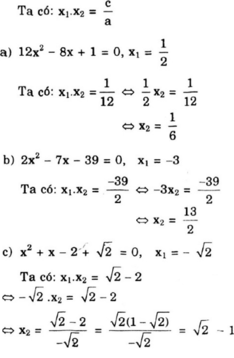
d) x 2 - 2 m x + m - 1 = 0 ( 1 )
Vì x 1 = 2 là một nghiệm của pt (1) nên:
2 2 - 2 m . 2 + m - 1 = 0
⇔ 4- 4 m+ m – 1 = 0
⇔ 3- 3m = 0
⇔ m = 1
Khi m = 1 ta có: x 1 . x 2 = m - 1 (hệ thức Vi-ét)
⇔ 2 . x 2 = 0 ( v ì x 1 = 2 và m = 1)
⇔ x 2 = 0
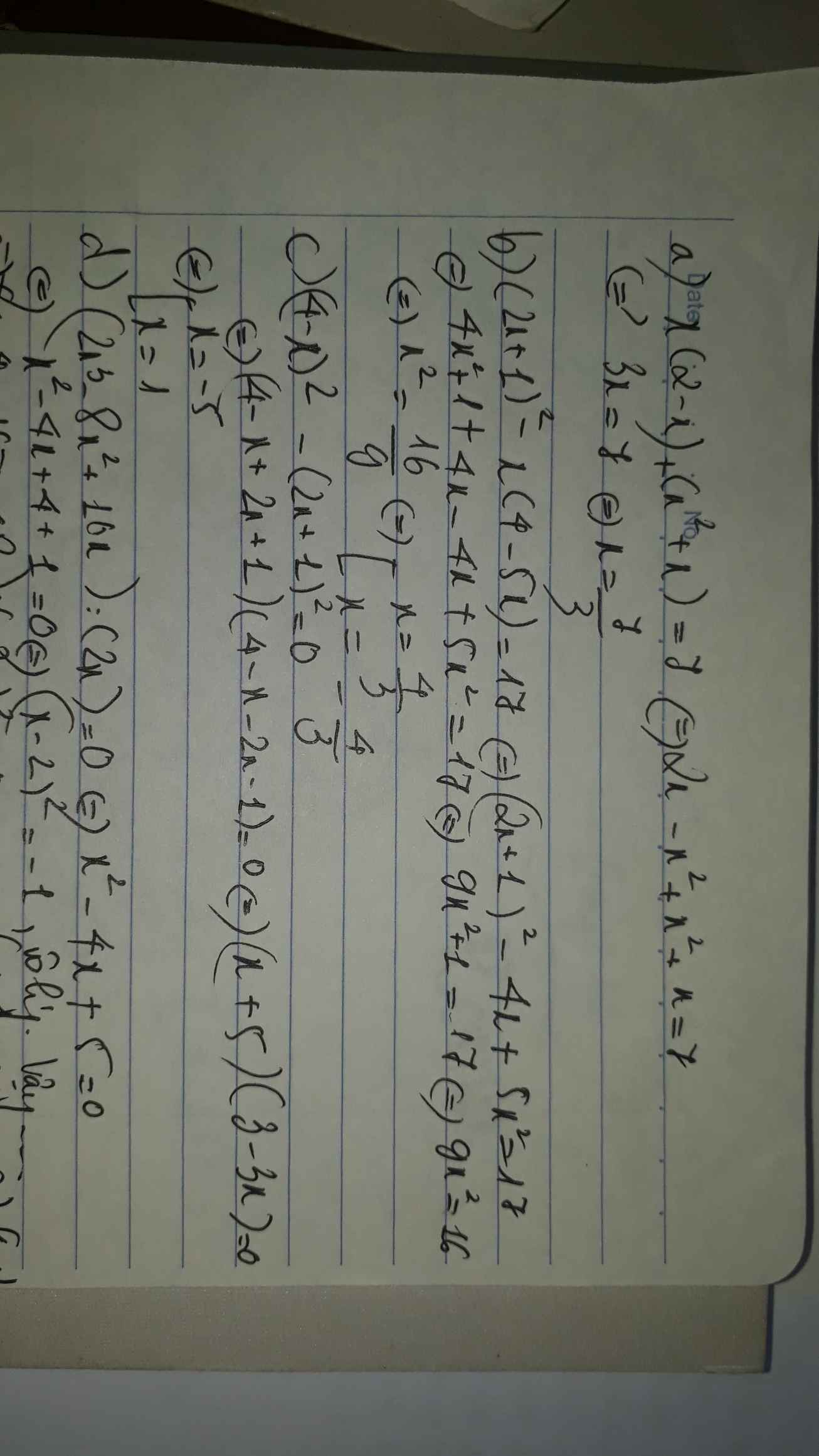
a: Ta có: \(x\left(2-x\right)+x^2+x=7\)
\(\Leftrightarrow2x-x^2+x^2+x=7\)
\(\Leftrightarrow3x=7\)
hay \(x=\dfrac{7}{3}\)
b: Ta có: \(\left(x-4\right)^2-\left(2x+1\right)^2=0\)
\(\Leftrightarrow\left(x-4-2x-1\right)\left(x-4+2x+1\right)=0\)
\(\Leftrightarrow\left(x+5\right)\left(3x-3\right)=0\)
\(\Leftrightarrow\left[{}\begin{matrix}x=-5\\x=1\end{matrix}\right.\)
a, \(A=2x^3-9x^5+3x^5-3x^2+7x^2-12=-6x^5+2x^3+4x^2-12\)
b, \(B=2x^4+x^2+2x-2x^3-2x^2+x^2-2x+1=2x^4-2x^3+1\)
c, \(C=2x^2+x-x^3-2x^2+x^3-x+3=3\)
a: Thay m=-12 vào phương trình, ta được:
\(x^2+5x-12-2=0\)
=>\(x^2+5x-14=0\)
=>(x+7)(x-2)=0
=>x=2 hoặc x=-7
a: Ta có: \(x\left(2-x\right)+\left(x^2+x\right)=7\)
\(\Leftrightarrow2x-x^2+x^2+x=7\)
\(\Leftrightarrow3x=7\)
hay \(x=\dfrac{7}{3}\)
b: Ta có: \(\left(2x+1\right)^2-x\left(4-5x\right)=17\)
\(\Leftrightarrow4x^2+4x+1-4x+5x^2=17\)
\(\Leftrightarrow9x^2=16\)
\(\Leftrightarrow x^2=\dfrac{16}{9}\)
hay \(x\in\left\{\dfrac{4}{3};-\dfrac{4}{3}\right\}\)
1: ĐKXĐ: x<>0
\(\sqrt{x^2+x+2} + \frac{1}{x} = \frac{13-7x}{2}\)
\(\Leftrightarrow \sqrt{x^2+x+2} = \frac{13}{2} - \frac{7x}{2} - \frac{1}{x} = \frac{13x - 7x^2 - 2}{2x}\)
=>\(\left(\sqrt{x^2+x+2} - 2\right) + \left(\frac{1}{x} - 1\right) + \frac{7x - 7}{2} = 0\)
=>\(\frac{x^2+x-2}{\sqrt{x^2+x+2} + 2}+\frac{1-x}{x}+\frac{7(x-1)}{2}=0\)
=>\((x-1)\left[\frac{x+2}{\sqrt{x^2+x+2} + 2}-\frac{1}{x}+\frac{7}{2}\right]=0\)
=>x-1=0
=>x=1(nhận)
7: ĐKXĐ: \(16-x^2>0\)
=>\(x^2<16\)
=>-4<x<4
\(\frac{x^3}{\sqrt{16-x^2}} + x^2 - 16 = 0\)
\(\Leftrightarrow \frac{x^3}{\sqrt{16-x^2}} - \left(\sqrt{16-x^2}\right)^2 = 0\)
\(\Leftrightarrow x^3 - \left(\sqrt{16-x^2}\right)^3 = 0\)
\(\Leftrightarrow x^3 = \left(\sqrt{16-x^2}\right)^3\)
\(\Leftrightarrow x = \sqrt{16-x^2} \quad (x > 0)\)
\(\Leftrightarrow x^2 = 16 - x^2\) và x>0
=>\(2x^2=16\) và x>0
=>\(x^2=8\) và 0<x<4
=>\(x=2\sqrt2\)
a) x = 1; x = - 1 3 b) x = 2.
c) x = 3; x = -2. d) x = -3; x = 0; x = 2.
\(a,\Leftrightarrow6x^2-6x^2-11x+10=-12\\ \Leftrightarrow-11x=-22\\ \Leftrightarrow x=2\\ b,\Leftrightarrow x^3+27-x^3-2x=12-5x\\ \Leftrightarrow3x=-15\\ \Leftrightarrow x=-5\\ c,\Leftrightarrow x^2-6x-16=0\\ \Leftrightarrow\left(x-8\right)\left(x+2\right)=0\\ \Leftrightarrow\left[{}\begin{matrix}x=8\\x=-2\end{matrix}\right.\)
a: ta có: \(6x^2-\left(2x+5\right)\left(3x-2\right)=-12\)
\(\Leftrightarrow6x^2-6x^2+4x-15x+10=-12\)
\(\Leftrightarrow-11x=-22\)
hay x=2
b: Ta có: \(\left(x+3\right)\left(x^2-3x+9\right)-x\left(x^2+2\right)=12-5x\)
\(\Leftrightarrow x^3+27-x^3-2x+5x=12\)
\(\Leftrightarrow x=-5\)


a)\(\left(x-4\right)^2-48=-12\)
=>\(\left(x-4\right)^2-6^2=0\)
=>(x+2)(x-10)=0
=>x=-2;10
b)\(\left(x+1\right)^2\left(x^2+1\right)=0\)
Mà x2+1\(\ge0\)
=>x+1=0
=>x=-1
tìm x thuộc n