
15 : x = 5
K
Khách
Hãy nhập câu hỏi của bạn vào đây, nếu là tài khoản VIP, bạn sẽ được ưu tiên trả lời.

Những câu hỏi liên quan
15 tháng 3 2021
Không biết em có làm sai không:
ĐKXĐ: \(x,y\ge0\).
Đặt 2x = a; 3y = b.
HPT trở thành:
\(\left\{{}\begin{matrix}\left(\sqrt{5}\right)^a-\left(\sqrt{5}\right)^b+\left(a-b\right)\left(ab+12\right)=0\\a^2+b^2=16\end{matrix}\right.\)
\(\Leftrightarrow\left\{{}\begin{matrix}a^2+b^2=16\\\left(\sqrt{5}\right)^a-\left(\sqrt{5}\right)^b+\left(b-a\right)\left(a^2+b^2\right)+a^3-b^3+12\left(a-b\right)=0\end{matrix}\right.\)
\(\Leftrightarrow\left\{{}\begin{matrix}a^2+b^2=16\\\left(\sqrt{5}\right)^a+a^3-4a=\left(\sqrt{5}\right)^b+b^3-4b=0\left(1\right)\end{matrix}\right.\).
Giả sử \(a\ge b\Rightarrow\left(\sqrt{5}\right)^a\ge\left(\sqrt{5}\right)^b\). Mà \(\left(a^3-4a\right)-\left(b^3-4b\right)=\left(a-b\right)\left(a^2+ab+b^2-4\right)\ge0\) nên VT(1) \(\ge\) VP(1).
Do đẳng thức xảy ra nên ta có a = b. Thay vào ta tìm được a = b = \(2\sqrt{2}\) nên \(x=\sqrt{2};y=\dfrac{2\sqrt{2}}{3}\).
HT
15 tháng 3 2021
\(\left\{{}\begin{matrix}\left(\sqrt{5}\right)^{2x}-\left(\sqrt{5}\right)^{3y}=\left(3y-2x\right)\left(6xy+12\right)\left(1\right)\\4x^2+9y^2=16\left(2\right)\end{matrix}\right.\)
\(\left(2\right)\Rightarrow4x^2+9y^2-4=12\) the vo (1)
\(\Rightarrow\left(\sqrt{5}\right)^{2x}-\left(\sqrt{5}\right)^{3y}=\left(3y-2x\right)\left(6xy+4x^2+9y^2-4\right)\)
\(\Leftrightarrow\left(\sqrt{5}\right)^{2x}-\left(\sqrt{5}\right)^{3y}=27y^3-8x^3-12y+8x\)
\(\Leftrightarrow\left(\sqrt{5}\right)^{2x}+\left(2x\right)^3-4.\left(2x\right)=\left(\sqrt{5}\right)^{3y}+\left(3y\right)^3-4.\left(3y\right)\left(3\right)\)
Xét hàm số \(f\left(t\right)=\left(\sqrt{5}\right)^{2t}+\left(2t\right)^3-4.2t\) đồng biến trên R
\(\Rightarrow\left(3\right):f\left(2x\right)=f\left(3y\right)\Leftrightarrow\left\{{}\begin{matrix}2x=3y\\4x^2+9y^2=16\end{matrix}\right.\Leftrightarrow\left\{{}\begin{matrix}x=\sqrt{2}\\y=\dfrac{2\sqrt{2}}{3}\end{matrix}\right.\)
4 tháng 2 2021
\(a,2x\left(x-5\right)+4\left(x-5\right)=0\\ \Leftrightarrow\left(x-5\right)\left(2x+4\right)=0\\ \Leftrightarrow\left[{}\begin{matrix}x-5=0\\2x+4=0\end{matrix}\right.\\ \Leftrightarrow\left[{}\begin{matrix}x=5\\2x=-4\end{matrix}\right.\\ \Leftrightarrow\left[{}\begin{matrix}x=5\\x=-2\end{matrix}\right.\)
Vậy \(x\in\left\{5;-2\right\}\)
\(b,3x-15=2x\left(x-5\right)\\ \Leftrightarrow3\left(x-5\right)-2x\left(x-5\right)=0\\ \Leftrightarrow\left(x-5\right)\left(-2x+3\right)=0\\ \Leftrightarrow\left[{}\begin{matrix}x-5=0\\-2x+3=0\end{matrix}\right.\\ \Leftrightarrow\left[{}\begin{matrix}x=5\\2x=3\end{matrix}\right.\\ \Leftrightarrow\left[{}\begin{matrix}x=5\\x=\dfrac{3}{2}\end{matrix}\right.\)
Vậy \(x\in\left\{5;\dfrac{3}{2}\right\}\)
\(c,\left(2x+1\right)\left(3x-2\right)=\left(5x-8\right)\left(2x+1\right)\\ \Leftrightarrow\left(2x+1\right)\left(3x-2\right)-\left(5x-8\right)\left(2x+1\right)=0\\ \Leftrightarrow\left(2x+1\right)\left(3x-2-5x+8\right)=0\\ \Leftrightarrow\left(2x+1\right)\left(-2x+6\right)=0\\ \Leftrightarrow\left[{}\begin{matrix}2x+1=0\\-2x+6=0\end{matrix}\right.\\ \Leftrightarrow\left[{}\begin{matrix}2x=-1\\2x=6\end{matrix}\right.\\ \Leftrightarrow\left[{}\begin{matrix}x=-\dfrac{1}{2}\\x=3\end{matrix}\right.\)
Vậy \(x\in\left\{-\dfrac{1}{2};3\right\}\)
Câu d xem lại đề

10 tháng 6 2018
ta có: - Tích của 10 x 20 x 30 x 40 x 60 x 70 x 80 x 90 x 100 tận cùng là 10 chữ số 0
- Tích của 50 với một số chẵn tận cùng có 2 chữ số 0
- Tích của 25 x 4 tận cùng là 2 chữ số 0
- Tích của 75 x 36 tận cùng là 2 chữ số 0
- Các số 5; 15;35;45;55;65;85;95 nhân với 1 số chẵn đều có 1 chữ số 0
=> 10 + 2 + 2 + 2 + 1 x 8 = 24 ( chữ số 0)
=> 1 x 2 x 3 x 4 x 5 x ... x 99 x 100 có 24 chữ số 0 liên tiếp bắt đầu từ chữ số hàng đơn vị trong tích
5 tháng 3 2021
Xem video này nhé:
https://www.facebook.com/BBCnewsVietnamese/videos/408386896476118
MH
11 tháng 10 2021
Nhúng một thanh sắt vào dung dịch và để một thời gian cho phản ứng xảy ra hoàn toàn.
CuSO4 + Fe → FeSO4 + Cu
Cu2+ +Fe→ Fe2+ + Cu
(Fe đứng trước Cu trong dãy hoạt động hóa học nên đẩy Cu ra khỏi dung dịch muối)
Toàn bộ Cu thoát ra bám trên bề mặt thanh sắt, lấy thanh sắt ra ta còn lại dung dịch chỉ có FeSO4
CM
15 tháng 7 2017
x 2 – 5 = (2x - 5 )(x + 5 )
⇔ (x + 5 )(x - 5 ) = (2x - 5 )(x + 5 )
⇔ (x + 5 )(x - 5 ) – (2x - 5 )(x + 5 ) = 0
⇔ (x + 5 )[(x - 5 ) – (2x - 5 )] = 0
⇔ (x + 5 )(- x) = 0 ⇔ x + 5 = 0 hoặc – x = 0
x + 5 = 0 ⇔ x = - 5
x = 0 ⇔ x = 0
Vậy phương trình có nghiệm x = - 5 hoặc x = 0.
CM
24 tháng 4 2017
Ta có: x 3 – 5 x 2 –x +5 = 0 ⇔ x 2 ( x -5) – ( x -5) =0
⇔ (x -5)(x2 -1) =0 ⇔ (x -5)(x -1)(x +1) =0
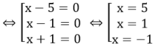
Vậy phương trình đã cho có 3 nghiệm :x1 = 5;x2 =1;x3=-1
CM
16 tháng 8 2018
(x2 + 2x – 5)2 = (x2 – x + 5)2
⇔ (x2 + 2x – 5)2 – (x2 – x + 5)2 = 0
⇔ [(x2 + 2x – 5) – (x2 – x + 5)].[(x2 + 2x – 5) + (x2 – x + 5)] = 0
⇔ (3x – 10)(2x2 + x ) = 0
⇔ (3x-10).x.(2x+1)=0
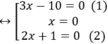
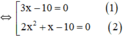
+ Giải (1): 3x – 10 = 0 ⇔ 
+ Giải (2):
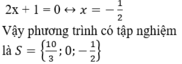
x=3 nhé bn
15 : x = 5
x = 15 : 5
x = 3
Vậy x = 3