K
Khách

Hãy nhập câu hỏi của bạn vào đây, nếu là tài khoản VIP, bạn sẽ được ưu tiên trả lời.

24 tháng 11 2025

??? là sao

24 tháng 11 2025

???????????????????????


9 tháng 2 2023

food poisoning

stole

delayed

fire alarm

8 tháng 2 2023

1. saw

2. chatted

3. had

4. enjoyed

5. was

6. left

7. stayed

8. felt

9. were

10. went

THE PAST CONTINUOUSSemi-controlled Task 1Complete these jokes using the Past Continuous.1. A young man (stand) ________ on a bus. He (chew) ________ gum. An old man (sit) ________ opposite him. After five minutes the old man shouted at him, "It's no good talking to me. I'm deaf.”AnswerAnswer Answer 2. A motorist was in court for speeding. He told the judge that on the day he (drive) ________   at ten miles an hour and not at sixty miles an hour.“How can you be so sure that you (travel)...
Đọc tiếp

THE PAST CONTINUOUS

Semi-controlled 

Task 1

Complete these jokes using the Past Continuous.

1. A young man (stand) ________ on a bus. He (chew) ________ gum. An old man (sit) ________ opposite him. After five minutes the old man shouted at him, "It's no good talking to me. I'm deaf.”

Answer

Answer 

Answer 

2. A motorist was in court for speeding. He told the judge that on the day he (drive) ________   at ten miles an hour and not at sixty miles an hour.

“How can you be so sure that you (travel) ________   at ten miles an hour?” “Because I (go) ________ to the dentist at the time!”


Answer

Answer

3. Mr Goldsmith (shop) ________ in an expensive London store. He (talk) ________ to a young male shop assistant. "I want something unusual to give my beautiful eighteen-year-old daughter for her birthday." The young man thought for a second, then said, "Here's my phone number, sir!" 

Answe

Answer 

4. Two cannibals (walk) ________ along the road when they saw a long line of people at a bus stop. One said to the other, "Oh, look, do you fancy a barbeque?" 

Answer


5. Two very drunk men (try) ________ to find their way home, but they were lost. They (stagger) ________ along a railway line. "This is a very long staircase," said the first one. "My legs are killing me!" The second drunk (hold) ________ his back. "And the handrail is so low my back is killing me!

Answer


1
11 tháng 10 2023

1. A young man (stand) ___was standing_____ on a bus. He (chew) ____was chewing____ gum. An old man (sit) ___was sitting_____ opposite him. After five minutes the old man shouted at him, "It's no good talking to me. I'm deaf.”

2. A motorist was in court for speeding. He told the judge that on the day he (drive) ____was driving____   at ten miles an hour and not at sixty miles an hour.

3. Mr Goldsmith (shop) ___was shopping_____ in an expensive London store. He (talk) ___was talking_____ to a young male shop assistant. "I want something unusual to give my beautiful eighteen-year-old daughter for her birthday." The young man thought for a second, then said, "Here's my phone number, sir!" 

5. Two very drunk men (try) ___were trying_____ to find their way home, but they were lost. They (stagger) ___was staggering_____ along a railway line. "This is a very long staircase," said the first one. "My legs are killing me!" The second drunk (hold) ____was holding____ his back. "And the handrail is so low my back is killing me!

11 tháng 9 2023

1. have 

a. I have had this laptop since my birthday.

(Tôi có cái laptop này từ sinh nhật tôi.)

b. We had dinner in the garden last night.


(Chúng tôi ăn tối ngoài vườn tối qua.)

2. not buy 

a. I didn’t buy a new jacket in the sale last weekend.

(Tôi đã không mua cái áo khoác giảm giá cuối tuần trước.)

b I haven’t bought any new clothes for months.

(Tôi đã không mua bất cứ món quần áo nào nhiều tháng nay rồi.)

3. leave 

a. I left school at five.

(Tôi nghỉ học lúc 5 tuổi.)

b I have left your dinner in the fridge. You can eat it later.

(Tôi để bữa tối trong tủ lạnh. Bạn có thể ăn sau.)

4. not text 

a. I didn’t text you last night because I don't have your number.

(Tôi đã nhắn tin cho bạn tối hôm qua bởi vì tôi không biết số của bạn.)

b. Jim haven’t texted his girlfriend since Monday. She's a bit upset about it.

(Jim đã không nhắn tin với bạn gái từ thứ Hai rồi. Cô ấy hơi thất vọng.)

4. Complete the broadcasting facts. Use the past simple passive form of the verbs in brackets.(Hoàn thành các dữ kiện được phát sóng. Sử dụng dạng bị động của thì quá khứ đơn của các động từ trong ngoặc.)1920 The first radio broadcast (1) _____ (transmit) by KDKA in the USA.1925 The first soap opera, The Smith Family, (2) _____ (broadcast) on the radio.1928 A television image (3) _____ (send) from England to the USA for the first time.1928 The first...
Đọc tiếp

4. Complete the broadcasting facts. Use the past simple passive form of the verbs in brackets.

(Hoàn thành các dữ kiện được phát sóng. Sử dụng dạng bị động của thì quá khứ đơn của các động từ trong ngoặc.)

1920 The first radio broadcast (1) _____ (transmit) by KDKA in the USA.

1925 The first soap opera, The Smith Family, (2) _____ (broadcast) on the radio.

1928 A television image (3) _____ (send) from England to the USA for the first time.

1928 The first television set (4) _____ (sell).

1936 The first BBC TV programmes (5) _____ (make) in the UK.

1940 Colour TV sets (6) _____ (demonstrate) by CBS in New York.

1947 Baseball games (7) _____ (tetevise) for the first time.

1954 More money (8) _____ (earn) by TV broadcasters than by radio broadcasters.

1964 Colour TV sets (9) _____ (buy) by families across the USA.

1983 The final episode of the comedy series M*A*S*H (10) _____ (watch) by more than 125 million viewers.

1990 The first episode of The Simpsons (11) _____ (show) on Fox.


1
11 tháng 9 2023

1920 The first radio broadcast (1) was transmitted by KDKA in the USA.

1925 The first soap opera, The Smith Family, (2) was broadcast on the radio.

1928 A television image (3) was sent from England to the USA for the first time.

1928 The first television set (4) was sold.

1936 The first BBC TV programmes (5) were made in the UK.

1940 Colour TV sets (6) were demonstrated by CBS in New York.

1947 Baseball games (7) were televised for the first time.

1954 More money (8) was earned by TV broadcasters than by radio broadcasters.

1964 Colour TV sets (9) were bought by families across the USA.

1983 The final episode of the comedy series M*A*S*H (10) was watched by more than 125 million viewers.

1990 The first episode of The Simpsons (11) was shown on Fox.

18 tháng 2 2023

1. had

2. took

3. grew,changed

4. collected,made

5. gave

13 tháng 10 2023

Dịch các câu:

1. Khi cô gái còn trẻ, cô ấy có đôi mắt nâu to và mái tóc đen.

2. Bố cô ấy chụp ảnh cô ấy mỗi ngày

3. Mỗi năm, cô gái ấy lớn hơn và cô ấy thay đổi một chút.

4. Ông ấy đã thu thập tất cả các bức ảnh và anh ấy đã tạo ra một bức tranh khổng lồ từ chúng.

5. Ông ấy đã đưa bức tranh lớn cho con gái mình.

13 tháng 10 2023

My family has 5 people. My sister is Ngoc, she grew up in Ninh Binh, Viet Nam. She went to university when she was 18 years old and she left school when she was 22 years old. She travelled 20 provinces in the country. Now, she is living in Hanoi.

13 tháng 10 2023

Tạm dịch:

Gia đình tôi có 5 người. Chị gái tôi là Ngọc, chị ấy lớn lên ở Ninh Bình, Việt Nam. Chị ấy vào đại học năm 18 tuổi và chị ấy ra trường năm 22 tuổi. Chị ấy đã đi du lịch 20 tỉnh thành trong cả nước. Bây giờ, chị ấy đang sống ở Hà Nội.
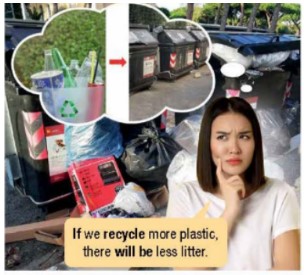
a. Listen and repeat. (Nghe và lặp lại.)If we recycle more plastic, there will be less litter. (Nếu chúng ta tái chế nhiều nhựa hơn, sẽ có ít rác hơn.) First Conditional (Câu điều kiện loại 1)Meaning and Use (Ý nghĩa và Cách sử dụng)We can use First Conditional to talk about things we can change (“If I do this thing…”), and the future result of that change (“...that thing will happen”).(Chúng ta có thể sử dụng Điều kiện loại 1...
Đọc tiếp

a. Listen and repeat. (Nghe và lặp lại.)

If we recycle more plastic, there will be less litter. (Nếu chúng ta tái chế nhiều nhựa hơn, sẽ có ít rác hơn.)


First Conditional (Câu điều kiện loại 1)

Meaning and Use (Ý nghĩa và Cách sử dụng)

We can use First Conditional to talk about things we can change (“If I do this thing…”), and the future result of that change (“...that thing will happen”).

(Chúng ta có thể sử dụng Điều kiện loại 1 để nói về những thứ chúng ta có thể thay đổi (“Nếu tôi làm điều này…”) và kết quả trong tương lai của sự thay đổi đó (“… điều đó sẽ xảy ra”).

If I study hard, I will do well on my test. (Nếu tôi học tập chăm chỉ, tôi sẽ làm tốt bài kiểm tra của mình.)

Form

If we recycle more plastic, there will be less litter. (Nếu chúng ta tái chế nhiều nhựa hơn, sẽ có ít rác hơn.)

There won't be as much trash if we ban single-use plastic. (Sẽ không có nhiều rác nếu chúng ta cấm đồ nhựa dùng một lần.)

If we don't protect the environment, what will happen? (Nếu chúng ta không bảo vệ môi trường, điều gì sẽ xảy ra?)

Will we reduce air pollution if we ban cars? (Chúng ta sẽ giảm ô nhiễm không khí nếu chúng ta cấm ô tô?)

(Yes, we will. (Có, chúng tôi sẽ.) /No, we won't. (Không, chúng tôi sẽ không.))


0
29 tháng 10 2021

1. A song (sing) ........is being sang........ by my classmates
2. I (bite) .....am bited........ by a small dog
3. My car (steal) ........is stolen..... by a thief
4. .....Is....... this bunch of flowers (give) .....gave...... by her father?
5. Their beds (not make) ......aren't made.....by her server
6. Chicken (cook) ...is cooked........with sauce and cucumber
7. These postcards (not send) ......aren't sent...... to Juliet
8. We (tell) .......told...... the truth two days ago
9. This coffee (drink) .......is being drank....
10. This street ( destroy) ....is destroyed...... by many trucks
