
Cho hàm số \(y=f\left(x\right)=4x^2+3\) Tìm x sao cho\(f\left(x\right)=4\)
K
Khách
Hãy nhập câu hỏi của bạn vào đây, nếu là tài khoản VIP, bạn sẽ được ưu tiên trả lời.

Những câu hỏi liên quan
NL
Nguyễn Lê Phước Thịnh
CTVHS
13 tháng 9
Đặt t=|x|+1
x∈[-2;2]
=>|x|∈[0;2]
=>t∈[1;3]
t=1
=>|x|=0
=>x=0
t∈(1;3]
=>|x|=t-1>0
=>x=t-1 hoặc x=-t+1
=>để phương trình ban đầu có đúng 4 nghiệm thuộc khoảng [-2;2] thì phương trình ẩn t phải có đúng 2 nghiệm thuộc khoảng (1; 3]
\(f(t) = t^2 - 4t + 3\) có đỉnh là t=2
f(1)=0
f(2)=-1
f(3)=0
BẢng biến thiên:
Khi u∈[-1;0) thì phương trình f(t)=u có đúng 2 nghiệm khi t∈(1;3], với một nghiệm thuộc (1; 2) và một nghiệm thuộc (2; 3].
Tại u = -1, phương trình f(t) = -1 chỉ có 1 nghiệm t = 2.
Tại u = 0, t = 1 và t = 3 (chứa t = 1, không cho đủ 4 nghiệm x).
Do đó: để có đúng 2 nghiệm t∈(1; 3], ta phải chọn đúng 1 giá trị u∈[-1; 0)
Phương trình trở thành f(u)=m, với u∈[-1;0)
\(f\left(u\right)=u^2-4u+3\)
=>f'(u)=2u-4
u∈[-1;0)
=>2u∈[-2;0)
=>2u-4∈[-6;-4)
=>2u-4<0∀u∈[-1;0)
=>f(u) nghịch biến trên [-1;0)
\(f(-1) = (-1)^2 - 4(-1) + 3 = 8\)
\(\lim_{u \to 0^-} f(u) = f(0) = 3\)
Do f(u) liên tục và giảm nghiêm ngặt từ 8 xuống 3 trên đoạn [-1;0), nên với mỗi giá trị m∈(3;8) thì phương trình f(u) = m sẽ có đúng 1 nghiệm u∈[-1;0)
=>m∈(3;8)
HP
1 tháng 1 2021
\(h\left(x\right)=x^2-4x+5+m\)
\(g\left(x\right)=\left|h\left(x\right)\right|=\left|f\left(x\right)+m\right|=\left|x^2-4x+5+m\right|\)
\(h\left(0\right)=5+m;h\left(4\right)=5+m;h\left(2\right)=1+m\)
TH1: \(1+m>0\Leftrightarrow m>-1\)
\(max=5+m=9\Leftrightarrow m=4\left(tm\right)\)
TH2: \(5+m< 0\Leftrightarrow m< -5\)
\(max=-1-m=9\Leftrightarrow m=-10\left(tm\right)\)
TH3: \(5+m>0>1+m\Leftrightarrow-5< m< -1\)
Nếu \(5+m< -1-m\Leftrightarrow m< -3\)
\(max=-1-m=9\Leftrightarrow m=-10\left(tm\right)\)
Nếu \(5+m=-1-m\Leftrightarrow m=-3\)
\(max=5+m=2\ne9\)
\(\Rightarrow m=-3\) không thỏa mãn yêu cầu bài toán
Nếu \(5+m>-1-m\Leftrightarrow m>-3\)
\(max=5+m=9\Leftrightarrow m=4\left(tm\right)\)
Vậy \(m=4;m=-10\)
29 tháng 1 2022
\(1.x^2+\dfrac{1}{x^2}-2m\left(x+\dfrac{1}{x}\right)+1+2m=0\left(1\right)\)\(đặt:x^2+\dfrac{1}{x^2}=t\)
\(x>0\Rightarrow t\ge2\sqrt{x^2.\dfrac{1}{x^2}}=2\)
\(x< 0\Rightarrow-t=-x^2+\dfrac{1}{\left(-x^2\right)}\ge2\Rightarrow t\le-2\)
\(\Rightarrow t\in(-\infty;-2]\cup[2;+\infty)\left(2\right)\)
\(\Rightarrow\left(1\right)\Leftrightarrow t^2-2mt+2m-1=0\)
\(\Leftrightarrow\left(t-1\right)\left(t-2m+1\right)=0\Leftrightarrow\left[{}\begin{matrix}t=1\notin\left(2\right)\\t=2m-1\end{matrix}\right.\)
\(\Rightarrow\left[{}\begin{matrix}2m-1\le-2\\2m-1\ge2\end{matrix}\right.\)\(\Leftrightarrow\left[{}\begin{matrix}m\le-\dfrac{1}{2}\\m\ge\dfrac{3}{4}\end{matrix}\right.\)
\(2.\) \(f^2\left(\left|x\right|\right)+\left(m-2\right)f\left(\left|x\right|\right)+m-3=0\left(1\right)\)
\(\Leftrightarrow\left[{}\begin{matrix}f\left(\left|x\right|\right)=-1\\f\left(\left|x\right|\right)=3-m\end{matrix}\right.\)
\(dựa\) \(vào\) \(đồ\) \(thị\) \(f\left(\left|x\right|\right)\) \(\Rightarrow f\left(\left|x\right|\right)=-1\) \(có\) \(2nghiem\) \(pb\)
\(\left(1\right)có\) \(6\) \(ngo\) \(pb\Leftrightarrow\left\{{}\begin{matrix}-1< 3-m< 3\\3-m\ne-1\\\end{matrix}\right.\)\(\Leftrightarrow0< m< 4\)
\(\Rightarrow m=\left\{1;2;3\right\}\)
S
4 tháng 9 2019
\(f\left(x\right)=\frac{x^2+2x+1-x^2}{x^2\left(x+1\right)^2}=\frac{\left(x+1\right)^2-x^2}{x^2\left(x+1\right)^2}=\frac{1}{x^2}-\frac{1}{\left(x+1\right)^2}\)
\(\Rightarrow f\left(1\right)+f\left(2\right)+....+f\left(x\right)=1-\frac{1}{2^2}+\frac{1}{2^2}-....-\frac{1}{\left(x+1\right)^2}\)
\(\Rightarrow\frac{2y\left(x+1\right)^3-1}{\left(x+1\right)^2}-19+x=\frac{x\left(x+2\right)}{\left(x+1\right)^2}\)
\(\Leftrightarrow\frac{2y\left(x+1\right)^3-1}{\left(x+1\right)^2}-19+x=\frac{2y\left(x+1\right)^3-1}{\left(x+1\right)^2}-20+\left(x+1\right)=\frac{x\left(x+2\right)}{\left(x+1\right)^2}\)
Dat:\(x+1=a\Rightarrow\frac{\left(2y+1\right)a^3-20a^2-1}{a^2}=\frac{a^2-1}{a^2}\Leftrightarrow\left(2y+1\right)a^3-20a^2-1=a^2-1\)
\(\Leftrightarrow\left(2y+1\right)a^3-20a^2=a^2\Leftrightarrow\left(2ay+a\right)-20=1\left(coi:x=-1cophailanghiemko\right)\)
\(\Leftrightarrow2ay+a=21\Leftrightarrow a\left(2y+1\right)=21\Leftrightarrow\left(x+1\right)\left(2y+1\right)=21\)
18 tháng 6 2021
\(g'\left(x\right)=0\Rightarrow x=0\)
Ta thấy \(g\left(x\right)\) đồng biến trên \(\left(0;+\infty\right)\)
\(\Rightarrow g\left(f\left(x\right)\right)\) đồng biến khi \(f\left(x\right)\ge0\)
\(\Rightarrow g\left(f\left(x\right)\right)\) đồng biến trên \(\left(3;+\infty\right)\) khi \(f\left(x\right)\ge0\) ; \(\forall x>3\)
\(\Leftrightarrow x^2-4x\ge-m\) ; \(\forall x>3\)
\(\Leftrightarrow-m\le\min\limits_{x>3}\left(x^2-4x\right)\)
\(\Rightarrow-m\le-3\Rightarrow m\ge3\)
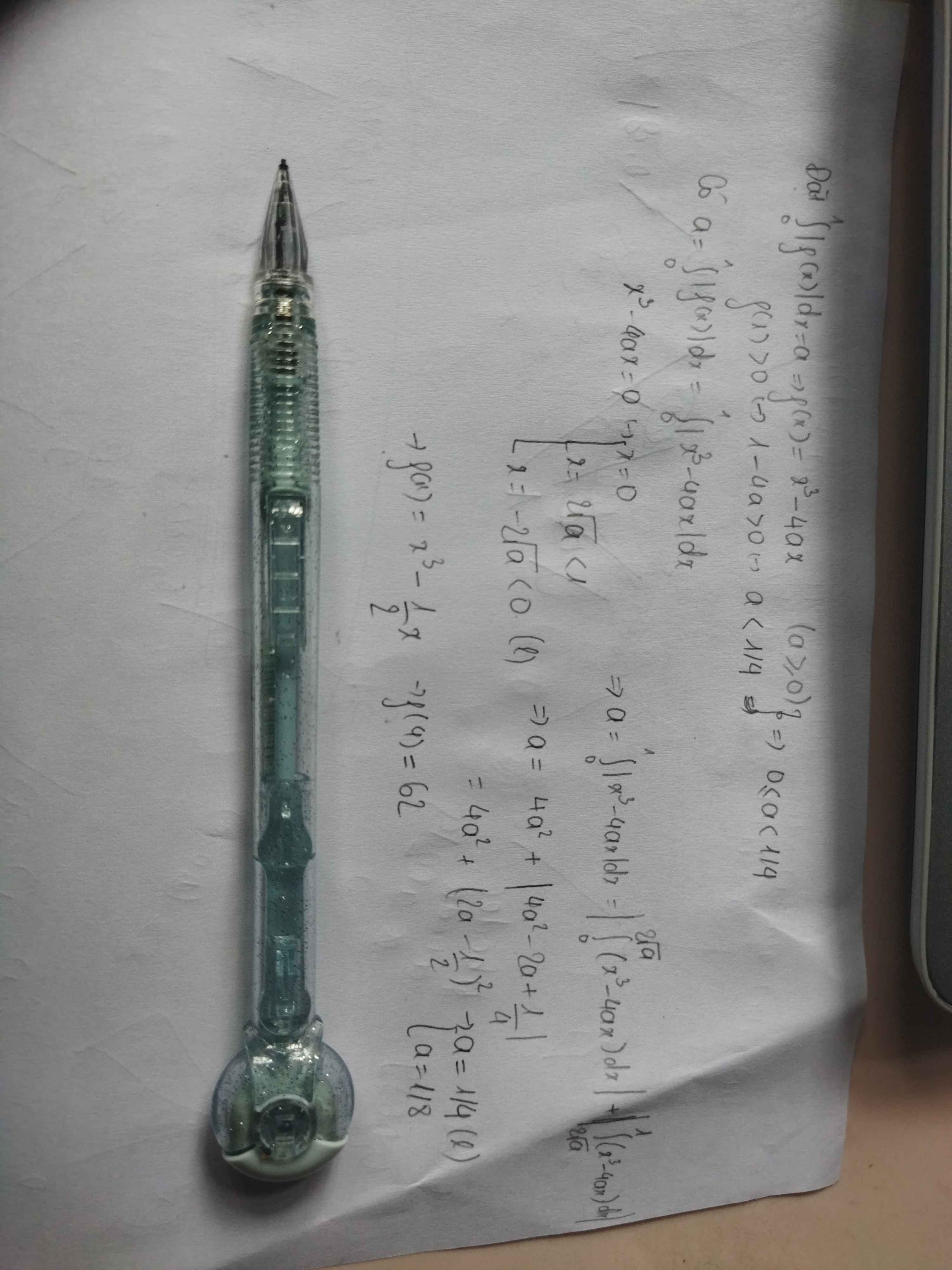
ML
30 tháng 6 2015
\(\text{1)}\)
\(\text{Thay }x=-2,\text{ ta có: }f\left(-2\right)-5f\left(-2\right)=\left(-2\right)^2\Rightarrow f\left(-2\right)=-1\)
\(\Rightarrow f\left(x\right)=x^2+5f\left(-2\right)=x^2-5\)
\(f\left(3\right)=3^2-5\)
\(\text{2)}\)
\(\text{Thay }x=1,\text{ ta có: }f\left(1\right)+f\left(1\right)+f\left(1\right)=6\Rightarrow f\left(1\right)=2\)
\(\text{Thay }x=-1,\text{ ta có: }f\left(-1\right)+f\left(-1\right)+2=6\Rightarrow f\left(-1\right)=2\)
\(\text{3)}\)
\(\text{Thay }x=2,\text{ ta có: }f\left(2\right)+3f\left(\frac{1}{2}\right)=2^2\text{ (1)}\)
\(\text{Thay }x=\frac{1}{2},\text{ ta có: }f\left(\frac{1}{2}\right)+3f\left(2\right)=\left(\frac{1}{2}\right)^2\text{ (2)}\)
\(\text{(1) - 3}\times\text{(2) }\Rightarrow f\left(2\right)+3f\left(\frac{1}{2}\right)-3f\left(\frac{1}{2}\right)-9f\left(2\right)=4-\frac{1}{4}\)
\(\Rightarrow-8f\left(2\right)=\frac{15}{4}\Rightarrow f\left(2\right)=-\frac{15}{32}\)