
bài khó : Bài toán: Giải phương trình sau:
\(2 x - 3 = 5 x + 6\)
K
Khách
Hãy nhập câu hỏi của bạn vào đây, nếu là tài khoản VIP, bạn sẽ được ưu tiên trả lời.
HB
4

Những câu hỏi liên quan
CM
20 tháng 5 2017
Đặt 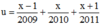
Suy ra 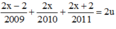
Phương trình đã cho trở thành:
0,05.2u = 3,3 − u ⇔ 0,1u = 3,3 – u ⇔ 1,1u = 3,3 ⇔ u = 3.
Do đó: 
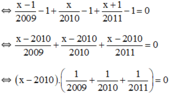
⇔ x – 2010 = 0
⇔ x = 2010.
PT
1
CM
13 tháng 8 2018
8x + 3(x + 1) > 5x – (2x – 6)
⇔ 8x + 3x + 3 > 5x – 2x + 6
⇔ 8x + 3x – 5x + 2x > 6 – 3 (Chuyển vế, đổi dấu)
⇔ 8x > 3
⇔  (Chia cả hai vế cho 8 > 0, BPT không đổi chiều)
Vậy bất phương trình có nghiệm 
NL
Nguyễn Lê Phước Thịnh
CTVHS
1 tháng 9
Câu 2:
TH1: \(x^2-3\ge0\)
=>\(x^2\ge3\)
=>\(\left[\begin{array}{l}x\ge\sqrt3\\ x\le-\sqrt3\end{array}\right.\) (1)
BPT sẽ trở thành: \(x^2-3+2x\ge0\)
=>\(x^2+2x-3\ge0\)
=>(x+3)(x-1)>=0
=>x>=1 hoặc x<=-3
Kết hợp (1), ta được: x>=\(\sqrt3\) hoặc x<=-3
TH2: \(x^2-3<0\)
=>\(x^2<3\)
=>\(-\sqrt3 (2)
BPT sẽ trở thành: \(3-x^2+2x\ge0\)
=>\(x^2-2x-3\le0\)
=>(x-3)(x+1)<=0
=>-1<=x<=3
Kết hợp (2), ta được: -1<=x<\(\sqrt3\)
PT
aGiải phương trình |x-1|+|x-2|=|2x-3|
b)Giải phương trình 1/(x−2 )+ 2/(x−3) − 3/(x−5) = 1/(x^2 −5x+6)
1
NL
Nguyễn Lê Phước Thịnh
CTVHS
18 tháng 2
a: |x-1|+|x-2|=|2x-3|
=>|x-1|+|x-2|-|2x-3|=0(1)
TH1: x<1
=>x-1<0; 2x-3<0; x-2<0
(1) sẽ trở thành: 1-x+2-x-(3-2x)=0
=>3-2x-3+2x=0
=>0x=0(luôn đúng)
TH2: 1<=x<3/2
=>x-1>=0; 2x-3<0; x-2<0
(1) sẽ trở thành: x-1+2-x-(3-2x)=0
=>1-3+2x=0
=>2x-2=0
=>x=1(nhận)
TH3: 3/2<=x<2
=>x-1>0; 2x-3>=0; x-2<0
(1) sẽ trở thành: x-1+2-x-(2x-3)=0
=>1-2x+3=0
=>-2x+4=0
=>-2x=-4
=>x=2(loại)
TH4: x>=2
=>x-1>0; 2x-3>0; x-2>=0
(1) sẽ trở thành: x-1+x-2-(2x-3)=0
=>2x-3-2x+3=0
=>0x=0(luôn đúng)
Vậy: x<=1 hoặc x>=2
b: ĐKXĐ: x∉{2;3;5}
\(\frac{1}{x-2}+\frac{2}{x-3}-\frac{3}{x-5}=\frac{1}{x^2-5x+6}\)
=>\(\frac{1}{x-2}+\frac{2}{x-3}-\frac{3}{x-5}=\frac{1}{\left(x-2\right)\left(x-3\right)}=\frac{1}{x-3}-\frac{1}{x-2}\)
=>\(\frac{2}{x-2}+\frac{1}{x-3}-\frac{3}{x-5}=0\)
=>\(\frac{2\left(x-3\right)\left(x-5\right)+\left(x-2\right)\left(x-5\right)-3\left(x-2\right)\left(x-3\right)}{\left(x-2\right)\left(x-3\right)\left(x-5\right)}=0\)
=>2(x-3)(x-5)+(x-2)(x-5)-3(x-2)(x-3)=0
=>\(2\left(x^2-8x+15\right)+x^2-7x+10-3\left(x^2-5x+6\right)=0\)
=>\(2x^2-16x+30+x^2-7x+10-3x^2+15x-18=0\)
=>-8x+22=0
=>-8x=-22
=>x=11/4(nhận)
N
2
3 tháng 9 2020
\(ĐK:x\ge-\frac{3}{2}\)
Ta có:
\(x^2+5x+8=3\sqrt{2x^3+5x^2+7x+6}\)
\(\Leftrightarrow\left(x^2+x+2\right)+2\left(2x+3\right)=3\sqrt{2x^3+5x^2+7x+6}\)
\(\Leftrightarrow\left(x^2+x+2\right)+2\left(2x+3\right)=3\sqrt{\left(x^2+x+2\right)\left(2x+3\right)}\)
Đặt \(\sqrt{x^2+x+2}=a;\sqrt{2x+3}=b\)
Khi đó: \(a^2+2b^2=3ab\Leftrightarrow\left(a-b\right)\left(a-2b\right)=0\)
\(\Leftrightarrow\sqrt{x^2+x+2}=\sqrt{2x+3}\left(hoac\right)\sqrt{x^2+x+2}=2\sqrt{2x+3}\)
Với \(\sqrt{x^2+x+2}=\sqrt{2x+3}\Rightarrow x^2+x+2=2x+3\Leftrightarrow x^2-x-1=0\Leftrightarrow x=\frac{1+\sqrt{5}}{2};x=\frac{1-\sqrt{5}}{2}\)Tự đối chiếu điều kiện xác định -,-
\(\sqrt{x^2+x+2}=2\sqrt{2x+3}\Rightarrow x^2+x+2=4\left(2x+3\right)\Leftrightarrow x^2-7x-10=0\)
Tới đây bí rồi huhu
25 tháng 1 2018
bình phương hai vế rồi rút gọn, phân tích thành nhân tử
\(\left(x+1\right)\left(x^3-9x^2+7x+10\right)=0\)0
KH
14 tháng 6 2021
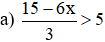
a) \(\dfrac{15-6x}{3}>5\Leftrightarrow15-6x>15\)
\(\Leftrightarrow-6x>0\Leftrightarrow x< 0\) (vì \(-6< 0\))
\(S=\left\{x|x< 0\right\}\)
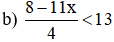
b) \(\dfrac{8-11x}{4}< 13\Leftrightarrow8-11x< 52\)
\(\Leftrightarrow-11x< -44\Leftrightarrow x>4\) (vì \(-11< 0\))
\(S=\left\{x|x>4\right\}\)
c) \(8x+3\left(x+1\right)>5x-\left(2x-6\right)\)
\(\Leftrightarrow8x+3x+1>5x-2x+6\)
\(\Leftrightarrow8x+3x-5x+2x>6-1\)
\(\Leftrightarrow8x>5\)
\(\Leftrightarrow x>\dfrac{5}{8}\) (vì \(8>0\))
\(S=\left\{x|x>\dfrac{5}{8}\right\}\)
d) \(2x\left(6x-1\right)>\left(3x-2\right)\left(4x+3\right)\)
\(\Leftrightarrow12x^2-2x>12x^2+9x-8x-6\)
\(\Leftrightarrow12x^2-2x-12x^2-9x+8x>-6\)
\(\Leftrightarrow-3x>-6\)
\(\Leftrightarrow x< 2\) (vì \(-3< 0\))
\(S=\left\{x|x< 2\right\}\)
SA
14 tháng 6 2021
a) \(\dfrac{15-6x}{3}>5\) <=> \(15-6x>15\) <=> \(6x< 0\) <=> \(x< 0\)
b) \(\dfrac{8-11x}{4}< 13\) <=> \(8-11x< 52\) <=> \(11x>-44\)<=> \(x>-4\)
c) \(8x+3\left(x+1\right)>5x-\left(2x-6\right)\)
<=> 8x + 3x + 3 - 5x + 2x - 6 > 0
<=> 8x > 3
<=> x > 3/8
d) 2x(6x - 1) > (3x - 2)(4x + 3)
<=> 12x2 - 2x > 12x2 + x - 6
<=> 12x2 - 2x - 12x2 - x > -6
<=> -3x > -6
<=> x < 2
LH
0
HL
0
2x -3= 5x +6
sử dụng quy tắc chuyển vế
2x-(-5x)= 3+6
2x+5x=9
x(2+5)=9
x .7=9
x= 9:7
=> x= 9/7
<=> 2x - 5x = 6+3
<=> -3x = 9
<=> x = -1