
Bài 4. (1 điểm) Tìm giá trị lớn nhất của $B=\dfrac{1}{x^2-4x+9}$.
Hãy nhập câu hỏi của bạn vào đây, nếu là tài khoản VIP, bạn sẽ được ưu tiên trả lời.

\(A=\sqrt{x-2}+\sqrt{4-x}\ge\sqrt{x-2+4-x}=\sqrt{2}\)
\(A_{min}=\sqrt{2}\) khi \(\left[{}\begin{matrix}x=2\\x=4\end{matrix}\right.\)
\(y=4x^2+\dfrac{9}{x^2}-3\ge2\sqrt{\dfrac{36x^2}{x^2}}-3=9\)
\(y_{min}=9\) khi \(x^2=\dfrac{3}{2}\)
\(P=\dfrac{x-1}{4}+\dfrac{1}{x-1}+\dfrac{1}{4}\ge2\sqrt{\dfrac{x-1}{4\left(x-1\right)}}+\dfrac{1}{4}=\dfrac{5}{4}\)
\(P_{min}=\dfrac{5}{4}\) khi \(x=\dfrac{3}{2}\)
b: \(T=\frac{2x^4-4x^2+8}{x^4+4}\)
=>\(T\left(x^4+4\right)=2x^4-4x^2+8\)
=>\(T\cdot x^4+4T-2x^4+4x^2-8=0\)
=>\(x^4\cdot\left(T-2\right)+4x^2+4T-8=0\) (1)
Đặt \(a=x^4\)
(1) sẽ trở thành: \(a^2\cdot\left(T-2\right)+4\cdot a+4T-8=0\) (2)
\(\Delta=4^2-4\left(T-2\right)\left(4T-8\right)=16-16\left(T-2\right)\cdot\left(T-2\right)\)
\(=16-16\left(T-2\right)^2\)
Để (2) có nghiệm thì Δ>=0
=>\(16-16\left(T-2\right)^2\ge0\)
=>\(16\left(T-2\right)^2\le16\)
=>\(\left(T-2\right)^2\le1\)
=>-1<=T-2<=1
=>1<=T<=3
Để T có giá trị lớn nhất thì T=3
=>\(2x^4-4x^2+8=3x^4+12\)
=>\(3x^4+12-2x^4+4x^2-8=0\)
=>\(x^4+4x^2+4=0\)
=>\(\left(x^2+2\right)^2=0\) (vô lý)
=>T không có giá trị lớn nhất
a: \(S=\frac{5x^4+4x^2+10}{x^4+2}=5+\frac{4x^2}{x^4+2}\)
Đặt \(A=\frac{4x^2}{x^4+2}\)
=>\(A\left(x^4+2\right)=4x^2\)
=>\(A\cdot x^4-4x^2+2A=0\) (1)
Đặt \(t=x^2\) (ĐK: t>=0)
(1) sẽ trở thành: \(A\cdot t^2-4t+2A=0\) (2)
\(\Delta=\left(-4\right)^2-4\cdot A\cdot2A=-8A^2+16\)
Để (2) có nghiệm thì Δ>=0
=>\(-8A^2+16\ge0\)
=>\(8A^2\le16\)
=>\(A^2\le2\)
=>\(-\sqrt2\le A\le\sqrt2\)
=>\(-\sqrt2+5\le A+5\le\sqrt2+5\)
=>\(5-\sqrt2\le S<=5+\sqrt2\)
=>S nhỏ nhất khi \(S=5-\sqrt2\)
=>\(A=-\sqrt2\)
(2) sẽ trở thành: \(t^2\cdot\left(-\sqrt2\right)-4t-2\sqrt2=0\)
\(\Delta=\left(-4\right)^2-4\cdot\left(-\sqrt2\right)\cdot\left(-2\sqrt2\right)=16-4\cdot4=0\)
=>(2) có nghiệm duy nhất là \(t=\frac{4}{2\cdot\left(-\sqrt2\right)}=-\sqrt2\) (loại)
=>S không có giá trị nhỏ nhất
\(A=\left|\dfrac{3}{5}-x\right|+\dfrac{1}{9}\ge\dfrac{1}{9}\\ A_{min}=\dfrac{1}{9}\Leftrightarrow x=\dfrac{3}{5}\\ B=\dfrac{2009}{2008}-\left|x-\dfrac{3}{5}\right|\le\dfrac{2009}{2008}\\ B_{max}=\dfrac{2009}{2008}\Leftrightarrow x=\dfrac{3}{5}\\ C=-2\left|\dfrac{1}{3}x+4\right|+1\dfrac{2}{3}\le1\dfrac{2}{3}\\ C_{max}=1\dfrac{2}{3}\Leftrightarrow\dfrac{1}{3}x=-4\Leftrightarrow x=-12\)
Bài 2:
a: \(x^4-x^3+6x^2-x+a\)
\(=x^4-x^3+5x^2+x^2-x+5+a-5\)
\(=\left(x^2-x+5\right)\left(x^2+1\right)+a-5\)
TA có: \(x^4-x^3+6x^2-x+a\) ⋮\(x^2-x+5\)
=>a-5=0
=>a=5
b: \(x^4+a\cdot x^2+b\)
\(=x^4-x^3+x^2+x^3-x^2+x+a\cdot x^2-a\cdot x+a\) +x(a-1)+b-a
\(=\left(x^2-x+1\right)\left(x^2-x+a\right)\) +x(a-1)+b-a
Để \(x^4+a\cdot x^2+b\) ⋮\(x^2-x+1\) thì a-1=0 và b-a=0
=>a=b=1
\(A=\left(x-1\right)^2+8\ge8\\ A_{min}=8\Leftrightarrow x=1\\ B=\left(x+3\right)^2-12\ge-12\\ B_{min}=-12\Leftrightarrow x=-3\\ C=x^2-4x+3+9=\left(x-2\right)^2+8\ge8\\ C_{min}=8\Leftrightarrow x=2\\ E=-\left(x+2\right)^2+11\le11\\ E_{max}=11\Leftrightarrow x=-2\\ F=9-4x^2\le9\\ F_{max}=9\Leftrightarrow x=0\)
$\textbf{a)}$
$S=\dfrac3{2x^2+2x+3}$
$=\dfrac3{2\left(x+\dfrac12\right)^2+\dfrac52}.$
Vì $2\left(x+\dfrac12\right)^2+\dfrac52\ge\dfrac52$
$\Rightarrow S\le\dfrac3{5/2}=\dfrac65.$
Dấu ``='' khi $x=-\dfrac12.$
Vậy $\max S=\dfrac65.$
$\textbf{b)}$
$T=\dfrac5{3x^2+4x+15}$
$=\dfrac5{3\left(x+\dfrac23\right)^2+\dfrac{41}3}.$
Vì $3\left(x+\dfrac23\right)^2+\dfrac{41}3\ge\dfrac{41}3$
$\Rightarrow T\le\dfrac5{41/3}=\dfrac{15}{41}.$
Dấu ``='' khi $x=-\dfrac23.$
Vậy $\max T=\dfrac{15}{41}.$
$\textbf{A)}$
$A=\dfrac{4+5|1-2x|}{7}.$
Vì $|1-2x|\ge0$
$\Rightarrow A\ge\dfrac47.$
Dấu ``='' khi $1-2x=0\Leftrightarrow x=\dfrac12.$
Vậy $\min A=\dfrac47.$
(Biểu thức không có GTLN vì $|1-2x|$ có thể lớn tùy ý.)
$\textbf{B)}$
$B=\dfrac{x^2+4x-6}{3}$
$=\dfrac{(x+2)^2-10}{3}$
$\ge-\dfrac{10}{3}.$
Dấu ``='' khi $x=-2.$
Vậy $\min B=-\dfrac{10}{3}.$
(Biểu thức không có GTLN vì $(x+2)^2$ có thể lớn tùy ý.)
a, \(A=-x^2-2x+3=-\left(x^2+2x-3\right)=-\left(x^2+2x+1-4\right)\)
\(=-\left(x+1\right)^2+4\le4\)
Dấu ''='' xảy ra khi x = -1
Vậy GTLN là 4 khi x = -1
b, \(B=-4x^2+4x-3=-\left(4x^2-4x+3\right)=-\left(4x^2-4x+1+2\right)\)
\(=-\left(2x-1\right)^2-2\le-2\)
Dấu ''='' xảy ra khi x = 1/2
Vậy GTLN B là -2 khi x = 1/2
c, \(C=-x^2+6x-15=-\left(x^2-2x+15\right)=-\left(x^2-2x+1+14\right)\)
\(=-\left(x-1\right)^2-14\le-14\)
Vâỵ GTLN C là -14 khi x = 1
Bài 8 :
b, \(B=x^2-6x+11=x^2-6x+9+2=\left(x-3\right)^2+2\ge2\)
Dấu ''='' xảy ra khi x = 3
Vậy GTNN B là 2 khi x = 3
c, \(x^2-x+1=x^2-x+\dfrac{1}{4}+\dfrac{3}{4}=\left(x-\dfrac{1}{2}\right)^2+\dfrac{3}{4}\ge\dfrac{3}{4}\)
Dấu ''='' xảy ra khi x = 1/2
Vậy ...
c, \(x^2-12x+2=x^2-12x+36-34=\left(x-6\right)^2-34\ge-34\)
Dấu ''='' xảy ra khi x = 6
Vậy ...
a: Khi x=6 thì \(A=\dfrac{4}{6-3}=\dfrac{4}{3}\)
b: \(B=\dfrac{4x}{x^2-9}-\dfrac{x-3}{x+3}\)(ĐKXĐ: \(x\notin\left\{3;-3\right\}\))
\(=\dfrac{4x}{\left(x-3\right)\left(x+3\right)}-\dfrac{x-3}{x+3}\)
\(=\dfrac{4x-\left(x-3\right)^2}{\left(x+3\right)\left(x-3\right)}\)
\(=\dfrac{4x-x^2+6x-9}{\left(x+3\right)\left(x-3\right)}=\dfrac{-x^2+10x-9}{\left(x+3\right)\left(x-3\right)}\)
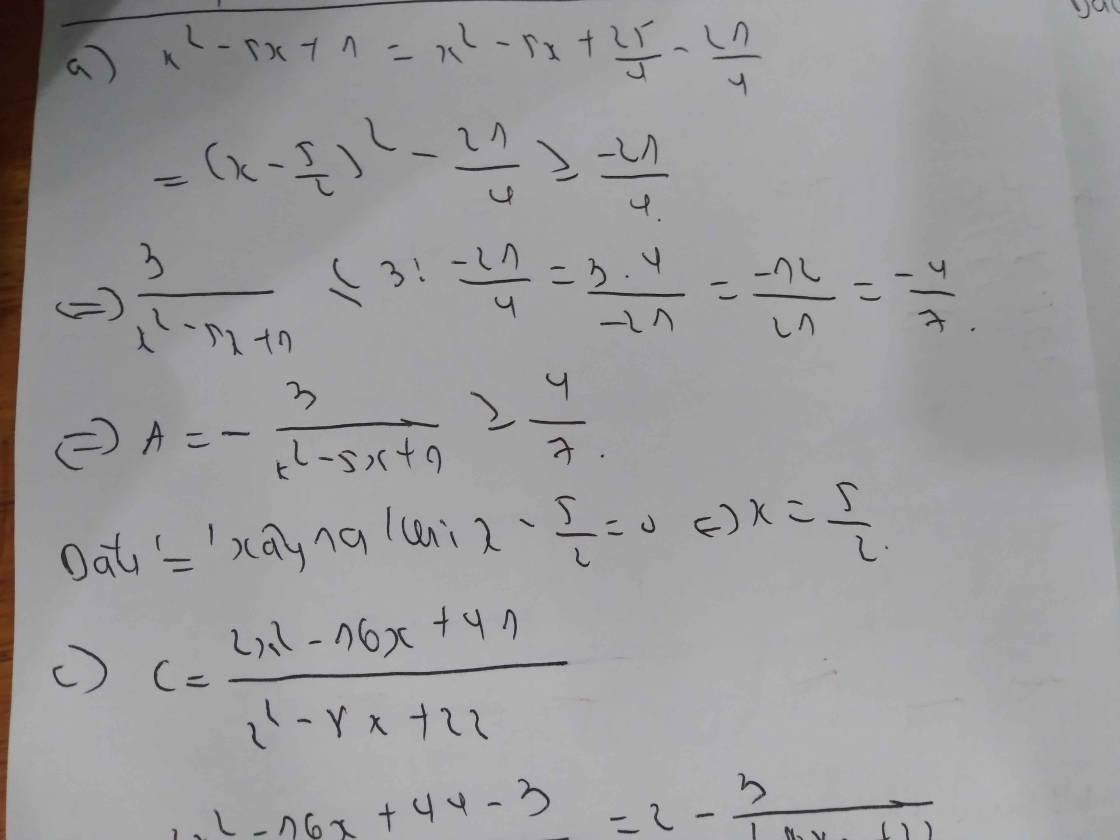
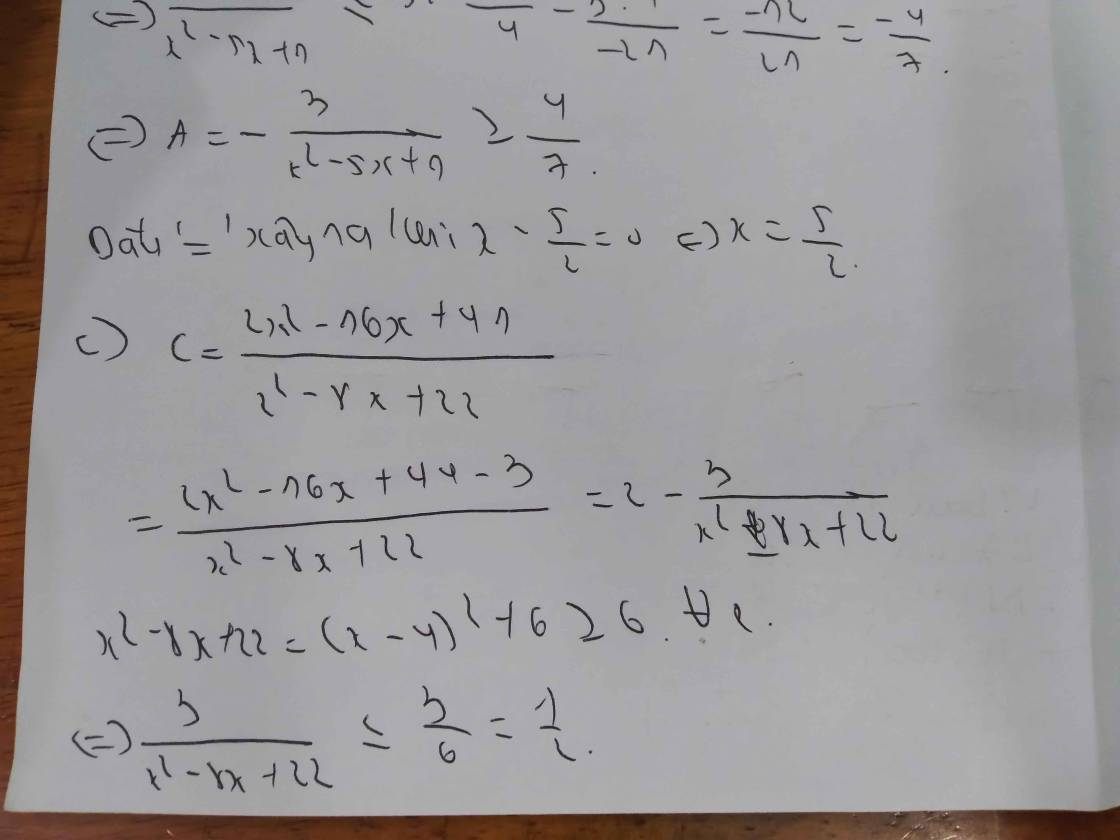
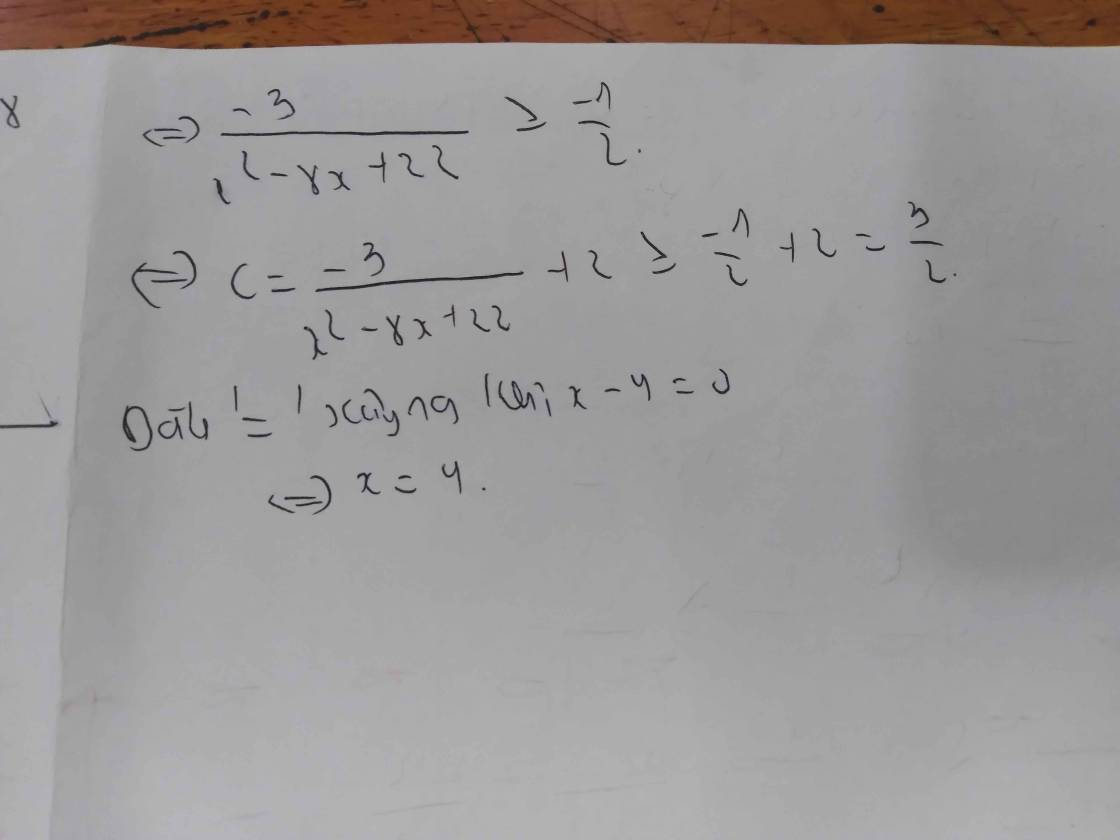
Ta có �2−4�+9=(�−2)2+5⩾5x2−4x+9=(x−2)2+5⩾5.
Suy ra �=1�2−4�+9=1(�−2)2+5⩽15B=x2−4x+91=(x−2)2+51⩽51.