
Tìm giá trị lớn nhất và nhỏ nhất của hàm số \(y=\sqrt{\left(sinx+cosx\right)^2+2sinx.cosx+2}\)
K
Khách
Hãy nhập câu hỏi của bạn vào đây, nếu là tài khoản VIP, bạn sẽ được ưu tiên trả lời.

Những câu hỏi liên quan
NL
Nguyễn Lê Phước Thịnh
CTVHS
16 tháng 7
1: \(-1<=cosx\le1\)
=>\(-3\le-3\cdot cosx\le3\)
=>\(-3+5\le-3\cdot cosx+5\le3+5\)
=>2<=y<=8
y min=2 khi cosx=1
=>\(x=k2\pi\)
y min=8 khi cosx=-1
=>\(x=\pi+k2\pi\)
3: \(y=cos^2x+2\cdot cos2x\)
\(=\frac{1+cos2x}{2}+2\cdot cos2x=2,5\cdot cos2x+0,5\)
Ta có: \(-1\le cos2x\le1\)
=>\(-2,5\le2,5cos2x\le2,5\)
=>\(-2,5+0,5\le2,5cos2x+0,5\le2,5+0,5\)
=>-2<=y<=3
y min=-2 khi cos2x=-1
=>\(2x=\pi+k2\pi\)
=>\(x=\frac{\pi}{2}+k\pi\)
y max=3 khi cos2x=1
=>\(2x=k2\pi\)
=>\(x=k\pi\)
6: \(y=\sqrt3\cdot\sin x-cosx-2\)
\(=2\left(\frac{\sqrt3}{2}\cdot\sin x-\frac12\cdot cosx\right)-2=2\cdot\sin\left(x-\frac{\pi}{6}\right)-2\)
Ta có: \(-1\le\sin\left(x-\frac{\pi}{6}\right)\le1\)
=>\(-2\le2\sin\left(x-\frac{\pi}{6}\right)\le2\)
=>\(-2-2\le2\sin\left(x-\frac{\pi}{6}\right)-2\le2-2\)
=>-4<=y<=0
y min=-4 khi \(\sin\left(x-\frac{\pi}{6}\right)=-1\)
=>\(x-\frac{\pi}{6}=-\frac{\pi}{2}+k2\pi\)
=>\(x=-\frac{\pi}{2}+\frac{\pi}{6}+k2\pi=-\frac26\pi+k2\pi=-\frac13\pi+k2\pi\)
y max=0 khi \(\sin\left(x-\frac{\pi}{6}\right)=1\)
=>\(x-\frac{\pi}{6}=\frac{\pi}{2}+k2\pi\)
=>\(x=\frac23\pi+k2\pi\)
1 tháng 7 2021
\(ĐK:sinx-cosx\ne-2\)
\(< =>2y-1=sinx\left(1-y\right)+cosx\left(y+3\right)\)
Theo Bunhiacopxki:
\(\left[sinx\left(1-y\right)+cosx\left(y+3\right)\right]^2\)\(\le\left(sin^2x+cos^2x\right)\left[\left(1-y\right)^2+\left(y+3\right)^2\right]\)
\(< =>\left(2y-1\right)^2\le2y^2+4y+10\)
\(< =>2y^2-8y-9\le0\)
=> Bấm máy tìm Max, Min của y
(Sry máy tính của t bị ngáo không bấm ra)
1 tháng 7 2021
\(\Rightarrow y.sinx-y.cosx+2y=sinx+3cosx+1\)
\(\Rightarrow\left(y-1\right)sinx-\left(y+3\right)cosx=1-2y\)
Theo điều kiện có nghiệm của pt lượng giác bậc nhất
\(\Rightarrow\left(y-1\right)^2+\left(y+3\right)^2\ge\left(1-2y\right)^2\)
\(\Leftrightarrow2y^2-8y-9\le0\)
\(\Rightarrow\dfrac{4-\sqrt{34}}{2}\le y\le\dfrac{4+\sqrt{34}}{2}\)
\(y_{max}=\dfrac{4+\sqrt{34}}{2}\) ; \(y_{min}=\dfrac{4-\sqrt{34}}{2}\)
1 tháng 9 2021
y = \(\dfrac{sin^2x}{cosx\left(sinx-cosx\right)}+\dfrac{1}{4}\)
y = \(\dfrac{sin^2x}{sinx.cosx-cos^2x}+\dfrac{1}{4}=\dfrac{\dfrac{sin^2x}{cos^2x}}{\dfrac{sinx.cosx}{cos^2x}-1}+\dfrac{1}{4}\)
y = \(\dfrac{tan^2x}{tanx-1}+\dfrac{1}{4}\)
y = \(\dfrac{4tan^2x+tanx-1}{4tanx-4}\). Đặt t = tanx. Do x ∈ \(\left(\dfrac{\pi}{4};\dfrac{\pi}{2}\right)\) nên t ∈ (1 ; +\(\infty\))\
Ta đươc hàm số f(t) = \(\dfrac{4t^2+t-1}{4t-4}\)
⇒ ymin = \(\dfrac{17}{4}\) khi t = 2. hay x = arctan(2) + kπ
11 tháng 9 2021
1. Không dịch được đề
2.
\(-1\le cos2x\le1\Rightarrow1\le y\le3\)
3.
a. \(-2\le2sinx\le2\Rightarrow-1\le y\le3\)
\(y_{min}=-1\) khi \(sinx=-1\Rightarrow x=-\dfrac{\pi}{2}+k2\pi\)
\(y_{max}=3\) khi \(sinx=1\Rightarrow x=\dfrac{\pi}{2}+k2\pi\)
b.
\(0\le cos^2x\le1\Rightarrow-1\le y\le2\)
\(y_{min}=-1\) khi \(cos^2x=1\Rightarrow x=k\pi\)
\(y_{max}=2\) khi \(cosx=0\Rightarrow x=\dfrac{\pi}{2}+k\pi\)
4.
\(y=\left(tanx-1\right)^2+2\ge2\)
\(y_{min}=2\) khi \(tanx=1\Rightarrow x=\dfrac{\pi}{4}+k\pi\)
CM
22 tháng 6 2018
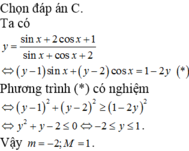
Đáp án C
Đặt t = tan x 2 ta có: y = sin x + 2 cos x + 1 s i n x + cos x + 2
= 2 t 1 + t 2 + 2 1 − t 2 1 + t 2 + 1 2 t 1 + t 2 + 1 − t 2 1 + t 2 + 2 = − t 2 + 2 t + 3 t 2 + 2 t + 3
Tập các giá trị của y là tập các giá tri làm cho PT y = − t 2 + 2 t + 3 t 2 + 2 t + 3 ⇔ y + 1 t + 2 y − 1 t + 3 y − 1 = 0 có nghiệm với ẩn t
⇒ Δ ' = y − 1 2 − 3 y + 1 y − 1 = − 2 y 2 − 2 y + 4 ≥ 0 ⇒ − 2 ≤ y ≤ 1 ⇒ m = − 2 , M = 1
LA
1
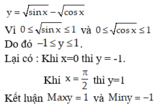
\(y=\sqrt{\left(sinx+cosx\right)^2+2\cdot sinx\cdot cosx+2}\)
\(=\sqrt{1+2sinx\cdot cosx+2\cdot sinx\cdot cosx+2}\)
\(=\sqrt{3+2sin2x}\)
\(-1< =sin2x< =1\)
=>\(-2< =2\cdot sin2x< =2\)
=>\(-2+3< =2\cdot sin2x+3< =5\)
=>\(1< =2\cdot sin2x+3< =5\)
=>\(1< =\sqrt{2\cdot sin2x+3}< =\sqrt{5}\)
=>\(1< =y< =\sqrt{5}\)
\(y_{min}=1\) khi \(sin2x=-1\)
=>\(2x=-\dfrac{\Omega}{2}+k2\Omega\)
=>\(x=-\dfrac{\Omega}{4}+k\Omega\)
\(y_{max}=\sqrt{5}\) khi sin 2x=1
=>\(2x=\dfrac{\Omega}{2}+k2\Omega\)
=>\(x=\dfrac{\Omega}{4}+k\Omega\)