
Cứu t với ạ =')))) t cảm ơn nhìu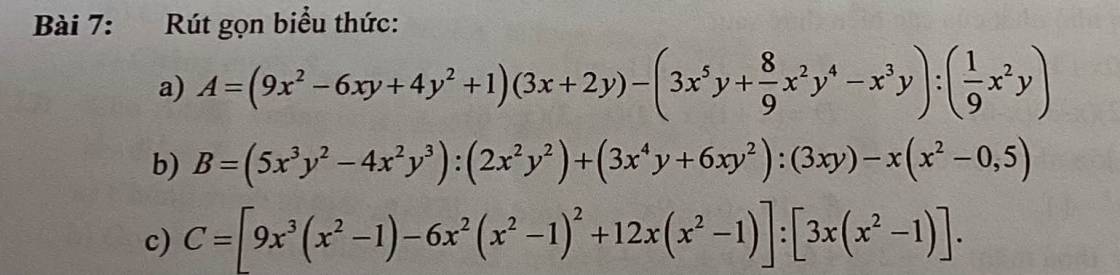
K
Khách
Hãy nhập câu hỏi của bạn vào đây, nếu là tài khoản VIP, bạn sẽ được ưu tiên trả lời.

Những câu hỏi liên quan
5 tháng 4 2022
I believe that with the improvement of technology, in the future there will be more modern transportation for humankind. There will be flying cars, trains that goes underwater,... anything we can imagine .Flying cars will make us be able to go with high-speed and less accidents. underwater trains will help us to travel overseas. There might be some disadvantages but those can help clear traffic due to the growth of today's population. Moreover, transport will also improve its security. To sum up, future's mean of transport will be better.
nếu ok thì cho mình like nha, nếu không ok thì không cho. :)

TK

0
P
3 tháng 7 2023
\(\left(0,5\times m-0,75\right):4=2,5\)
\(0,5\times m-0,75=2,5\times4\)
\(0,5\times m-0,75=10\)
\(0,5\times m=10+0,75\)
\(0,5\times m=10,75\)
\(m=10,75:0,5\)
\(m=21,5\)
3 tháng 7 2023
`@` `\text {Ans}`
`\downarrow`
`(0,5 \times m - 0,75) \div 4 = 2,5`
`=> 0,5 \times m - 0,75 = 2,5 \times 4`
`=> 0,5 \times m - 0,75 = 10`
`=> 0,5 \times m = 10 + 0,75`
`=> 0,5 \times m = 10,75`
`=> m = 10,75 \div 0,5`
`=> m =21,5`
Vậy, `m=21,5`.
GX
1
25 tháng 10 2023
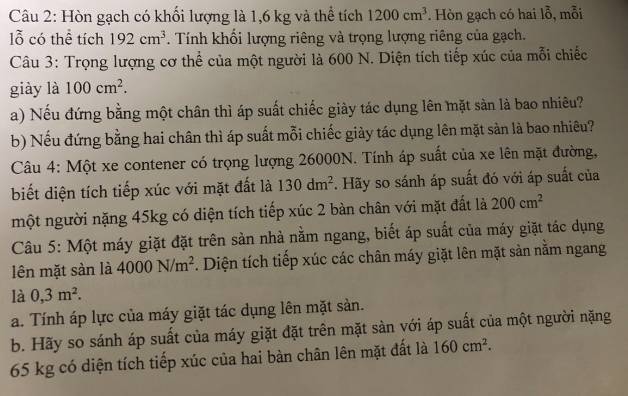
Câu 2.
Khối lượng riêng của hòn gạch:
\(D=\dfrac{m}{V}=\dfrac{1,6}{\left(1200-2\cdot192\right)\cdot10^{-6}}\approx1961kg/m^3\)
Trọng lượng riêng của gạch:
\(d=10D\approx19610\left(N/m^3\right)\)
Câu 3.
a)Nếu đứng bằng một chân thì áp suất chiếc giày tác dụng lên mặt sàn:
\(p_1=\dfrac{F}{S_1}=\dfrac{P}{S_1}=\dfrac{600}{100\cdot10^{-4}}=60000Pa\)
b)Nếu đứng bằng một chân thì áp suất mỗi chiếc giày tác dụng lên mặt sàn:
\(p_2=\dfrac{F}{S_2}=\dfrac{P}{S_2}=\dfrac{600}{2\cdot100\cdot10^{-4}}=30000Pa\)
Câu 4.
Áp suất của xe tác dụng lên mặt đường:
\(p=\dfrac{F}{S}=\dfrac{26000}{130\cdot10^{-2}}=20000N/m^2\)
Trọng lượng của người đó: \(P=10m=10\cdot45=450N\)
Áp suất của người tác dụng hai chân lên mặt đất:
\(p'=\dfrac{P}{S'}=\dfrac{450}{200\cdot10^{-2}}=225N/m^2\)
Như vậy \(p>p'\).
Câu 5.
a)Áp lực của máy giặt tác dụng lên sàn:
\(F=p\cdot S=4000\cdot0,3=1200N\)
b)Trọng lượng người đó: \(P=10m=10\cdot65=650N\)
Áp suất của máy giặt đặt trên mặt sàn:
\(p'=\dfrac{P}{S'}=\dfrac{650}{160\cdot10^{-4}}=40625N/m^2\)
Vậy \(p< < < p'\).
NL
Nguyễn Lê Phước Thịnh
CTVHS
10 tháng 5 2022
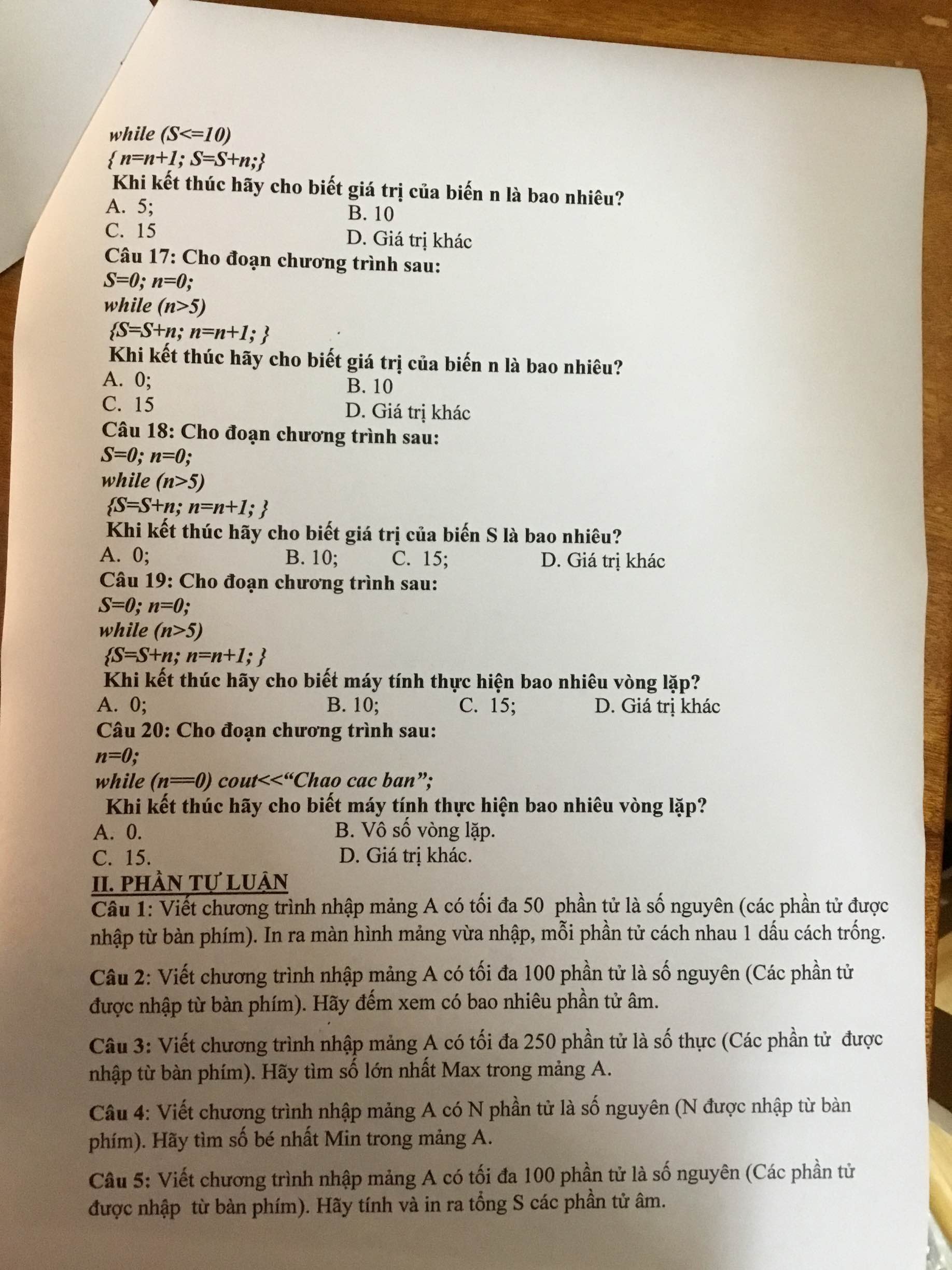
Câu 1:
#include <bits/stdc++.h>
using namespace std;
long long a[1000],i,n;
int main()
{
cin>>n;
for (i=1; i<=n; i++) cin>>a[i];
for (i=1; i<=n; i++) cout<<a[i]<<" ";
return 0;
}


14 tháng 3 2022
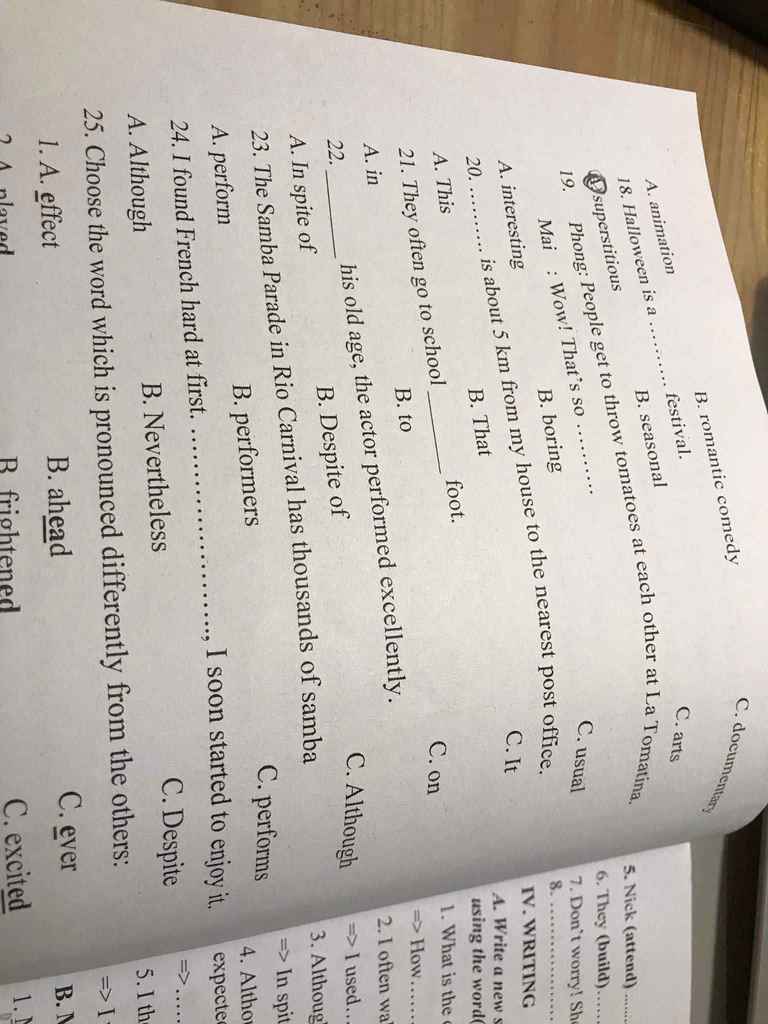
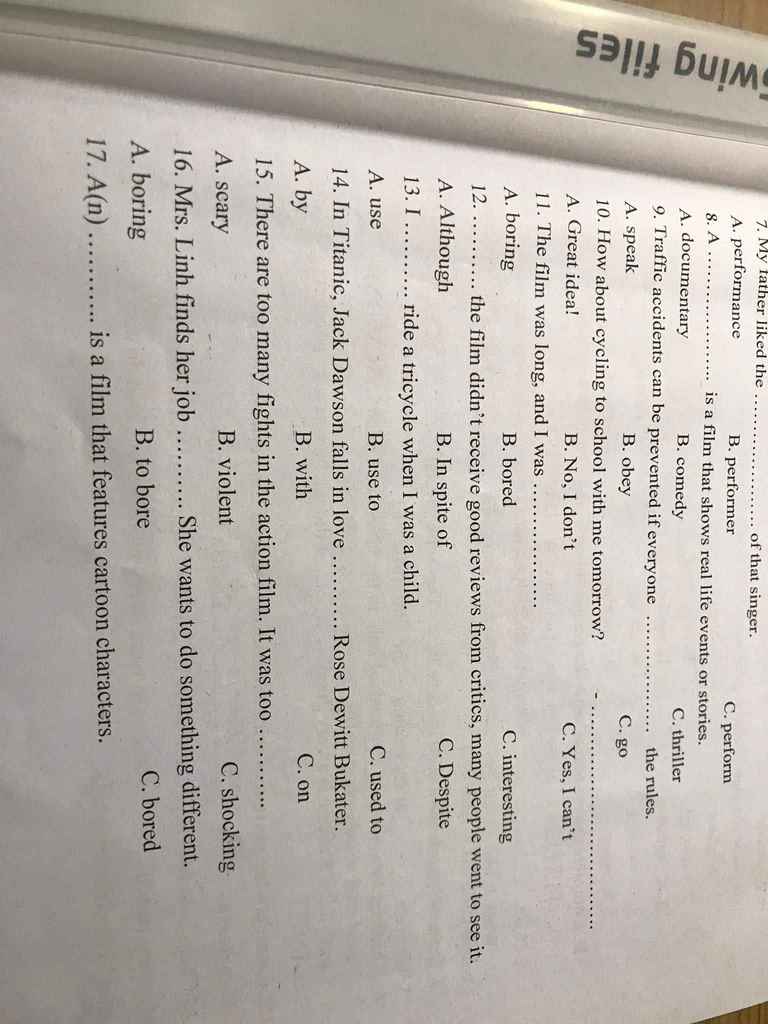
1.A
2.A
3.B
4.C
5.B
6.C
7.A
8.A
9.B
10.A
11.B
12.A
13.C
14.B
15.B
16.A
17.A
18.A
19.A
20.C

NL
Nguyễn Lê Phước Thịnh
CTVHS
29 tháng 1 2024
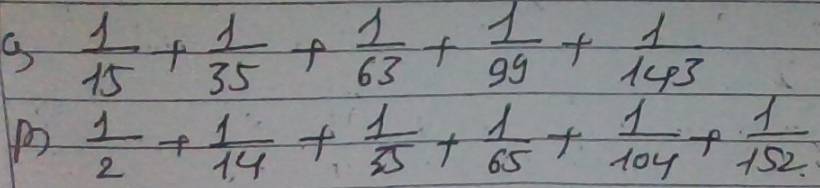
o: \(\dfrac{1}{15}+\dfrac{1}{35}+\dfrac{1}{63}+\dfrac{1}{99}+\dfrac{1}{143}\)
\(=\dfrac{1}{3\cdot5}+\dfrac{1}{5\cdot7}+\dfrac{1}{7\cdot9}+\dfrac{1}{9\cdot11}+\dfrac{1}{11\cdot13}\)
\(=\dfrac{1}{2}\left(\dfrac{2}{3\cdot5}+\dfrac{2}{5\cdot7}+\dfrac{2}{7\cdot9}+\dfrac{2}{9\cdot11}+\dfrac{2}{11\cdot13}\right)\)
\(=\dfrac{1}{2}\left(\dfrac{1}{3}-\dfrac{1}{5}+\dfrac{1}{5}-\dfrac{1}{7}+...+\dfrac{1}{11}-\dfrac{1}{13}\right)\)
\(=\dfrac{1}{2}\left(\dfrac{1}{3}-\dfrac{1}{13}\right)=\dfrac{1}{2}\cdot\dfrac{10}{39}=\dfrac{5}{39}\)
p: \(\dfrac{1}{2}+\dfrac{1}{14}+\dfrac{1}{35}+\dfrac{1}{65}+\dfrac{1}{104}+\dfrac{1}{152}\)
\(=\dfrac{2}{4}+\dfrac{2}{28}+\dfrac{2}{70}+\dfrac{2}{130}+\dfrac{2}{208}+\dfrac{2}{304}\)
\(=\dfrac{2}{1\cdot4}+\dfrac{2}{4\cdot7}+\dfrac{2}{7\cdot10}+\dfrac{2}{10\cdot13}+\dfrac{2}{13\cdot16}+\dfrac{2}{16\cdot19}\)
\(=\dfrac{2}{3}\left(\dfrac{3}{1\cdot4}+\dfrac{3}{4\cdot7}+...+\dfrac{3}{16\cdot19}\right)\)
\(=\dfrac{2}{3}\left(1-\dfrac{1}{4}+\dfrac{1}{4}-\dfrac{1}{7}+...+\dfrac{1}{16}-\dfrac{1}{19}\right)\)
\(=\dfrac{2}{3}\left(1-\dfrac{1}{19}\right)=\dfrac{2}{3}\cdot\dfrac{18}{19}=\dfrac{2\cdot6}{19}=\dfrac{12}{19}\)
a) \(A=\left(9x^2-6xy+4y^2+1\right)\left(3x+2y\right)-\left(3x^5y+\dfrac{8}{9}x^2y^4-x^3y\right):\left(\dfrac{1}{9}x^2y\right)\)
\(=3x\left(9x^2-6xy+4y^2+1\right)+2y\left(9x^2-6xy+4y^2+1\right)-\left(3x^5y:\dfrac{1}{9}x^2y+\dfrac{8}{9}x^2y^4:\dfrac{1}{9}x^2y-x^3y:\dfrac{1}{9}x^2y\right)\)\(=27x^3-18x^2y+12xy^2+3x+18x^2y-12xy^2+8y^3+2y-27x^3-8y^3+9x\)
\(=12x+2y\)
b) \(B=\left(5x^3y^2-4x^2y^3\right):2x^2y^2+\left(3x^4y+6xy^2\right):3xy-x\left(x^2-0,5\right)\)
\(=5x^3y^2:2x^2y^2-4x^2y^3:2x^2y^2+3x^4y:3xy+6xy^2:3xy-x^3+0,5x\)
\(=2,5x-2y+x^3+2y-x^3+0,5x\)
\(=2,5x+0,5x\)
\(=3x\)
c) \(C=\left[9x^3\left(x^2-1\right)-6x^2\left(x^2-1\right)^2+12x\left(x^2-1\right)\right]:3x\left(x^2-1\right)\)
\(=9x^3\left(x^2-1\right):3x\left(x^2-1\right)-6x^2\left(x^2-1\right)^2:3x\left(x^2-1\right)+12x\left(x^2-1\right):3x\left(x^2-1\right)\)
\(=9x^3:3x-6x^2\left(x^2-1\right):3x+12x:3x\)
\(=3x^2-2x\left(x^2-1\right)+4\)
\(=-2x^3+3x^2+2x+4\)