
Tìm số hữu tỉ x , biết:
4.(2x+1)2=576
K
Khách
Hãy nhập câu hỏi của bạn vào đây, nếu là tài khoản VIP, bạn sẽ được ưu tiên trả lời.
PG
3

Những câu hỏi liên quan
NL
Nguyễn Lê Phước Thịnh
CTVHS
10 tháng 9 2021
Bài 2:
a: Ta có: \(2^{x+1}\cdot3^y=12^x\)
\(\Leftrightarrow2^{x+1}\cdot3^y=2^{2x}\cdot3^x\)
\(\Leftrightarrow\left\{{}\begin{matrix}x+1=2x\\x=y\end{matrix}\right.\Leftrightarrow\left\{{}\begin{matrix}x=1\\y=1\end{matrix}\right.\)
UN
4
13 tháng 9 2025
chắc bạn đang học lớp 7 nên mik sẽ giải kiểu lớp 7 nha
mỗi câu mik chia làm 2 bài nhé!
Bài 1. Tìm \(\left(\right. x , y \left.\right) \in \mathbb{Q}^{2}\)
(a) \(x + 3 y - x \sqrt{5} = y \sqrt{5} + 7\)
\(\Rightarrow - \left(\right. x + y \left.\right) \sqrt{5} = 7 - x - 3 y\).
Vế trái vô tỉ (nếu \(x + y \neq 0\)), vế phải hữu tỉ.
\(\Rightarrow x + y = 0 , \textrm{ }\textrm{ } 7 - x - 3 y = 0\).
\(\Rightarrow x = - y , \textrm{ }\textrm{ } 7 + y - 3 y = 0 \Rightarrow y = \frac{7}{2} , x = - \frac{7}{2}\).
Đáp số: \(\left(\right. - \frac{7}{2} , \frac{7}{2} \left.\right)\).
(b) \(5 x + y - \left(\right. 2 x - 1 \left.\right) \sqrt{7} = y \sqrt{7} + 2\).
\(\Rightarrow - \left(\right. 2 x + y - 1 \left.\right) \sqrt{7} = 2 - 5 x - y\).
\(\Rightarrow 2 x + y - 1 = 0 , \textrm{ }\textrm{ } 2 - 5 x - y = 0\).
Giải hệ:
\(\left{\right. 2 x + y = 1 \\ 5 x + y = 2 \Rightarrow x = \frac{1}{3} , y = \frac{1}{3} .\)
Đáp số: \(\left(\right. \frac{1}{3} , \frac{1}{3} \left.\right)\).
Bài 2. Tìm \(\left(\right. x , y \left.\right) \in \mathbb{Q}^{2}\)
(a) \(x + y + 61 = 10 \sqrt{x} + 12 \sqrt{y}\).
Đặt \(x = a^{2} , y = b^{2}\).
\(\Rightarrow a^{2} + b^{2} + 61 = 10 a + 12 b\).
Thử \(a = 5 , b = 6\): \(25 + 36 + 61 = 122 , \textrm{ }\textrm{ } 10 \cdot 5 + 12 \cdot 6 = 122\).
Đáp số: \(\left(\right. 25 , 36 \left.\right)\).
(b) \(2 x + y + 4 = 2 \sqrt{x} \left(\right. \sqrt{y} + 2 \left.\right)\).
Đặt \(x = a^{2} , y = b^{2}\).
\(\Rightarrow 2 a^{2} + b^{2} + 4 = 2 a b + 4 a\).
\(\Rightarrow \left(\right. a - b \left.\right)^{2} + 2 \left(\right. a - 2 \left.\right) = 0\).
\(\Rightarrow a = 2 , b = 2\).
Đáp số: \(\left(\right. 4 , 4 \left.\right)\).
👉 Vậy:
- Bài 1(a): \(\left(\right. - 7 / 2 , 7 / 2 \left.\right)\).
- Bài 1(b): \(\left(\right. 1 / 3 , 1 / 3 \left.\right)\).
- Bài 2(a): \(\left(\right. 25 , 36 \left.\right)\).
- Bài 2(b): \(\left(\right. 4 , 4 \left.\right)\).
cho mik xin tick nha. Cảm ơn cậu !
GK
1
22 tháng 9 2020
a) \(\left|1-2x\right|>7\)
<=> \(\orbr{\begin{cases}1-2x>7\\1-2x< -7\end{cases}}\Leftrightarrow\orbr{\begin{cases}x< -3\\x>4\end{cases}}\)
b) Lập bảng:
x+2 -2 4-x x-2 4 2 1 (x-1)^2 0 0 0 0 0 0 0 0 0 0 0 0 0 0 + - + + + + + + + + + + + + + + + - - - - - - - - - - - - - - - - - + + +
Ta có: (x-2)(x+2)(4-x)(x-1)2 \(\le\)0
<=> \(\orbr{\begin{cases}-2\le x\le2\\x\ge4\end{cases}}\)
NL
Nguyễn Lê Phước Thịnh
CTVHS
1 tháng 5 2021
Bài 1:
Ta có: \(3x=2y\)
nên \(\dfrac{x}{2}=\dfrac{y}{3}\)
mà x+y=-15
nên Áp dụng tính chất của dãy tỉ số bằng nhau, ta được:
\(\dfrac{x}{2}=\dfrac{y}{3}=\dfrac{x+y}{2+3}=\dfrac{-15}{5}=-3\)
Do đó:
\(\left\{{}\begin{matrix}\dfrac{x}{2}=-3\\\dfrac{y}{3}=-3\end{matrix}\right.\Leftrightarrow\left\{{}\begin{matrix}x=-6\\y=-9\end{matrix}\right.\)
Vậy: (x,y)=(-6;-9)
NL
Nguyễn Lê Phước Thịnh
CTVHS
1 tháng 5 2021
Bài 2:
a) Ta có: \(\dfrac{x}{4}=\dfrac{y}{3}=\dfrac{z}{5}\)
mà x+y-z=20
nên Áp dụng tính chất của dãy tỉ số bằng nhau, ta được:
\(\dfrac{x}{4}=\dfrac{y}{3}=\dfrac{z}{5}=\dfrac{x+y-z}{4+3-5}=\dfrac{20}{2}=10\)
Do đó:
\(\left\{{}\begin{matrix}\dfrac{x}{4}=10\\\dfrac{y}{3}=10\\\dfrac{z}{5}=10\end{matrix}\right.\Leftrightarrow\left\{{}\begin{matrix}x=40\\y=30\\z=50\end{matrix}\right.\)
Vậy: (x,y,z)=(40;30;50)
LV
27 tháng 8 2016
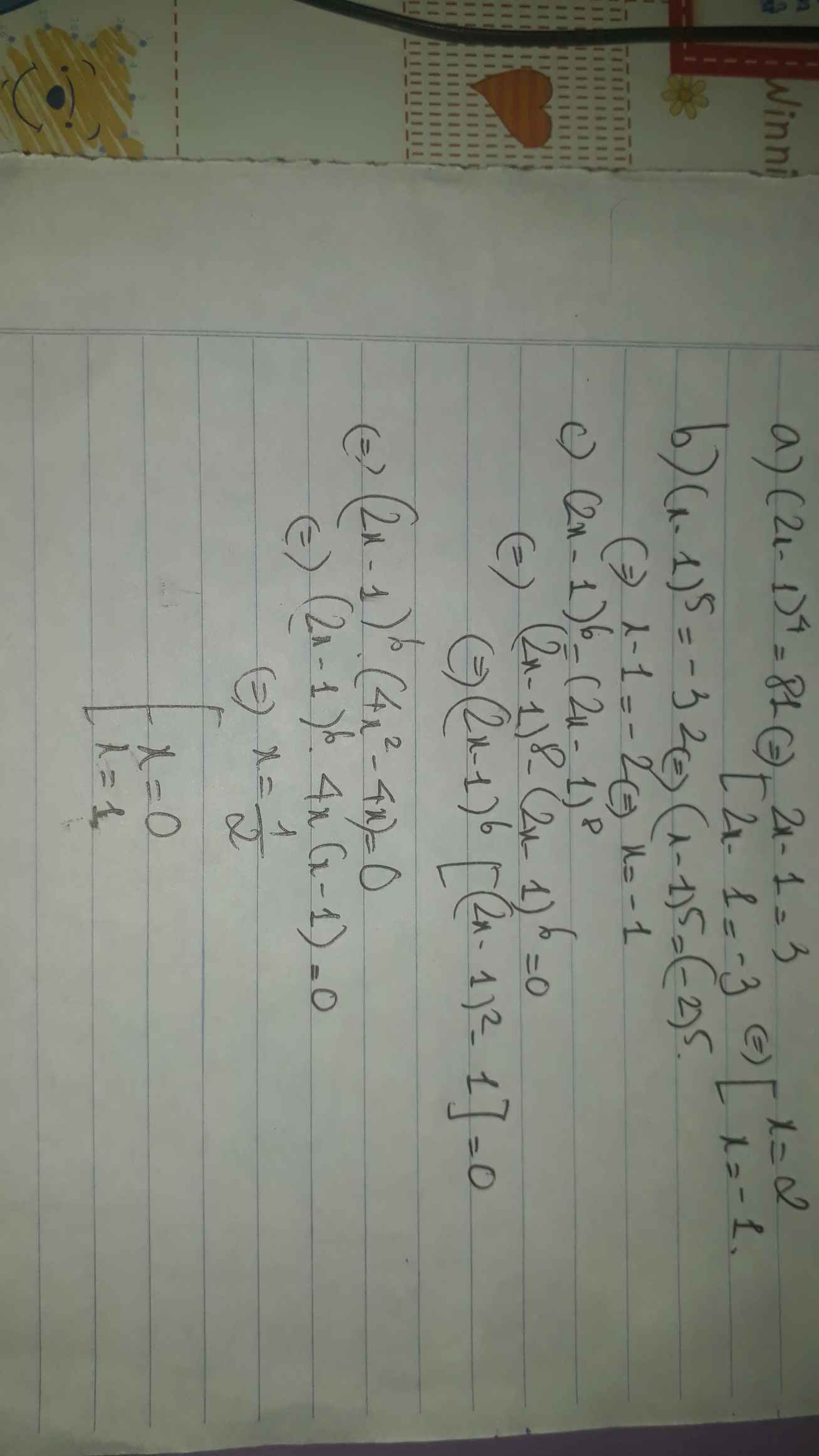
(2x-1)^6=(2x-1)^8'
=> (2x-1)=1 hoặc (2x-1)=0
(2x-1)=1 =>2x=2 =>x=1
(2x-1)=0 =>2x=1 =>x=0,5
\(4\left(2x+1\right)^2=576\)
\(\left(2x+1\right)^2=\dfrac{576}{4}=144=12^2\)
\(\Leftrightarrow\left[{}\begin{matrix}2x+1=12\\2x+1=-12\end{matrix}\right.\)
\(\Leftrightarrow\left[{}\begin{matrix}2x=11\\2x=-13\end{matrix}\right.\)
\(\Leftrightarrow\left[{}\begin{matrix}x=\dfrac{11}{2}\\x=-\dfrac{13}{2}\end{matrix}\right.\)
\(4\cdot(2x+1)^2=576\\\Rightarrow (2x+1)^2=576:4\\\Rightarrow(2x+1)^2=144\\\Rightarrow(2x+1)^2=(\pm12)^2\)
\(\Rightarrow\left[{}\begin{matrix}2x+1=12\\2x+1=-12\end{matrix}\right.\)
\(\Rightarrow\left[{}\begin{matrix}2x=11\\2x=-13\end{matrix}\right.\)
\(\Rightarrow\left[{}\begin{matrix}x=\dfrac{11}{2}\\x=-\dfrac{13}{2}\end{matrix}\right.\)
Vậy: \(x\in\left\{-\dfrac{13}{2};\dfrac{11}{2}\right\}\)