
em xin giải chi tiết bài này em cảm ơn ạaaTT
Hãy nhập câu hỏi của bạn vào đây, nếu là tài khoản VIP, bạn sẽ được ưu tiên trả lời.

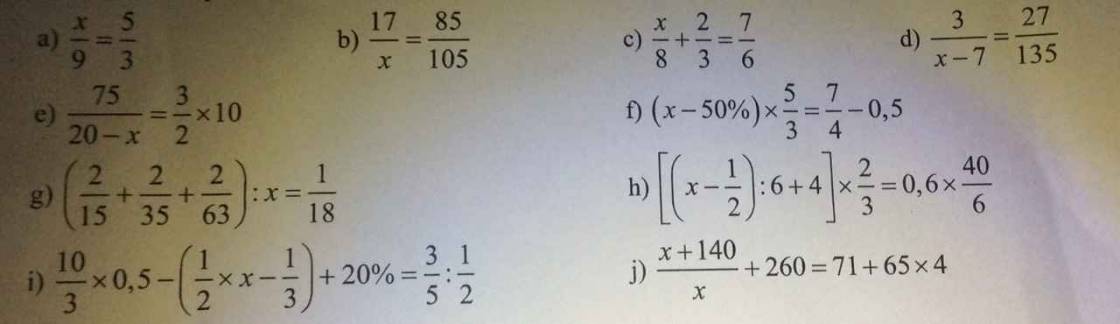
\(a,\dfrac{x}{9}=\dfrac{5}{3}\\ \Leftrightarrow x=9\cdot\dfrac{5}{3}\\ \Leftrightarrow x=15\\ b,\dfrac{17}{x}=\dfrac{85}{105}\\ \Leftrightarrow x=17\cdot\dfrac{105}{85}\\ \Leftrightarrow x=21\\ c,\dfrac{x}{8}+\dfrac{2}{3}=\dfrac{7}{6}\\ \Leftrightarrow\dfrac{x}{8}=\dfrac{1}{2}\\ \Leftrightarrow x=4\\ d,\dfrac{3}{x-7}=\dfrac{27}{135}\\ \Leftrightarrow x-7=15\\ \Leftrightarrow x=22\)
\(e,\dfrac{75}{20-x}=\dfrac{3}{2}\times10\\ \Leftrightarrow\dfrac{75}{20-x}=15\\ \Leftrightarrow20-x=5\\ \Leftrightarrow x=15\\ f,\left(x-50\%\right)\times\dfrac{5}{3}=\dfrac{7}{4}-0,5\\ \Leftrightarrow\left(x-\dfrac{1}{2}\right)\times\dfrac{5}{3}=\dfrac{5}{4}\\ \Leftrightarrow x-\dfrac{1}{2}=\dfrac{3}{4}\\ \Leftrightarrow x=\dfrac{5}{4}\\ g,\left(\dfrac{2}{15}+\dfrac{3}{35}+\dfrac{2}{63}\right):x=\dfrac{1}{18}\\ \Leftrightarrow\dfrac{2}{9}:x=\dfrac{1}{18}\\ \Leftrightarrow x=4\)
\(h,\left[\left(x-\dfrac{1}{2}\right):6+4\right]\times\dfrac{2}{3}=0,6\times\dfrac{40}{6}\\ \Leftrightarrow\left[\left(x-\dfrac{1}{2}\right):6+4\right]\times\dfrac{2}{3}=4\\ \Leftrightarrow\left(x-\dfrac{1}{2}\right):6+4=6\\ \Leftrightarrow\left(x-\dfrac{1}{2}\right):6=2\\ \Leftrightarrow x-\dfrac{1}{2}=12\\ \Leftrightarrow x=\dfrac{25}{2}\)
3 ) Ngày thứ nhất cửa bán được
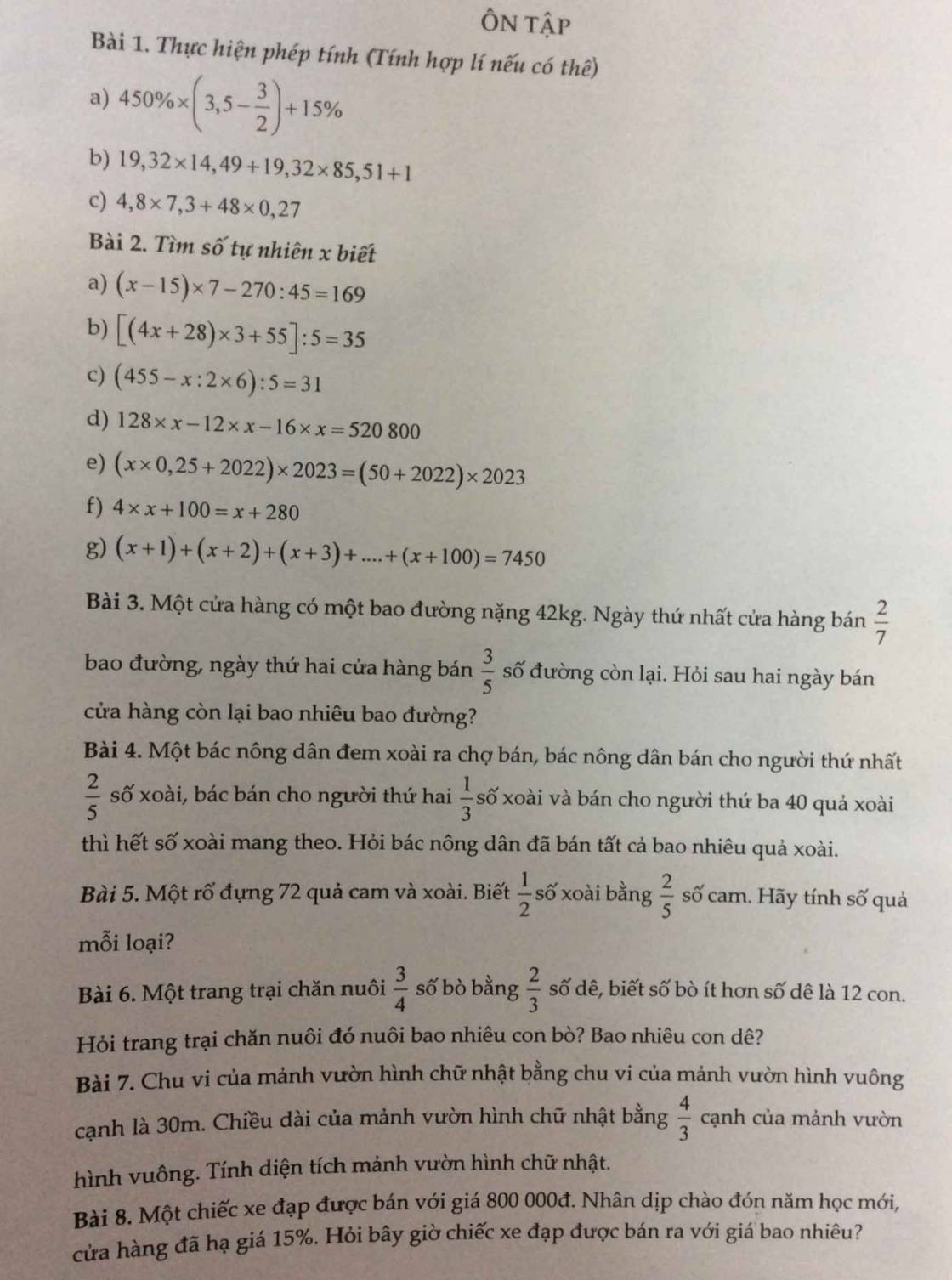
42 x \(\dfrac{2}{7}=12\) (bao đường)
Ngày thứ hai cửa hàng bán được
(42 - 12) x \(\dfrac{3}{5}\) = 18 (bao đường)
Cửa hàng còn lại số bao đường
42 - 12 - 18 = 12 (bao đường)
Đáp số 12 bao đường
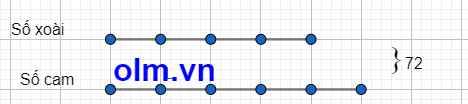
Tỉ số cam và xoài là
\(\dfrac{1}{2}:\dfrac{2}{5}=\dfrac{5}{4}\)
Số cam là
72: ( 5+4) x 5 = 40 (cam)
Số xoài là
72 - 40 = 32 (xoài)
Đáp số : xoài 32 quả
cam 40 quả
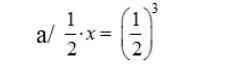
\(x=\left(\dfrac{1}{2}\right)^3:\left(\dfrac{1}{2}\right)=\left(\dfrac{1}{2}\right)^{3-1}=\left(\dfrac{1}{2}\right)^2=\dfrac{1}{4}\)
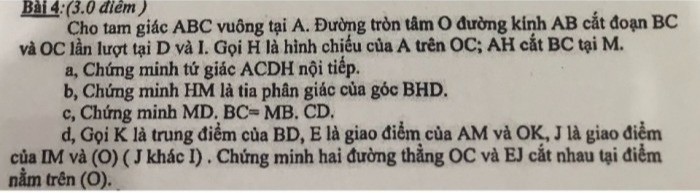
a: Xét (O) có
ΔADB nội tiếp
AB là đường kính
Do đó: ΔADB vuông tại D
=>AD⊥BC tại D
Xét tứ giác AHDC có \(\hat{AHC}=\hat{ADC}=90^0\)
nên AHDC là tứ giác nội tiếp
b: AHDC nội tiếp
=>\(\hat{AHD}+\hat{ACD}=180^0\)
mà \(\hat{AHD}+\hat{MHD}=180^0\) (hai góc kề bù)
nên \(\hat{MHD}=\hat{ACD}=\hat{ACB}\)
Xét ΔOAC vuông tại A có AH là đường cao
nên \(OH\cdot OC=OA^2\)
=>\(OH\cdot OC=OB^2\)
=>\(\frac{OH}{OB}=\frac{OB}{OC}\)
Xét ΔOHB và ΔOBC có
\(\frac{OH}{OB}=\frac{OB}{OC}\)
góc HOB chung
Do đó: ΔOHB~ΔOBC
=>\(\hat{OHB}=\hat{OBC}=\hat{ABC}\)
mà \(\hat{OHB}+\hat{MHB}=\hat{OHM}=90^0\) và \(\hat{ABC}+\hat{ACB}=90^0\) (ΔABC vuông tại A)
nên \(\hat{MHB}=\hat{ACB}\)
=>\(\hat{MHB}=\hat{DHM}\)
=>HM là phân giác của góc DHB
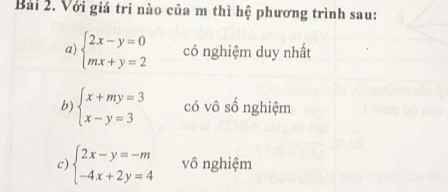
a.
Hệ có nghiệm duy nhất khi:
\(\dfrac{m}{2}\ne\dfrac{1}{-1}\Rightarrow m\ne-2\)
b.
Hệ có vô số nghiệm khi:
\(\dfrac{1}{1}=\dfrac{m}{-1}=\dfrac{3}{3}\Rightarrow m=-1\)
c.
Hệ vô nghiệm khi:
\(\dfrac{2}{-4}=\dfrac{-1}{2}\ne\dfrac{-m}{4}\Rightarrow m\ne2\)
\(n_{Fe}=\dfrac{5,6}{56}=0,1mol\)
\(n_S=\dfrac{4,8}{32}=0,15mol\)
\(Fe+S\underrightarrow{t^o}FeS\)
0,1 0,15 0,1
\(FeS+2HCl\rightarrow FeCl_2+H_2S\uparrow\)
0,1 0,1 0,1
\(V_Y=0,1\cdot22,4=2,24l\)
\(m_Z=m_{FeCl_2}=0,1\cdot127=12,7g\)
Bổ sung đề Nếu vòi 1 và vòi 3 cùng chảy thì sẽ đầy bể trong 20 giờ
Trong 1 giờ, vòi 1 và vòi 2 chảy được: \(\frac34:9=\frac{3}{36}=\frac{1}{12}\) (bể)
Trong 1 giờ, vòi 2 và vòi 3 chảy được: \(\frac{7}{12}:5=\frac{7}{60}\) (bể)
Trong 1 giờ, vòi 1 và vòi 3 chảy được: \(\frac{1}{20}\) (bể)
Trong 1 giờ, ba vòi chảy được: \(\left(\frac{1}{12}+\frac{7}{60}+\frac{1}{20}\right):2=\left(\frac{5}{60}+\frac{7}{60}+\frac{3}{60}\right):2=\frac{15}{60}:2=\frac14:2=\frac18\) (bể)
Thời gian ba vòi cùng chảy đầy bể là;
\(1:\frac18=8\) (giờ)=480(phút)
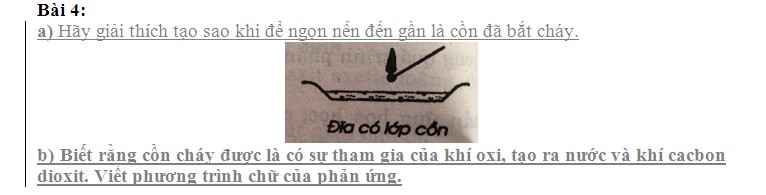 mấy anh chị giải chi tiết giùm em,em cần lời giải chi tiết ạ em xin cảm ơn
 giúp em bài này với ạ,giải chi tiết luôn nha,em cảm ơn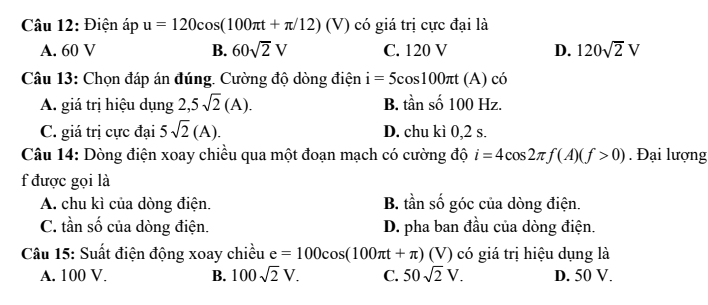
 giải chi tiết 3 bài này dùm em vs ạ


\(a,A=\dfrac{1}{1\times2}+\dfrac{1}{2\times3}+...+\dfrac{1}{99\times100}\\ =1-\dfrac{1}{2}+\dfrac{1}{2}-\dfrac{1}{3}+...+\dfrac{1}{99}-\dfrac{1}{100}\\ =1-\dfrac{1}{100}\\ =\dfrac{99}{100}\\ b,B=\dfrac{1}{1\times4}+\dfrac{1}{4\times7}+...+\dfrac{1}{97\times100}\\ =\dfrac{1}{3}\left(1-\dfrac{1}{4}+\dfrac{1}{4}-\dfrac{1}{7}+...+\dfrac{1}{97}-\dfrac{1}{100}\right)\\ =\dfrac{1}{3}\cdot\left(1-\dfrac{1}{100}\right)\\ =\dfrac{1}{3}\cdot\dfrac{99}{100}\\ =\dfrac{33}{100}\)
\(c,C=\dfrac{1}{2}+\dfrac{1}{4}+...+\dfrac{1}{128}\\ =\dfrac{1}{2}+\dfrac{1}{2^2}+...+\dfrac{1}{2^7}\\ \Rightarrow2C=1+\dfrac{1}{2}+...+\dfrac{1}{2^6}\\ \Rightarrow2C-C=1-\dfrac{1}{2^7}\\ \Rightarrow C=\dfrac{127}{128}\)
\(d,D=\dfrac{2}{1\times2}+\dfrac{2}{2\times3}+...+\dfrac{2}{99\times100}\\ =2\cdot\left(1-\dfrac{1}{2}+\dfrac{1}{2}-\dfrac{1}{3}+...+\dfrac{1}{99}-\dfrac{1}{100}\right)\\ =2\cdot\left(1-\dfrac{1}{100}\right)\\ =\dfrac{99}{55}\)
\(e,E=\dfrac{1}{10}+\dfrac{1}{40}+...+\dfrac{1}{340}\\ =\dfrac{1}{2\times5}+\dfrac{1}{5\times8}+...+\dfrac{1}{17\times20}\\ =\dfrac{1}{3}\cdot\left(\dfrac{1}{2}-\dfrac{1}{5}+\dfrac{1}{5}-\dfrac{1}{8}+...+\dfrac{1}{17}-\dfrac{1}{20}\right)\\ =\dfrac{1}{3}\cdot\left(\dfrac{1}{2}-\dfrac{1}{20}\right)\\ =\dfrac{1}{3}\cdot\dfrac{9}{20}\\ =\dfrac{3}{20}\)