
Giúp mình câu này với ạ:Talk about the way you use to communicate
K
Khách
Hãy nhập câu hỏi của bạn vào đây, nếu là tài khoản VIP, bạn sẽ được ưu tiên trả lời.

Những câu hỏi liên quan
NQ
Nguyễn Quốc Đạt
CTVVIP
21 tháng 6
Stress has become an inevitable part of modern life, but its persistent presence can severely damage a person’s well-being. To begin with, chronic stress takes a heavy toll on physical health. When the body remains in a constant state of high alert, it continuously releases hormones like cortisol and adrenaline, which can lead to high blood pressure, a weakened immune system, and an increased risk of heart disease over time.
Another type of negative impact is emotional and psychological exhaustion. Prolonged pressure frequently triggers severe anxiety, irritability, and mood swings, making it difficult to cope with minor daily challenges. Additionally, stress dramatically impairs cognitive function. It clouds mental clarity, reduces concentration, and harms memory retention, which directly lowers productivity at work or school.
The final way stress disrupts life is through the deterioration of personal relationships and behavioral habits. When overwhelmed, individuals often withdraw from social connections, experience disrupted sleep patterns, or turn to unhealthy coping mechanisms. Ultimately, managing stress is crucial, as its unchecked effects can diminish almost every aspect of a person's life.
NQ
Nguyễn Quốc Đạt
CTVVIP
21 tháng 6
Chào bạn, mình sẵn sàng giúp bạn hoàn thành bài luận này một cách tự nhiên và mạch lạc nhé.
Vì bạn đang học ngành kỹ nghệ phần mềm, mình sẽ chọn laptop làm công nghệ cốt lõi để viết. Bài viết dưới đây hoàn toàn sử dụng từ vựng và cấu trúc vừa vặn, tự nhiên, bám sát độ dài khoảng 200 từ theo đúng yêu cầu của đề bài.
In the modern educational landscape, technology plays an indispensable role in enhancing learning efficiency. As a software engineering student, the most essential piece of technology that drastically assists me in my studies is my laptop. It serves as an all-in-one workstation, enabling me to manage academic responsibilities and develop practical skills effectively.
To begin with, my laptop is the primary tool for my core programming tasks and coursework. It allows me to install heavy integrated development environments (IDEs) to write, debug, and run code for university projects. Without it, mastering complex software concepts or managing large databases would be nearly impossible. Additionally, this device acts as a gateway to an endless library of knowledge. I can easily access online documentation, research papers, and educational platforms to learn new frameworks or troubleshoot programming bugs.
Furthermore, my laptop significantly improves my productivity and collaboration with peers. It helps me organize study materials, write technical reports, and participate in group assignments through version control systems and online meeting tools. In conclusion, my laptop is not just a device for entertainment, but a powerful educational companion that prepares me for my future career.
VH
Ai giúp mình câu này đi
How about inviting her to the party ?
🡪Why don’t you ………………………………………………………………?
1
14 tháng 1 2022
\(\text{ How about inviting her to the party?}\)
\(\Rightarrow\text{Why don’t you invite her to the party?}\)
19 tháng 6 2019
In this paper, I would to discuss about the advantages and disadvantages of the internet. In the first place, the internet benefits us in many ways. It provides us with much information from every corner of the world. It helps us to know about what is happening on the earth and updates us with the most recent news. Also, the internet helps us to widen our social network with many friend in every country in the world. Through some programs such as Skype, facebook, Yahoo Messenger, etc, we have chance to make friend and talk to a variety of people. Moreover, it entertains us. Sometimes we can spend times listening to music or watching films on some websites. However, the internet also causes us many problems. The first one is to our health. Some people spend too much time searching and playing on the internet, which is not good for their brains and eyes. Next, it also prevents us from some activities such as reading books or going our with our friends. In addition, some programmes on the internet contain some bad content such as violence or sex which are not good for young people's mental lifem.
11 tháng 9 2023
1,
Everyday life: The life of Mongolian is punctuated by caring animals. A Mongolian nomadic family has five types of animals: horses and sheep for hot season and cows, camels and goats for cold season.
Several times during the year, according to the needs of livestock and pasture conditions, nomadic families move their yurts.
In summer, the nomadic family will favor a location near a river, to ensure water supply for the family and herds, and good pastures.
In winter, the priority is given to protection against the intense cold of Mongolian winter, and the family settles its "winter" camp sheltered from the wind in a small valley or at the edge of a forest.
The woman is very busy with the household, kitchen, 2 or 3 children, and milking the mares, cows... at least five times a day.
The husband watches the herds of yaks, horses, cows and sheep scattered on often significant surfaces and must gather them every night to protect them against the wolf attacks, frequent in Mongolia.
He also deals with equipment maintenance and repairs.
Ways of cooking: In traditional Mongolian cooking, seasoning was not used; although salt was there a long time and it is used it even in tea! Typically, they cook with a wok and most of the foods are either boiled or stir-fried.
Since a lot of livestock is raised in Mongolia, it is no mystery that Mongolian cuisine revolves around them. Sheep and goat are most popularly which are either grilled or boiled. Traditionally soup and dumplings used to be in all the courses of the meals, without which, it was regarded to be incomplete.
There are many types of crafts can be found in Mongolian culture: wooden sculptures, ger - nomadic dwelling, metalwork, embroidery art, leather crafting, art of jewelery.
The traditional masterpiece of Mongolian is the urtyn duu accompanied with the morin-khurr. Most famous Mongolian dance are: Jinai dance (milking dance), the Caihong dance (rainbow dance), the Zhongwan dance (bowl dance), the Kuaizi dance (chopsticks dance), and the Andai dance
There are lots of festival in Mongolia but these are the most well-known one: Tsagaan Sar (Lunar New Year); Khovsgol Ice Festival; Naadam Festival; Gongoriin Bombani Hural; Ölgii Eagle Festival.
2,
3,
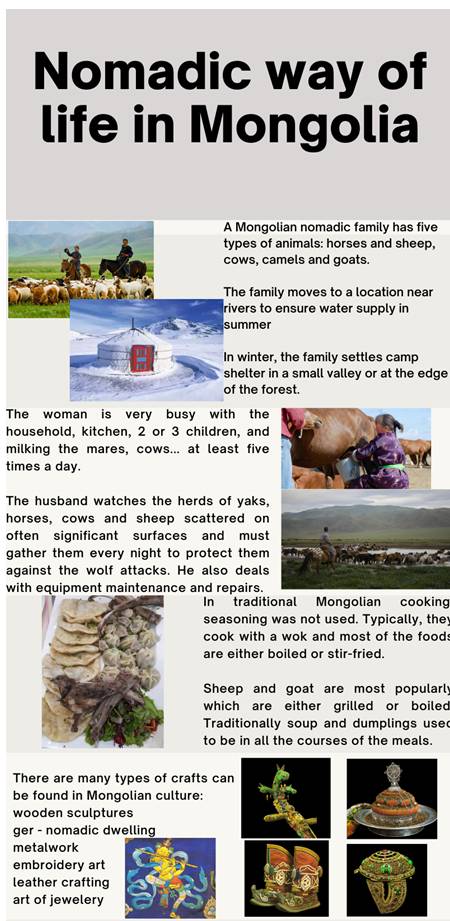
Hello everyone, today our group will introduce the nomadic way of life in Mongolia. The life of Mongolian family depends on the healths of herds and is punctuated by caring for animals.
Traditionally, a Mongolian nomadic family has five types of animals: horses and sheep, cows / yaks, camels and goats.
Several times during the year, according to the needs of livestock and pasture conditions, nomadic families move their yurts.
In summer, the nomadic family will favor a location near a river, to ensure water supply for the family and herds, and good pastures.
In winter, the priority is given to protection against the intense cold of Mongolian winter, and the family settles its "winter" camp sheltered from the wind in a small valley or at the edge of a forest.
The woman is very busy with the household, kitchen, 2 or 3 children, and milking the mares, cows... at least five times a day.
The processing of dairy products (cream, yogurt, liquor, milk, cheese ...) takes a long time as well.
The husband watches the herds of yaks, horses, cows and sheep scattered on often significant surfaces and must gather them every night to protect them against the wolf attacks, frequent in Mongolia. He also deals with equipment maintenance and repairs.
In traditional Mongolian cooking, seasoning was not used; although salt was there a long time and it is used it even in tea! Typically, they cook with a wok and most of the foods are either boiled or stir-fried. Sheep and goat are most popularly which are either grilled or boiled. Traditionally soup and dumplings used to be in all the courses of the meals.
There are many types of crafts can be found in Mongolian culture: wooden sculptures, ger - nomadic dwelling, metalwork, embroidery art, leather crafting, art of jewelery.
The traditional masterpiece of Mongolian is the urtyn duu accompanied with the morin-khurr. Most famous Mongolian dance are: Jinai dance (milking dance), the Caihong dance (rainbow dance), the Zhongwan dance (bowl dance), the Kuaizi dance (chopsticks dance), and the Andai dance
There are lots of festival in Mongolia but these are the most well-known one: Tsagaan Sar (Lunar New Year); Khovsgol Ice Festival; Naadam Festival; Gongoriin Bombani Hural; Ölgii Eagle Festival. Thanks for listening.
In today’s digital age, the way I communicate is a blend of modern technology and traditional face-to-face interactions. For daily conversations with friends, classmates, and family, my primary choices are instant messaging apps and social media platforms like Zalo, Messenger, or Discord. These tools allow me to send quick text updates, share study materials, and make video calls instantly, regardless of distance. When working on university group projects, I heavily rely on platforms like Slack or Discord because they help keep tasks organized and track discussions easily. However, despite the convenience of digital screens, I still believe that face-to-face communication is the most effective way to build deep connections. Meeting people in person allows me to read body language, feel genuine emotions, and avoid the misunderstandings that often happen through text. Balancing both methods helps me stay connected efficiently while maintaining meaningful relationships.