
(x2-x+1)(x2-x+2)=12
Giải dùm với ạ :))
Hãy nhập câu hỏi của bạn vào đây, nếu là tài khoản VIP, bạn sẽ được ưu tiên trả lời.

Bài 5:
a. 1 - 2y + y2
= (1 - y)2
b. (x + 1)2 - 25
= (x + 1)2 - 52
= (x + 1 - 5)(x + 1 + 5)
= (x - 4)(x + 6)
c. 1 - 4x2
= 12 - (2x)2
= (1 - 2x)(1 + 2x)
d. 8 - 27x3
= 23 - (3x)3
= (2 - 3x)(4 + 6x + 9x2)
e. (đề hơi khó hiểu ''x3'' !?)
g. x3 + 8y3
= (x + 2y)(x2 - 2xy + y2)
$=x^3-2x^5$
b) $(x^2+1)(5-x)$
$=5x^2-x^3+5-x$
$=-x^3+5x^2-x+5$
c) $(x-2)(x^2+3x-4)$$=x^3+3x^2-4x-2x^2-6x+8$
$=x^3+x^2-10x+8$
d) $(x-2)(x-x^2+4)$$=x^2-x^3+4x-2x+2x^2-8$
$=-x^3+3x^2+2x-8$
e) $(x^2-1)(x^2+2x)$$=x^4+2x^3-x^2-2x$
f) $(2x-1)(3x+2)(3-x)$Trước hết:
$(3x+2)(3-x)=9x+6-3x^2-2x$
$=-3x^2+7x+6$
Do đó:
$(2x-1)(-3x^2+7x+6)$
$=-6x^3+14x^2+12x+3x^2-7x-6$
$=-6x^3+17x^2+5x-6$
g) $(x+3)(x^2+3x-5)$
$=x^3+3x^2-5x+3x^2+9x-15$
$=x^3+6x^2+4x-15$
h) $(xy-2)(x^3-2x-6)$$=x^4y-2x^2y-6xy-2x^3+4x+12$
i) $(5x^3-x^2+2x-3)(4x^2-x+2)$$=20x^5-5x^4+10x^3-4x^4+x^3-2x^2+8x^3-2x^2+4x-12x^2+3x-6$
$=20x^5-9x^4+19x^3-16x^2+7x-6$
Hai bài bị trùng nhau nên các bạn nhìn ảnh hay văn bản đều như nhau ạ
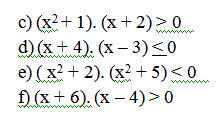
c: =>x+2>0
hay x>-2
d: =>-4<=x<=3
e: =>\(x\in\varnothing\)
f: \(\Leftrightarrow\left[{}\begin{matrix}x>4\\x< -6\end{matrix}\right.\)
\(A=x^3-xy-x^3-x^2y+x^2y-xy=-2xy\\ A=-2\cdot\dfrac{1}{2}\left(-100\right)=100\)
1.
Đặt \(x-2=t\ne0\Rightarrow x=t+2\)
\(B=\dfrac{4\left(t+2\right)^2-6\left(t+2\right)+1}{t^2}=\dfrac{4t^2+10t+5}{t^2}=\dfrac{5}{t^2}+\dfrac{2}{t}+4=5\left(\dfrac{1}{t}+\dfrac{1}{5}\right)^2+\dfrac{19}{5}\ge\dfrac{19}{5}\)
\(B_{min}=\dfrac{19}{5}\) khi \(t=-5\) hay \(x=-3\)
2.
Đặt \(x-1=t\ne0\Rightarrow x=t+1\)
\(C=\dfrac{\left(t+1\right)^2+4\left(t+1\right)-14}{t^2}=\dfrac{t^2+6t-9}{t^2}=-\dfrac{9}{t^2}+\dfrac{6}{t}+1=-\left(\dfrac{3}{t}-1\right)^2+2\le2\)
\(C_{max}=2\) khi \(t=3\) hay \(x=4\)
\(x^2+4mx+4m+2m-8=0\)
\(x^2+4mx+6m-8=0\)
\(x^2+2m\left(2x+3-4\right)=0\)
\(x^2+2m\left(2x-1\right)=0\)
(\(x^3\) + \(x^2\) - 12) : (\(x\) - 2)
= [(\(x^3-8)\) + (\(x^2\) - 4)] :(\(x-2\))
= [(\(x-2\))(\(x^2+2x+4)\) + \(\left(x-2\right)\left(x+2\right)\)] :(\(x-2\))
= (\(x-2\))(\(x^2+2x+4\) + \(x+2\)):(\(x-2\)
= (\(x-2):\left(x-2\right)\).[\(x^2\) + (2\(x\) + \(x\)) + (4 + 2)]
= 1.[\(x^2\) + 3\(x\) + 6]
= \(x^2+3x+6\)
(8x3+1):(2x+1)=((2x)3+1):(2x+1)=(2x+1)(4x2−2x+1):(2x+1)=4x2−2x+1
x2 + 3x + 6

 Giúp mình với, mình cần gấp ạ
(x2 - x + 1)(x2 - x + 2) = 12 (*)
Đặt \(x^2-x+\frac{3}{2}=t\) \(=\left(x-\frac{1}{2}\right)^2+\frac{5}{4}\)
(*) trở thành \(\left(x-\frac{1}{2}\right)\left(t+\frac{1}{2}\right)-12=0\)
\(\Leftrightarrow t^2-\frac{1}{4}-12=0\)
\(\Leftrightarrow t^2=12+\frac{1}{4}=\frac{49}{4}\)
=> \(\left[\left(x-\frac{1}{2}\right)^2+\frac{5}{4}\right]^2=\frac{49}{4}\)
Lại có:\(\left(x-\frac{1}{2}\right)^2+\frac{5}{4}\ge\frac{5}{4}\forall x\)
nên \(\left(x-\frac{1}{2}\right)^2+\frac{5}{4}=\frac{7}{2}\)
đến đây dễ r`