
B2:Vẽ đồ thị hàm số:
a)y=2x\(^2\)
b)y=\(\dfrac{-1}{2}x^2\)
c)y=2x+3
Hãy nhập câu hỏi của bạn vào đây, nếu là tài khoản VIP, bạn sẽ được ưu tiên trả lời.

a:
ĐKXĐ: x<>-2
\(y=\frac{2x-3}{x+2}\)
=>y'=\(\frac{\left(2x-3\right)^{\prime}\cdot\left(x+2\right)-\left(2x-3\right)\left(x+2\right)^{\prime}}{\left(x+2\right)^2}\)
=>y'\(=\frac{2\left(x+2\right)-\left(2x-3\right)}{\left(x+2\right)^2}=\frac{2x+4-2x+3}{\left(x+2\right)^2}=\frac{7}{\left(x+2\right)^2}>0\)
=>Hàm số luôn đồng biến trên mọi khoảng xác định
Vẽ đồ thị:
b:
ĐKXĐ: x<>-2
TH1: x>=3/2 hoặc x<-2
=>\(\frac{2x-3}{x+2}\ge0\)
=>\(y=\left|\frac{2x-3}{x+2}\right|=\frac{2x-3}{x+2}\)
\(y=\frac{2x-3}{x+2}\)
=>y'=\(\frac{\left(2x-3\right)^{\prime}\cdot\left(x+2\right)-\left(2x-3\right)\left(x+2\right)^{\prime}}{\left(x+2\right)^2}\)
=>y'\(=\frac{2\left(x+2\right)-\left(2x-3\right)}{\left(x+2\right)^2}=\frac{2x+4-2x+3}{\left(x+2\right)^2}=\frac{7}{\left(x+2\right)^2}>0\)
=>Hàm số luôn đồng biến trên (-∞;-2); [3/2;+∞)
TH2: -2<x<3/2
=>\(\frac{2x-3}{x+2}<0\)
=>\(y=\left|\frac{2x-3}{x+2}\right|=\frac{-2x+3}{x+2}\)
\(y=\frac{-2x+3}{x+2}\)
=>y'=\(\frac{\left(-2x+3\right)^{\prime}\cdot\left(x+2\right)-\left(-2x+3\right)\left(x+2\right)^{\prime}}{\left(x+2\right)^2}\)
=>y'=\(\frac{-2\left(x+2\right)+2x-3}{\left(x+2\right)^2}=\frac{-7}{\left(x+2\right)^2}<0\)
=>Hàm số nghịch biến trên (-2;3/2)
Vẽ đồ thị:
c: TH1: x>-2
=>x+2>0
=>\(y=\frac{2x-3}{\left|x+2\right|}=\frac{2x-3}{x+2}\)
=>y'=\(\frac{\left(2x-3\right)^{\prime}\cdot\left(x+2\right)-\left(2x-3\right)\left(x+2\right)^{\prime}}{\left(x+2\right)^2}\)
=>y'\(=\frac{2\left(x+2\right)-\left(2x-3\right)}{\left(x+2\right)^2}=\frac{2x+4-2x+3}{\left(x+2\right)^2}=\frac{7}{\left(x+2\right)^2}>0\)
=>Hàm số luôn đồng biến trên (-2;+∞)
TH2: x<-2
=>x+2<0
=>\(y=\frac{2x-3}{\left|x+2\right|}=\frac{-2x+3}{x+2}\)
\(y=\frac{-2x+3}{x+2}\)
=>y'=\(\frac{\left(-2x+3\right)^{\prime}\cdot\left(x+2\right)-\left(-2x+3\right)\left(x+2\right)^{\prime}}{\left(x+2\right)^2}\)
=>y'=\(\frac{-2\left(x+2\right)+2x-3}{\left(x+2\right)^2}=\frac{-7}{\left(x+2\right)^2}<0\)
=>Hàm số nghịch biến trên (-∞;-2)
Vẽ đồ thị:
Bài 1:
a: \(y=x^3-2x^2+x\)
=>y'=\(3x^2-2\cdot2x+1=3x^2-4x+1\)
=(3x-1)(x-1)
Đặt y'<0
=>(3x-1)(x-1)<0
=>1/3<x<1
=>hàm số nghịch biến trên khoảng (1/3;1)
Đặt y'>0
=>(x-1)(3x-1)>0
=>x>1 hoặc x<1/3
=>Hàm số đồng biến trên các khoảng (1;+∞) và (-∞;1/3)
Vẽ đồ thị:
b: Đồ thị hàm số y=|x^3-2x^2+x|
Đồ thị hàm số \(y=\left|x\right|^3-2x^2+\left|x\right|\)
Bài 2:
\(y=x^4-2x^2-3\)
=>y'=\(4x^3-2\cdot2x=4x^3-4x=4x\left(x^2-1\right)\)
Đặt y'<0
=>\(x\left(x^2-1\right)\) <0
TH1: \(\begin{cases}x<0\\ x^2-1>0\end{cases}\)
=>x<0 và x^2>1
=>x<0 và (x>1 hoặc x<-1)
=>x<-1
TH2: \(\begin{cases}x>0\\ x^2-1<0\end{cases}\)
=>\(\begin{cases}x>0\\ x^2<1\end{cases}\)
=>x>0 và -1<x<1
=>0<x<1
Vậy: hàm số nghịch biến trên các khoảng (-∞;-1); (0;1)
Đặt y'>0
=>\(x\left(x^2-1\right)>0\)
TH1: \(\begin{cases}x>0\\ x^2-1>0\end{cases}\Rightarrow\begin{cases}x>0\\ x^2>1\end{cases}\)
=>x>0 và (x>1 hoặc x<-1)
=>x>1
TH2: \(\begin{cases}x<0\\ x^2-1<0\end{cases}\)
=>\(\begin{cases}x<0\\ x^2<1\end{cases}\)
=>x<0 và -1<x<1
=>-1<x<0
Vậy: Hàm số đồng biến trên các khoảng (1;+∞) và (-1;0)
Vẽ đồ thị:
a: \(\lim\limits_{x\rightarrow-\dfrac{3m}{2}}\dfrac{x+3}{2x+3m}=\infty\) vì \(\left\{{}\begin{matrix}\lim\limits_{x\rightarrow-\dfrac{3m}{2}}2x+3m=0\\\lim\limits_{x\rightarrow-\dfrac{3m}{2}}x+3=\dfrac{-3m}{2}+3\end{matrix}\right.\)
=>x=-3m/2 là tiệm cận đứng duy nhất của đồ thị hàm số \(y=\dfrac{x+3}{2x+3m}\)
Để tiệm cận đứng của đồ thị hàm số \(y=\dfrac{x+3}{2x+3m}\) đi qua M(3;-1) thì \(-\dfrac{3m}{2}=3\)
=>-1,5m=3
=>m=-2
b: \(\lim\limits_{x\rightarrow-m}\dfrac{2x-3}{x+m}=\infty\) vì \(\left\{{}\begin{matrix}\lim\limits_{x\rightarrow-m}2x-3=-2m-3\\\lim\limits_{x\rightarrow-m}x+m=0\end{matrix}\right.\)
=>x=-m là tiệm cận đứng duy nhất của đồ thị hàm số \(y=\dfrac{2x-3}{x+m}\)
Để x=-2 là tiệm cận đứng của đồ thị hàm số \(y=\dfrac{2x-3}{x+m}\) thì -m=-2
=>m=2
c: \(\lim\limits_{x\rightarrow\dfrac{2}{b}}\dfrac{ax+1}{bx-2}=\infty\) vì \(\left\{{}\begin{matrix}\lim\limits_{x\rightarrow\dfrac{2}{b}}ax+1=a\cdot\dfrac{2}{b}+1\\\lim\limits_{x\rightarrow\dfrac{2}{b}}bx-2=b\cdot\dfrac{2}{b}-2=0\end{matrix}\right.\)
=>Đường thẳng \(x=\dfrac{2}{b}\) là tiệm cận đứng của đồ thị hàm số \(y=\dfrac{ax+1}{bx-2}\)
=>2/b=2
=>b=1
=>\(y=\dfrac{ax+1}{x-2}\)
\(\lim\limits_{x\rightarrow+\infty}\dfrac{ax+1}{x-2}=\lim\limits_{x\rightarrow+\infty}\dfrac{a+\dfrac{1}{x}}{1-\dfrac{2}{x}}=a\)
\(\lim\limits_{x\rightarrow-\infty}\dfrac{ax+1}{x-2}=\lim\limits_{x\rightarrow-\infty}\dfrac{a+\dfrac{1}{x}}{1-\dfrac{2}{x}}=a\)
=>Đường thẳng y=a là tiệm cận ngang của đồ thị hàm số \(y=\dfrac{ax+1}{x-2}\)
=>a=3
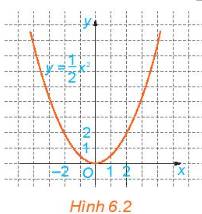
a) Để \(y = 8 \Leftrightarrow \frac{1}{2}{x^2} = 8 \Leftrightarrow {x^2} = 16 \Leftrightarrow x = 4\) hoăc \(x = - 4\)
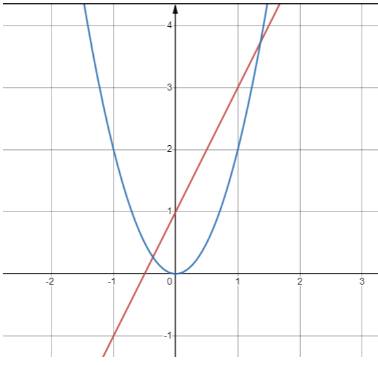
b) Vẽ đồ thị y=2x+1:
-Là đồ thị bậc nhất nên đồ thị là đường thẳng đi qua điểm có tọa độ (0; 1) và
(-1; -1)
Vẽ đồ thị \(y = 2{x^2}\)
- Đi qua điểm (1; 2) ; (-1; 2);(0;0)
a: Bảng giá trị:
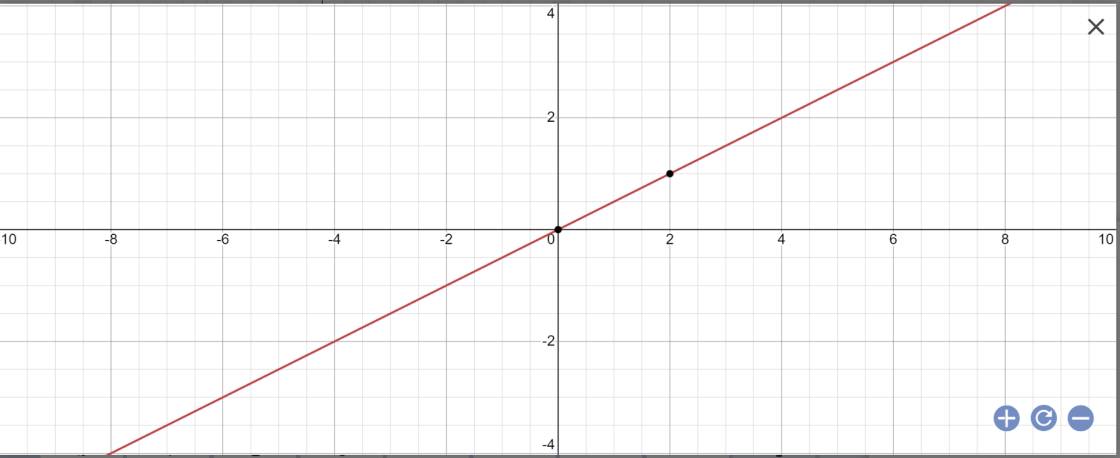
x | 0 | 2 |
\(y=-\frac12x\) | 0 | -1 |
Vẽ đồ thị:
b: Bảng giá trị:
x | 0 | 1 |
y=2x | 0 | 2 |
Vẽ đồ thị:
Bạn tự vẽ nhé.
\(a,\) 2 đồ thị hàm số \(y=2x,y=-3x+5\) giao nhau khi và chỉ khi :
\(2x=-3x+5\\ \Leftrightarrow5x=5\\ \Leftrightarrow x=1\)
Thay \(x=1\) vào \(y=2x\Leftrightarrow y=2\)
Vậy giao điểm của 2 đồ thị là \(\left(1;2\right)\)
\(b,\) 2 đồ thị hàm số \(y=3x+2,y=-\dfrac{1}{2}x+1\) giao nhau khi và chỉ khi :
\(3x+2=-\dfrac{1}{2}x+1\\ \Leftrightarrow\dfrac{7}{2}x=-1\\ \Leftrightarrow x=-\dfrac{2}{7}\)
Thay \(x=-\dfrac{2}{7}\) vào \(y=3x+2\Rightarrow y=\dfrac{8}{7}\)
Vậy giao điểm của 2 đồ thị là \(\left(-\dfrac{2}{7};\dfrac{8}{7}\right)\)
\(c,\) 2 đồ thị hàm số \(y=\dfrac{3}{2}x-2,y=-\dfrac{1}{2}x+2\) giao nhau khi và chỉ khi :
\(\dfrac{3}{2}x-2=-\dfrac{1}{2}x+2\\ \Leftrightarrow2x=4\\ \Leftrightarrow x=2\)
Thay \(x=2\) vào \(y=\dfrac{3}{2}x-2\Rightarrow y=1\)
Vậy giao điểm của 2 đồ thị là \(\left(2;1\right)\)
\(d,\) 2 đồ thị hàm số \(y=-2x+5,y=x+2\) giao nhau khi và chỉ khi :
\(-2x+5=x+2\\ \Leftrightarrow-3x=-3\\ \Leftrightarrow x=1\)
Thay \(x=1\) vào \(y=x+2\Rightarrow y=3\)
Vậy giao điểm của 2 đồ thị là \(\left(1;3\right)\)
a: Bảng giá trị:
x | -4 | -2 | 0 | 2 | 4 |
\(y=-\frac12x^2\) | -8 | -1 | 0 | -1 | -8 |
Vẽ đồ thị:
b: Bảng giá trị:
x | -2 | -1 | 0 | 1 | 2 |
\(y=-2x^2\) | -8 | -2 | 0 | -2 | -8 |
Vẽ đồ thị:
c: BẢng giá trị:
x | -4 | -2 | 0 | 2 | 4 |
\(y=\frac12x^2\) | 8 | 2 | 0 | 2 | 8 |
Vẽ đồ thị:
d: Bảng giá trị:
x | -2 | -1 | 0 | 1 | 2 |
\(y=-x^2\) | -4 | -1 | 0 | -1 | -4 |
Vẽ đồ thị:
e: Bảng giá trị:
x | 0 | 1 |
y=-3x-1 | -1 | -4 |
Vẽ đồ thị:

a: Bảng giá trị:
x
-2
-1
0
1
2
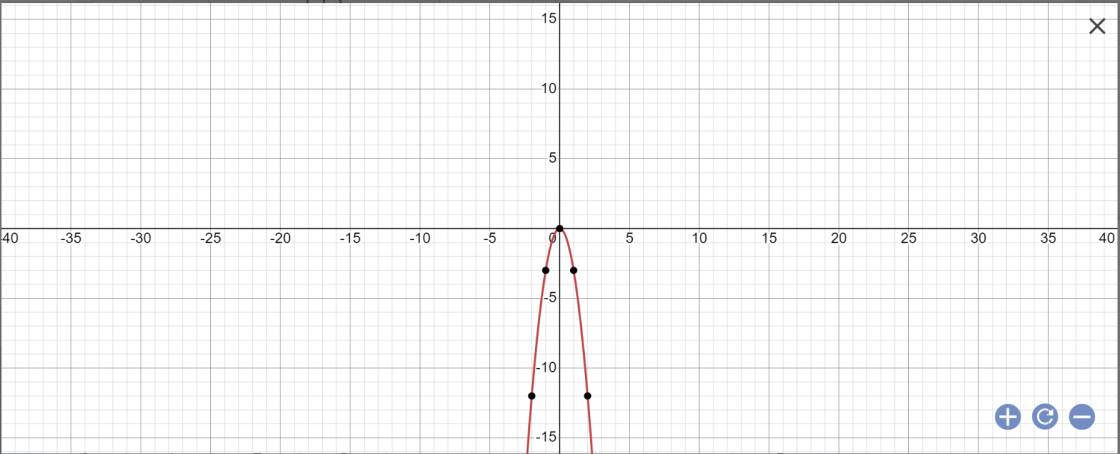
\(y=2x^2\)
8
2
0
2
8
Vẽ đồ thị:
b:
Bảng giá trị:
x
-2
-1
0
1
2
\(y=-\frac12x^2\)
-2
-1/2
0
-1/2
-2
Vẽ đồ thị:
c: Bảng giá trị:
x
0
1
y=2x+3
3
5
Vẽ đồ thị: