
Tìm x biết (1.2x)^3=-8
K
Khách
Hãy nhập câu hỏi của bạn vào đây, nếu là tài khoản VIP, bạn sẽ được ưu tiên trả lời.

Những câu hỏi liên quan
HT
27 tháng 1 2021
Câu này thiếu -1 trên tử rồi :v
Tham khảo câu trả lời của mod Lâm Đọc bị lú rồi :D
21 tháng 2 2019
Cái \(\sqrt[3]{2.3x+a}\) đúng hay sai đấy bạn? Bạn có gõ nhầm 1 thành a ko?
28 tháng 2 2019
Sửa đề:
\(\lim\limits_{x\rightarrow0}\dfrac{\sqrt{1.2x+1}\sqrt[3]{2.3x+1}...\sqrt[2018]{2017.2018x+1}-1}{x}\)
Do gõ \(x\rightarrow0\) dưới lim rất tốn thời gian nên mình bỏ qua, bạn tự hiểu tất cả các giới hạn bên dưới đều là \(x\rightarrow0\)
Trước hết ta dùng L'Hopital để tính giới hạn dạng tổng quát sau:
\(lim\dfrac{\sqrt[n]{\left(n-1\right)n.x+1}-1}{x}=lim\dfrac{\left[\left(n-1\right)nx+1\right]^{\dfrac{1}{n}}-1}{x}\)
\(=lim\dfrac{\dfrac{1}{n}\left[\left(n-1\right)nx+1\right]^{\dfrac{1}{n}-1}.\left(n-1\right)n}{x}=n-1\)
Và \(\sqrt{2.3x+1}...\sqrt[n]{\left(n-1\right)n.x+1}=1\) khi \(x=1\)
\(\Rightarrow lim\dfrac{\sqrt[k]{\left(k-1\right)kx+1}...\sqrt[m]{\left(m-1\right)mx+1}\left(\sqrt[n]{\left(n-1\right)nx+1}-1\right)}{x}=n-1\)
với mọi \(m;k\) (vì đằng nào cái cụm nhân đằng trước cũng ra 1, ko ảnh hưởng)
Áp dụng vào bài toán:
\(lim\dfrac{\sqrt{1.2x+1}\sqrt[3]{2.3x+1}...\sqrt[2018]{2017.2018x+1}-1}{x}\)
\(=lim\dfrac{\sqrt[3]{2.3x+1}...\sqrt[2018]{2017.2018x+1}\left(\sqrt{2.3x+1}-1\right)}{x}+\) \(lim\dfrac{\sqrt[4]{3.4x+1}...\sqrt[2018]{2017.2018x+1}\left(\sqrt[3]{2.3x+1}-1\right)}{x}+...\)
\(+lim\dfrac{\sqrt[2018]{2017.2018x+1}-1}{x}\)
\(=2+3+...2017=\dfrac{2016.2019}{2}=2035152\)
28 tháng 1 2022
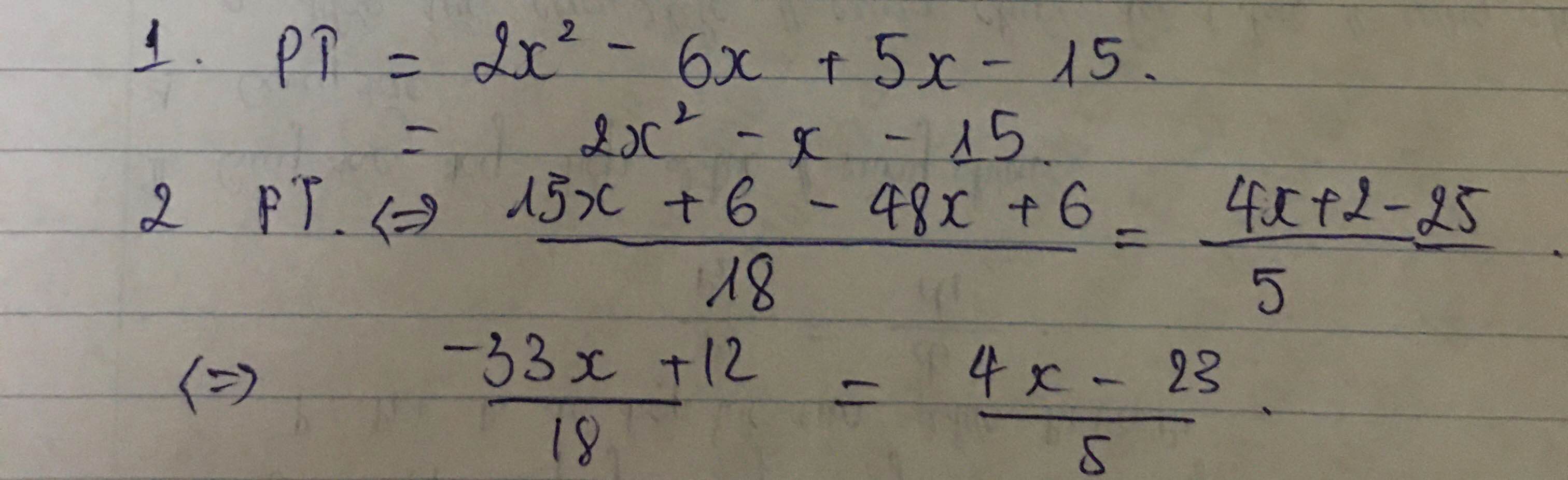
\(1,\) thiếu đề
\(2,\dfrac{5x+2}{6}-\dfrac{8x-1}{3}=\dfrac{4x+2}{5}-5\)
\(\Leftrightarrow\dfrac{5\left(5x+2\right)}{30}-\dfrac{10\left(8x-1\right)}{30}=\dfrac{6\left(4x+2\right)}{30}-\dfrac{150}{30}\)
\(\Leftrightarrow5\left(5x+2\right)-10\left(8x-1\right)=6\left(4x+2\right)-150\)
\(\Leftrightarrow25x+10-80x+10=24x+12-150\)
\(\Leftrightarrow-55x+20=24x-138\)
\(\Leftrightarrow24x-138+55x-20=0\)
\(\Leftrightarrow79x-158=0\)
\(\Leftrightarrow x=2\)
\(3,ĐKXĐ:\left\{{}\begin{matrix}x\ne1\\x\ne-1\\x\ne3\end{matrix}\right.\\ \dfrac{x}{2x-6}+\dfrac{x}{2x-2}=\dfrac{-2x}{\left(x+1\right)\left(3-x\right)}\)
\(\Leftrightarrow\dfrac{x}{2\left(x-3\right)}+\dfrac{x}{2\left(x-1\right)}+\dfrac{2x}{\left(x+1\right)\left(3-x\right)}=0\)
\(\Leftrightarrow\dfrac{x}{2\left(x-3\right)}+\dfrac{x}{2\left(x-1\right)}-\dfrac{2x}{\left(x+1\right)\left(x-3\right)}=0\)
\(\Leftrightarrow x\left(\dfrac{1}{2\left(x-3\right)}+\dfrac{1}{2\left(x-1\right)}-\dfrac{2}{\left(x+1\right)\left(x-3\right)}\right)=0\)
\(\Leftrightarrow x\left(\dfrac{\left(x-1\right)\left(x+1\right)}{2\left(x-1\right)\left(x-3\right)\left(x+1\right)}+\dfrac{\left(x-3\right)\left(x+1\right)}{2\left(x-1\right)\left(x-3\right)\left(x+1\right)}-\dfrac{4\left(x-1\right)}{2\left(x+1\right)\left(x-3\right)\left(x-1\right)}\right)=0\)
\(\Leftrightarrow x\left(\dfrac{x^2-1}{2\left(x-1\right)\left(x-3\right)\left(x+1\right)}+\dfrac{x^2-2x-3}{2\left(x-1\right)\left(x-3\right)\left(x+1\right)}-\dfrac{4x-4}{2\left(x+1\right)\left(x-3\right)\left(x-1\right)}\right)=0\)
\(\Leftrightarrow x.\dfrac{x^2-1+x^2-2x-3-4x+4}{2\left(x-1\right)\left(x-3\right)\left(x+1\right)}=0\)
\(\Leftrightarrow x.\dfrac{2x^2-6x}{2\left(x-1\right)\left(x-3\right)\left(x+1\right)}=0\)
\(\Leftrightarrow x.\dfrac{2x\left(x-3\right)}{2\left(x-1\right)\left(x-3\right)\left(x+1\right)}=0\)
\(\Leftrightarrow x.\dfrac{x}{\left(x-1\right)\left(x+1\right)}=0\)
\(\Leftrightarrow\dfrac{x^2}{\left(x-1\right)\left(x+1\right)}=0\)
\(\Leftrightarrow x=0\)

LD
21 tháng 6 2017
Bài 3. a) x(x-2)-2x+x=0
<=> x2-2x-2x+x=0
<=>x2-4x+x=0
<=>x2-3x=0
<=> x(x-3)=0 => x=0; x=3.

QH
1
CM
5 tháng 10 2019

Bất phương trình trở thành:
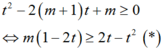
Để bất phương trình ban đầu nghiệm đúng với mọi x ≥ 0 thì (*) nghiệm đúng với mọi t ≥ 0
Do
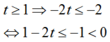
Khi đó
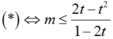
nghiệm đúng với mọi
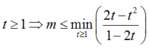
Xét hàm số
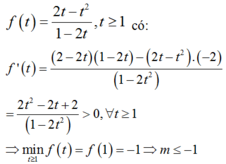
Vậy, tập tất cả các giá trị của m là ( - ∞ ; - 1 ].
Chọn B.
<=>(1.2x)^3=(-2)^3
<=>1.2x=-2
<=>2x=-2
<=>x=-2:2
<=>x=-1
Vậy x=-1
<3 <3