
Hãy nhập câu hỏi của bạn vào đây, nếu là tài khoản VIP, bạn sẽ được ưu tiên trả lời.


Bài 1:
a: AD+DB=AB
AE+EC=AC
mà BD=CE và AB=AC
nên AD=AE
Xét ΔABC có \(\frac{AD}{AB}=\frac{AE}{AC}\)
nên DE//BC
b: Xét ΔABE và ΔACD có
AB=AC
\(\hat{BAE}\) chung
AE=AD
Do đó: ΔABE=ΔACD
c: ΔABE=ΔACD
=>\(\hat{ABE}=\hat{ACD};\hat{AEB}=\hat{ADC}\)
Ta có: \(\hat{AEB}+\hat{BEC}=180^0\) (hai góc kề bù)
\(\hat{ADC}+\hat{CDB}=180^0\) (hai góc kề bù)
mà \(\hat{AEB}=\hat{ADC}\)
nên \(\hat{BEC}=\hat{CDB}\)
Xét ΔIDB và ΔIEC có
\(\hat{IDB}=\hat{IEC}\)
DB=EC
\(\hat{IBD}=\hat{ICE}\)
Do đó: ΔIDB=ΔIEC
d: ΔIDB=ΔIEC
=>ID=IE và IB=IC
Xét ΔAIB và ΔAIC có
AI chung
IB=IC
AB=AC
Do đó; ΔAIB=ΔAIC
=>\(\hat{BAI}=\hat{CAI}\)
=>AI là phân giác của góc BAC
e: Ta có: AB=AC
=>A nằm trên đường trung trực của BC(1)
Ta có: IB=IC
=>I nằm trên đường trung trực của BC(2)
Từ (1),(2) suy ra AI là đường trung trực của BC
=>AI⊥BC
d: DE=DB
=>ΔDBE cân tại D
=>\(\hat{DEB}=\hat{DBE}\)
mà \(\hat{DEB}=\hat{EBC}\) (hai góc so le trong, DE//BC)
nên \(\hat{DBE}=\hat{CBE}\)
=>BE là phân giác của góc ABC
=>E là chân đường phân giác kẻ từ B xuống AC
Ta có: ED=EC
=>ΔEDC cân tại E
=>\(\hat{EDC}=\hat{ECD}\)
mà \(\hat{EDC}=\hat{BCD}\) (hai góc so le trong, ED//BC)
nên \(\hat{ECD}=\hat{BCD}\)
=>CD là phân giác của góc ACB
=>D là chân đường phân giác kẻ từ C xuống AB
 Mọi người ơi,giúp em bài với ạ em cảm ơn ạ
ĐKXĐ: x>=0; x<>9
\(B=\dfrac{2x-6\sqrt{x}+x+3\sqrt{x}-3x-3}{\left(\sqrt{x}-3\right)\left(\sqrt{x}+3\right)}\cdot\dfrac{\sqrt{x}-3}{\sqrt{x}+1}\)
\(=\dfrac{-3\sqrt{x}-3}{\sqrt{x}+3}\cdot\dfrac{1}{\sqrt{x}+1}=\dfrac{-3}{\sqrt{x}+3}\)

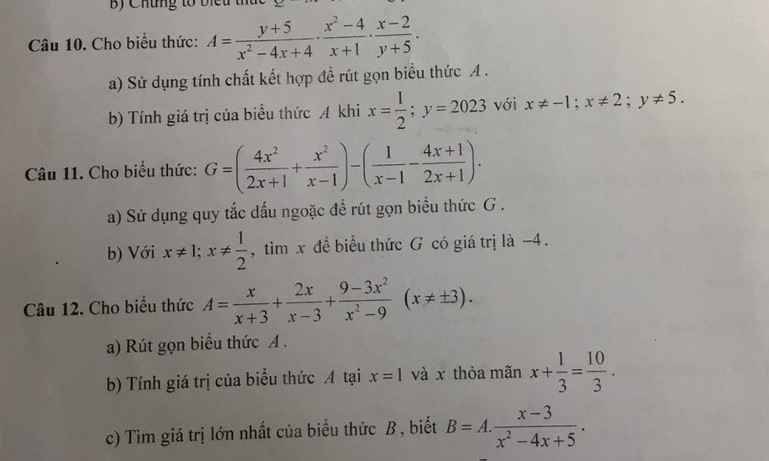
Câu 10:
a: ĐKXĐ: \(\left\{{}\begin{matrix}x\notin\left\{2;-1\right\}\\y\ne-5\end{matrix}\right.\)
\(A=\dfrac{y+5}{x^2-4x+4}\cdot\dfrac{x^2-4}{x+1}\cdot\dfrac{x-2}{y+5}\)
\(=\dfrac{y+5}{y+5}\cdot\dfrac{\left(x^2-4\right)}{x^2-4x+4}\cdot\dfrac{x-2}{x+1}\)
\(=\dfrac{\left(x^2-4\right)\cdot\left(x-2\right)}{\left(x+1\right)\left(x^2-4x+4\right)}\)
\(=\dfrac{\left(x+2\right)\left(x-2\right)\cdot\left(x-2\right)}{\left(x+1\right)\left(x-2\right)^2}=\dfrac{x+2}{x+1}\)
b: \(A=\dfrac{x+2}{x+1}\)
=>A không phụ thuộc vào biến y
Khi x=1/2 thì \(A=\left(\dfrac{1}{2}+2\right):\left(\dfrac{1}{2}+1\right)=\dfrac{5}{2}:\dfrac{3}{2}=\dfrac{5}{2}\cdot\dfrac{2}{3}=\dfrac{5}{3}\)
Câu 12:
a: \(A=\dfrac{x}{x+3}+\dfrac{2x}{x-3}+\dfrac{9-3x^2}{x^2-9}\)
\(=\dfrac{x}{x+3}+\dfrac{2x}{x-3}+\dfrac{9-3x^2}{\left(x+3\right)\left(x-3\right)}\)
\(=\dfrac{x\left(x-3\right)+2x\left(x+3\right)+9-3x^2}{\left(x+3\right)\left(x-3\right)}\)
\(=\dfrac{x^2-3x+2x^2+6x+9-3x^2}{\left(x+3\right)\left(x-3\right)}\)
\(=\dfrac{3x+9}{\left(x+3\right)\left(x-3\right)}=\dfrac{3\left(x+3\right)}{\left(x+3\right)\left(x-3\right)}=\dfrac{3}{x-3}\)
b: Khi x=1 thì \(A=\dfrac{3}{1-3}=\dfrac{3}{-2}=-\dfrac{3}{2}\)
\(x+\dfrac{1}{3}=\dfrac{10}{3}\)
=>\(x=\dfrac{10}{3}-\dfrac{1}{3}\)
=>\(x=\dfrac{9}{3}=3\left(loại\right)\)
Vậy: Khi x=3 thì A không có giá trị
c: \(B=A\cdot\dfrac{x-3}{x^2-4x+5}\)
\(=\dfrac{3}{x-3}\cdot\dfrac{x-3}{x^2-4x+5}\)
\(=\dfrac{3}{x^2-4x+5}\)
\(x^2-4x+5=x^2-4x+4+1=\left(x-2\right)^2+1>=1\forall x\) thỏa mãn ĐKXĐ
=>\(B=\dfrac{3}{x^2-4x+5}< =\dfrac{3}{1}=3\forall x\) thỏa mãn ĐKXĐ
Dấu '=' xảy ra khi x-2=0
=>x=2
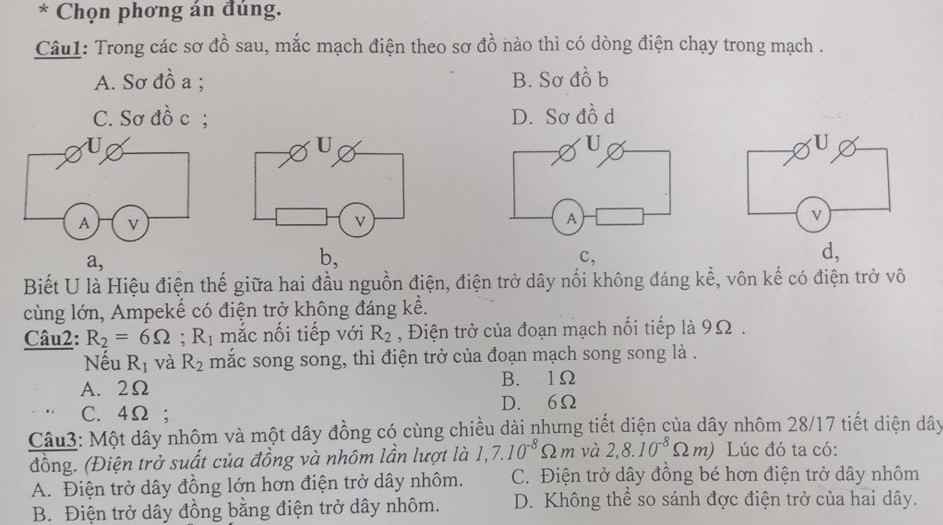


XI
1 That book was published a few years ago
2 The magazines are put on the shelf in the corner
3 These toys are sold on Disneyland and in Hong Kong
4 My house was built in 2001
5 This computer was made in China
6 These old clothes are collected for the poor children.
7 This reports had been finished by five o'clock
8 Nam said he would attend the lecture last night
XI.1. That book/ publish/ a few years ago
--> That book was published a few years ago
2. The magazines/ put/ shelf/ the corner
--> The magazines are put on the sheft in the corner
3. These toys/ sell/ Disneyland/ Hong Kong
--> These toys are sold at Disneyland in Hong Kong
4. My house/ build/ 2001
--> My house was built in 2001
5. This computer/ make/ China
--> This computer is made in China
6. These old clothes/ collect/ the poor children
--> These old clothes are collected for the poor children
7. These reports/ finish/ by / 5 o'clock
--> These reports are finish by him/her at 5 o'clock
8. Nam/ said/ he/ attend/ the lecture/ that night
--> Nam said he attended the lecture that night
Chúc cậu học tốt:3
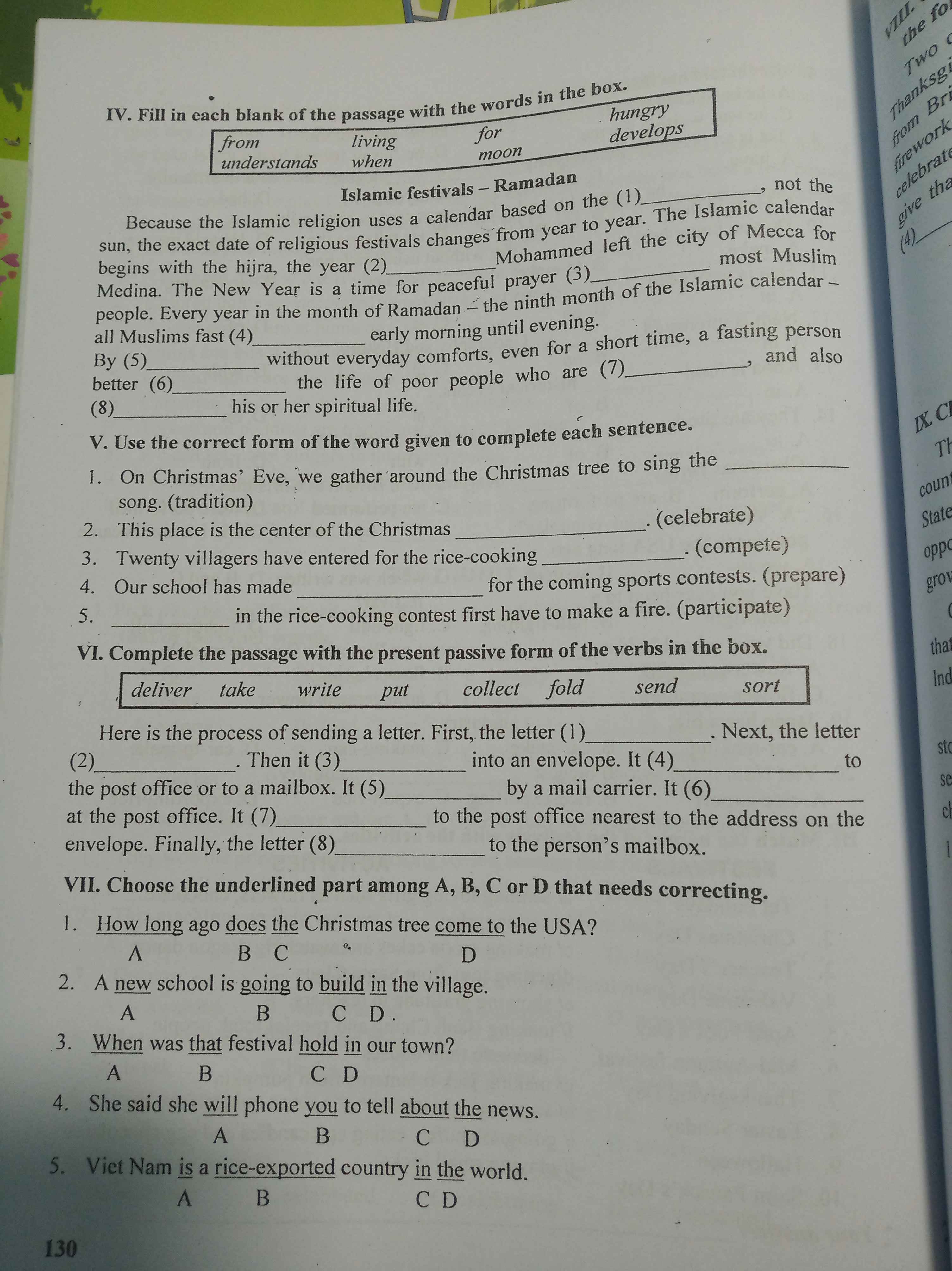
IV
1 moon
2 when
3 for
4 from
5 living
6 understands
7 hungry
8 developes
VI
1 is written
2 is folded
3 is put
4 is sent
5 is collected
6 is sorted
7 is taken
8 is delivered
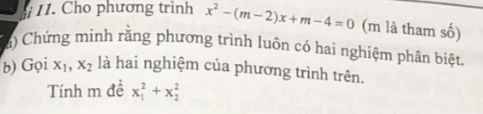
a: Δ=(m-2)^2-4(m-4)
=m^2-4m+4-4m+16
=m^2-8m+20
=m^2-8m+16+4
=(m-2)^2+4>=4>0
=>Phương trình luôn có 2 nghiệm pb
b: x1^2+x2^2
=(x1+x2)^2-2x1x2
=(m-2)^2-2(m-4)
=m^2-4m+4-2m+8
=m^2-6m+12
=(m-3)^2+3>=3
Dấu = xảy ra khi m=3
 . Em cảm ơn
lỗi đề rồi em nhé
Dạ, vâng ạ! Em đang tìm cách khắc phục ạ!