
Giải các bất phương trình sau :
\(\sqrt{2}x^2+\left(1+\sqrt{2}\right)x+1\ge0\)
K
Khách
Hãy nhập câu hỏi của bạn vào đây, nếu là tài khoản VIP, bạn sẽ được ưu tiên trả lời.
Những câu hỏi liên quan

28 tháng 2 2021
Do \(x^6-x^3+x^2-x+1=\left(x^3-\dfrac{1}{2}\right)^2+\left(x-\dfrac{1}{2}\right)^2+\dfrac{1}{2}>0\) ; \(\forall x\) nên BPT tương đương:
\(\sqrt{13}-\sqrt{2x^2-2x+5}-\sqrt{2x^2-4x+4}\ge0\)
\(\Leftrightarrow\sqrt{4x^2-4x+10}+\sqrt{4x^2-8x+8}\le\sqrt{26}\) (1)
Ta có:
\(VT=\sqrt{\left(2x-1\right)^2+3^2}+\sqrt{\left(2-2x\right)^2+2^2}\ge\sqrt{\left(2x-1+2-2x\right)^2+\left(3+2\right)^2}=\sqrt{26}\) (2)
\(\Rightarrow\left(1\right);\left(2\right)\Rightarrow\sqrt{4x^2-4x+10}+\sqrt{4x^2-8x+8}=\sqrt{26}\)
Dấu "=" xảy ra khi và chỉ khi \(2\left(2x-1\right)=3\left(2-2x\right)\Leftrightarrow x=\dfrac{4}{5}\)
Vậy BPT có nghiệm duy nhất \(x=\dfrac{4}{5}\)
1 tháng 5 2021
a, ĐKXĐ : \(D=R\)
BPT \(\Leftrightarrow x^2+5x+4< 5\sqrt{x^2+5x+4+24}\)
Đặt \(x^2+5x+4=a\left(a\ge-\dfrac{9}{4}\right)\)
BPTTT : \(5\sqrt{a+24}>a\)
\(\Leftrightarrow\left[{}\begin{matrix}\left\{{}\begin{matrix}a+24\ge0\\a< 0\end{matrix}\right.\\\left\{{}\begin{matrix}a\ge0\\25\left(a+24\right)>a^2\end{matrix}\right.\end{matrix}\right.\)
\(\Leftrightarrow\left[{}\begin{matrix}-24\le a< 0\\\left\{{}\begin{matrix}a^2-25a-600< 0\\a\ge0\end{matrix}\right.\end{matrix}\right.\)
\(\Leftrightarrow\left[{}\begin{matrix}-24\le a< 0\\0\le a< 40\end{matrix}\right.\)
\(\Leftrightarrow-24\le a< 40\)
- Thay lại a vào ta được : \(\left\{{}\begin{matrix}x^2+5x-36< 0\\x^2+5x+28\ge0\end{matrix}\right.\)
\(\Leftrightarrow-9< x< 4\)
Vậy ....
1 tháng 5 2021
b, ĐKXĐ : \(x>0\)
BĐT \(\Leftrightarrow2\left(\sqrt{x}+\dfrac{1}{2\sqrt{x}}\right)< x+\dfrac{1}{4x}+1\)
- Đặt \(\sqrt{x}+\dfrac{1}{2\sqrt{x}}=a\left(a\ge\sqrt{2}\right)\)
\(\Leftrightarrow a^2=x+\dfrac{1}{4x}+1\)
BPTTT : \(2a\le a^2\)
\(\Leftrightarrow\left[{}\begin{matrix}a\le0\\a\ge2\end{matrix}\right.\)
\(\Leftrightarrow a\ge2\)
\(\Leftrightarrow a^2\ge4\)
- Thay a vào lại BPT ta được : \(x+\dfrac{1}{4x}-3\ge0\)
\(\Leftrightarrow4x^2-12x+1\ge0\)
\(\Leftrightarrow x=(0;\dfrac{3-2\sqrt{2}}{2}]\cup[\dfrac{3+2\sqrt{2}}{2};+\infty)\)
Vậy ...
NL
Nguyễn Lê Phước Thịnh
CTVHS
5 tháng 2
e: \(\begin{cases}x\left(x+5\right)<4x+2\\ \left(2x-1\right)\left(x+3\right)\ge4x\end{cases}\Rightarrow\begin{cases}x^2+5x-4x-2<0\\ 2x^2+6x-x-3-4x\ge0\end{cases}\)
=>\(\begin{cases}x^2+x-2<0\\ 2x^2+x-3\ge0\end{cases}\Rightarrow\begin{cases}\left(x+2\right)\left(x-1\right)<0\\ 2x^2+3x-2x-3\ge0\end{cases}\)
=>\(\begin{cases}-2
=>-2<x<=-1
f: ĐKXĐ: x∉{1;4;2;5}
Ta có: \(\frac{1}{x^2-5x+4}\le\frac{1}{x^2-7x+10}\)
=>\(\frac{1}{x^2-5x+4}-\frac{1}{x^2-7x+10}\le0\)
=>\(\frac{x^2-7x+10-x^2+5x-4}{\left(x-1\right)\left(x-4\right)\left(x-2\right)\left(x-5\right)}\le0\)
=>\(\frac{-2x+6}{\left(x-1\right)\left(x-4\right)\left(x-2\right)\left(x-5\right)}\le0\)
=>\(\frac{x-3}{\left(x-1\right)\left(x-2\right)\left(x-4\right)\left(x-5\right)}\ge0\)
Đặt \(A=\frac{x-3}{\left(x-1\right)\left(x-2\right)\left(x-4\right)\left(x-5\right)}\)
Đặt x-3=0
=>x=3
Đặt x-1=0
=>x=1
Đặt x-2=0
=>x=2
Đặt x-4=0
=>x=4
Đặt x-5=0
=>x=5
Bảng xét dấu:
Theo bãng xét dấu, ta có: A>=0 khi 1<x<2; 3<=x<4; x>5
HP
16 tháng 1 2021
ĐK: \(x\ge2\)
\(\dfrac{\sqrt{x^2+1}-\sqrt{x+1}}{x^2+\sqrt{3x-6}}\ge0\)
\(\Leftrightarrow\sqrt{x^2+1}-\sqrt{x+1}\ge0\)
\(\Leftrightarrow\sqrt{x^2+1}\ge\sqrt{x+1}\)
\(\Leftrightarrow\left\{{}\begin{matrix}x+1\ge0\\x^2+1\ge x+1\end{matrix}\right.\)
\(\Leftrightarrow\left\{{}\begin{matrix}x\ge-1\\x^2-x\ge0\end{matrix}\right.\)
\(\Leftrightarrow\left[{}\begin{matrix}-1\le x\le0\\x\ge1\end{matrix}\right.\)
Kết hợp điều kiện xác định ta được \(x\ge2\)
28 tháng 1 2022
\(\dfrac{2x-1}{x+1}-2< 0.\left(x\ne-1\right).\\ \Leftrightarrow\dfrac{2x-1-2x-2}{x+1}< 0.\Leftrightarrow\dfrac{-3}{x+1}< 0.\)
Mà \(-3< 0.\)
\(\Rightarrow x+1>0.\Leftrightarrow x>-1\left(TMĐK\right).\)
\(\dfrac{x^2-2x+5}{x-2}-x+1\ge0.\left(x\ne2\right).\\ \Leftrightarrow\dfrac{x^2-2x+5-x^2+2x+x-2}{x-2}\ge0.\\ \Leftrightarrow\dfrac{x+3}{x-2}\ge0.\)
\(\Leftrightarrow\left[{}\begin{matrix}\left\{{}\begin{matrix}x+3\ge0.\\x-2\ge0.\end{matrix}\right.\\\left\{{}\begin{matrix}x+3\le0.\\x-2\le0.\end{matrix}\right.\end{matrix}\right.\) \(\Leftrightarrow\left[{}\begin{matrix}\left\{{}\begin{matrix}x\ge-3.\\x\ge2.\end{matrix}\right.\\\left\{{}\begin{matrix}x\le-3.\\x\le2.\end{matrix}\right.\end{matrix}\right.\) \(\Leftrightarrow\left[{}\begin{matrix}x\ge2.\\x\le-3.\end{matrix}\right.\)
Kết hợp ĐKXĐ.
\(\Rightarrow\left[{}\begin{matrix}x>2.\\x\le-3.\end{matrix}\right.\)
\(\dfrac{\left(1+2x\right)\left(x-2\right)}{\left(2x+3\right)\left(1-x\right)}\le0.\left(x\ne1;x\ne\dfrac{-3}{2}\right).\)
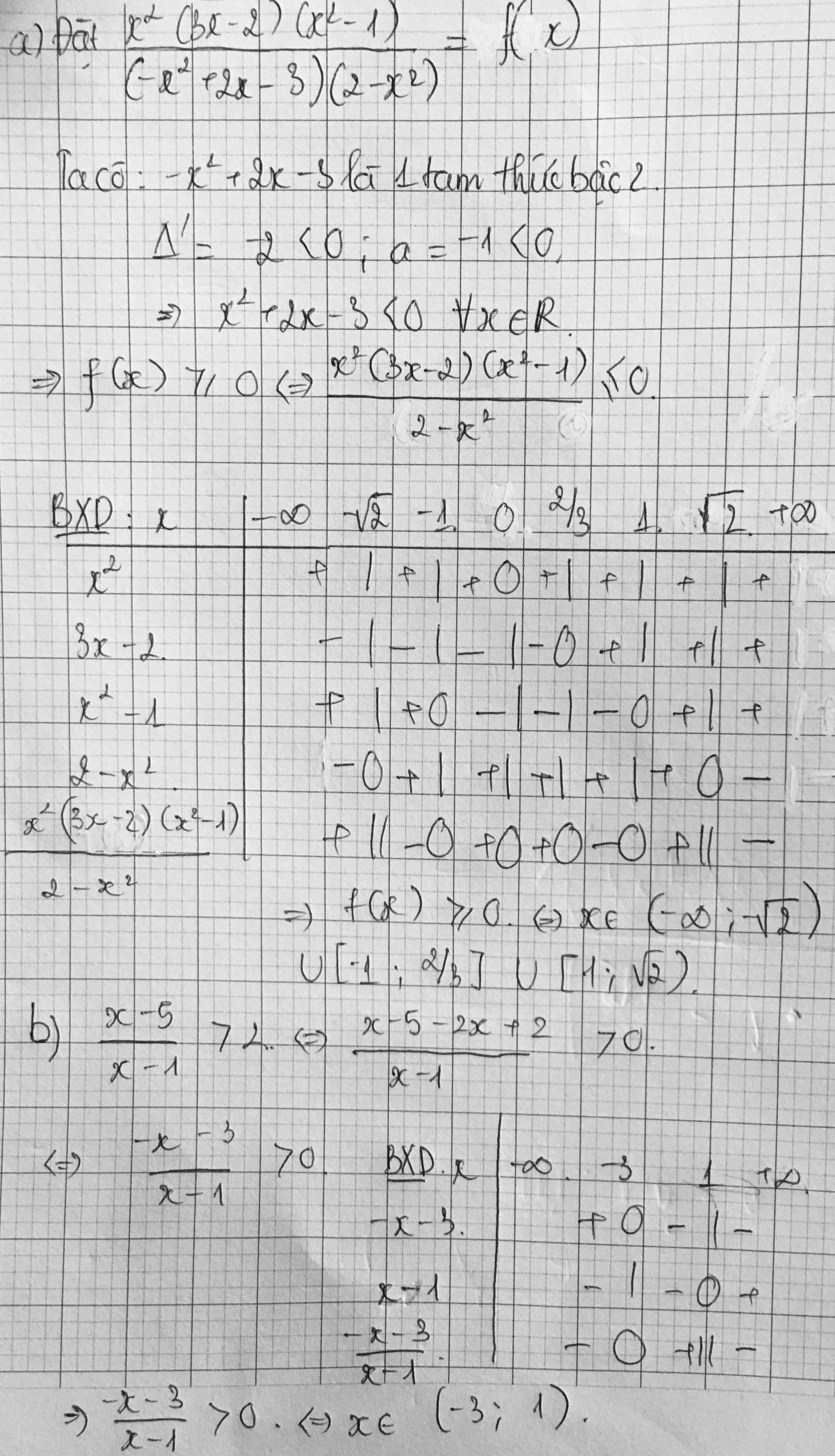
Đặt \(\dfrac{\left(1+2x\right)\left(x-2\right)}{\left(2x+3\right)\left(1-x\right)}=f\left(x\right).\)
Ta có bảng sau:
| \(x\) | \(-\infty\) \(-\dfrac{3}{2}\) \(-\dfrac{1}{2}\) \(1\) \(2\) \(+\infty\) |
| \(1+2x\) | - | - 0 + | + | + |
| \(x-2\) | - | - | - | - 0 + |
| \(2x+3\) | - 0 + | + | + | + |
| \(1-x\) | + | + | + 0 - | - |
| \(f\left(x\right)\) | - || + 0 - || + 0 - |
Vậy \(f\left(x\right)\ge0.\Leftrightarrow x\in\left(\dfrac{-3}{2};\dfrac{-1}{2}\right)\cup\)(1;2].
Ta có; \(x^2\cdot\sqrt2+\left(1+\sqrt2\right)x+1\ge0\)
=>\(x^2\cdot\sqrt2+x\cdot\sqrt2+x+1\ge0\)
=>\(x\sqrt2\left(x+1\right)+\left(x+1\right)\ge0\)
=>\(\left(x+1\right)\left(x\sqrt2+1\right)\ge0\)
TH1: \(\begin{cases}x+1\ge0\\ x\sqrt2+1\ge0\end{cases}\Rightarrow\begin{cases}x\ge-1\\ x\sqrt2\ge-1\end{cases}\Rightarrow x\ge-\frac{1}{\sqrt2}=\frac{-\sqrt2}{2}\)
TH2: \(\begin{cases}x+1\le0\\ x\sqrt2+1\le0\end{cases}\Rightarrow\begin{cases}x\le-1\\ x\sqrt2\le-1\end{cases}\Rightarrow x<=-1\)