
làm giúp bài VII ạ

Hãy nhập câu hỏi của bạn vào đây, nếu là tài khoản VIP, bạn sẽ được ưu tiên trả lời.

a) \(\dfrac{13}{15}< \dfrac{14}{15}\) ( vì 13 < 14 )
b) Ta có:
\(\dfrac{2}{3}=\dfrac{2\times3}{3\times3}=\dfrac{6}{9}\)
Vì 6 = 6 nên \(\dfrac{6}{9}=\dfrac{6}{9}\)
Vậy \(\dfrac{2}{3}=\dfrac{6}{9}\)
c) Ta có:
\(\dfrac{4}{7}=\dfrac{4\times6}{7\times6}=\dfrac{24}{42}\)
\(\dfrac{5}{6}=\dfrac{5\times7}{6\times7}=\dfrac{35}{42}\)
Vì 24 < 35 nên \(\dfrac{24}{42}< \dfrac{35}{42}\)
Vậy \(\dfrac{4}{7}< \dfrac{5}{6}\)
d) Vì 9 < 13 nên \(\dfrac{4}{9}>\dfrac{4}{13}\)
Vậy \(\dfrac{4}{9}>\dfrac{4}{13}\)
everybody
over a billion dolars
relieve the symtoms
no there isn't
VI
1 Everybody can get the common cold
2 A billion dollars is spent on cold medicine every year
3 This medicine can relieve the symptoms
4 No, It can't
5 No, there isn't
VII
1 What is your brother's height?
2 Because Lan was sick, she was absent from class yesterday
3 How heavy is the parcel?
4 Where do you live?
5 How much is you weight last year?
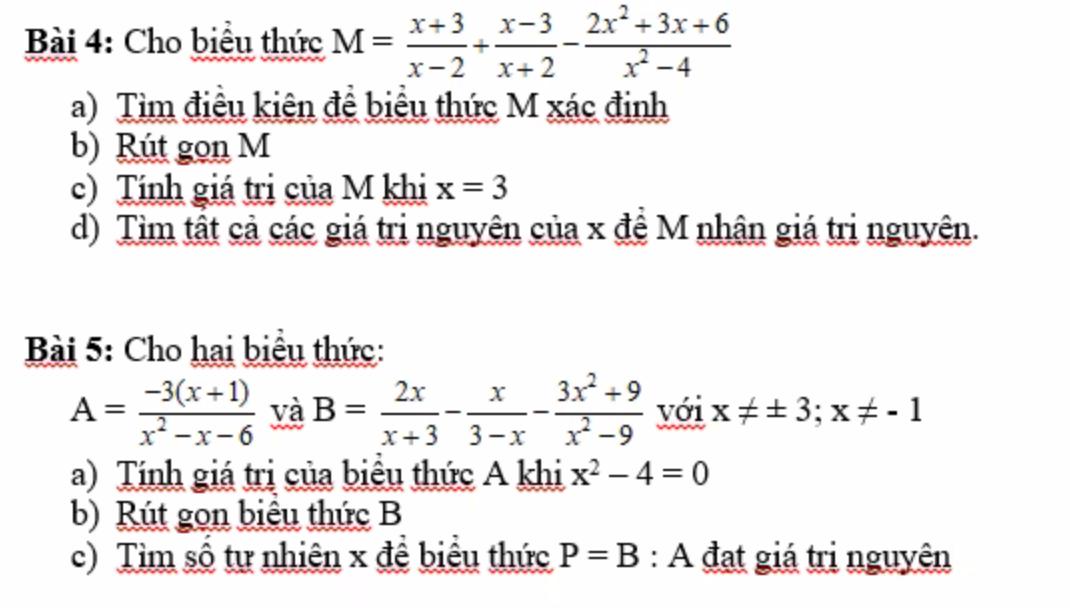
Bài 5:
a: \(A=\frac{-3\left(x+1\right)}{x^2-x-6}\)
\(=\frac{-3\left(x+1\right)}{x^2-3x+2x-6}\)
\(=\frac{-3\left(x+1\right)}{\left(x-3\right)\left(x+2\right)}\)
\(x^2-4=0\)
=>(x-2)(x+2)=0
=>x=2(nhận) hoặc x=-2(loại)
Khi x=2 thì \(A=\frac{-3\cdot\left(2+1\right)}{\left(2-3\right)\left(2+2\right)}=\frac{-3\cdot3}{\left(-1\right)\cdot4}=\frac94\)
b: \(B=\frac{2x}{x+3}-\frac{x}{3-x}-\frac{3x^2+9}{x^2-9}\)
\(=\frac{2x}{x+3}+\frac{x}{x-3}-\frac{3x^2+9}{\left(x-3\right)\left(x+3\right)}\)
\(=\frac{2x\left(x-3\right)+x\left(x+3\right)-3x^2-9}{\left(x-3\right)\left(x+3\right)}=\frac{2x^2-6x+x^2+3x-3x^2-9}{\left(x-3\right)\left(x+3\right)}\)
\(=\frac{-3x-9}{\left(x-3\right)\left(x+3\right)}=\frac{-3\left(x+3\right)}{\left(x-3\right)\left(x+3\right)}=\frac{-3}{x-3}\)
c: P=B:A
\(=-\frac{3}{x-3}:\frac{-3\left(x+1\right)}{\left(x-3\right)\left(x+2\right)}\)
\(=\frac{3}{x-3}\cdot\frac{\left(x-3\right)\left(x+2\right)}{3\left(x+1\right)}=\frac{x+2}{x+1}\)
Để P nguyên thì x+2⋮x+1
=>x+1+1⋮x+1
=>1⋮x+1
=>x+1∈{1;-1}
=>x∈{0;-2}
mà x là số tự nhiên
nên x=0
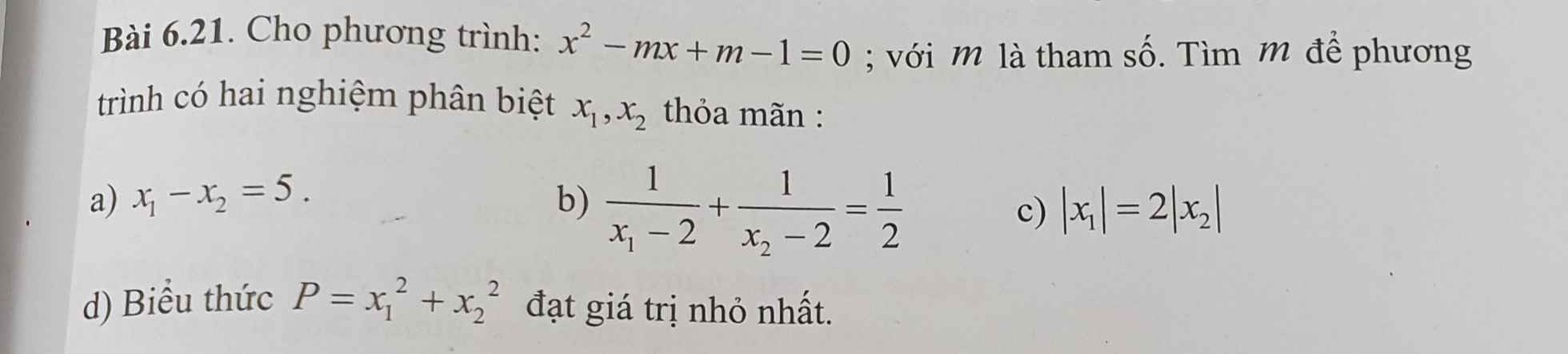
a: \(\Delta=\left(-m\right)^2-4\left(m-1\right)=m^2-4m+4=\left(m-2\right)^2\)
Để phương trình có hai nghiệm phân biệt thì Δ>0
=>\(\left(m-2\right)^2>0\)
=>m-2<>0
=>m<>2
Theo Vi-et, ta có: \(x_1+x_2=-\frac{b}{a}=m;x_1x_2=\frac{c}{a}=m-1\)
\(x_1-x_2=5\)
=>\(\left(x_1-x_2\right)^2=5^2=25\)
=>\(\left(x_1+x_2\right)^2-4x_1x_2=25\)
=>\(m^2-4\left(m-1\right)=25\)
=>\(m^2-4m+4=25\)
=>\(m^2-4m-21=0\)
=>(m-7)(m+3)=0
=>m=7(nhận) hoặc m=-3(nhận)
b: \(\frac{1}{x_1-2}+\frac{1}{x_2-2}=\frac12\)
=>\(\frac{x_2-2+x_1-2}{\left(x_1-2\right)\left(x_2-2\right)}=\frac12\)
=>\(\frac{x_1+x_2-4}{x_1x_2-2\left(x_1+x_2\right)+4}=\frac12\)
=>\(\frac{m-4}{m-1-2m+4}=\frac12\)
=>\(\frac{m-4}{-m+3}=\frac12\)
=>2(m-4)=-m+3
=>2m-8=-m+3
=>3m=11
=>\(m=\frac{11}{3}\) (nhận)
c: \(\left|x_1\right|=2\left|x_2\right|\)
=>\(\left[\begin{array}{l}x_1=2x_2\\ x_1=-2x_2\end{array}\right.\)
TH1: \(x_1=2x_2\)
mà \(x_1+x_2=m\)
nên \(x_1=\frac{2m}{3};x_2=\frac{m}{3}\)
\(x_1\cdot x_2=m-1\)
=>\(\frac{2m}{3}\cdot\frac{m}{3}=m-1\)
=>\(2m^2=9\left(m-1\right)=9m-9\)
=>\(2m^2-9m+9=0\)
=>\(2m^2-3m-6m+9=0\)
=>m(2m-3)-3(2m-3)=0
=>(2m-3)(m-3)=0
=>\(\left[\begin{array}{l}m=\frac32\left(nhận\right)\\ m=3\left(nhận\right)\end{array}\right.\)
TH2: \(x_1=-2x_2\)
\(x_1+x_2=m\)
=>\(-2x_2+x_2=m\)
=>\(-x_2=m\)
=>\(x_2=-m\)
=>\(x_1=-2\cdot\left(-m\right)=2m\)
\(x_1x_2=m-1\)
=>\(-2m^2=m-1\)
=>\(2m^2+m-1=0\)
=>\(2m^2+2m-m-1=0\)
=>(m+1)(2m-1)=0
=>m=-1(nhận) hoặc m=1/2(nhận)
d: \(P=x_1^2+x_2^2\)
\(=\left(x_1+x_2\right)^2-2x_1x_2\)
\(=m^2-2\left(m-1\right)=m^2-2m+2=m^2-2m+1+1=\left(m-1\right)^2+1\ge1\forall m\)
Dấu '=' xảy ra khi m-1=0
=>m=1


 Giúp e bài 2 thôi ạ bài 1 e làm r ạ! Mong mn giúp e, e cần gấp ạ!

1. C
2. A
3. D
4. A
5. C
1-a
2-b
3-c
4-d
5-a