
thực hiện phép tính:a) (x-2)(x+2)-x(x-1)+8
b) (4x^3y^3-6x^2y^3+2x^2y^2):2xy
Hãy nhập câu hỏi của bạn vào đây, nếu là tài khoản VIP, bạn sẽ được ưu tiên trả lời.

Bài 1:
a, (\(x\) - 4).(\(x\) + 4) - (5 - \(x\)).(\(x\) + 1)
= \(x^2\) - 16 - 5\(x\) - 5 + \(x^2\) + \(x\)
= (\(x^2\) + \(x^2\)) - (5\(x\) - \(x\)) - (16 + 5)
= 2\(x^2\) - 4\(x\) - 21
b, (3\(x^2\) - 2\(xy\) + 4) + (5\(xy\) - 6\(x^2\) - 7)
= 3\(x^2\) - 2\(xy\) + 4 + 5\(xy\) - 6\(x^2\) - 7
= (3\(x^2\) - 6\(x^2\)) + (5\(xy\) - 2\(xy\)) - (7 - 4)
= - 3\(x^2\) + 3\(xy\) - 3
a: \(=\dfrac{2x-2x+y}{2\left(2x-y\right)}=\dfrac{y}{2\left(2x-y\right)}\)
b: \(=\dfrac{3x+1}{\left(x-1\right)\left(x+1\right)}-\dfrac{x}{2\left(x-1\right)}\)
\(=\dfrac{6x+2-x^2-x}{2\left(x-1\right)\left(x+1\right)}\)
\(=\dfrac{-x^2+5x+2}{2\left(x-1\right)\left(x+1\right)}\)
c: \(=\dfrac{1}{x+2}+\dfrac{x+8}{3x\left(x+2\right)}\)
\(=\dfrac{3x+x+8}{3x\left(x+2\right)}=\dfrac{4x+8}{3x\left(x+2\right)}=\dfrac{4}{3x}\)
d: \(=\dfrac{4x+6-2x^2+3x+2x+1}{\left(2x-3\right)\left(2x+3\right)}\)
\(=\dfrac{-2x^2+9x+7}{\left(2x-3\right)\left(2x+3\right)}\)
Bài 3:
a: \(\frac{x}{x-3}+\frac{9-6x}{x^2-3x}\)
\(=\frac{x}{x-3}+\frac{-6x+9}{x\left(x-3\right)}\)
\(=\frac{x^2-6x+9}{x\left(x-3\right)}=\frac{\left(x-3\right)^2}{x\left(x-3\right)}=\frac{x-3}{x}\)
b: \(\frac{6x-3}{x}:\frac{4x^2-1}{3x^2}\)
\(=\frac{3\left(2x-1\right)}{x}\cdot\frac{3x^2}{\left(2x-1\right)\left(2x+1\right)}=\frac{3\cdot3x}{2x+1}=\frac{9x}{2x+1}\)
Bài 2:
a: \(\frac{x^3-x}{3x+3}\)
\(=\frac{x\left(x^2-1\right)}{3\left(x+1\right)}=\frac{x\left(x-1\right)\left(x+1\right)}{3\left(x+1\right)}=\frac{x\left(x-1\right)}{3}\)
b: \(\frac{x^2+3xy}{x^2-9y^2}=\frac{x\left(x+3y\right)}{\left(x-3y\right)\left(x+3y\right)}=\frac{x}{x-3y}\)
Bài 1:
a: \(\frac{x^2-9}{2x+6}:\frac{3-x}{2}\)
\(=\frac{\left(x-3\right)\left(x+3\right)}{2\left(x+3\right)}\cdot\frac{2}{-\left(x-3\right)}=\frac{-2}{2}=-1\)
b: \(\frac{2x}{x-y}-\frac{2y}{x-y}=\frac{2x-2y}{x-y}=\frac{2\left(x-y\right)}{x-y}=2\)
c: \(\frac{x+15}{x^2-9}+\frac{2}{x+3}\)
\(=\frac{x+15}{\left(x-3\right)\left(x+3\right)}+\frac{2}{x+3}\)
\(=\frac{x+15+2\left(x-3\right)}{\left(x-3\right)\left(x+3\right)}=\frac{x+15+2x-6}{\left(x-3\right)\left(x+3\right)}=\frac{3x+9}{\left(x-3\right)\left(x+3\right)}\)
\(=\frac{3\left(x+3\right)}{\left(x-3\right)\left(x+3\right)}=\frac{3}{x-3}\)
d: \(\frac{x+y}{2x-2y}-\frac{x-y}{2x+2y}-\frac{y^2+x^2}{y^2-x^2}\)
\(=\frac{x+y}{2\left(x-y\right)}-\frac{x-y}{2\left(x+y\right)}+\frac{x^2+y^2}{\left(x-y\right)\left(x+y\right)}\)
\(=\frac{\left(x+y\right)^2-\left(x-y\right)^2+2\left(x^2+y^2\right)}{2\left(x-y\right)\left(x+y\right)}=\frac{x^2+2xy+y^2-x^2+2xy-y^2+2x^2+2y^2}{2\left(x-y\right)\left(x+y\right)}\)
\(=\frac{2x^2+4xy+2y^2}{2\left(x-y\right)\left(x+y\right)}=\frac{2\left(x^2+2xy+y^2\right)}{2\left(x-y\right)\left(x+y\right)}=\frac{\left(x+y\right)^2}{\left(x-y\right)\left(x+y\right)}=\frac{x+y}{x-y}\)
a/ (x-1)2-(4x+3)(2-x)=x2-2x+1-(8x-4x2+6-3x)
=x2-2x+1-8x+4x2-6+3x=5x2-7x-6
b/ (15x3y2 - 6x2y3) : 3x2y2 = 5x - 2y
c/ \(\dfrac{x+7}{x-7}-\dfrac{x-7}{x+7}+\dfrac{4x^2}{x^2-49}\)=\(\dfrac{\left(x+7\right)^2-\left(x-7\right)^2+4x^2}{\left(x-7\right)\left(x+7\right)}\)=\(\dfrac{x^2+14x+49-\left(x^2-14x+49\right)+4x^2}{\left(x-7\right)\left(x+7\right)}\)=\(\dfrac{28x+4x^2}{\left(x-7\right)\left(x+7\right)}\)=\(\dfrac{4x\left(x+7\right)}{\left(x-7\right)\left(x+7\right)}\)=\(\dfrac{4x}{x-7}\)
a: \(=\dfrac{5}{3}x^2-x+\dfrac{1}{3}\)
b: \(=-5y-9+xy\)
Bài 3:
3: \(6x\left(x-y\right)-9y^2+9xy\)
\(=6x\left(x-y\right)+9xy-9y^2\)
\(=6x\left(x-y\right)+9y\left(x-y\right)\)
\(=\left(x-y\right)\left(6x+9y\right)\)
\(=3\left(2x+3y\right)\left(x-y\right)\)
Bài 4:
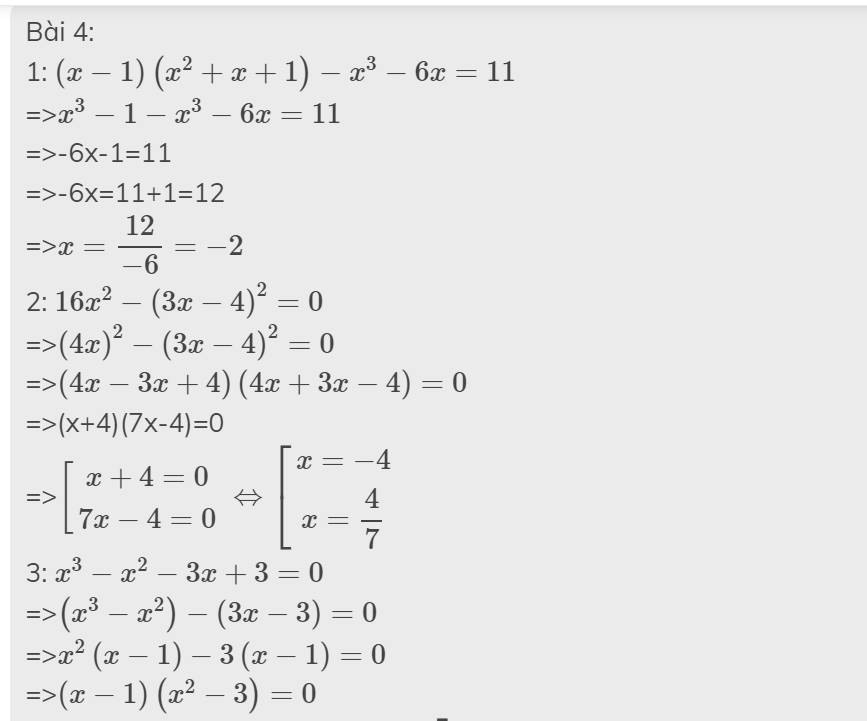
$(x-1)(x^2+x+1)-x^3-6x=11$
Dùng $(x-1)(x^2+x+1)=x^3-1$:
$x^3-1-x^3-6x=11$
$-6x-1=11$
$-6x=12$
$x=-2$
Vậy $x=-2$.
2.$16x^2-(3x-4)^2=0$
$(4x)^2-(3x-4)^2=0$
$(4x-3x+4)(4x+3x-4)=0$
$(x+4)(7x-4)=0$
$x=-4$ hoặc $x=\dfrac47$
Vậy $x=-4,\dfrac47$.
3.$x^3-x^2+3-3x=0$
$=x^2(x-1)-3(x-1)=0$
$=(x-1)(x^2-3)=0$
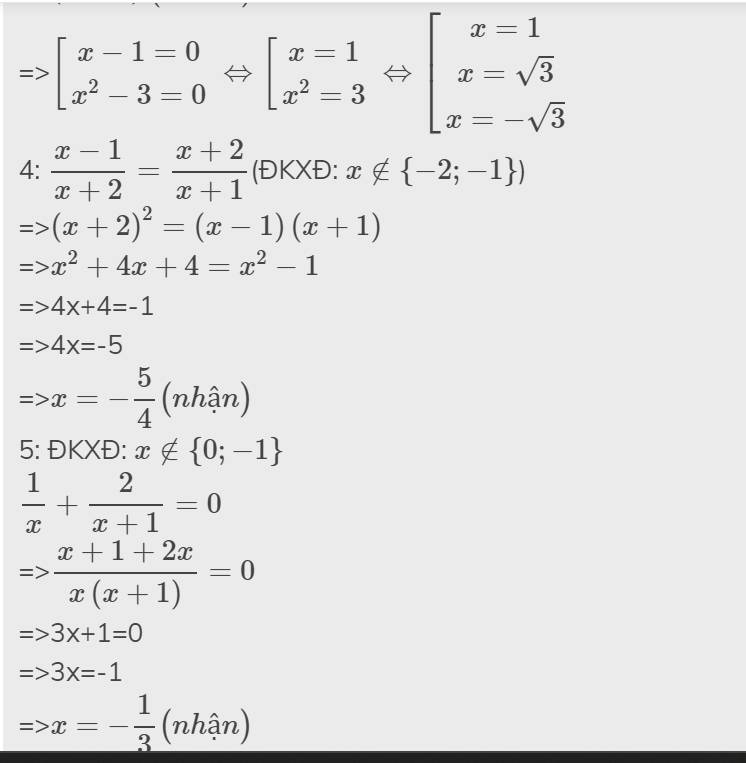
$x-1=0$ hoặc $x^2-3=0$
$x=1$ hoặc $x=\pm\sqrt3$
Vậy $x=1,\sqrt3,-\sqrt3$.
4.$\dfrac{x-1}{x+2}=\dfrac{x+2}{x+1}$
Điều kiện: $x\ne-2,-1$.
$(x-1)(x+1)=(x+2)^2$
$x^2-1=x^2+4x+4$
$-4x=5$
$x=-\dfrac54$
Vậy $x=-\dfrac54$.
5.$\dfrac1{x+2}+\dfrac2{x+1}=0$
Điều kiện: $x\ne-2,-1$.
$\dfrac{x+1+2(x+2)}{(x+2)(x+1)}=0$
$x+1+2x+4=0$
$3x+5=0$
$x=-\dfrac53$
Vậy $x=-\dfrac53$.
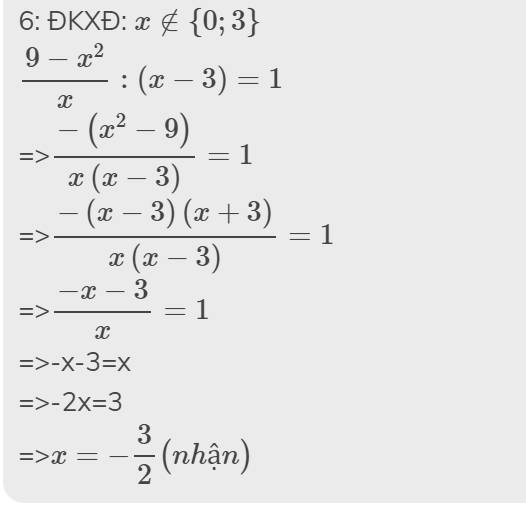
6.$\dfrac{9-x^2}{x}:(x-3)=1$
Điều kiện: $x\ne0,3$.
$\dfrac{9-x^2}{x(x-3)}=1$
$9-x^2=x(x-3)$
$9-x^2=x^2-3x$
$2x^2-3x-9=0$
$(2x+3)(x-3)=0$
$x=-\dfrac32$ hoặc $x=3$
Nhưng $x=3$ không thỏa điều kiện.
Vậy $x=-\dfrac32$.
a: \(=x^2-4-x^2+x+8=x+4\)
a) (x-2)(x+2)-x(x-1)+8
= x2-4-x2+x+8
= (x2-x2)+(-4+8)+x
= 4+x
b) bn viết lại đề đi:v
đọc khó quá.