
 Giải chi tiết hộ em với ạ
K
Khách
Hãy nhập câu hỏi của bạn vào đây, nếu là tài khoản VIP, bạn sẽ được ưu tiên trả lời.

Những câu hỏi liên quan
M
2
H
4 tháng 4 2021
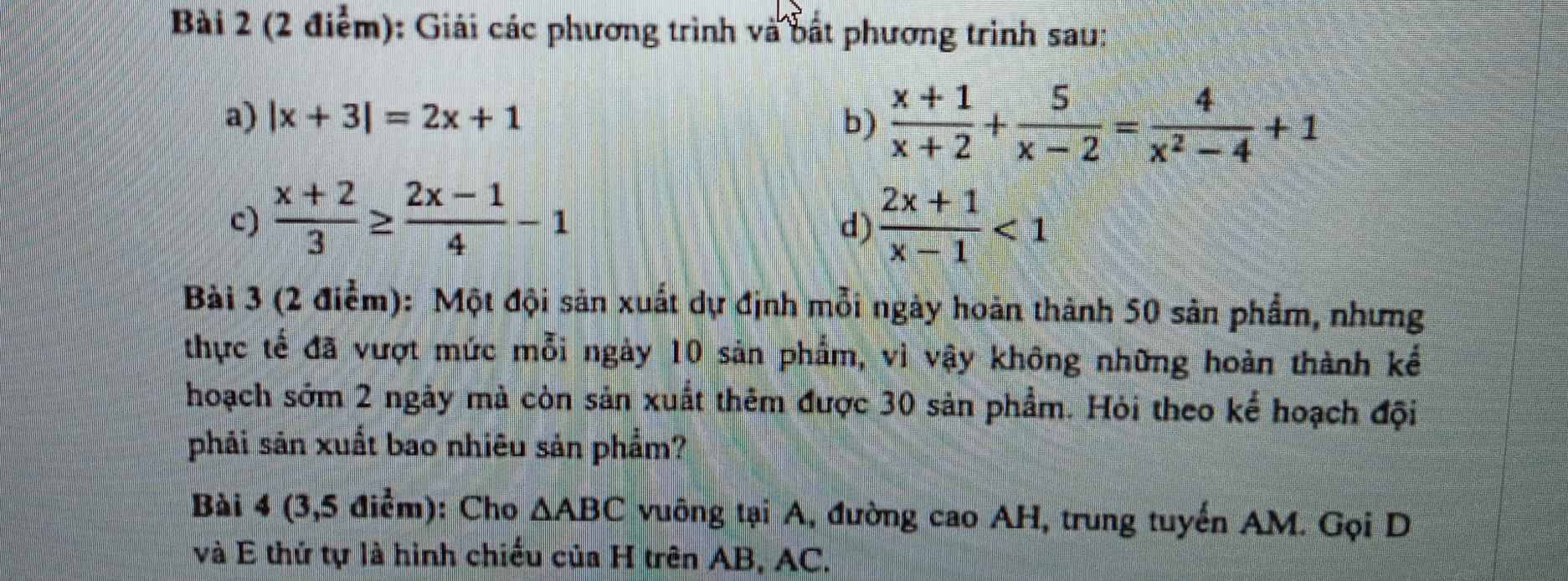
Gọi số sản phẩm dự định là a (sản phẩm ) (a là số tự nhiên khác 0)
Vì theo dự định mỗi ngày sản xuất 50 sản phẩm nên số ngày theo dự định là \(\dfrac{a}{50}\)
Nhưng thực tế , đội đã sản xuất theeo được 30 sản phẩm do mỗi ngày vượt mức 10 sản phẩm (nghĩa là sản xuất 60 sản phẩm) , nên số ngày thực tế là \(\dfrac{a+30}{60}\)
Vì thực tế sớm hơn dự định 2 ngày nên ta có phương trình :
\(\dfrac{a}{50}=\dfrac{a+30}{60}+2\\ \Leftrightarrow6a=5\left(a+30+120\right)\\\Leftrightarrow a=750\left(t.m\right) \)
Vậy số sản phẩm dự định là 750 sản phẩm
4 tháng 4 2021
Bài 3:
Gọi số sản phẩm đội phải sản xuất theo kế hoạch là x( sản phẩm, x\(\in N\)*)
Thời gian đội sản xuất theo kế hoạch là: \(\dfrac{x}{50}\) (ngày)
Số ngày làm thực tế là: \(\dfrac{x+30}{50+10}=\dfrac{x+30}{60}\) (ngày)
Theo bài ra, ta có phương trình:
\(\dfrac{x}{50}-\dfrac{x+30}{60}=2\)
\(\Leftrightarrow\dfrac{60x-50\left(x+30\right)}{50.60}=2\)
\(\Leftrightarrow60x-50x-1500=6000\Leftrightarrow x=750\)(thoả mãn)
Vậy theo kế hoạch đội phải sản xuất 750 sản phẩm
CE
1
24 tháng 4 2020
Câu 1 em mở SGK nha
Câu 2:
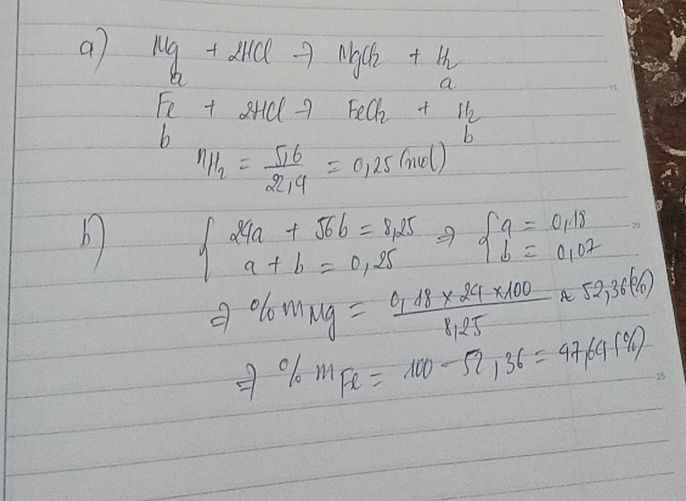
a) Fe2O3 + 3 H2 -to-> 2 Fe + 3 H2O
b) HgO + H2 -to->Hg + H2O
c)PbO + H2 -to-> Pb + H2O
Câu 3:
nHgO= 21,7/217=0,1(mol)
PTHH: HgO + H2 -to-> Hg + H2O
0,1________0,1_______0,1(mol)
a) nHg= 0,1.201=20,1(g)
b)mH2=0,1.2=0,2(g)
V(H2,đktc)=0,1.22,4=2,24(l)
4)
nH2= 8,4/22,4=0,375(mol)
PTHH: H2 + 1/2 O2 -to-> H2O
0,375__________________0,375
=>mH2O=0,375.18= 6,75(g)
PK

1
NL
Nguyễn Lê Phước Thịnh
CTVHS
2 tháng 6
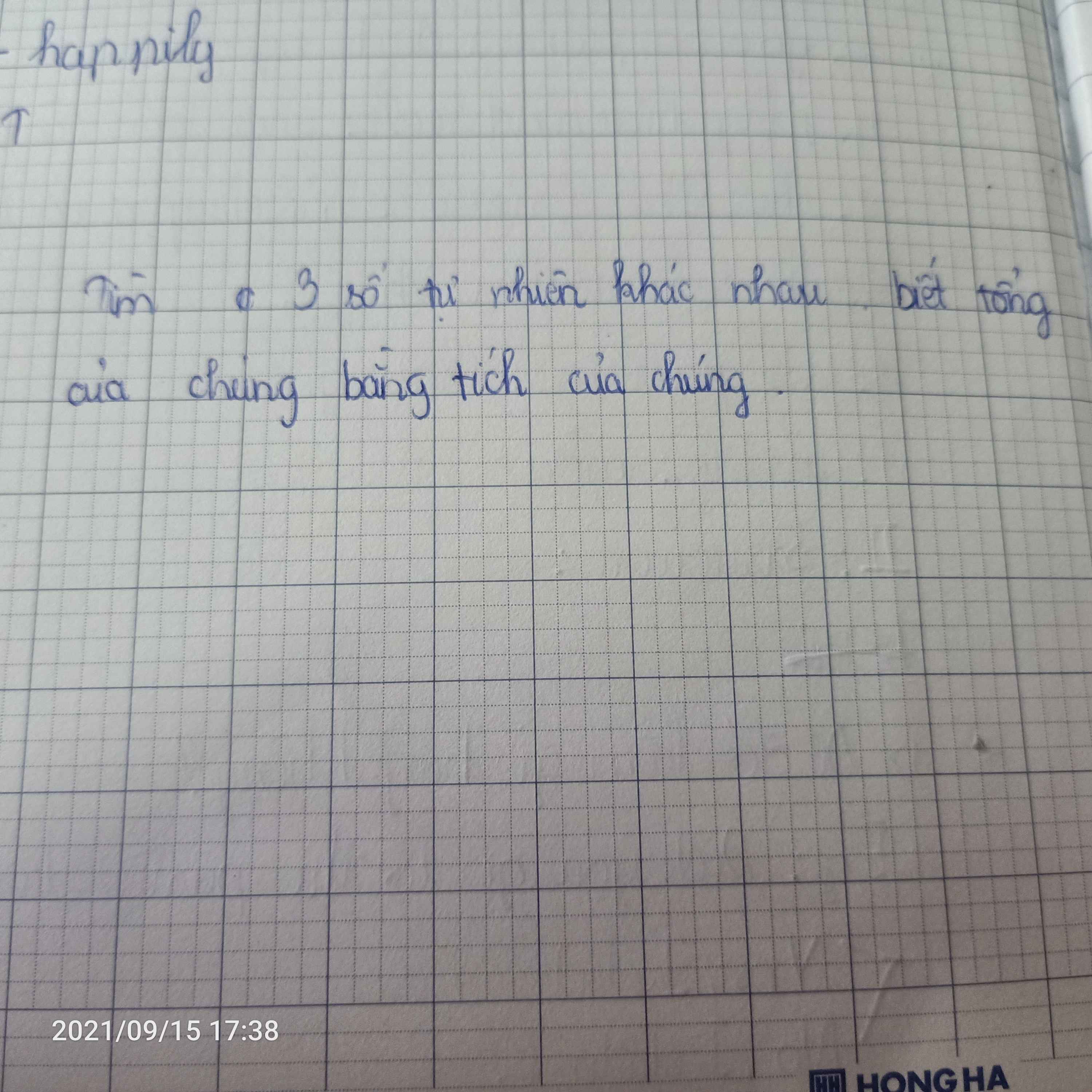
1: Gọi ba số tự nhiên đề bài cho là a,b,c
(ĐIều kiện: a<>b; b<>c; a<>c)
Tổng của chúng bằng tích của chúng nên ta có: abc=a+b+c
=>a=1; b=2; c=3
Bài 2:
\(x\left(x+1\right)=2+4+6+\cdots+2500\)
=>\(x\left(x+1\right)=2\left(1+2+\cdots+1250\right)\)
=>\(x\left(x+1\right)=2\cdot\frac{1250\cdot1251}{2}=1250\cdot1251\)
=>\(x^2+x-1250\cdot1251=0\)
=>(x+1251)(x-1250)=0
=>x=-1251 hoặc x=1250


NL
Nguyễn Lê Phước Thịnh
CTVHS
4 tháng 6
Bài 1:
\(cos45^0=cos\left(2\cdot22^030p\right)=2\cdot cos^2\alpha-1\)
=>\(2\cdot cos^2\alpha=1+\frac{\sqrt2}{2}=\frac{2+\sqrt2}{2}\)
=>\(cos^2\alpha=\frac{2+\sqrt2}{4}\)
=>\(\sin^2a=1-\frac{2+\sqrt2}{4}=\frac{4-2-\sqrt2}{4}=\frac{2-\sqrt2}{4}\)
\(cos\alpha=\sqrt{\frac{2+\sqrt2}{4}}=\frac{\sqrt{2+\sqrt2}}{2}\)
\(\sin a=\sqrt{\frac{\left(2-\sqrt2\right)}{4}}=\frac{\sqrt{2-\sqrt2}}{2}\)
\(\tan\alpha=\frac{\sin\alpha}{cos\alpha}=\frac{\sqrt{2-\sqrt2}}{2}:\frac{\sqrt{2+\sqrt2}}{2}=\sqrt{\frac{2-\sqrt2}{2+\sqrt2}}=\sqrt{\frac{\sqrt2-1}{\sqrt2+1}}\)
\(=\sqrt{\frac{\left(\sqrt2-1\right)^2}{\left(\sqrt2-1\right)\left(\sqrt2+1\right)}}=\sqrt{\left(\sqrt2-1\right)^2}=\sqrt2-1\)
\(\cot\alpha=\frac{1}{\tan\alpha}=\frac{1}{\sqrt2-1}=\sqrt2+1\)
b: \(cos30^0=cos\left(2\cdot15^0\right)=2\cdot cos^215^0-1\)
=>\(2\cdot cos^215^0-1=\frac{\sqrt3}{2}\)
=>\(2\cdot cos^215^0=\frac{2+\sqrt3}{2}\)
=>\(cos^215^0=\frac{2+\sqrt3}{4}\)
=>\(cos15^0=\sqrt{\frac{2+\sqrt3}{4}}=\frac{\sqrt{2+\sqrt3}}{2}=\frac{\sqrt{4+2\sqrt3}}{2\sqrt2}=\frac{\sqrt3+1}{2\sqrt2}=\frac{\sqrt6+\sqrt2}{4}\)
Ta có: \(cos^215^0+\sin^215^0=1\)
=>\(\sin^215^0=1-\frac{2+\sqrt3}{4}=\frac{2-\sqrt3}{4}=\frac{\left(4-2\sqrt3\right)}{8}=\frac{\left(\sqrt3-1\right)^2}{\left(2\sqrt2\right)^2}\)
=>\(\sin15^0=\frac{\sqrt3-1}{2\sqrt2}=\frac{\sqrt6-\sqrt2}{4}\)
\(\tan15^0=\frac{\sin15^0}{cos15^0}=\frac{\sqrt6-\sqrt2}{4}:\frac{\sqrt6+\sqrt2}{4}=\frac{\sqrt6-\sqrt2}{\sqrt6+\sqrt2}\)
\(=\frac{\sqrt3-1}{\sqrt3+1}=\frac{\left(\sqrt3-1\right)^2}{2}=\frac{4-2\sqrt3}{2}=2-\sqrt3\)
\(\cot15^0=\frac{1}{\tan15^0}=\frac{1}{2-\sqrt3}=2+\sqrt3\)
Bài 2:
\(cos^2a-cos^2b\)
\(=1-\sin^2a-\left(1-\sin^2b\right)=1-\sin^2a-1+\sin^2b\)
\(=\sin^2b-\sin^2a\)

AH
Akai Haruma
Giáo viên
30 tháng 10 2021
Bài 1:
a. $\sin ^2a+\cos ^2a=1$
$\cos ^2a=1-\sin ^2a=1-(\frac{1}{3})^2=\frac{8}{9}$
$\Rightarrow \cos a=\frac{2\sqrt{2}}{3}$ (do $\cos a>0$)
b.
\(\sin 32-\cos 58+2\frac{\tan 33}{\cot 57}-3(\sin ^210+\sin ^280)\)
\(=\cos (90-32)-\cos 58+2\frac{\tan 33}{\tan (90-57)}-3(\sin ^210+\cos ^2(90-80))\)
\(=\cos 58-\cos 58+2\frac{\tan 33}{\tan 33}-3(\sin ^210+\cos ^210)\)
\(=0+2.1-3.1=-1\)
LD

2
22 tháng 10 2021
\(b,B=\dfrac{x-4+2\sqrt{x}+6-3\sqrt{x}-4}{\left(\sqrt{x}+3\right)\left(\sqrt{x}-2\right)}\\ B=\dfrac{x-\sqrt{x}+2}{\left(\sqrt{x}+3\right)\left(\sqrt{x}-2\right)}=\dfrac{\left(\sqrt{x}+1\right)\left(\sqrt{x}-2\right)}{\left(\sqrt{x}+3\right)\left(\sqrt{x}-2\right)}=\dfrac{\sqrt{x}+1}{\sqrt{x}+3}\\ c,M=B:A=\dfrac{\sqrt{x}+1}{\sqrt{x}+3}\cdot\dfrac{\sqrt{x}+3}{x-\sqrt{x}+2}=\dfrac{\sqrt{x}+1}{x-\sqrt{x}+2}\\ M=\dfrac{x-\sqrt{x}+2-x+2\sqrt{x}-1}{x-\sqrt{x}+2}\\ M=1-\dfrac{x-2\sqrt{x}+1}{x-\sqrt{x}+2}=1-\dfrac{\left(\sqrt{x}-1\right)^2}{x-\sqrt{x}+2}\)
Ta có \(\left(\sqrt{x}-1\right)^2\ge0;x-\sqrt{x}+2=\left(\sqrt{x}-\dfrac{1}{2}\right)^2+\dfrac{7}{4}>0\)
Do đó \(\dfrac{\left(\sqrt{x}-1\right)^2}{x-\sqrt{x}+2}\ge0\)
\(\Leftrightarrow M=1-\dfrac{\left(\sqrt{x}-1\right)^2}{x-\sqrt{x}+2}\le1-0=1\)
Vậy \(M_{max}=1\Leftrightarrow\sqrt{x}=1\Leftrightarrow x=1\left(tm\right)\)
NL
Nguyễn Lê Phước Thịnh
CTVHS
22 tháng 10 2021
a: Thay \(x=3+2\sqrt{2}\) vào A, ta được:
\(A=\dfrac{3+2\sqrt{2}-\sqrt{2}-1+2}{\sqrt{2}+1+3}=\dfrac{4+\sqrt{2}}{4+\sqrt{2}}=1\)
NP
2
ĐKXĐ: \(-1\le x\le4\)
\(\Leftrightarrow\left(x-3\right)\sqrt{1+x}-\left(x-3\right)+x-x\sqrt{4-x}=2x^2-6x\)
\(\Leftrightarrow\left(x-3\right)\left(\sqrt{1+x}-1\right)+x\left(1-\sqrt{4-x}\right)=2x^2-6x\)
\(\Leftrightarrow\dfrac{x\left(x-3\right)}{\sqrt{1+x}+1}+\dfrac{x\left(x-3\right)}{1+\sqrt{4-x}}=2\left(x^2-3x\right)\)
\(\Leftrightarrow\left[{}\begin{matrix}x^2-3x=0\Rightarrow x=...\\\dfrac{1}{\sqrt{1+x}+1}+\dfrac{1}{1+\sqrt{4-x}}=2\left(1\right)\end{matrix}\right.\)
Xét (1), do \(VT< \dfrac{1}{1}+\dfrac{1}{1}=2\Rightarrow VT< VP\Rightarrow\left(1\right)\) vô nghiệm
Vậy ...