
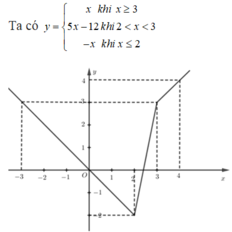
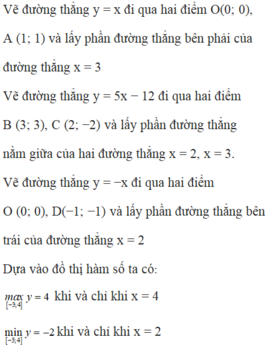
Cho hàm số y=\(x^2-2x-3\). Tìm giá trị lớn nhất của hàm số với \(x\in\left[-3;4\right]\).
K
Khách
Hãy nhập câu hỏi của bạn vào đây, nếu là tài khoản VIP, bạn sẽ được ưu tiên trả lời.

Những câu hỏi liên quan
HP
22 tháng 3 2021
b, \(\left\{{}\begin{matrix}x^2-2x-3\le0\\x^2-2mx+m^2-9\ge0\end{matrix}\right.\)
\(\Leftrightarrow\left\{{}\begin{matrix}-1\le x\le3\\x^2-2mx+m^2-9\ge0\end{matrix}\right.\)
Yêu cầu bài toán thỏa mãn khi phương trình \(f\left(x\right)=x^2-2mx+m^2-9\ge0\) có nghiệm \(x\in\left[-1;3\right]\)
\(\Leftrightarrow\left\{{}\begin{matrix}\Delta'=m^2-m^2+9=9>0,\forall m\\-1< m< 3\\f\left(-1\right)=m^2+2m-8\ge0\\f\left(3\right)=m^2-6m\ge0\end{matrix}\right.\)
\(\Leftrightarrow m\in[2;3)\cup(-1;0]\)
NL
Nguyễn Lê Phước Thịnh
CTVHS
23 tháng 2 2021
Câu 1:
a) Để hàm số \(y=\left(3m+5\right)\cdot x^2\) nghịch biến với mọi x>0 thì \(3m+5< 0\)
\(\Leftrightarrow3m< -5\)
hay \(m< -\dfrac{5}{3}\)
Vậy: Để hàm số \(y=\left(3m+5\right)\cdot x^2\) nghịch biến với mọi x>0 thì \(m< -\dfrac{5}{3}\)
b) Để hàm số \(y=\left(3m+5\right)\cdot x^2\) đồng biến với mọi x>0 thì
3m+5>0
\(\Leftrightarrow3m>-5\)
hay \(m>-\dfrac{5}{3}\)
Vậy: Để hàm số \(y=\left(3m+5\right)\cdot x^2\) đồng biến với mọi x>0 thì \(m>-\dfrac{5}{3}\)
23 tháng 2 2021
2.
Để hàm nghịch biến với x>0 \(\Leftrightarrow\sqrt{3k+4}-3< 0\)
\(\Leftrightarrow\sqrt{3k+4}< 3\Leftrightarrow3k+4< 9\)
\(\Rightarrow-\dfrac{4}{3}\le k< \dfrac{5}{3}\)
Để hàm đồng biến khi x>0
\(\Leftrightarrow\sqrt{3k+4}-3>0\Leftrightarrow\sqrt{3k+4}>3\)
\(\Leftrightarrow3k+4>9\Rightarrow k>\dfrac{5}{3}\)
NL
Nguyễn Lê Phước Thịnh
CTVHS
26 tháng 5
a: \(5-2\cdot cos^2x\cdot\sin^2x\)
\(=5-2\cdot\left(\sin x\cdot cosx\right)^2\)
\(=5-2\cdot\left(\frac12\cdot\sin2x\right)^2=5-2\cdot\frac14\cdot\sin^22x=-\frac12\cdot\sin^22x+5\)
Ta có: \(0\le\sin^22x\le1\)
=>\(-\frac12\le-\frac12\cdot\sin^22x\le0\)
=>\(-\frac12+5\le-\frac12\cdot\sin^22x+5\le0+5\)
=>\(\frac92\le-\frac12\cdot\sin^22x+5\le5\)
=>\(\frac{3\sqrt2}{2}\le\sqrt{-\frac12\cdot\sin^22x+5}\le\sqrt5\)
=>\(4:\frac{3\sqrt2}{2}\ge\frac{4}{\sqrt{-\frac12\cdot sin^22x+5}}\ge\frac{4}{\sqrt5}\)
=>\(\frac{2\sqrt2}{3}\ge y\ge\frac{4\sqrt5}{5}\)
Do đó: \(y_{\max}=\frac{2\sqrt2}{3}\) khi \(\sin^22x=1\)
=>\(cos^22x=0\)
=>cos2x=0
=>\(2x=\frac{\pi}{2}+k\pi\)
=>\(x=\frac{\pi}{4}+\frac{k\pi}{2}\)
\(y_{\min}=\frac{4\sqrt5}{5}\) khi \(\sin^22x=0\)
=>sin 2x=0
=>\(2x=k\pi\)
=>\(x=\frac{k\pi}{2}\)
b: \(f\left(x\right)=3\cdot\sin^2x+5\cdot cos^2x-4\cdot cos2x-2\)
\(=3\cdot\sin^2x+5\cdot cos^2x-4\left(cos^2x-\sin^2x\right)-2\)
\(=3\cdot\sin^2x+5\cdot cos^2x-4\cdot cos^2x+4\cdot\sin^2x-2\)
\(=7\cdot\sin^2x+cos^2x-2=7\cdot\sin^2x+1-\sin^2x-2=6\cdot\sin^2x-1\)
Ta có: \(0\le\sin^2x\le1\)
=>\(0\le6\sin^2x\le6\)
=>\(0-1\le6\sin^2x-1\le6-1\)
=>-1<=f(x)<=5
f(x) min=-1 khi \(\sin^2x=0\)
=>sin x=0
=>\(x=k\pi\)
f(x) max=5 khi \(\sin^2x=1\)
=>\(cos^2x=0\)
=>cosx=0
=>\(x=\frac{\pi}{2}+k\pi\)
24 tháng 9 2023
Tham khảo:
Đỉnh S có tọa độ: \({x_S} = \dfrac{{ - b}}{{2a}} = \dfrac{{ - 2}}{{2.1}} = - 1;\,{y_S} = {\left( { - 1} \right)^2} + 2.( - 1) + 3 = 2.\)
Hay \(S\left( { - 1;2} \right).\)
Vì hàm số bậc hai có \(a = 1 > 0\) nên ta có bảng biến thiên sau:
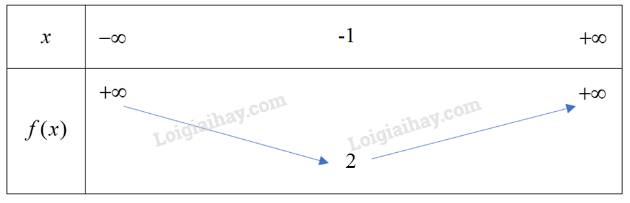
Hàm số đạt giá trị nhỏ nhất bằng \(2\).
Lời giải:
$x^2-2x-3=x(x+3)-5(x+3)+12=(x+3)(x-5)+12$
Vì $x\in [-3;4]$ nên $x+3\geq 0; x-5< 0$
$\Rightarrow x^2-2x-3=(x+3)(x-5)+12\leq 12$
Vậy GTLN của hàm số là $12$ khi $x=-3$