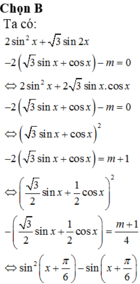
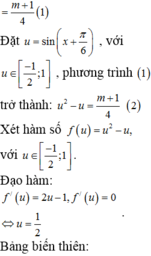
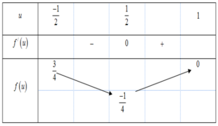
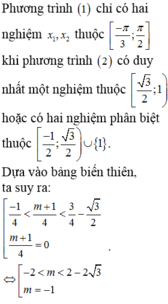
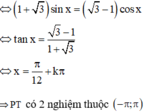
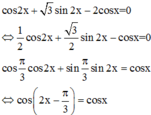
Cho phương trình: . Để phương trình chỉ có hai nghiệm thuộc thì . Giá trị b-a là

Hãy nhập câu hỏi của bạn vào đây, nếu là tài khoản VIP, bạn sẽ được ưu tiên trả lời.


\(sin^2x-2m.sinx.cosx-sinx.cosx+2mcos^2x=0\)
\(\Leftrightarrow sinx\left(sinx-cosx\right)-2mcosx\left(sinx-cosx\right)=0\)
\(\Leftrightarrow\left(sinx-cosx\right)\left(sinx-2m.cosx\right)=0\)
\(\Rightarrow\left[{}\begin{matrix}sinx=cosx\\sinx=2m.cosx\end{matrix}\right.\)
\(\Rightarrow\left[{}\begin{matrix}tanx=1\\tanx=2m\end{matrix}\right.\)
Do \(tanx=1\) ko có nghiệm đã cho nên \(tanx=2m\) phải có nghiệm trên khoảng đã cho
\(\Rightarrow tan\left(\dfrac{\pi}{4}\right)< 2m< tan\left(\dfrac{\pi}{3}\right)\)
\(\Rightarrow1< 2m< \sqrt[]{3}\)
\(\Rightarrow m\in\left(\dfrac{1}{2};\dfrac{\sqrt{3}}{2}\right)\) (hoặc có thể 1 đáp án là tập con của tập này cũng được)
Chọn C
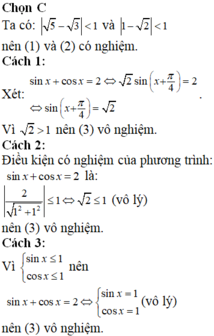
Ta có:
nên (1) và (2) có nghiệm.
Cách 1:
Xét: ![]()
nên (3) vô nghiệm.
Cách 2:
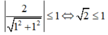
Điều kiện có nghiệm của phương trình: sin x + cos x = 2 là: 
(vô lý) nên (3) vô nghiệm.
Cách 3:
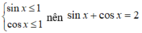
Vì 

nên (3) vô nghiệm.
Với \(cosx=0\) ko phải nghiệm
Với \(cosx\ne0\) chia 2 vế cho \(cos^2x\)
\(\Rightarrow tan^2x-4\sqrt{3}tanx+1=-2\left(1+tan^2x\right)\)
\(\Leftrightarrow3tan^2x-4\sqrt{3}tanx+3=0\)
\(\Rightarrow\left[{}\begin{matrix}tanx=\sqrt{3}\\tanx=\dfrac{\sqrt{3}}{3}\end{matrix}\right.\)
\(\Rightarrow\left[{}\begin{matrix}x=\dfrac{\pi}{3}+k\pi\\x=\dfrac{\pi}{6}+k\pi\end{matrix}\right.\)
c.
\(\Leftrightarrow cos\left(x+12^0\right)+cos\left(90^0-78^0+x\right)=1\)
\(\Leftrightarrow2cos\left(x+12^0\right)=1\)
\(\Leftrightarrow cos\left(x+12^0\right)=\dfrac{1}{2}\)
\(\Leftrightarrow\left[{}\begin{matrix}x+12^0=60^0+k360^0\\x+12^0=-60^0+k360^0\end{matrix}\right.\)
\(\Rightarrow\left[{}\begin{matrix}x=48^0+k360^0\\x=-72^0+k360^0\end{matrix}\right.\)
2.
Do \(-1\le sin\left(3x-27^0\right)\le1\) nên pt có nghiệm khi:
\(\left\{{}\begin{matrix}2m^2+m\ge-1\\2m^2+m\le1\end{matrix}\right.\) \(\Leftrightarrow\left\{{}\begin{matrix}2m^2+m+1\ge0\left(luôn-đúng\right)\\2m^2+m-1\le0\end{matrix}\right.\)
\(\Rightarrow-1\le m\le\dfrac{1}{2}\)
a.
\(\Rightarrow\left[{}\begin{matrix}x+15^0=arccos\left(\dfrac{2}{5}\right)+k360^0\\x+15^0=-arccos\left(\dfrac{2}{5}\right)+k360^0\end{matrix}\right.\)
\(\Rightarrow\left[{}\begin{matrix}x=-15^0+arccos\left(\dfrac{2}{5}\right)+k360^0\\x=-15^0-arccos\left(\dfrac{2}{5}\right)+k360^0\end{matrix}\right.\)
b.
\(2x-10^0=arccot\left(4\right)+k180^0\)
\(\Rightarrow x=5^0+\dfrac{1}{2}arccot\left(4\right)+k90^0\)
Sửa đề: Trên đoạn [-pi/4;pi/4]
x∈[-pi/4;pi/4]
=>cosx>0
Đặt t=tan x
x∈[-pi/4;pi/4]
=>t∈[-1;1]
\(\frac{1}{\cos^2 x} = 1 + \tan^2 x = 1 + t^2\)
\(2\sin^2x-\sin x\cos x-m\cos^2x=1\quad\)
=>\(\frac{2\sin^2 x}{\cos^2 x} - \frac{\sin x \cos x}{\cos^2 x} - \frac{m\cos^2 x}{\cos^2 x} = \frac{1}{\cos^2 x}\)
=>\(2t^2 - t - m = 1 + t^2\)
\(\Leftrightarrow t^2 - t - 1 = m\)
Xét hàm số \(f(t) = t^2 - t - 1\) trên đoạn t∈[-1;1]
Hoành độ đỉnh của f(t) là \(t = -\frac{b}{2a} = \frac{1}{2} \in [-1; 1]\)
\(f(-1) = (-1)^2 - (-1) - 1 = 1\)
\(f(1) = 1^2 - 1 - 1 = -1\)
\(f\left(\frac{1}{2}\right) = \left(\frac{1}{2}\right)^2 - \frac{1}{2} - 1 = -\frac{5}{4}\)
=>Tập giá trị của f(t) trên đoạn [-1;1] là [-5/4;1]
=>Để phương trình ban đầu có nghiệm trên đoạn [-1;1] thì -5/4<=m<=1
mà m nguyên
nên m∈{-1;0;1}
=>Có 3 giá trị nguyên m thỏa mãn
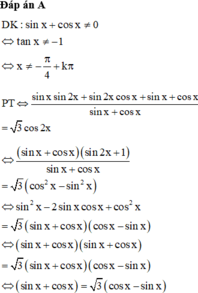
Đáp án D
Ta có

Do đó để phương trình
tương đương với phương trình
![]()
\(\Leftrightarrow1-2sin^2x+\left(2m-3\right)sinx+m-2=0\)
\(\Leftrightarrow2sin^2x-\left(2m-3\right)sinx-m+1=0\)
\(\Leftrightarrow2sin^2x+sinx-2\left(m-1\right)sinx-\left(m-1\right)=0\)
\(\Leftrightarrow sinx\left(2sinx+1\right)-\left(m-1\right)\left(2sinx+1\right)=0\)
\(\Leftrightarrow\left(2sinx+1\right)\left(sinx-m+1\right)=0\)
\(\Leftrightarrow\left[{}\begin{matrix}sinx=-\dfrac{1}{2}\\sinx=m-1\end{matrix}\right.\)
Pt có đúng 2 nghiệm thuộc khoảng đã cho khi và chỉ khi:
\(\left\{{}\begin{matrix}m-1\ne-\dfrac{1}{2}\\-1\le m-1\le1\end{matrix}\right.\) \(\Leftrightarrow\left\{{}\begin{matrix}m\ne\dfrac{1}{2}\\0\le m\le2\end{matrix}\right.\)