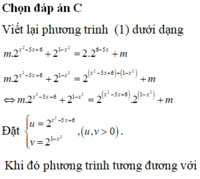
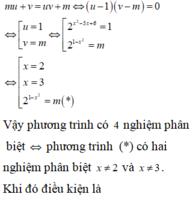
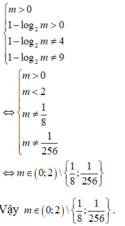
Cho phương trình (1). Tìm tất cả các giá trị thực của tham số m để phương trình có 4 nghiệm phân biệt
Hãy nhập câu hỏi của bạn vào đây, nếu là tài khoản VIP, bạn sẽ được ưu tiên trả lời.


1, Thay m=6 vào pt ta có:
\(x^2-\left(6-2\right)x-6+5=0\\ \Leftrightarrow x^2-4x-1=0\)
\(\Delta=\left(-4\right)^2-4.1.\left(-1\right)=16+4=20\)
\(x_1=\dfrac{4+2\sqrt{5}}{2}=2+\sqrt{5},x_2=\dfrac{4-2\sqrt{5}}{2}=2-\sqrt{5}\)
\(2,\Delta=\left[-\left(m-2\right)\right]^2-4\left(-m+5\right)\\ =m^2-4m+4+4m-20\\ =m^2-16\)
Để pt có 2 nghiệm phân biệt thì
\(\Delta>0\\ \Leftrightarrow m^2-16>0\\ \Leftrightarrow\left[{}\begin{matrix}m>4\\m< -4\end{matrix}\right.\)
a) Thay m=1 vào phương trình, ta được:
\(x^2-6\cdot x+5=0\)
a=1; b=-6; c=5
Vì a+b+c=0 nên phương trình có hai nghiệm phân biệt là:
\(x_1=1;x_2=\dfrac{c}{a}=\dfrac{5}{1}=5\)
b) Ta có: \(x^2-\left(m+5\right)x-m+6=0\)
a=1; b=-m-5; c=-m+6
\(\Delta=b^2-4ac\)
\(=\left(-m-5\right)^2-4\cdot1\cdot\left(-m+6\right)\)
\(=\left(m+5\right)^2-4\left(-m+6\right)\)
\(=m^2+10m+25+4m-24\)
\(=m^2+14m+1\)
\(=m^2+14m+49-48\)
\(=\left(m+7\right)^2-48\)
Để phương trình có hai nghiệm phân biệt thì \(\left(m+7\right)^2\ge48\)
\(\Leftrightarrow\left[{}\begin{matrix}m+7\ge4\sqrt{3}\\m+7\le-4\sqrt{3}\end{matrix}\right.\Leftrightarrow\left[{}\begin{matrix}m\ge4\sqrt{3}-7\\m\le-4\sqrt{3}-7\end{matrix}\right.\)
Vì x1,x2 là hai nghiệm của phương trình (1) nên ta có:
\(\left\{{}\begin{matrix}x_1^2-\left(m+5\right)x_1-m+6=0\\x_2^2-\left(m+5\right)x_2-m+6=0\end{matrix}\right.\)
\(\Leftrightarrow\left\{{}\begin{matrix}x_1^2=\left(m+5\right)x_1+m-6\\x_2^2=\left(m+5\right)x_2+m-6\end{matrix}\right.\)
Ta có: \(x_1^2+x_1\cdot x_2^2=24\)
\(\Leftrightarrow\left(m+5\right)x_1+m-6+x_1\cdot\left[\left(m+5\right)x_2+m-6\right]=24\)
\(\Leftrightarrow\left(m+5\right)x_1+m-6+\left(m+5\right)\cdot x_1x_2+x_1\left(m-6\right)=24\)
Xin lỗi bạn, đến đây mình thua
a, khi m=1
\(=>x^2-6x+5=0\)
\(=>a+b+c=0=>\left[{}\begin{matrix}x1=1\\x2=5\end{matrix}\right.\)
b,\(\Delta=\left[-\left(m+5\right)\right]^2-4\left(-m+6\right)=m^2+10m+25+4m-24\)
\(=m^2+14m+1=m^2+2.7m+49-48\)\(=\left(m+7\right)^2-48\)
pt (1) có nghiệm \(< =>\left(m+7\right)^2-48\ge0\)
\(< =>\left[{}\begin{matrix}m\ge-7+4\sqrt{3}\\m\le-7-4\sqrt{3}\end{matrix}\right.\)
theo vi ét \(=>\left\{{}\begin{matrix}x1+x2=m+5\\x1x2=-m+6\end{matrix}\right.\)
tui nghĩ là đề thế này \(x1^2x2+x1x2^2=24=>x1x2\left(x1+x2\right)=24\)
\(=>\left(6-m\right)\left(m+5\right)=24\)
\(< =>-m^2-5m+6m+30-24=0\)
\(< =>-m^2+m+6=0\)
\(\Delta=1^2-4\left(-1\right).6=25>0\)
\(=>\left[{}\begin{matrix}m1=\dfrac{-1+\sqrt{25}}{2\left(-1\right)}=-2\left(loai\right)\\m2=\dfrac{-1-\sqrt{25}}{2\left(-1\right)}=3\left(tm\right)\end{matrix}\right.\)
Bài 3: (d) cắt (d2) tại điểm C nằm trên trục tung
=>\(\begin{cases}a<>a^{\prime}\\ b=b^{\prime}\end{cases}\Rightarrow\begin{cases}m+3<>m-4\\ 2m-10=-2m-8\end{cases}\Rightarrow2m-10=-2m-8\)
=>2m+2m=-8+10
=>4m=2
=>m=0,5
Khi m=0,5 thì(d): y=(0,5+3)x+2*0,5-10=3,5x-9
Khi m=0,5 thì (d2): y=(0,5-4)x-2*0,5-8=-3,5x-9
Tọa độ A là:
\(\begin{cases}y=0\\ 3,5x-9=0\end{cases}\Rightarrow\begin{cases}y=0\\ 3,5x=9\end{cases}=>\begin{cases}y=0\\ x=\frac{9}{3,5}=\frac{18}{7}\end{cases}\)
Tọa độ B là:
\(\begin{cases}y=0\\ -3,5x-9=0\end{cases}\Rightarrow\begin{cases}y=0\\ -3,5x=9\end{cases}\Rightarrow\begin{cases}y=0\\ x=-\frac{18}{7}\end{cases}\)
B(-18/7;0); C(0;-9); A(18/7;0)
\(BC=\sqrt{\left(0+\frac{18}{7}\right)^2+\left(-9-0\right)^2}=\sqrt{\left(\frac{18}{7}\right)^2+9^2}=\sqrt{\frac{324}{49}+81}=\sqrt{\frac{4293}{49}}=\frac{\sqrt{4293}}{7}\)
\(AC=\sqrt{\left(\frac{18}{7}-0\right)^2+\left(0+9\right)^2}=\sqrt{\left(\frac{18}{7}\right)^2+9^2}=\frac{\sqrt{4293}}{7}\)
\(OA=\sqrt{\left(\frac{18}{7}-0\right)^2+\left(0-0\right)^2}=\frac{18}{7}\)
\(OB=\sqrt{\left(-\frac{18}{7}-0\right)^2+\left(0-0\right)^2}=\frac{18}{7}\)
Vì OA=OB và AC=BC
nên \(\frac{OA}{BC}=\frac{OB}{AC}\)
Câu 4:
Xét ΔOAI và ΔOBI có
OA=OB
AI=BI
OI chung
Do đó: ΔOAI=ΔOBI
Ta có:
2(a − 1)x − a(x − 1) = 2a + 3
⇔(a − 2)x = a + 3 (3)
Do đó, khi a = 2, phương trình (2) tương đương với phương trình 0x = 5.
Phương trình này vô nghiệm nên phương trình (2) vô nghiệm.
a.
\(3\sqrt{-x^2+x+6}\ge2\left(1-2x\right)\)
\(\Leftrightarrow\left[{}\begin{matrix}\left\{{}\begin{matrix}-x^2+x+6\ge0\\1-2x< 0\end{matrix}\right.\\\left\{{}\begin{matrix}1-2x\ge0\\9\left(-x^2+x+6\right)\ge4\left(1-2x\right)^2\end{matrix}\right.\end{matrix}\right.\)
\(\Leftrightarrow\left[{}\begin{matrix}\left\{{}\begin{matrix}-2\le x\le3\\x>\dfrac{1}{2}\end{matrix}\right.\\\left\{{}\begin{matrix}x\le\dfrac{1}{2}\\25\left(x^2-x-2\right)\le0\end{matrix}\right.\end{matrix}\right.\)
\(\Leftrightarrow\left[{}\begin{matrix}\dfrac{1}{2}< x\le3\\\left\{{}\begin{matrix}x\le\dfrac{1}{2}\\-1\le x\le2\end{matrix}\right.\end{matrix}\right.\)
\(\Rightarrow-1\le x\le3\)
b.
ĐKXĐ: \(x\ge0\)
\(\Leftrightarrow\sqrt{2x^2+8x+5}-4\sqrt{x}+\sqrt{2x^2-4x+5}-2\sqrt{x}=0\)
\(\Leftrightarrow\dfrac{2x^2+8x+5-16x}{\sqrt{2x^2+8x+5}+4\sqrt{x}}+\dfrac{2x^2-4x+5-4x}{\sqrt{2x^2-4x+5}+2\sqrt{x}}=0\)
\(\Leftrightarrow\dfrac{2x^2-8x+5}{\sqrt{2x^2+8x+5}+4\sqrt{x}}+\dfrac{2x^2-8x+5}{\sqrt{2x^2-4x+5}+2\sqrt{x}}=0\)
\(\Leftrightarrow\left(2x^2-8x+5\right)\left(\dfrac{1}{\sqrt{2x^2+8x+5}+4\sqrt{x}}+\dfrac{1}{\sqrt{2x^2-4x+5}+2\sqrt{x}}\right)=0\)
\(\Leftrightarrow2x^2-8x+5=0\)
\(\Leftrightarrow x=\dfrac{4\pm\sqrt{6}}{2}\)
aGiải phương trình |x-1|+|x-2|=|2x-3|
b)Giải phương trình 1/(x−2 )+ 2/(x−3) − 3/(x−5) = 1/(x^2 −5x+6)
a: |x-1|+|x-2|=|2x-3|
=>|x-1|+|x-2|-|2x-3|=0(1)
TH1: x<1
=>x-1<0; 2x-3<0; x-2<0
(1) sẽ trở thành: 1-x+2-x-(3-2x)=0
=>3-2x-3+2x=0
=>0x=0(luôn đúng)
TH2: 1<=x<3/2
=>x-1>=0; 2x-3<0; x-2<0
(1) sẽ trở thành: x-1+2-x-(3-2x)=0
=>1-3+2x=0
=>2x-2=0
=>x=1(nhận)
TH3: 3/2<=x<2
=>x-1>0; 2x-3>=0; x-2<0
(1) sẽ trở thành: x-1+2-x-(2x-3)=0
=>1-2x+3=0
=>-2x+4=0
=>-2x=-4
=>x=2(loại)
TH4: x>=2
=>x-1>0; 2x-3>0; x-2>=0
(1) sẽ trở thành: x-1+x-2-(2x-3)=0
=>2x-3-2x+3=0
=>0x=0(luôn đúng)
Vậy: x<=1 hoặc x>=2
b: ĐKXĐ: x∉{2;3;5}
\(\frac{1}{x-2}+\frac{2}{x-3}-\frac{3}{x-5}=\frac{1}{x^2-5x+6}\)
=>\(\frac{1}{x-2}+\frac{2}{x-3}-\frac{3}{x-5}=\frac{1}{\left(x-2\right)\left(x-3\right)}=\frac{1}{x-3}-\frac{1}{x-2}\)
=>\(\frac{2}{x-2}+\frac{1}{x-3}-\frac{3}{x-5}=0\)
=>\(\frac{2\left(x-3\right)\left(x-5\right)+\left(x-2\right)\left(x-5\right)-3\left(x-2\right)\left(x-3\right)}{\left(x-2\right)\left(x-3\right)\left(x-5\right)}=0\)
=>2(x-3)(x-5)+(x-2)(x-5)-3(x-2)(x-3)=0
=>\(2\left(x^2-8x+15\right)+x^2-7x+10-3\left(x^2-5x+6\right)=0\)
=>\(2x^2-16x+30+x^2-7x+10-3x^2+15x-18=0\)
=>-8x+22=0
=>-8x=-22
=>x=11/4(nhận)