Tìm giá trị nhỏ nhất của hàm số trên R
Hãy nhập câu hỏi của bạn vào đây, nếu là tài khoản VIP, bạn sẽ được ưu tiên trả lời.
a: \(5-2\cdot cos^2x\cdot\sin^2x\)
\(=5-2\cdot\left(\sin x\cdot cosx\right)^2\)
\(=5-2\cdot\left(\frac12\cdot\sin2x\right)^2=5-2\cdot\frac14\cdot\sin^22x=-\frac12\cdot\sin^22x+5\)
Ta có: \(0\le\sin^22x\le1\)
=>\(-\frac12\le-\frac12\cdot\sin^22x\le0\)
=>\(-\frac12+5\le-\frac12\cdot\sin^22x+5\le0+5\)
=>\(\frac92\le-\frac12\cdot\sin^22x+5\le5\)
=>\(\frac{3\sqrt2}{2}\le\sqrt{-\frac12\cdot\sin^22x+5}\le\sqrt5\)
=>\(4:\frac{3\sqrt2}{2}\ge\frac{4}{\sqrt{-\frac12\cdot sin^22x+5}}\ge\frac{4}{\sqrt5}\)
=>\(\frac{2\sqrt2}{3}\ge y\ge\frac{4\sqrt5}{5}\)
Do đó: \(y_{\max}=\frac{2\sqrt2}{3}\) khi \(\sin^22x=1\)
=>\(cos^22x=0\)
=>cos2x=0
=>\(2x=\frac{\pi}{2}+k\pi\)
=>\(x=\frac{\pi}{4}+\frac{k\pi}{2}\)
\(y_{\min}=\frac{4\sqrt5}{5}\) khi \(\sin^22x=0\)
=>sin 2x=0
=>\(2x=k\pi\)
=>\(x=\frac{k\pi}{2}\)
b: \(f\left(x\right)=3\cdot\sin^2x+5\cdot cos^2x-4\cdot cos2x-2\)
\(=3\cdot\sin^2x+5\cdot cos^2x-4\left(cos^2x-\sin^2x\right)-2\)
\(=3\cdot\sin^2x+5\cdot cos^2x-4\cdot cos^2x+4\cdot\sin^2x-2\)
\(=7\cdot\sin^2x+cos^2x-2=7\cdot\sin^2x+1-\sin^2x-2=6\cdot\sin^2x-1\)
Ta có: \(0\le\sin^2x\le1\)
=>\(0\le6\sin^2x\le6\)
=>\(0-1\le6\sin^2x-1\le6-1\)
=>-1<=f(x)<=5
f(x) min=-1 khi \(\sin^2x=0\)
=>sin x=0
=>\(x=k\pi\)
f(x) max=5 khi \(\sin^2x=1\)
=>\(cos^2x=0\)
=>cosx=0
=>\(x=\frac{\pi}{2}+k\pi\)
Chọn A.
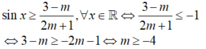
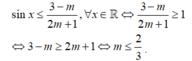
Tập xác định:D= R. Ta có:y ‘= m-3 + (2m+1).sinx
Hàm số nghịch biến trên R
![]()
Trường hợp 1: m= -1/ 2 ; ta có 0 ≤ 7 2 ∀ x ∈ ℝ
Vậy hàm số luôn nghịch biến trên R.
Trường hợp 2: m< -1/ 2 ; ta có

Trường hợp 3:m > -1/2 ; ta có:

Vậy - 4 ≤ m ≤ 2 3
Ta có: \(y = \cos x\)
\(y\left( { - x} \right) = \cos \left( { - x} \right) = \cos x = y\)
Suy ra hàm số \(y = \cos x\) là hàm số chẵn
Vậy ta chọn đáp án C


Chọn D