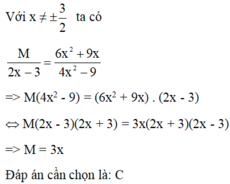
Tìm đa thức M thỏa mãn
Hãy nhập câu hỏi của bạn vào đây, nếu là tài khoản VIP, bạn sẽ được ưu tiên trả lời.

a)\(M\left(x\right)=3x^4-x^3-2x^2+5x+7\)
\(N\left(x\right)=-3x^4+x^3+10x^2+x-7\)
a, \(P\left(x\right)=4x^3+2x-3+2x-2x^2-1\\ =4x^3-2x^2+\left(2x+2x\right)+\left(-3-1\right)\\ =4x^3-2x^2+4x-4\)
Bậc của P(x) là 3
\(Q\left(x\right)=6x^3-3x+5-2x+3x^2\\ =6x^3+3x^2+\left(-3x-2x\right)+5\\ =6x^3+3x^2-5x+5\)
Bậc của Q(x) là 3
b, \(M\left(x\right)=P\left(x\right)+Q\left(x\right)=4x^3-2x^2+4x-4+6x^3+3x^2-5x+5\\ =\left(4x^3+6x^3\right)+\left(-2x^2+3x^2\right)+\left(4x-5x\right)+\left(-4+5\right)\\ =10x^3+x^2-x+1\)
Bài 3:
a: \(M=4x^2-20x+25\)
\(=\left(2x\right)^2-2\cdot2x\cdot5+5^2\)
\(=\left(2x-5\right)^2=\left(2\cdot\frac{105}{2}-5\right)^2=\left(105-5\right)^2=100^2=10000\)
b: \(x^3-\frac19x=0\)
=>\(x\left(x^2-\frac19\right)=0\)
=>\(x\left(x-\frac13\right)\left(x+\frac13\right)=0\)
=>\(\left[\begin{array}{l}x=0\\ x-\frac13=0\\ x+\frac13=0\end{array}\right.\Rightarrow\left[\begin{array}{l}x=0\\ x=\frac13\\ x=-\frac13\end{array}\right.\)
Bài 2:
a: \(6x^3y-9x^2y^2=3x^2y\cdot2x-3x^2y\cdot3y\)
\(=3x^2y\left(2x-3y\right)\)
b: \(4x^2-25=\left(2x\right)^2-5^2=\left(2x-5\right)\left(2x+5\right)\)
\(A\left(x\right)=\dfrac{4x^4+81}{2x^2-6x+9}\)
\(=\dfrac{4x^4+36x^2+81-36x^2}{2x^2-6x+9}\)
\(=\dfrac{\left(2x^2+9\right)^2-\left(6x\right)^2}{2x^2+9-6x}\)
\(=\dfrac{\left(2x^2+9+6x\right)\left(2x^2+9-6x\right)}{2x^2+9-6x}\)
\(=2x^2+6x+9\)
=>\(M\left(x\right)=2x^2+6x+9\)
\(=2\left(x^2+3x+\dfrac{9}{2}\right)\)
\(=2\left(x^2+3x+\dfrac{9}{4}+\dfrac{9}{4}\right)\)
\(=2\left(x+\dfrac{3}{2}\right)^2+\dfrac{9}{2}>=\dfrac{9}{2}\forall x\)
Dấu '=' xảy ra khi \(x+\dfrac{3}{2}=0\)
=>\(x=-\dfrac{3}{2}\)
a) \(x^2-xz-9y^2+3yz\)
\(=\left(x^2-9y^2\right)-\left(xz-3yz\right)\)
\(=\left[x^2-\left(3y\right)^2\right]-z\left(x-3y\right)\)
\(=\left(x-3y\right)\left(x+3y\right)-z\left(x-3y\right)\)
\(=\left(x-3y\right)\left(x+3y-z\right)\)
b) \(x^3-x^2-5x+125\)
\(=\left(x^3+125\right)-\left(x^2+5x\right)\)
\(=\left(x^3+5^3\right)-x\left(x+5\right)\)
\(=\left(x+5\right)\left(x^2-5x+5^2\right)-x\left(x+5\right)\)
\(=\left(x+5\right)\left(x^2-5x+5^2-x\right)\)
\(=\left(x+5\right)\left(x^2-6x+25\right)\)
c) \(x^3+2x^2-6x-27\)
\(=\left(x^3-27\right)-\left(2x^2-6x\right)\)
\(=\left(x^3-3^3\right)-2x\left(x-3\right)\)
\(=\left(x-3\right)\left(x^2+3x+3^2\right)-2x\left(x-3\right)\)
\(=\left(x-3\right)\left(x^2+3x+3^2-2x\right)\)
\(=\left(x-3\right)\left(x^2+x+9\right)\)
e) \(4x^4+4x^3-x^2-x\)
\(=4x^3\left(x+1\right)-x\left(x+1\right)\)
\(=\left(x+1\right)\left(4x^3-x\right)\)
f) \(x^6-x^4-9x^3+9x^2\)
\(=x^4\left(x^2-1\right)-9x^2\left(x-1\right)\)
\(=x^4\left(x-1\right)\left(x+1\right)-9x^2\left(x-1\right)\)
\(=\left(x-1\right)\left[x^4\left(x+1\right)-9x^2\right]\)
\(=\left(x-1\right)\left(x^5+x^4-9x^2\right)\)
Bài 3:
A(x)⋮B(x)
=>\(3x^2+5x+m\) ⋮x-2
=>\(3x^2-6x+11x-22+m+22\) ⋮x-2
=>m+22=0
=>m=-22
Bài 2:
a: \(2x^3-8x^2+8x\)
\(=2x\left(x^2-4x+4\right)\)
\(=2x\left(x-2\right)^2\)
b: 2xy+2x+yz+z
=2x(y+1)+z(y+1)
=(y+1)(2x+z)
c: \(x^2+2x+1-y^2\)
\(=\left(x+1\right)^2-y^2\)
=(x+1-y)(x+1+y)
Câu 1:
a:\(\left(4x-1\right)\left(2x^2-x-1\right)\)
\(=8x^3-4x^2-4x-2x^2+x+1\)
\(=8x^3-6x^2-3x+1\)
b: \(\left(4x^3+8x^2-2x\right):2x\)
\(=\frac{4x^3}{2x}+\frac{8x^2}{2x}-\frac{2x}{2x}\)
\(=2x^2+4x-1\)
c: \(\left(6x^3-7x^2-16x+12\right):\left(2x+3\right)\)
\(=\left(6x^3+9x^2-16x^2-24x+8x+12\right):\left(2x+3\right)\)
\(=\left\lbrack3x^2\left(2x+3\right)-8x\left(2x+3\right)+4\left(2x+3\right)\right\rbrack:\left(2x+3\right)\)
\(=3x^2-8x+4\)