Cộng hai phân thức
Hãy nhập câu hỏi của bạn vào đây, nếu là tài khoản VIP, bạn sẽ được ưu tiên trả lời.
a)\(=\dfrac{x-2+x+5}{x+3}=\dfrac{2x+3}{x+3}\)
b)ĐKXĐ: \(x+3\ne0\Leftrightarrow x\ne-3\)
a) Ta có: \(\dfrac{x-2}{x+3}+\dfrac{x+5}{x+3}\)
\(=\dfrac{x-2+\left(x+5\right)}{x+3}\)
\(=\dfrac{x-2+x+5}{x+3}\)
\(=\dfrac{2x+3}{x+3}\)
b) ĐKXĐ: \(x+3\ne0\)
hay \(x\ne-3\)
- Muốn cộng hai phân thức cùng mẫu, ta cộng các tử với nhau và giữ nguyên mẫu.
- Muốn cộng hai phân thức khác mẫu, ta quy đồng mẫu thức rồi cộng các phân thức cùng mẫu vừa tìm được.
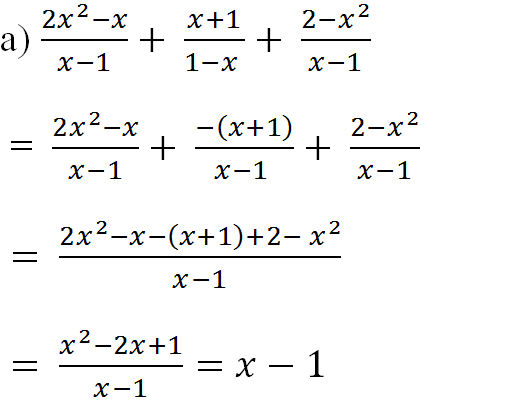
\(\dfrac{3x}{x^3-1}+\dfrac{x-1}{x^2+x+1}\)
\(=\dfrac{3x}{\left(x-1\right)\left(x^2+x+1\right)}+\dfrac{\left(x-1\right)\left(x-1\right)}{\left(x-1\right)\left(x^2+x+1\right)}\)
\(=\dfrac{3x+x^2-2x+1}{\left(x-1\right)\left(x^2+x+1\right)}\)
\(=\dfrac{x^2+x+1}{\left(x-1\right)\left(x^2+x+1\right)}\)
\(=\dfrac{1}{x-1}\)
\(P\left(x\right)=x^2+5x^4-3x^3+x^2+4x^4+3x^3-x+5\)
\(=\left(5x^4+4x^4\right)+\left(-3x^3+3x^3\right)+\left(x^2+x^2\right)-x+5\)
\(=9x^4+2x^2-x+5\)
\(Q\left(x\right)=x-5x_{}^3-x^2-x^4+4x^3-x^2+3x-1\)
\(=\left(-5x^4-x^4\right)+4x^3+\left(-x^2-x^2\right)+\left(x+3x\right)-1\)
\(=-6x^4+4x^3-2x^2+4x-1\)
P(x)+Q(x)
\(=9x^4+2x^2-x+5-6x^4+4x^3-2x^2+4x-1\)
\(=3x^4+4x^3+3x+4\)
Đặt P(x)+Q(x)=0
=>\(3x^4+4x^3+3x+4=0\)
=>\(x^3\left(3x+4\right)+\left(3x+4\right)=0\)
=>\(\left(3x+4\right)\left(x^3+1\right)=0\)
=>\(\left[\begin{array}{l}3x+4=0\\ x^3+1=0\end{array}\right.\Longrightarrow\left[\begin{array}{l}x=-\frac43\\ x=-1\end{array}\right.\)
Câu 4: Không có nghĩa khi x-3=0
=>x=3
Câu 5:
\(A=\dfrac{x-3}{\left(x-3\right)\left(x+3\right)}=\dfrac{1}{x+3}\)
\(\dfrac{1}{x^2-x+1}-\dfrac{x^2+2}{x^3+1}=\dfrac{1}{x^2-x+1}-\dfrac{x^2+2}{\left(x+1\right)\left(x^2-x+1\right)}=\dfrac{x+1}{\left(x+1\right)\left(x^2-x+1\right)}-\dfrac{x^2+2}{\left(x+1\right)\left(x^2-x+1\right)}=\dfrac{x+1-x^2-2}{\left(x+1\right)\left(x^2-x+1\right)}=\dfrac{-x^2+x-1}{\left(x+1\right)\left(x^2-x+1\right)}\)
`a, a/(a-3) - 3/(a+3) = (a(a+3) - 3(a-3))/(a^2-9)`
`= (a^2+9)/(a^2-9)`
`b, 1/(2x) + 2/x^2 = x/(2x^2) + 4/(2x^2) = (x+4)/(2x^2)`
`c, 4/(x^2-1) - 2/(x^2+x) = (4x)/(x(x-1)(x+1)) - (2(x-1))/(x(x+1)(x-1))`
`= (2x+2)/(x(x-1)(x+1)`
`= 2/(x(x-1))`
a) Ta thấy: số mũ của x trong hai đơn thức trên bằng nhau (đều bằng 2).
b) \(2{x^2} + 3{x^2} = {x^2} + {x^2} + {x^2} + {x^2} + {x^2} = 5{x^2}\) .
c) Ta có: \((2 + 3){x^2} = 5{x^2}\).
Vậy \(2{x^2} + 3{x^2}\) = \((2 + 3){x^2}\).
Hướng dẫn:
Ta có:
+ Cộng hai phân thức
Ta có: