
Thực hiện phép tính (1/2 x – 1)(2x – 3)
K
Khách
Hãy nhập câu hỏi của bạn vào đây, nếu là tài khoản VIP, bạn sẽ được ưu tiên trả lời.

Những câu hỏi liên quan
DC
1
HM
1
NL
Nguyễn Lê Phước Thịnh
CTVHS
3 tháng 1 2021
Ta có: \(\dfrac{2x+3}{1-x^2}+\dfrac{2x+1}{x^2-2x+1}\)
\(=\dfrac{-2x-3}{\left(x-1\right)\left(x+1\right)}+\dfrac{2x+1}{\left(x-1\right)^2}\)
\(=\dfrac{\left(-2x-3\right)\left(x-1\right)}{\left(x-1\right)^2\cdot\left(x+1\right)}+\dfrac{\left(2x+1\right)\left(x+1\right)}{\left(x+1\right)\cdot\left(x-1\right)^2}\)
\(=\dfrac{-2x^2+2x-3x+3+2x^2+2x+x+1}{\left(x-1\right)^2\cdot\left(x+1\right)}\)
\(=\dfrac{2x+4}{\left(x-1\right)^2\cdot\left(x+1\right)}\)
YF
1
24 tháng 1 2022
a, \(\left(2x-1\right)\left(3-2x\right)=6x-4x^2-3+2x=-4x^2+8x-3\)
b, \(\left(x+2\right)+\left(1+x\right)\left(1-x\right)=x+2+1-x^2=-x^2+x+3\)
T
2 tháng 12 2023
ĐKXĐ: \(x\ne0;x\ne\pm1\)
\(\dfrac{3}{2x^2+2x}+\dfrac{2x-1}{x^2-1}-\dfrac{2}{x}\)
\(=\dfrac{3}{2x\left(x+1\right)}+\dfrac{2x-1}{\left(x-1\right)\left(x+1\right)}-\dfrac{4}{2x}\)
\(=\dfrac{3\left(x-1\right)}{2x\left(x-1\right)\left(x+1\right)}+\dfrac{2x\left(2x-1\right)}{2x\left(x-1\right)\left(x+1\right)}-\dfrac{4\left(x^2-1\right)}{2x\left(x-1\right)\left(x+1\right)}\)
\(=\dfrac{3x-3+4x^2-2x-4x^2+4}{2x\left(x-1\right)\left(x+1\right)}\)
\(=\dfrac{x+1}{2x\left(x-1\right)\left(x+1\right)}\)
\(=\dfrac{1}{2x\left(x-1\right)}\)
\(=\dfrac{1}{2x^2-2x}\)
NL
Nguyễn Lê Phước Thịnh
CTVHS
7 tháng 1 2022
Bài 1:
b: \(=\dfrac{x+3-4-x}{x-2}=\dfrac{-1}{x-2}\)
Bài 2:
a: \(=\dfrac{x+1}{2\left(x+3\right)}+\dfrac{2x+3}{x\left(x+3\right)}\)
\(=\dfrac{x^2+x+4x+6}{2x\left(x+3\right)}=\dfrac{x^2+5x+6}{2x\left(x+3\right)}=\dfrac{x+2}{2x}\)
d: \(=\dfrac{3}{2x^2y}+\dfrac{5}{xy^2}+\dfrac{x}{y^3}\)
\(=\dfrac{3y^2+10xy+2x^3}{2x^2y^3}\)
e: \(=\dfrac{x^2+2xy+x^2-2xy-4xy}{\left(x+2y\right)\left(x-2y\right)}=\dfrac{2x^2-4xy}{\left(x+2y\right)\cdot\left(x-2y\right)}=\dfrac{2x}{x+2y}\)
NL
Nguyễn Lê Phước Thịnh
CTVHS
2 tháng 12 2023
Bài 3:
3: \(6x\left(x-y\right)-9y^2+9xy\)
\(=6x\left(x-y\right)+9xy-9y^2\)
\(=6x\left(x-y\right)+9y\left(x-y\right)\)
\(=\left(x-y\right)\left(6x+9y\right)\)
\(=3\left(2x+3y\right)\left(x-y\right)\)
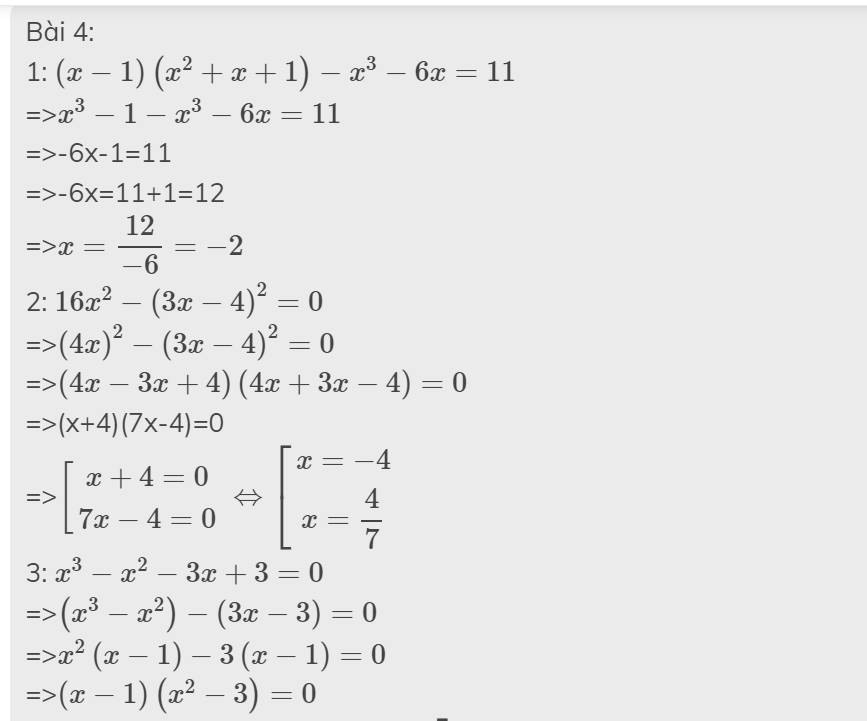
Bài 4:
NQ
Nguyễn Quốc Đạt
CTVVIP
10 tháng 9
Bài 4: Tìm $x$1.
$(x-1)(x^2+x+1)-x^3-6x=11$
Dùng $(x-1)(x^2+x+1)=x^3-1$:
$x^3-1-x^3-6x=11$
$-6x-1=11$
$-6x=12$
$x=-2$
Vậy $x=-2$.
2.$16x^2-(3x-4)^2=0$
$(4x)^2-(3x-4)^2=0$
$(4x-3x+4)(4x+3x-4)=0$
$(x+4)(7x-4)=0$
$x=-4$ hoặc $x=\dfrac47$
Vậy $x=-4,\dfrac47$.
3.$x^3-x^2+3-3x=0$
$=x^2(x-1)-3(x-1)=0$
$=(x-1)(x^2-3)=0$
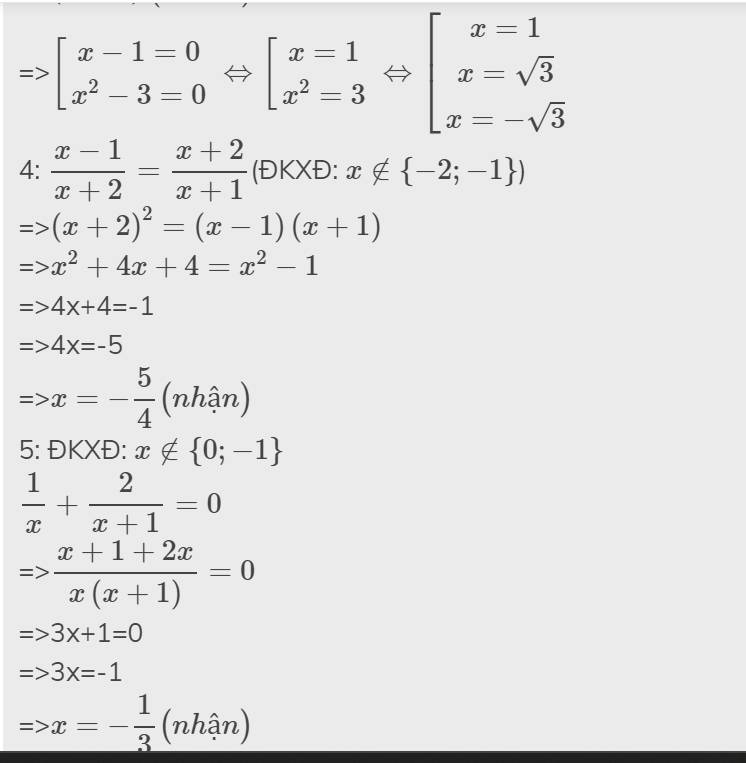
$x-1=0$ hoặc $x^2-3=0$
$x=1$ hoặc $x=\pm\sqrt3$
Vậy $x=1,\sqrt3,-\sqrt3$.
4.$\dfrac{x-1}{x+2}=\dfrac{x+2}{x+1}$
Điều kiện: $x\ne-2,-1$.
$(x-1)(x+1)=(x+2)^2$
$x^2-1=x^2+4x+4$
$-4x=5$
$x=-\dfrac54$
Vậy $x=-\dfrac54$.
5.$\dfrac1{x+2}+\dfrac2{x+1}=0$
Điều kiện: $x\ne-2,-1$.
$\dfrac{x+1+2(x+2)}{(x+2)(x+1)}=0$
$x+1+2x+4=0$
$3x+5=0$
$x=-\dfrac53$
Vậy $x=-\dfrac53$.
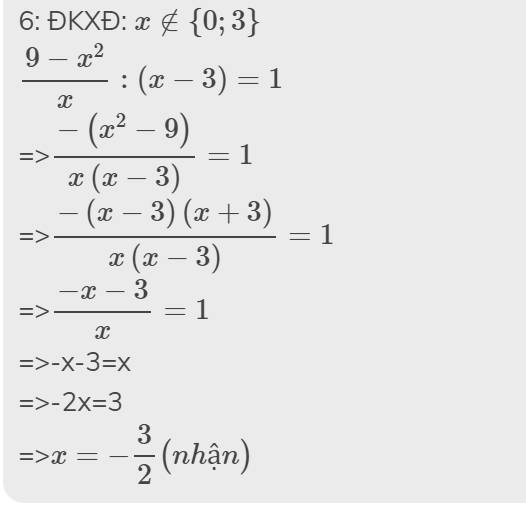
6.$\dfrac{9-x^2}{x}:(x-3)=1$
Điều kiện: $x\ne0,3$.
$\dfrac{9-x^2}{x(x-3)}=1$
$9-x^2=x(x-3)$
$9-x^2=x^2-3x$
$2x^2-3x-9=0$
$(2x+3)(x-3)=0$
$x=-\dfrac32$ hoặc $x=3$
Nhưng $x=3$ không thỏa điều kiện.
Vậy $x=-\dfrac32$.
AH
Akai Haruma
Giáo viên
19 tháng 12 2022
Bạn cần viết lại đề bằng công thức toán (biểu tượng $\sum$ góc trái khung soạn thảo). Viết như thế này nhìn khó đọc quá.
KC
1
N
0
(1/2 x – 1) (2x – 3)
= x 2 - 3/2 x – 2x + 3
= x 2 - 7/2 x + 3