
giải phương trình: \(4x^2-5x+6\sqrt{x}-8=0\)
K
Khách
Hãy nhập câu hỏi của bạn vào đây, nếu là tài khoản VIP, bạn sẽ được ưu tiên trả lời.

Những câu hỏi liên quan
NL
Nguyễn Lê Phước Thịnh
CTVHS
16 tháng 5 2023
2:
a: =>2x^2-4x-2=x^2-x-2
=>x^2-3x=0
=>x=0(loại) hoặc x=3
b: =>(x+1)(x+4)<0
=>-4<x<-1
d: =>x^2-2x-7=-x^2+6x-4
=>2x^2-8x-3=0
=>\(x=\dfrac{4\pm\sqrt{22}}{2}\)
25 tháng 11 2021
\(a,PT\Leftrightarrow\left|x+3\right|=3x-6\\ \Leftrightarrow\left[{}\begin{matrix}x+3=3x-6\left(x\ge-3\right)\\x+3=6-3x\left(x< -3\right)\end{matrix}\right.\Leftrightarrow\left[{}\begin{matrix}x=\dfrac{9}{2}\left(tm\right)\\x=\dfrac{3}{4}\left(ktm\right)\end{matrix}\right.\\ \Leftrightarrow x=\dfrac{9}{2}\\ b,PT\Leftrightarrow\left|x-1\right|=\left|2x-1\right|\\ \Leftrightarrow\left[{}\begin{matrix}x-1=2x-1\\1-x=2x-1\end{matrix}\right.\Leftrightarrow\left[{}\begin{matrix}x=0\\x=\dfrac{2}{3}\end{matrix}\right.\)
\(c,ĐK:x\le\dfrac{2}{5}\\ PT\Leftrightarrow4-5x=25x^2-20x+4\\ \Leftrightarrow25x^2-15x=0\\ \Leftrightarrow5x\left(5x-3\right)=0\\ \Leftrightarrow\left[{}\begin{matrix}x=0\left(tm\right)\\x=\dfrac{3}{5}\left(ktm\right)\end{matrix}\right.\Leftrightarrow x=0\\ d,ĐK:x\le\dfrac{2}{5}\\ PT\Leftrightarrow4-5x=2-5x\\ \Leftrightarrow x\in\varnothing\)
NL
Nguyễn Lê Phước Thịnh
CTVHS
14 tháng 8 2021
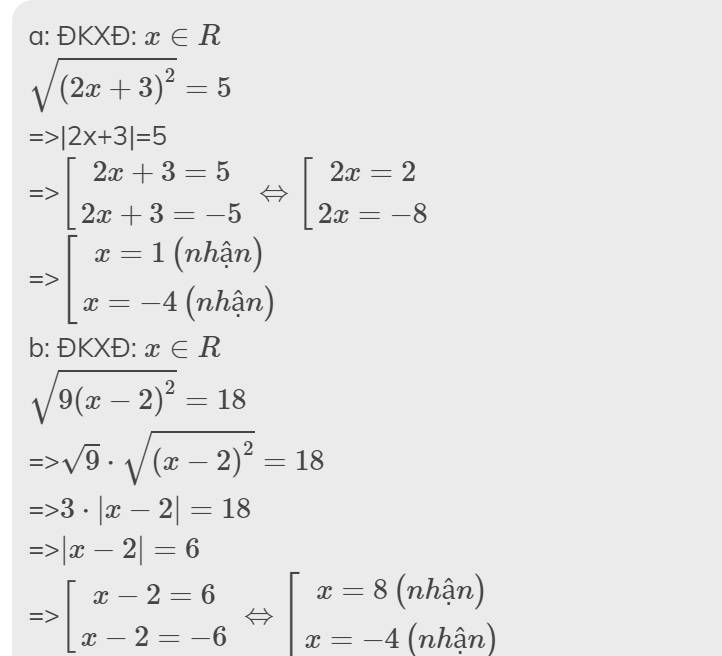
a: Ta có: \(\sqrt{4x^2+4x+3}=8\)
\(\Leftrightarrow4x^2+4x+1+2-64=0\)
\(\Leftrightarrow4x^2+4x-61=0\)
\(\Delta=4^2-4\cdot4\cdot\left(-61\right)=992\)
Vì Δ>0 nên phương trình có hai nghiệm phân biệt là:
\(\left\{{}\begin{matrix}x_1=\dfrac{-4-4\sqrt{62}}{8}=\dfrac{-1-\sqrt{62}}{2}\\x_2=\dfrac{-4+4\sqrt{62}}{8}=\dfrac{-1+\sqrt{62}}{2}\end{matrix}\right.\)
NL
Nguyễn Lê Phước Thịnh
CTVHS
6 tháng 2 2022
a: \(\Leftrightarrow\dfrac{1}{3}\sqrt{x-2}-\dfrac{2}{3}\cdot3\sqrt{x-2}+6\cdot\dfrac{\sqrt{x-2}}{9}=-4\)
\(\Leftrightarrow\sqrt{x-2}=4\)
=>x-2=16
hay x=18
b: \(\Leftrightarrow\left|3x+2\right|=4x\)
\(\Leftrightarrow\left[{}\begin{matrix}3x+2=4x\left(x>=-\dfrac{2}{3}\right)\\3x+2=-4x\left(x< -\dfrac{2}{3}\right)\end{matrix}\right.\Leftrightarrow\left[{}\begin{matrix}x=2\left(nhận\right)\\x=-\dfrac{2}{7}\left(nhận\right)\end{matrix}\right.\)
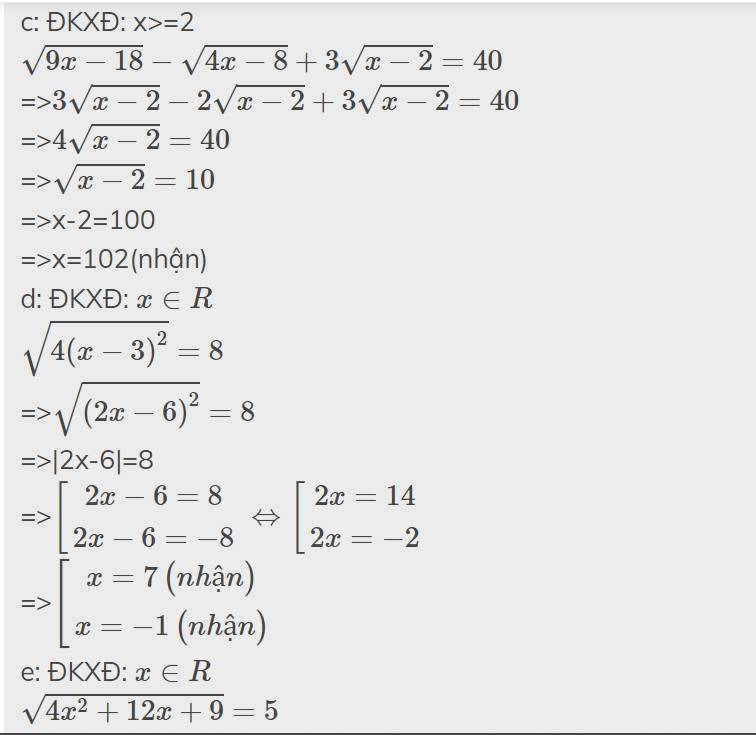
c: \(\Leftrightarrow3\sqrt{x-2}-2\sqrt{x-2}+3\sqrt{x-2}=40\)
\(\Leftrightarrow4\sqrt{x-2}=40\)
=>x-2=100
hay x=102
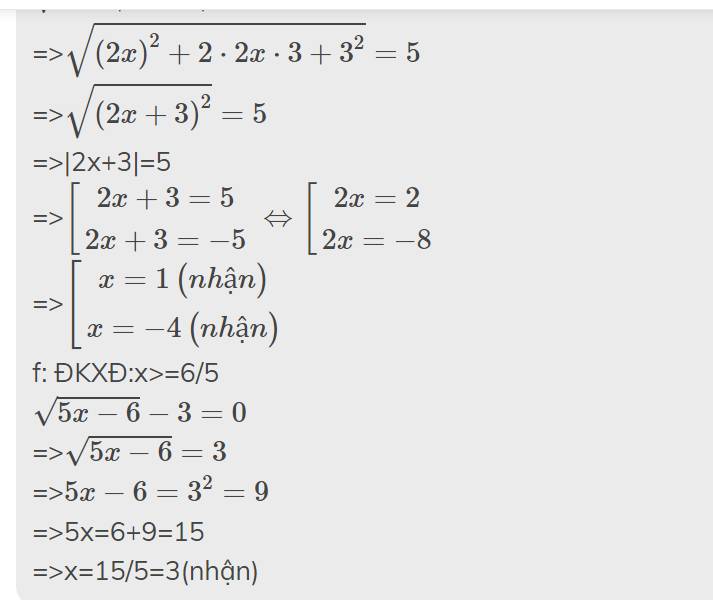
d: =>5x-6=9
hay x=3
MH
6 tháng 2 2022
\(\dfrac{1}{3}\sqrt{x-2}-\dfrac{2}{3}\sqrt{9x-18}+6\sqrt{\dfrac{x-2}{81}}=-4\) (đk: x≥2)
\(\dfrac{1}{3}\sqrt{x-2}-\dfrac{2}{3}\sqrt{9\left(x-2\right)}+6\sqrt{\dfrac{1}{81}\left(x-2\right)}=-4\)
\(\dfrac{1}{3}\sqrt{x-2}-2\sqrt{x-2}+\dfrac{2}{3}\sqrt{x-2}=-4\)
\(\dfrac{1}{3}\sqrt{x-2}-\dfrac{4}{3}\sqrt{x-2}=-4\)
\(-\sqrt{x-2}=-4\)
\(\sqrt{x-2}=4\)
\(\left|x-2\right|=16\)
\(\Leftrightarrow\left[{}\begin{matrix}x-2=16\\x-2=-16\end{matrix}\right.\Leftrightarrow\left[{}\begin{matrix}x=18\left(TM\right)\\x=-14\left(L\right)\end{matrix}\right.\)
24 tháng 9 2023
`a, <=> 5/3 . 3sqrt(x^2+2) + 3/2.2sqrt(x^2+2)-7sqrt6=sqrt(x^2+2)`
`= (5+3-1)sqrt(x^2+2)=7sqrt6`
`<=> 7sqrt(x^2+2)=7sqrt6`.
`<=> x^2+2=36`.
`<=> x^2=34`.
`<=> x=+-sqrt(34)`.
Vậy...
`b, sqrt(4x^2-12x+9)-6=0`
`<=> |2x-3|=6`.
`@ x >=3/2 <=> 2x-3=6.`
`<=> x=9/2 (tm)`.
`@x <3/2 <=> 3-2x=6`
`<=> 2x=-3`
`<=> x=-3/2.`
Vậy...
BH
1
NL
Nguyễn Lê Phước Thịnh
CTVHS
9 tháng 3 2022
a: \(\Leftrightarrow\left(x-\sqrt{5}\right)^2=0\)
\(\Leftrightarrow x-\sqrt{5}=0\)
hay \(x=\sqrt{5}\)
b: \(\Leftrightarrow4x^4-9x^2+4x^2-9=0\)
\(\Leftrightarrow4x^2-9=0\)
=>x=3/2hoặc x=-3/2
Lớp 9 đã học giải phương trình bậc 3 chưa nhỉ ?
\(4x^2-5x+6\sqrt{x}-8=0\)
\(< =>\left(4x^2-5x+6\sqrt{x}-8\right)x=0.x\)
\(< =>4x^3-5x^2-2x=0\)(đến đây giải pt bậc 3 hoặc làm theo mình)
\(< =>x\left(4x^2-5x-2\right)=0\)
\(< =>\orbr{\begin{cases}x=0\\4x^2-5x-2=0\left(1\right)\end{cases}}\)
Từ 1 ta có \(\Delta=\left(-5\right)^2-4.4.\left(-2\right)=25+32=57\)
Nên phương trình (1) có 2 nghiệm phân biệt
\(x_1=\frac{5+\sqrt{57}}{8}\)
\(x_2=\frac{5-\sqrt{57}}{8}\)
Vậy tập nghiệm của phương trình trên là \(\left\{0;\frac{5+\sqrt{57}}{8};\frac{5-\sqrt{57}}{8}\right\}\)
ĐK:..
Đặt: \(\sqrt{x}=t\ge0\) ta có phương trình ẩn t :
\(4t^4-5t^2+6t-8=0\)
<=> \(4t^4-\left(t^2-4t+4\right)-4t^2+2t-4=0\)
<=> \(\left(2t^2\right)^2-\left(t-2\right)^2-2\left(2t^2-t+2\right)=0\)
<=> \(\left(2t^2-t+2\right)\left(2t^2+t-2\right)-2\left(2t^2-t+2\right)=0\)
<=> \(\left(2t^2+t-4\right)\left(2t^2-t+2\right)\)= 0
<=> \(\orbr{\begin{cases}2t^2+t-4=0\\2t^2-t+2=0\left(vn\right)\end{cases}}\)
<=> \(\orbr{\begin{cases}t=\frac{-1+\sqrt{33}}{4}\\t=\frac{-1-\sqrt{33}}{4}< 0\left(loai\right)\end{cases}}\)
Khi đó: \(\sqrt{x}=\frac{-1+\sqrt{33}}{4}\Leftrightarrow x=\frac{17-\sqrt{33}}{8}\)tm
Vậy:...