
Mọi người ơi giúp mình bài này với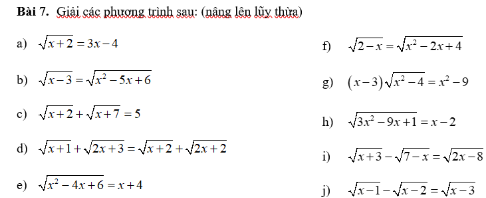
K
Khách
Hãy nhập câu hỏi của bạn vào đây, nếu là tài khoản VIP, bạn sẽ được ưu tiên trả lời.

Những câu hỏi liên quan
20 tháng 8 2021
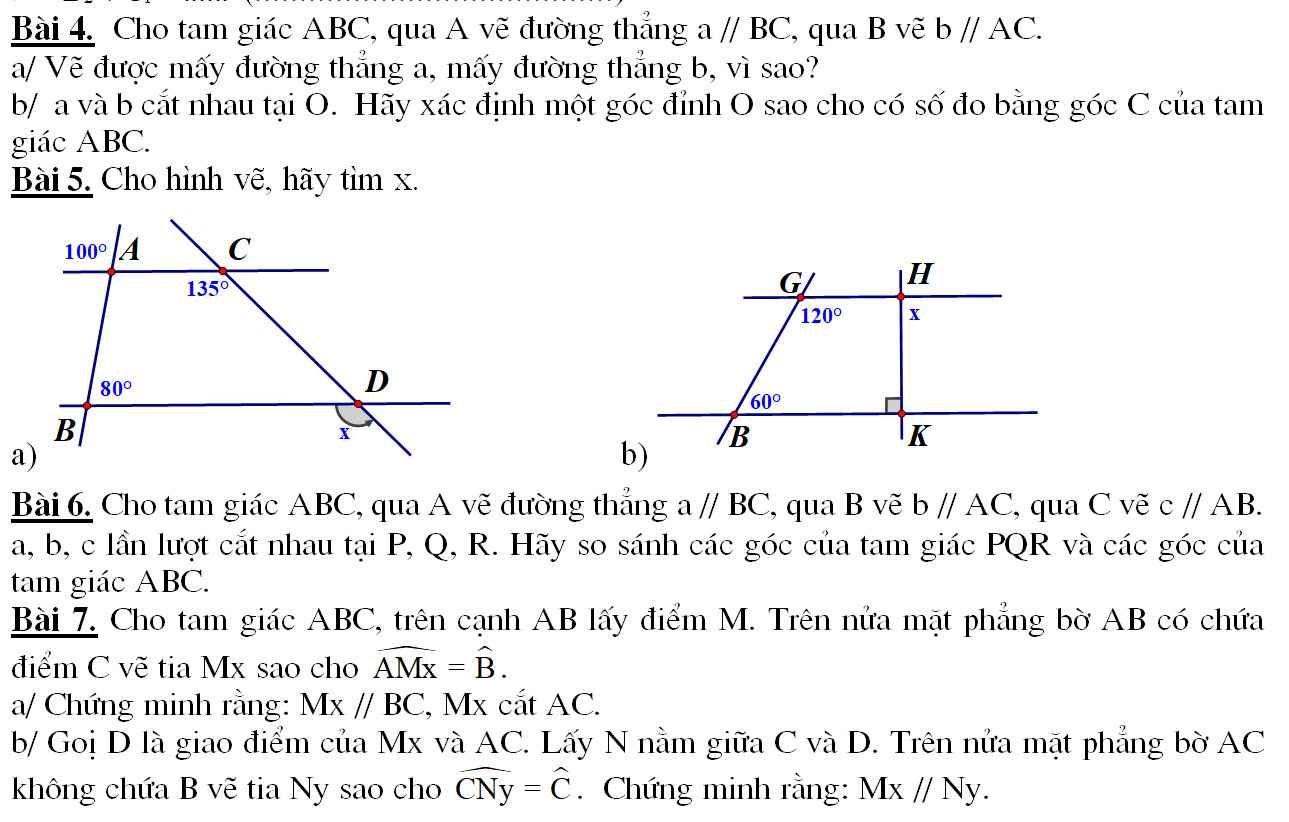
Bài 5:
A 1 2 3 4 B 1 C 1 D 1
Ta có : \(\widehat{A_1}+\widehat{A_3}=180^o\) (kề bù)
\(100^o+\widehat{A_3}=180^o\)
\(\widehat{A_3}=80^o\)
Ta có: \(\widehat{A_3}=\widehat{B_1}=80^o\)
\(\widehat{A_3}\) và \(\widehat{B_1}\) ở vị trí đồng vị
\(\Rightarrow AC//BD\)
\(\Rightarrow\widehat{C}_1=\widehat{D_1}=135^o\) (đồng vị)
\(x=135^o\)
b)
G H B K 1 1 1 1
Ta có: \(\widehat{G_1}+\widehat{B_1}=180^o\left(120^o+60^o=180^o\right)\)
\(\widehat{G_1}\) và \(\widehat{B_1}\) ở vị trí trong cùng phía
\(\Rightarrow QH//BK\)
\(\Rightarrow\widehat{H_1}=\widehat{K_1}=90^o\)(so le)
\(x=90^o\)
TH
1
NL
Nguyễn Lê Phước Thịnh
CTVHS
6 tháng 12 2021
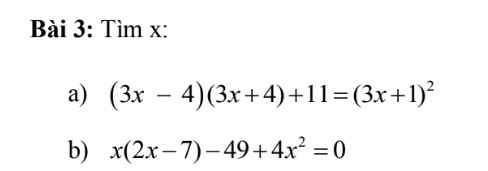
b: \(\Leftrightarrow\left(2x-7\right)\left(3x+7\right)=0\)
\(\Leftrightarrow\left[{}\begin{matrix}x=\dfrac{7}{2}\\x=-\dfrac{7}{3}\end{matrix}\right.\)
TH

2
NL
Nguyễn Lê Phước Thịnh
CTVHS
13 tháng 11 2021
a: Xét tứ giác AEDF có
AE//DF
AF//DE
Do đó: AEDF là hình bình hành
mà \(\widehat{DAE}=90^0\)
nên AEDF là hình chữ nhật
NH
1
NL
Nguyễn Lê Phước Thịnh
CTVHS
24 tháng 5
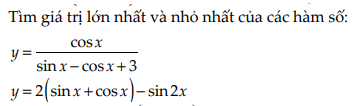
a: \(y=\frac{cosx}{\sin x-cosx+3}\)
=>\(y\cdot\sin x-y\cdot cosx+3y=cosx\)
=>\(y\cdot\sin x+cosx\left(-y-1\right)=-3y\) (1)
Để phương trình (1) có nghiệm thì \(y^2+\left(-y-1\right)^2\ge\left(-3y\right)^2\)
=>\(y^2+y^2+2y+1\ge9y^2\)
=>\(-7y^2+2y+1\ge0\)
=>\(y^2-\frac27y-\frac17\le0\)
=>\(y^2-\frac27y+\frac{1}{49}-\frac{1}{49}-\frac17\le0\)
=>\(\left(y-\frac17\right)^2\le\frac{1}{49}+\frac17=\frac{1}{49}+\frac{7}{49}=\frac{8}{49}\)
=>\(-\frac{2\sqrt2}{7}\le y-\frac17\le\frac{2\sqrt2}{7}\)
=>\(\frac{-2\sqrt2+1}{7}\le y\le\frac{2\sqrt2+1}{7}\)
=>\(y_{\min}=\frac{-2\sqrt2+1}{7};y_{\max}=\frac{2\sqrt2+1}{7}\)
NH
1
NL
Nguyễn Lê Phước Thịnh
CTVHS
24 tháng 5
a: \(y=\frac{cosx}{\sin x-cosx+3}\)
=>\(y\cdot\sin x-y\cdot cosx+3y=cosx\)
=>\(y\cdot\sin x+cosx\left(-y-1\right)=-3y\) (1)
Để phương trình (1) có nghiệm thì \(y^2+\left(-y-1\right)^2\ge\left(-3y\right)^2\)
=>\(y^2+y^2+2y+1\ge9y^2\)
=>\(-7y^2+2y+1\ge0\)
=>\(y^2-\frac27y-\frac17\le0\)
=>\(y^2-\frac27y+\frac{1}{49}-\frac{1}{49}-\frac17\le0\)
=>\(\left(y-\frac17\right)^2\le\frac{1}{49}+\frac17=\frac{1}{49}+\frac{7}{49}=\frac{8}{49}\)
=>\(-\frac{2\sqrt2}{7}\le y-\frac17\le\frac{2\sqrt2}{7}\)
=>\(\frac{-2\sqrt2+1}{7}\le y\le\frac{2\sqrt2+1}{7}\)
=>\(y_{\min}=\frac{-2\sqrt2+1}{7};y_{\max}=\frac{2\sqrt2+1}{7}\)
P
1
TL
1
f: Ta có: \(\sqrt{2-x}=\sqrt{x^2-2x+4}\)
\(\Leftrightarrow x^2-2x+4=2-x\)
\(\Leftrightarrow x^2-x+2=0\)
\(\Leftrightarrow x\in\varnothing\)