
a.(2x^2+x+1)(2x^2+x-4)=-4
b.(x-3)(x-2)(x+1)(x+2)=60
c.(x+2)^4+(x+4)^4=16
Hãy nhập câu hỏi của bạn vào đây, nếu là tài khoản VIP, bạn sẽ được ưu tiên trả lời.

1:
a: \(\left(2x-5\right)^2-4x\left(x+3\right)\)
\(=4x^2-20x+25-4x^2-12x\)
=-32x+25
b: \(\left(x-2\right)^3-6\left(x+4\right)\left(x-4\right)-\left(x-2\right)\left(x^2+2x+4\right)\)
\(=x^3-6x^2+12x-8-\left(x^3-8\right)-6\left(x^2-16\right)\)
\(=-6x^2+12x-6x^2+96=-12x^2+12x+96\)
c: \(\left(x-1\right)^2-2\left(x-1\right)\left(x+2\right)+\left(x+2\right)^2+5\left(2x-3\right)\)
\(=\left(x-1-x-2\right)^2+5\left(2x-3\right)\)
\(=\left(-3\right)^2+5\left(2x-3\right)\)
\(=9+10x-15=10x-6\)
2:
a: \(\left(2-3x\right)^2-5x\left(x-4\right)+4\left(x-1\right)\)
\(=9x^2-12x+4-5x^2+20x+4x-4\)
\(=4x^2+12x\)
b: \(\left(3-x\right)\left(x^2+3x+9\right)+\left(x-3\right)^3\)
\(=27-x^3+x^3-9x^2+27x-27\)
\(=-9x^2+27x\)
c: \(\left(x-4\right)^2\left(x+4\right)-\left(x-4\right)\left(x+4\right)^2+3\left(x^2-16\right)\)
\(=\left(x-4\right)\left(x+4\right)\left(x-4-x-4\right)+3\left(x^2-16\right)\)
\(=\left(x^2-16\right)\left(-8\right)+3\left(x^2-16\right)\)
\(=-5\left(x^2-16\right)=-5x^2+80\)
a: Ta có: \(\left(x+2\right)\left(x^2-2x+4\right)-x\left(x^2+2\right)=15\)
\(\Leftrightarrow x^3+8-x^3-2x=15\)
\(\Leftrightarrow2x=-7\)
hay \(x=-\dfrac{7}{2}\)
b: Ta có: \(\left(x-2\right)^3-\left(x-4\right)\left(x^2+4x+16\right)+6\left(x+1\right)^2=49\)
\(\Leftrightarrow x^3-6x^2+12x-8-x^3+64+6\left(x+1\right)^2=49\)
\(\Leftrightarrow-6x^2+12x+56+6x^2+12x+6=49\)
\(\Leftrightarrow24x=-13\)
hay \(x=-\dfrac{13}{24}\)
Câu d đề có đúng ko bn
mk thấy hơi sai Nguyen Thi tuong Vi
1a) -3x2(2x3 - 2x + 1/3) = -6x5 + 6x3 - x2
b) (x4 + 2x3 - 2/3).(-3x4) = -3x8 - 6x7 + 2x4
c) (x + 3)(x - 4) = x2 - 4x + 3x - 12 = x2 - x - 12
d)(x - 4)(x2 + 4x + 16) = (x - 4)(x2 + 4x + 42) = x3 - 64
e) 4(x - 1/2)(x + 1/2)(4x2 + 1) =4(x2 - 1/4)(4x2 + 1) = 4(4x4 + x2 - x2 - 1/4) = 4(4x4 - 1/4) = 16x4 - 1
B2. a) (2 - x)(x2 + 2x + 4) + x(x - 3)(x + 4) - x2 + 24 = 0
=> 8 - x3 + x(x2 + 4x - 3x - 12) - x2 + 24 = 0
=> 8 - x3 + x3 + x2 - 12x - x2 + 24 = 0
=> -12x + 32 = 0
=> -12x = -32
=> x = -32 : (-12) = 8/3
b) (x/2 + 3)(5 - 6x) + (12x - 2)(x/4 + 3) = 0
=> 5x/2 - 3x2 + 15 - 18x + 3x2 + 36x - x/2 - 6 = 0
=> 20x + 9 = 0
=> 20x = -9
=> x = -9/20
b: \(x^4+4\)
\(=x^4+4x^2+4-4x^2\)
\(=\left(x^2+2\right)^2-\left(2x\right)^2=\left(x^2-2x+2\right)\left(x^2+2x+2\right)\)
Ta có: \(\frac{x^2}{x^2+2x+2}+\frac{x^2}{x^2-2x+2}=\frac{5\left(x^2-5\right)}{x^4+4}+\frac{25}{4}\)
=>\(\frac{x^2\left(x^2-2x+2\right)+x^2\left(x^2+2x+2\right)}{\left(x^2+2x+2\right)\left(x^2-2x+2\right)}-\frac{5\left(x^2-5\right)}{\left(x^2+2x+2\right)\left(x^2-2x+2\right)}=\frac{25}{4}\)
=>\(\frac{x^4-2x^3+2x^2+x^4+2x^3+2x^2-5x^2+25}{x^4+4}=\frac{25}{4}\)
=>\(\frac{2x^4-x^2+25}{x^4+4}=\frac{25}{4}\)
=>\(25\left(x^4+4\right)=4\left(2x^4-x^2+25\right)\)
=>\(25x^4+100-8x^4+4x^2-100=0\)
=>\(17x^4+4x^2=0\)
=>\(x^2\left(17x^2+4\right)=0\)
=>\(x^2=0\)
=>x=0
a: \(x^4+4x^2+16\)
\(=x^4+8x^2+16-4x^2\)
\(=\left(x^2+4\right)_{}^2-\left(2x\right)^2=\left(x^2-2x+4\right)\cdot\left(x^2+2x+4\right)\)
\(\frac{x^2+2x}{\left(x+1\right)^2+3}-\frac{x^2-2x}{\left(x-1\right)^2+3}=\frac{16}{x^4+4x^2+16}\)
=>\(\frac{x^2+2x}{x^2+2x+4}-\frac{x^2-2x}{x^2-2x+4}=\frac{16}{\left(x^2+2x+4\right)\left(x^2-2x+4\right)}\)
=>\(\left(x^2+2x\right)\left(x^2-2x+4\right)-\left(x^2-2x\right)\left(x^2+2x+4_{}\right)=16\)
=>\(\left(x^2+2x\right)\left(x^2-2x\right)+4\left(x^2+2x\right)-\left(x^2-2x\right)\left(x^2+2x\right)-4\left(x^2-2x\right)=16\)
=>\(4\cdot\left(x^2+2x-x^2+2x\right)=16\)
=>4*4x=16
=>16x=16
=>x=1
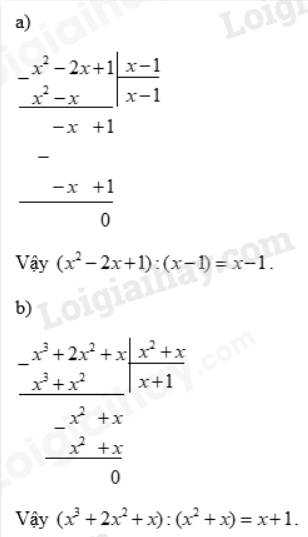

Vậy \(( - 32{x^5} + 1):( - 2x + 1) = 16{x^4} + 8{x^3} + 4{x^2} + 2x + 1\).
Bài 1.
\( a)\dfrac{{4x - 8}}{{2{x^2} + 1}} = 0 (x \in \mathbb{R})\\ \Leftrightarrow 4x - 8 = 0\\ \Leftrightarrow 4x = 8\\ \Leftrightarrow x = 2\left( {tm} \right)\\ b)\dfrac{{{x^2} - x - 6}}{{x - 3}} = 0\left( {x \ne 3} \right)\\ \Leftrightarrow \dfrac{{{x^2} + 2x - 3x - 6}}{{x - 3}} = 0\\ \Leftrightarrow \dfrac{{x\left( {x + 2} \right) - 3\left( {x + 2} \right)}}{{x - 3}} = 0\\ \Leftrightarrow \dfrac{{\left( {x + 2} \right)\left( {x - 3} \right)}}{{x - 3}} = 0\\ \Leftrightarrow x - 2 = 0\\ \Leftrightarrow x = 2\left( {tm} \right) \)
Bài 2.
\(c)\dfrac{{x + 5}}{{3x - 6}} - \dfrac{1}{2} = \dfrac{{2x - 3}}{{2x - 4}}\)
ĐK: \(x\ne2\)
\( Pt \Leftrightarrow \dfrac{{x + 5}}{{3x - 6}} - \dfrac{{2x - 3}}{{2x - 4}} = \dfrac{1}{2}\\ \Leftrightarrow \dfrac{{x + 5}}{{3\left( {x - 2} \right)}} - \dfrac{{2x - 3}}{{2\left( {x - 2} \right)}} = \dfrac{1}{2}\\ \Leftrightarrow \dfrac{{2\left( {x + 5} \right) - 3\left( {2x - 3} \right)}}{{6\left( {x - 2} \right)}} = \dfrac{1}{2}\\ \Leftrightarrow \dfrac{{ - 4x + 19}}{{6\left( {x - 2} \right)}} = \dfrac{1}{2}\\ \Leftrightarrow 2\left( { - 4x + 19} \right) = 6\left( {x - 2} \right)\\ \Leftrightarrow - 8x + 38 = 6x - 12\\ \Leftrightarrow - 14x = - 50\\ \Leftrightarrow x = \dfrac{{27}}{5}\left( {tm} \right)\\ d)\dfrac{{12}}{{1 - 9{x^2}}} = \dfrac{{1 - 3x}}{{1 + 3x}} - \dfrac{{1 + 3x}}{{1 - 3x}} \)
ĐK: \(x \ne -\dfrac{1}{3};x \ne \dfrac{1}{3}\)
\( Pt \Leftrightarrow \dfrac{{12}}{{1 - 9{x^2}}} - \dfrac{{1 - 3x}}{{1 + 3x}} - \dfrac{{1 + 3x}}{{1 - 3x}} = 0\\ \Leftrightarrow \dfrac{{12}}{{\left( {1 - 3x} \right)\left( {1 + 3x} \right)}} - \dfrac{{1 - 3x}}{{1 + 3x}} - \dfrac{{1 + 3x}}{{1 - 3x}} = 0\\ \Leftrightarrow \dfrac{{12 - {{\left( {1 - 3x} \right)}^2} - {{\left( {1 + 3x} \right)}^2}}}{{\left( {1 - 3x} \right)\left( {1 + 3x} \right)}} = 0\\ \Leftrightarrow \dfrac{{12 + 12x}}{{\left( {1 - 3x} \right)\left( {1 + 3x} \right)}} = 0\\ \Leftrightarrow 12 + 12x = 0\\ \Leftrightarrow 12x = - 12\\ \Leftrightarrow x = - 1\left( {tm} \right) \)
