GIÚP MÌNH BÀI NÀY ĐI CÁC BẠN. MÌNH ĐANG CẦN GẤP !!
Hãy nhập câu hỏi của bạn vào đây, nếu là tài khoản VIP, bạn sẽ được ưu tiên trả lời.

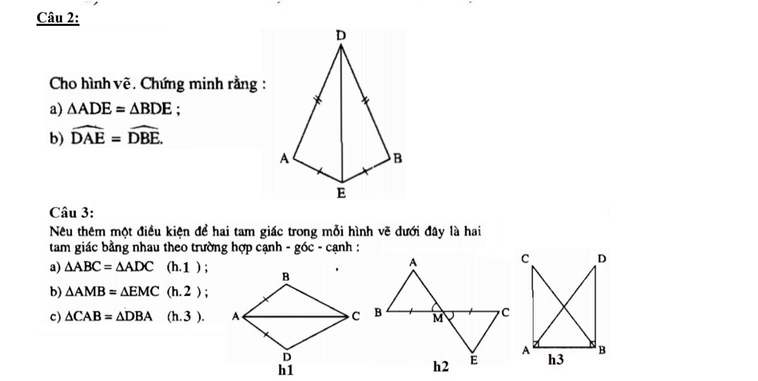
Câu 2:
a: Xét ΔDAE và ΔDBE có
DA=DB
EA=EB
DE chung
Do đó; ΔDAE=ΔDBE
b: ΔDAE=ΔDBE
=>\(\hat{DAE}=\hat{DBE}\)
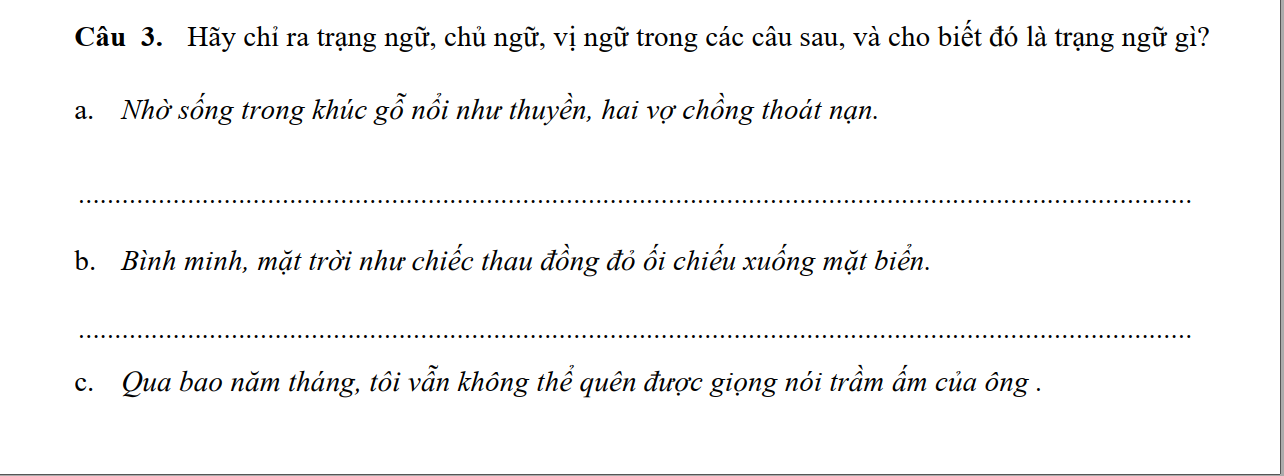
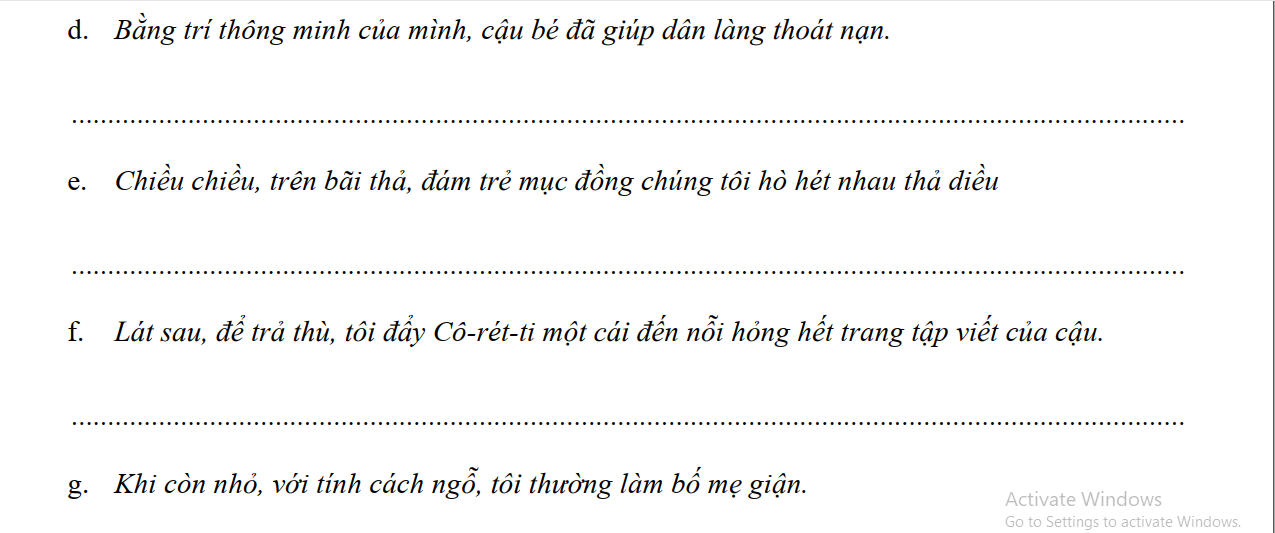
Câu 3:
a: Để ΔABC=ΔADC thì cần có thêm một điều kiện là \(\hat{BAC}=\hat{DAC}\)
b: Để ΔAMB=ΔEMC thì cần có thêm một điều kiện là MA=ME
c: Để ΔCAB=ΔDBA thì cần có thêm điều kiện là CA=DB
a: 6/5-2/3=18/15-10/15=8/15
b: 9/7-5/8=72/56-35/56=37/56
c: 7/6-3/4=14/12-9/12=5/12
d: 9/8-8/9=81/72-64/72=17/72
e: 7/5-7/6=7(1/5-1/6)=7/30
f: 3/4-2/5=15/20-8/20=7/20
g: 4/7-5/6=24/42-35/42=-11/41
i: 6/13-5/11=66/143-65/143=1/143
k: 1-4/5=1/5
m: 2-5/9=18/9-5/9=13/9
n: 3-9/5=15/5-9/5=6/5
p: 4-3/4=16/4-3/4=13/4
a) \(\dfrac{6}{5}-\dfrac{2}{3}=\dfrac{18}{15}-\dfrac{10}{15}=\dfrac{8}{15}\)
b) \(\dfrac{9}{7}-\dfrac{5}{8}=\dfrac{72}{56}-\dfrac{35}{56}=\dfrac{37}{56}\)
c) \(\dfrac{7}{6}-\dfrac{3}{4}=\dfrac{28}{24}-\dfrac{18}{24}=\dfrac{10}{24}=\dfrac{5}{12}\)
d) \(\dfrac{9}{8}-\dfrac{8}{9}=\dfrac{81}{72}-\dfrac{64}{72}=\dfrac{17}{72}\)
e) \(\dfrac{7}{5}-\dfrac{7}{6}=\dfrac{42}{30}-\dfrac{35}{30}=\dfrac{7}{30}\)
h) \(\dfrac{4}{7}-\dfrac{5}{6}=\dfrac{24}{42}-\dfrac{35}{42}=-\dfrac{11}{42}\)
i) \(\dfrac{6}{13}-\dfrac{5}{11}=\dfrac{66}{143}-\dfrac{65}{143}=\dfrac{1}{143}\)
k) \(1-\dfrac{4}{5}=\dfrac{5}{5}-\dfrac{4}{5}=\dfrac{1}{5}\)
m) \(2-\dfrac{5}{9}=\dfrac{18}{9}-\dfrac{5}{9}=\dfrac{13}{9}\)
n) \(3-\dfrac{9}{5}=\dfrac{15}{5}-\dfrac{9}{5}=\dfrac{6}{5}\)
p) \(4-\dfrac{3}{4}=\dfrac{16}{4}-\dfrac{3}{4}=\dfrac{13}{4}\)
b: =45/8+1/2=45/8+4/8=49/8
c: =7/2-1/20=70/20-1/20=69/20
d: =5/4+3/10=25/20+6/20=31/20
a nhờ... thuyền
b bình minh
c qua bao năm tháng
d bắng... mình
e chiều chiều , trên bãi thả
f lát sau, để trả thù
g khi... ngỗ
h đêm... quá
nhé
Sau ngày thứ nhất, kho còn số gạo là :
200 - 40 = 160 ( tạ gạo )
Ngày thứ hai bán được số gạo là :
160 : ( 2 + 3 ) x 2 = 64 ( tạ gạo )
Ngày thứ ba bán được số gạo là :
160 - 64 = 96 ( tạ gạo )
Đáp số : Ngày thứ nhất : 40 tạ gạo
Ngày thứ hai : 64 tạ gạo
Ngày thứ ba : 96 tạ gạo
1 create $\rightarrow$ c. energy (tạo ra năng lượng)
2 drive $\rightarrow$ a. machinery (vận hành máy móc)
3 generate $\rightarrow$ e. electricity (phát/tạo ra điện)
4 turn $\rightarrow$ b. turbines (quay tua-bin)
5 heat $\rightarrow$ d. houses (sưởi ấm nhà cửa)
b
1 How many types of energy sources are mentioned in the text? What are they?
$\rightarrow$ Two types of energy sources are mentioned. They are renewable and non-renewable energy sources. (hoặc kể tên cụ thể: fossil fuels/coal/oil, hydro power, nuclear power, wind power, solar power)
2 What are the disadvantages of hydro and nuclear power?
$\rightarrow$ Hydro power is expensive to build dams, and nuclear power can be very dangerous.
3 Why do you think the wind and the sun are called alternative sources of energy?
$\rightarrow$ Because they are clean, renewable, and can be used instead of non-renewable sources (fossil fuels).
4 What types of energy does Viet Nam use most?
$\rightarrow$ Viet Nam uses hydro power and fossil fuels (coal, gas, oil) most.
5 What does the professor think Viet Nam will use more in the future?
$\rightarrow$ He thinks Viet Nam will use more renewable energy sources like solar and wind power in the future.
a: 1-1/2=1/2
b: 1-3/10=7/10
c:3-1/3=8/3
d: 4-1/9=35/9
e: 8-2/3=22/3
f: 5-2/5=23/5
a: bằng 1 phần 2
b: bằng 7 phần 10
c: bằng 2 phần 3
d:bằng 35 phần 9
e: bằng 22 phần 3
g: bằng 23 phần 5
chúc bn học tốt
a: \(\dfrac{5}{3}\cdot\dfrac{4}{5}=\dfrac{4}{3}\)
b: \(\dfrac{2}{3}\cdot\dfrac{3}{5}=\dfrac{2}{5}\)
c: \(\dfrac{7}{6}\cdot\dfrac{6}{5}=\dfrac{7}{5}\)
d: \(\dfrac{8}{5}\cdot\dfrac{5}{7}=\dfrac{8}{7}\)
e: \(\dfrac{7}{6}\cdot\dfrac{6}{7}=\dfrac{7}{7}=1\)
g: \(\dfrac{9}{5}\cdot\dfrac{5}{2}=\dfrac{9}{2}\)
h: \(\dfrac{4}{3}\cdot\dfrac{3}{5}=\dfrac{4}{5}\)