
giải phương trình sau:
a)3x2-5x +2 =0
b)-3x2 +14x -8 =0
Hãy nhập câu hỏi của bạn vào đây, nếu là tài khoản VIP, bạn sẽ được ưu tiên trả lời.

a. 2x2-5x+1=0
△= b2 - 4ac = (-5)2 - 4*2*1 = 17 ⇒√△ = √17
\(\Rightarrow x_1=\frac{5+\sqrt{17}}{4};x_2=\frac{5-\sqrt{17}}{4}\)
Vậy .... S={\(\frac{5\pm\sqrt{17}}{4}\)}
b. 4x2 +4x+1=0
⇔(2x+1)2 = 0 ⇔ x=\(\frac{-1}{2}\)
c. -3x2 +2x+8=0
△' = b'2 - ac = 12 - (-3)*8 = 25 ⇒√△ = 5
\(\Rightarrow x_1=\frac{-1+5}{-3}=-\frac{4}{3};x_2=\frac{-1-5}{-3}=2\)
Vậy... S={-\(\frac{4}{3}\);2}
d. 5x2 6x1=0 (thiếu dấu nên mk chưa giải được)
e. -3x2+ 14x - 8=0
△' = b'2 - ac = 72 - (-3)*(-8) = 25 ⇒ √△ = 5
⇒\(x_1=\frac{-7+5}{-3}=\frac{2}{3};x_2=\frac{-7-5}{-3}=4\)
Vậy .... S={\(\frac{2}{3};4\)}
g. -7x2 +4x-3=0
△' = b'2 - ac = 22 - (-7)*(-3) = -17<0
Vậy pt vô nghiệm , S=∅
a) 3 x 2 + 5x - 1 = 0
Ta có: a = 3; b = 5; c = -1
Δ = b 2 - 4ac = 5 2 - 4.3.(-1) = 37 > 0
Phương trình có 2 nghiệm phân biệt:
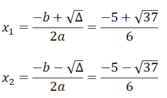
Vậy phương trình đã cho có tập nghiệm 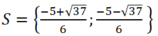
Phương trình bậc hai 3x2 + 5x + 2 = 0
Có a = 3; b = 5; c = 2; Δ = b2 – 4ac = 52 – 4.3.2 = 1 > 0
Áp dụng công thức nghiệm, phương trình có hai nghiệm phân biệt là:
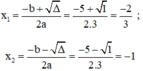
Vậy phương trình có hai nghiệm là -1 và 
3x2 + 2x - 1 = 0
=> 3x2 + 3x - x - 1 = 0
=> 3x(x + 1) - (x + 1) = 0
=> (3x - 1)(x + 1) = 0
=> \(\orbr{\begin{cases}3x-1=0\\x+1=0\end{cases}}\)
=> \(\orbr{\begin{cases}x=\frac{1}{3}\\x=-1\end{cases}}\)
x2 - 5x + 6 = 0
=> x2 - 2x - 3x + 6 = 0
=> x(x - 2) - 3(x - 2) = 0
=> (x - 3)(x - 2) = 0
=> \(\orbr{\begin{cases}x-3=0\\x-2=0\end{cases}}\)
=> \(\orbr{\begin{cases}x=3\\x=2\end{cases}}\)
3x2 + 7x + 2 = 0
=> 3x2 + 6x + x + 2 = 0
=> 3x(x + 2) + (x + 2) = 0
=> (3x + 1)(x + 2) = 0
=> \(\orbr{\begin{cases}3x+1=0\\x+2=0\end{cases}}\)
=> \(\orbr{\begin{cases}x=-\frac{1}{3}\\x=-2\end{cases}}\)
1, \(3x^2+2x-1=0\Leftrightarrow3x^2+3x-x-1=0\)
\(\Leftrightarrow3x\left(x+1\right)-\left(x+1\right)=0\)
\(\Leftrightarrow\left(x+1\right)\left(3x-1\right)=0\)
\(\Leftrightarrow\orbr{\begin{cases}x+1=0\\3x-1=0\end{cases}\Leftrightarrow\orbr{\begin{cases}x=-1\\x=\frac{1}{3}\end{cases}}}\)
2, \(x^2-5x+6=0\Leftrightarrow x^2-2x-3x+6=0\)
\(\Leftrightarrow x\left(x-2\right)-3\left(x-2\right)=0\)
\(\Leftrightarrow\left(x-2\right)\left(x-3\right)=0\)
\(\Leftrightarrow\orbr{\begin{cases}x-2=0\\x-3=0\end{cases}\Leftrightarrow\orbr{\begin{cases}x=2\\x=3\end{cases}}}\)
3, \(3x^2+7x+2=0\Leftrightarrow3x^2+6x+x+2=0\)
\(\Leftrightarrow3x\left(x+2\right)+\left(x+2\right)=0\)
\(\Leftrightarrow\left(x+2\right)\left(3x+1\right)=0\)
\(\Leftrightarrow\orbr{\begin{cases}x+2=0\\3x+1=0\end{cases}\Leftrightarrow\orbr{\begin{cases}x=-2\\x=-\frac{1}{3}\end{cases}}}\)
a: \(\Leftrightarrow\left(-x+3\right)\left(x+6\right)=18\)
\(\Leftrightarrow-x^2-6x+3x+18-18=0\)
\(\Leftrightarrow-x\left(x+3\right)=0\)
=>x=0 hoặc x=-3
b: \(\Leftrightarrow x\left(3x^2+6x-4\right)=0\)
\(\Leftrightarrow\left[{}\begin{matrix}x=0\\3x^2+6x-4=0\end{matrix}\right.\Leftrightarrow\left[{}\begin{matrix}x=0\\x^2+2x-\dfrac{4}{3}=0\end{matrix}\right.\)
\(\Leftrightarrow\left[{}\begin{matrix}x=0\\\left(x+1\right)^2=\dfrac{7}{3}\end{matrix}\right.\Leftrightarrow x\in\left\{0;\dfrac{\sqrt{21}}{3}-1;\dfrac{-\sqrt{21}}{3}-1\right\}\)
c: =>x(3x-5)=0
=>x=0 hoặc x=5/3
d: =>(x-2)(x+2)=0
=>x=2 hoặc x=-2
Bài 2:
a: =>2x^2-4x+1=x^2+x+5
=>x^2-5x-4=0
=>\(x=\dfrac{5\pm\sqrt{41}}{2}\)
b: =>11x^2-14x-12=3x^2+4x-7
=>8x^2-18x-5=0
=>x=5/2 hoặc x=-1/4
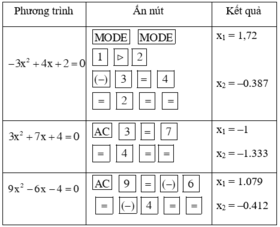
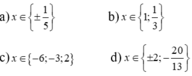
a) \(3x^2-5x+2=0\)
Vì \(a+b+c=3-5+2=0\)
\(\Rightarrow\) pt co 2 ngiệm pb : \(x_1=1\) ; \(x_2=\frac{2}{3}\)
Vậy \(S=\left\{1;\frac{2}{3}\right\}\)
b) \(-3x^2+14x-8=0\)
\(\Delta'=7^2-\left(-3\right)\times\left(-8\right)=49-24=25\)
\(\Rightarrow\) pt có 2 nghiệm pb : \(x_1=4\) ; \(x_2=\frac{2}{3}\)
Vậy \(S=\left\{4;\frac{2}{3}\right\}\)