
Phân tích các đa thức sau thành nhân tử
4x4+4x3-x2-x
Hãy nhập câu hỏi của bạn vào đây, nếu là tài khoản VIP, bạn sẽ được ưu tiên trả lời.

\(A=4x\left(x^2-2x+1\right)=4x\left(x-1\right)^2\\ B=\left(x-y\right)^2-16=\left(x-y-4\right)\left(x-y+4\right)\\ C=\left(x-2\right)\left(x^2+2x+4\right)+3\left(x-2\right)=\left(x-2\right)\left(x^2+2x+7\right)\)
a) \(A=4x\left(x^2-2x+1\right)=4x\left(x-1\right)^2\)
b) \(B=\left(x^2-2xy+y^2\right)-16=\left(x-y\right)^2-16=\left(x-y-4\right)\left(x-y+4\right)\)
c) \(C=\left(x-2\right)\left(x^2+2x+4\right)+3\left(x-2\right)=\left(x-2\right)\left(x^2+2x+7\right)\)
trời dài thế làm lâu phết đó nha hừm làm theo đúng công thức là được :)
Câu 2:
a: =x(x+6)
b: =(3x-1)*(3x+1)
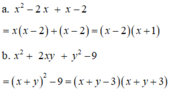
c: \(=\left(x+y\right)^2-9=\left(x+y+3\right)\left(x+y-3\right)\)
d: \(=\left(x-y\right)\left(x+y\right)-\left(x-y\right)=\left(x-y\right)\left(x+y-1\right)\)
\(A=x^2-y^2+7x+7y\)
\(=\left(x-y\right)\left(x+y\right)+7\left(x+y\right)\)
\(=\left(x+y\right)\left(x-y+7\right)\)
\(B=4x^3-4x^2+x\)
\(=x\left(4x^2-4x+1\right)\)
\(=x\left(2x-1\right)^2\)
\(C=x^2-6xy+9y^2-9\)
\(=\left(x-3y\right)^2-9\)
\(=\left(x-3y-3\right)\left(x-3y+3\right)\)
A=\(x^2+7x+7y-y^2=\left(x^2-y^2\right)+\left(7x+7y\right)=\left(x-y\right)\left(x+y\right)+7\left(x+y\right)=\left(x+y\right)\left(x-y+7\right)\)
B=\(4x^3-4x^2+x=x\left(4x^2-4x+1\right)=x\left(2x-1\right)^2\)
C=\(x^2+9y^2-9-6xy=\left(x^2-6xy+9y^2\right)-9=\left(x-3y\right)^2-3^2=\left(x-3y-3\right)\left(x-3y+3\right)\)
a: \(=x\left(x+y\right)-\left(x+y\right)=\left(x+y\right)\left(x-1\right)\)
b: \(=25-\left(x-2y\right)^2\)
\(=\left(5-x+2y\right)\left(5+x-2y\right)\)
a: \(x^4+2x^3+3x^2+2x+1\)
\(=x^4+x^3+x^2+x^3+x^2+x+x^2+x+1\)
\(=x^2\left(x^2+x+1\right)+x\left(x^2+x+1\right)+\left(x^2+x+1\right)\)
\(=\left(x^2+x+1\right)\left(x^2+x+1\right)=\left(x^2+x+1\right)^2\)
b: \(x^4-4x^3+2x^2+4x+1\)
\(=x^4-2x^3-x^2-2x^3+4x^2+2x-x^2+2x+1\)
\(=x^2\left(x^2-2x-1\right)-2x\left(x^2-2x-1\right)-\left(x^2-2x-1\right)\)
\(=\left(x^2-2x-1\right)\left(x^2-2x-1\right)=\left(x^2-2x-1\right)^2\)
c: \(x^4+x^3+2x^2+2x+4\)
\(=x^4-x^3+2x^2+2x^3-2x^2+4x+2x^2-2x+4\)
\(=x^2\left(x^2-x+2\right)+2x\left(x^2-x+2\right)+2\left(x^2-x+2\right)\)
\(=\left(x^2-x+2\right)\left(x^2+2x+2\right)\)
a) \(=x\left(x^2-2xy+y^2\right)=x\left(x-y\right)^2\)
b) \(=\left(x^2+2x\right)+\left(10x+20\right)=x\left(x+2\right)+10\left(x+2\right)=\left(x+2\right)\left(x+10\right)\)
c) đặt \(x^2+x+1=t\)
\(\left(x^2+x+1\right)\left(x^2+x+4\right)+2=t\left(t+3\right)+2=t^2+3t+2=\left(t^2+t\right)+\left(2t+2\right)=t\left(t+1\right)+2\left(t+1\right)=\left(t+1\right)\left(t+2\right)=\left(x^2+x+2\right)\left(x^2+x+3\right)\)
Cách 1: Tách một hạng tử thành tổng hai hạng tử để xuất hiện nhân tử chung.
a) x2 – 3x + 2
= x2 – x – 2x + 2 (Tách –3x = – x – 2x)
= (x2 – x) – (2x – 2)
= x(x – 1) – 2(x – 1) (Có x – 1 là nhân tử chung)
= (x – 1)(x – 2)
Hoặc: x2 – 3x + 2
= x2 – 3x – 4 + 6 (Tách 2 = – 4 + 6)
= x2 – 4 – 3x + 6
= (x2 – 22) – 3(x – 2)
= (x – 2)(x + 2) – 3.(x – 2) (Xuất hiện nhân tử chung x – 2)
= (x – 2)(x + 2 – 3) = (x – 2)(x – 1)
b) x2 + x – 6
= x2 + 3x – 2x – 6 (Tách x = 3x – 2x)
= x(x + 3) – 2(x + 3) (có x + 3 là nhân tử chung)
= (x + 3)(x – 2)
c) x2 + 5x + 6 (Tách 5x = 2x + 3x)
= x2 + 2x + 3x + 6
= x(x + 2) + 3(x + 2) (Có x + 2 là nhân tử chung)
= (x + 2)(x + 3)
Cách 2: Đưa về hằng đẳng thức (1) hoặc (2)
a) x2 – 3x + 2
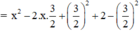
(Vì có x2 và  nên ta thêm bớt
  để xuất hiện HĐT)
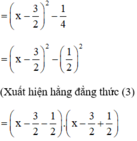
= (x – 2)(x – 1)
b) x2 + x - 6
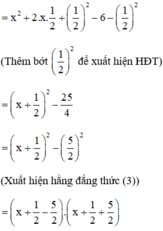
= (x – 2)(x + 3).
c) x2 + 5x + 6
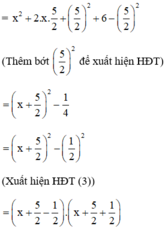
= (x + 2)(x + 3).
 .
. .
.
4x4 + 4x3 - x2 - x
= 4x3(x+1) - x(x+1)
= (4x3 - x)(x + 1)
4x3+4x4−x2−x
=4x3(x+1)−x(x+1)
=(x+1)(4x3−1)
ĐÂY NHÉ. T.I.C.K MÌNH VỚI