
Tìm giá trị lớn nhất của biểu thức: \(Q=\dfrac{3-4x}{x^2+1}\)
K
Khách
Hãy nhập câu hỏi của bạn vào đây, nếu là tài khoản VIP, bạn sẽ được ưu tiên trả lời.

Những câu hỏi liên quan
NL
Nguyễn Lê Phước Thịnh
CTVHS
25 tháng 2
b: \(T=\frac{2x^4-4x^2+8}{x^4+4}\)
=>\(T\left(x^4+4\right)=2x^4-4x^2+8\)
=>\(T\cdot x^4+4T-2x^4+4x^2-8=0\)
=>\(x^4\cdot\left(T-2\right)+4x^2+4T-8=0\) (1)
Đặt \(a=x^4\)
(1) sẽ trở thành: \(a^2\cdot\left(T-2\right)+4\cdot a+4T-8=0\) (2)
\(\Delta=4^2-4\left(T-2\right)\left(4T-8\right)=16-16\left(T-2\right)\cdot\left(T-2\right)\)
\(=16-16\left(T-2\right)^2\)
Để (2) có nghiệm thì Δ>=0
=>\(16-16\left(T-2\right)^2\ge0\)
=>\(16\left(T-2\right)^2\le16\)
=>\(\left(T-2\right)^2\le1\)
=>-1<=T-2<=1
=>1<=T<=3
Để T có giá trị lớn nhất thì T=3
=>\(2x^4-4x^2+8=3x^4+12\)
=>\(3x^4+12-2x^4+4x^2-8=0\)
=>\(x^4+4x^2+4=0\)
=>\(\left(x^2+2\right)^2=0\) (vô lý)
=>T không có giá trị lớn nhất
a: \(S=\frac{5x^4+4x^2+10}{x^4+2}=5+\frac{4x^2}{x^4+2}\)
Đặt \(A=\frac{4x^2}{x^4+2}\)
=>\(A\left(x^4+2\right)=4x^2\)
=>\(A\cdot x^4-4x^2+2A=0\) (1)
Đặt \(t=x^2\) (ĐK: t>=0)
(1) sẽ trở thành: \(A\cdot t^2-4t+2A=0\) (2)
\(\Delta=\left(-4\right)^2-4\cdot A\cdot2A=-8A^2+16\)
Để (2) có nghiệm thì Δ>=0
=>\(-8A^2+16\ge0\)
=>\(8A^2\le16\)
=>\(A^2\le2\)
=>\(-\sqrt2\le A\le\sqrt2\)
=>\(-\sqrt2+5\le A+5\le\sqrt2+5\)
=>\(5-\sqrt2\le S<=5+\sqrt2\)
=>S nhỏ nhất khi \(S=5-\sqrt2\)
=>\(A=-\sqrt2\)
(2) sẽ trở thành: \(t^2\cdot\left(-\sqrt2\right)-4t-2\sqrt2=0\)
\(\Delta=\left(-4\right)^2-4\cdot\left(-\sqrt2\right)\cdot\left(-2\sqrt2\right)=16-4\cdot4=0\)
=>(2) có nghiệm duy nhất là \(t=\frac{4}{2\cdot\left(-\sqrt2\right)}=-\sqrt2\) (loại)
=>S không có giá trị nhỏ nhất
K
7
11 tháng 12 2021
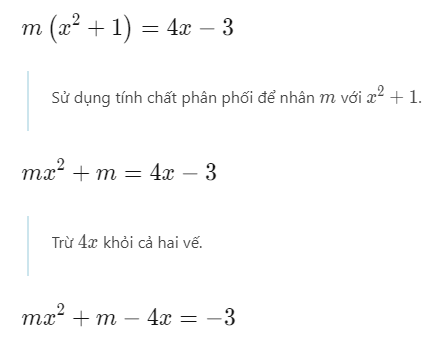
\(\Leftrightarrow Mx^2+M=4x-3\\ \Leftrightarrow Mx^2-4x+M+3=0\\ \text{PT có nghiệm nên }\Delta'=4-M\left(M+3\right)\ge0\\ \Leftrightarrow4-M^2-3M\ge0\\ \Leftrightarrow-4\le M\le1\)
Vậy \(M_{max}=1\Leftrightarrow\dfrac{4x-3}{x^2+1}=1\Leftrightarrow x^2+1-4x+3=0\Leftrightarrow x=2\)
NH
2
26 tháng 12 2021
Khi \(x=\dfrac{1}{4}\Leftrightarrow P=\dfrac{4.\dfrac{1}{4}-1}{\left(\dfrac{1}{4}\right)^2+3}=0\)
Khi \(x\ne\dfrac{1}{4}\Leftrightarrow P\ne\dfrac{4.\dfrac{1}{4}-1}{\left(\dfrac{1}{4}\right)^2+3}\Leftrightarrow P\ne0\)
\(P=\dfrac{4x-1}{x^2+3}\Leftrightarrow Px^2-4x+3P+1=0\) là pt bậc 2 do \(P\ne0\)
\(\Delta'=\left(-2\right)^2-P\left(3P+1\right)=-3P^2-P+4\)
Để pt có nghiệm thì \(\Delta'\ge0\Leftrightarrow-3P^2-P+4\ge0\Leftrightarrow-3\left(P+\dfrac{1}{6}\right)^2+\dfrac{49}{12}\ge0\Leftrightarrow P\le1\)
\(maxP=1\Leftrightarrow\dfrac{4x-1}{x^2+3}=1\Leftrightarrow x^2-4x+4=0\Leftrightarrow x=2\left(tm\right)\)
HP
26 tháng 12 2021
\(P=\dfrac{4x-1}{x^2+3}\)
\(\Leftrightarrow x^2P+3P-4x+1=0\)
\(\Leftrightarrow Px^2-4x+3P+1=0\left(1\right)\)
\(\left(1\right)\) có nghiệm khi:
\(\Delta'=4-P\left(3P+1\right)=-3P^2-P+4\ge0\)
\(\Leftrightarrow P\in\left[-\dfrac{4}{3};1\right]\)
\(\Rightarrow P_{max}=1\Leftrightarrow x=2\)
NQ
Nguyễn Quốc Đạt
CTVVIP
29 tháng 6
$\textbf{a)}$
$S=\dfrac3{2x^2+2x+3}$
$=\dfrac3{2\left(x+\dfrac12\right)^2+\dfrac52}.$
Vì $2\left(x+\dfrac12\right)^2+\dfrac52\ge\dfrac52$
$\Rightarrow S\le\dfrac3{5/2}=\dfrac65.$
Dấu ``='' khi $x=-\dfrac12.$
Vậy $\max S=\dfrac65.$
NQ
Nguyễn Quốc Đạt
CTVVIP
29 tháng 6
$\textbf{b)}$
$T=\dfrac5{3x^2+4x+15}$
$=\dfrac5{3\left(x+\dfrac23\right)^2+\dfrac{41}3}.$
Vì $3\left(x+\dfrac23\right)^2+\dfrac{41}3\ge\dfrac{41}3$
$\Rightarrow T\le\dfrac5{41/3}=\dfrac{15}{41}.$
Dấu ``='' khi $x=-\dfrac23.$
Vậy $\max T=\dfrac{15}{41}.$
VM
2
17 tháng 4 2022
\(A=\dfrac{3}{x^2+4x+10}=\dfrac{3}{x^2+4x+4+6}=\dfrac{3}{\left(x+2\right)^2+6}\le\dfrac{3}{6}=\dfrac{1}{2}\)
\(A_{max}=\dfrac{1}{2}\Leftrightarrow x=-2\)
NQ
Nguyễn Quốc Đạt
CTVVIP
29 tháng 6
ĐKXĐ: x \(\) \(\)≠ {-2,0,2}
$\textbf{a)}$
$A=\left(\dfrac{x^2}{x(x-2)(x+2)}+\dfrac6{-3(x-2)}+\dfrac1{x+2}\right):\left(x-2+\dfrac{10-x^2}{x+2}\right)$
$=\left(\dfrac{x}{(x-2)(x+2)}-\dfrac2{x-2}+\dfrac1{x+2}\right):\left(\dfrac{(x-2)(x+2)+10-x^2}{x+2}\right)$
$=\left(\dfrac{x-2(x+2)+(x-2)}{(x-2)(x+2)}\right):\dfrac6{x+2}$
$=\dfrac{-6}{(x-2)(x+2)}\cdot\dfrac{x+2}{6}$
$=-\dfrac1{x-2}=\dfrac1{2-x}.$
NQ
Nguyễn Quốc Đạt
CTVVIP
29 tháng 6
$\textbf{b)}$
$|2x-1|=3$
$\Leftrightarrow\begin{cases}2x-1=3\\\text{hoặc}\\2x-1=-3\end{cases}$
$\Leftrightarrow\begin{cases}x=2\\\text{hoặc}\\x=-1.\end{cases}$
Do $x=2$ không thuộc ĐKXĐ nên $x=-1.$
$A=\dfrac1{2-(-1)}=\dfrac13.$
NQ
Nguyễn Quốc Đạt
CTVVIP
29 tháng 6
$\textbf{A)}$
$A=\dfrac{4+5|1-2x|}{7}.$
Vì $|1-2x|\ge0$
$\Rightarrow A\ge\dfrac47.$
Dấu ``='' khi $1-2x=0\Leftrightarrow x=\dfrac12.$
Vậy $\min A=\dfrac47.$
(Biểu thức không có GTLN vì $|1-2x|$ có thể lớn tùy ý.)
NQ
Nguyễn Quốc Đạt
CTVVIP
29 tháng 6
$\textbf{B)}$
$B=\dfrac{x^2+4x-6}{3}$
$=\dfrac{(x+2)^2-10}{3}$
$\ge-\dfrac{10}{3}.$
Dấu ``='' khi $x=-2.$
Vậy $\min B=-\dfrac{10}{3}.$
(Biểu thức không có GTLN vì $(x+2)^2$ có thể lớn tùy ý.)
TN
19 tháng 5 2021
a) Ta có: \(M=\dfrac{8x+1}{4x-5}=\dfrac{8x-10+11}{4x-5}=\dfrac{2\left(x-5\right)+11}{4x-5}=2+\dfrac{11}{4x-5}\)
Để M nhận giá trị nguyên thì \(2+\dfrac{11}{4x-5}\) nhận giá trị nguyên
\(\Rightarrow\dfrac{11}{4x-5}\) nhận giá trị nguyên
\(\Rightarrow11⋮4x-5\)
Vì \(x\in Z\) nên \(4x-5\in Z\)
\(\Rightarrow4x-5\inƯ\left(11\right)=\left\{\pm1;\pm11\right\}\)
\(\Rightarrow x\in\left\{1;\pm1,5;4\right\}\)
Vậy \(x\in\left\{1;4\right\}\) thỏa mãn \(x\in Z\).
b) Ta có: \(A=\dfrac{5}{4-x}\). ĐK: \(x\ne4\)
Nếu 4 - x < 0 thì x > 4 \(\Rightarrow A>0\)
4 - x > 0 thì x < 4 \(\Rightarrow A< 0\)
Để A đạt GTLN thì 4 - x là số nguyên dương nhỏ nhất
\(\Rightarrow4-x=1\Rightarrow x=3\)
\(\Rightarrow A=\dfrac{5}{4-3}=5\)
Vậy MaxA = 5 tại x = 3
c) \(B=\dfrac{8-x}{x-3}\). ĐK: \(x\ne3\).
Ta có: \(B=\dfrac{8-x}{x-3}=\dfrac{-\left(x-8\right)}{x-3}=\dfrac{-\left(x-3\right)+5}{x-3}=\dfrac{5}{x-3}-1\)
Để B đạt giá trị nhỏ nhất thì \(\dfrac{5}{x-3}-1\) nhỏ nhất
\(\Rightarrow\dfrac{5}{x-3}\) nhỏ nhất
Nếu x - 3 > 0 thì x > 3 \(\Rightarrow\dfrac{5}{x-3}>0\)
x - 3 < 0 thì x < 3 \(\Rightarrow\dfrac{5}{x-3}< 0\)
Để \(\dfrac{5}{x-3}\) nhỏ nhất thì x - 3 là số nguyên âm lớn nhất
\(\Rightarrow x-3=-1\Rightarrow x=2\)
\(\Rightarrow B=\dfrac{8-2}{2-3}=-6\)
Vậy MaxB = -6 tại x = 2.
NL
Nguyễn Lê Phước Thịnh
CTVHS
19 tháng 5 2021
a) Để M nhận giá trị nguyên thì \(8x+1⋮4x-1\)
\(\Leftrightarrow8x-2+3⋮4x-1\)
mà \(8x-2⋮4x-1\)
nên \(3⋮4x-1\)
\(\Leftrightarrow4x-1\inƯ\left(3\right)\)
\(\Leftrightarrow4x-1\in\left\{1;-1;3;-3\right\}\)
\(\Leftrightarrow4x\in\left\{2;0;4;-2\right\}\)
\(\Leftrightarrow x\in\left\{\dfrac{1}{2};0;1;-\dfrac{1}{2}\right\}\)
mà x là số nguyên
nên \(x\in\left\{0;1\right\}\)
Vậy: \(x\in\left\{0;1\right\}\)
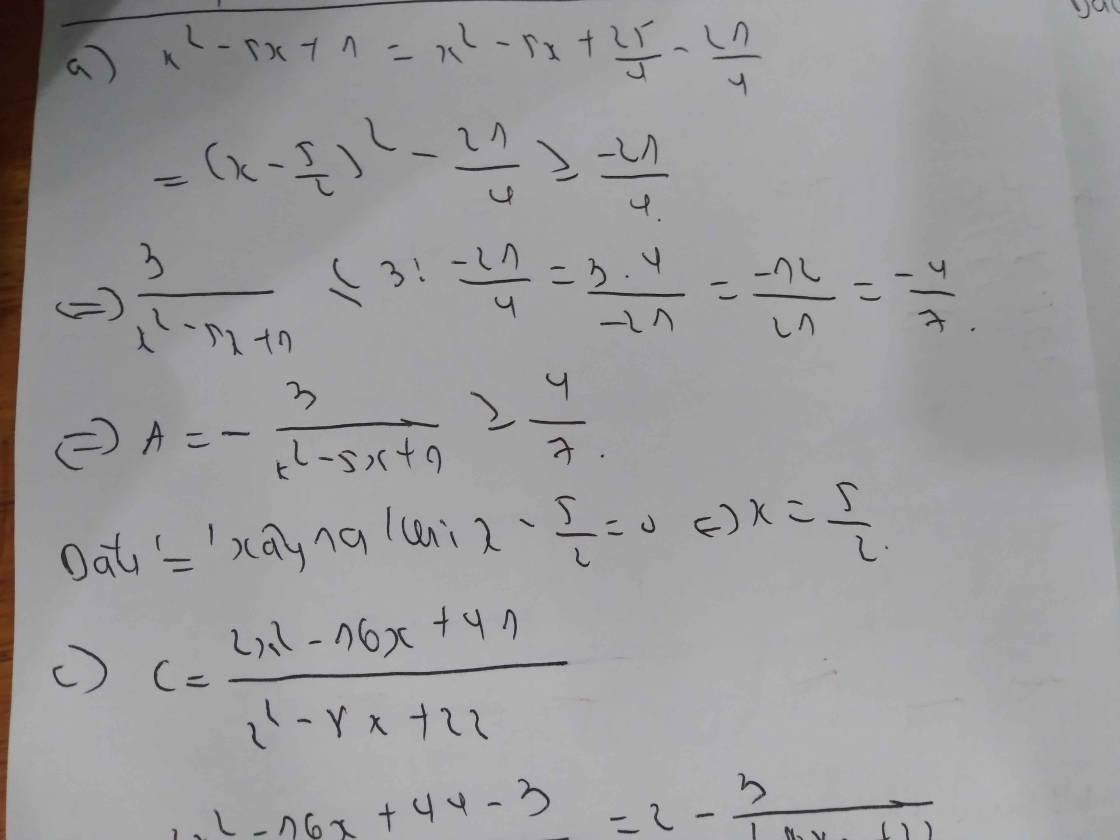
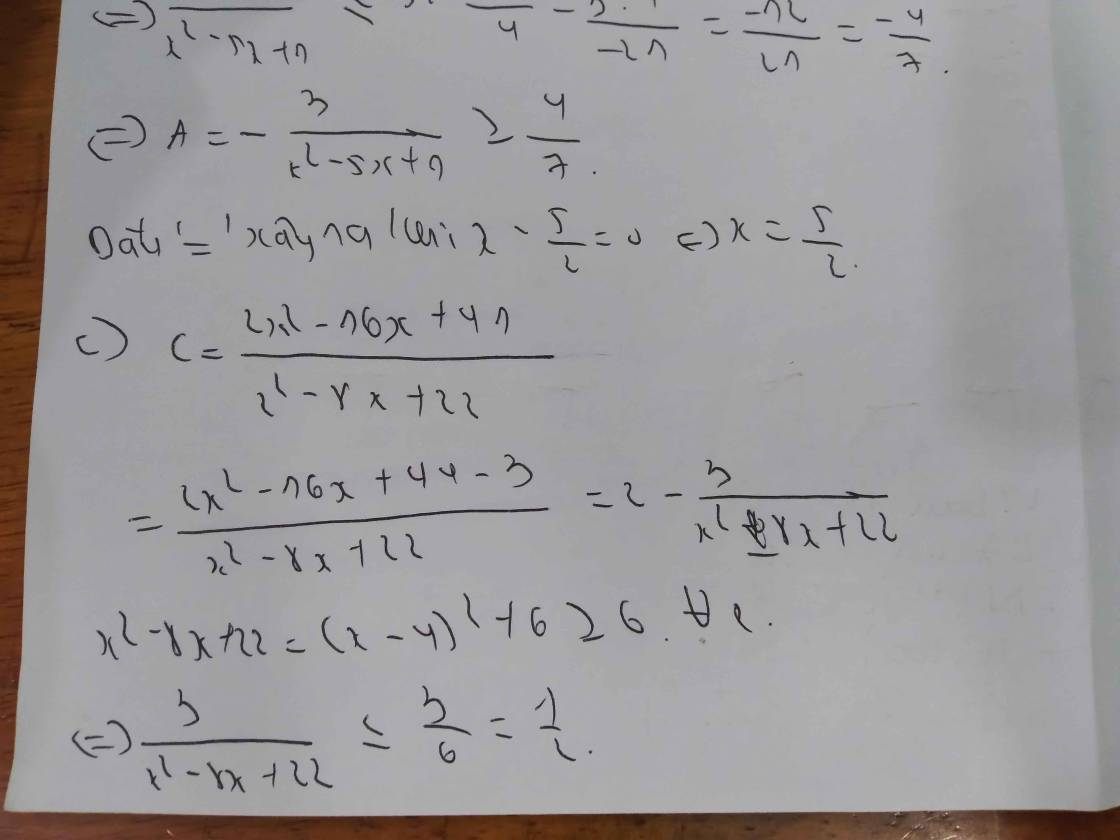
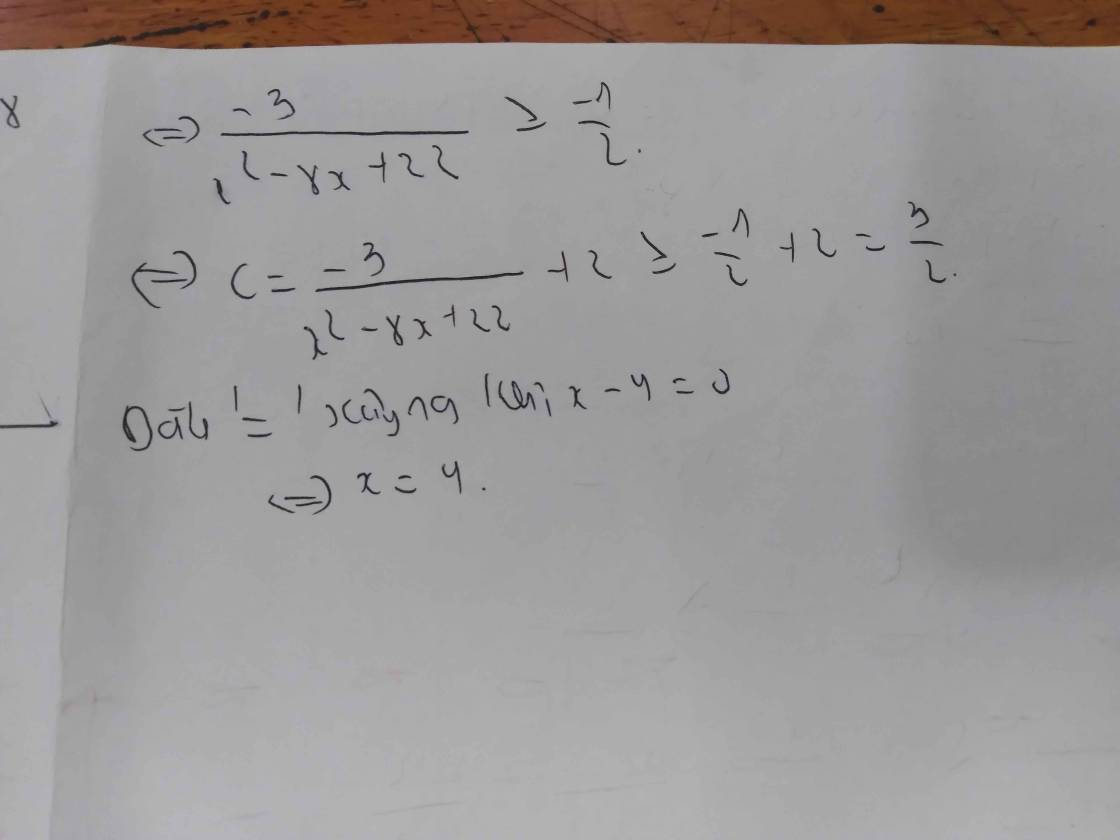
\(Q=\dfrac{3-4x}{x^2+1}=\dfrac{4x^2+4-4x^2-4x-1}{x^2+1}=\dfrac{4\left(x^2+1\right)-\left(2x+1\right)^2}{x^2+1}\)\(=4-\dfrac{\left(2x+1\right)^2}{x^2+1}\). Do \(\left(2x+1\right)^2\ge0;x^2+1>0\Rightarrow Q\le4\)
Vậy Max Q = 4 \(\Leftrightarrow x=-\dfrac{1}{2}\)
Cách khác:
\(Q=\dfrac{3-4x}{x^2+1}\)
\(\Leftrightarrow Qx^2+Q-3+4x=0\)(*)
+)Xét Q=0=>\(x=\dfrac{3}{4}\)
+)Xét Q\(\ne0\)
Để pt(*) có nghiệm thì \(\Delta=16-4Q\left(Q-3\right)\ge0\)
\(\Leftrightarrow4-Q^2+3Q\ge0\)
\(\Leftrightarrow\left(4-Q\right)\left(Q+1\right)\ge0\)
\(\Leftrightarrow-1\le Q\le4\)
\(\Rightarrow MAXQ=4\Leftrightarrow x=-\dfrac{1}{2}\)