Với giá trị nào của m thì hàm số \(y=\dfrac{e^x-1}{e^x-m}\) đồng biến trên \(\left(-2;-1\right)\) ?
\(A.\dfrac{1}{e}\le m< 1\)
\(B.m< 1\)
C. \(m\le\dfrac{1}{e^2}\) hoặc \(\dfrac{1}{e}\le m< 1\)
D. \(m\le\dfrac{1}{e^2}\)

Hãy nhập câu hỏi của bạn vào đây, nếu là tài khoản VIP, bạn sẽ được ưu tiên trả lời.
a) Ta có: \(y=\sqrt{m-3}\cdot x+\dfrac{2}{3}\left(m\ge3\right)\)
Để đây là hàm số bậc nhất thì: \(\sqrt{m-3}\ne0\Leftrightarrow m=3\)
Do: \(\sqrt{m-3}\ge0\forall m\ge3\)
Nên với \(m\ge3\) thì y đồng biến trên R
b) Ta có: \(y=\dfrac{\sqrt{m}+\sqrt{5}}{\sqrt{m}-\sqrt{5}}\cdot x+2010\left(m\ge0;m\ne5\right)\)
Để đây là hàm số bậc nhất thì: \(\sqrt{m}-\sqrt{5}\ne0\Leftrightarrow\left\{{}\begin{matrix}m\ge0\\m\ne5\end{matrix}\right.\)
Do \(\sqrt{m}+\sqrt{5}>0\Rightarrow\sqrt{m}-\sqrt{5}< 0\Leftrightarrow m< 5\)
Vậy với 0 ≤ m < 5 thì y nghịch biến trên R
\(a,\Leftrightarrow\dfrac{m-1}{m+1}\ne0\Leftrightarrow m\ne\pm1\\ b,\Leftrightarrow\dfrac{m-1}{m+1}>0\Leftrightarrow\left[{}\begin{matrix}m>1\\m< -1\end{matrix}\right.\\ c,\Leftrightarrow\dfrac{m-1}{m+1}+m+2=2\\ \Leftrightarrow\dfrac{m-1+m^2+m}{m+1}=0\\ \Leftrightarrow m^2+2m-1=0\\ \Leftrightarrow\left[{}\begin{matrix}m=-1+\sqrt{2}\\m=-1-\sqrt{2}\end{matrix}\right.\)
a: Để hàm số y=(m+2)x-3 đồng biến trên R thì m+2>0
=>m>-2
b: Để hàm số y=(3-k)x+2 nghịch biến trên R thì 3-k<0
=>k>3
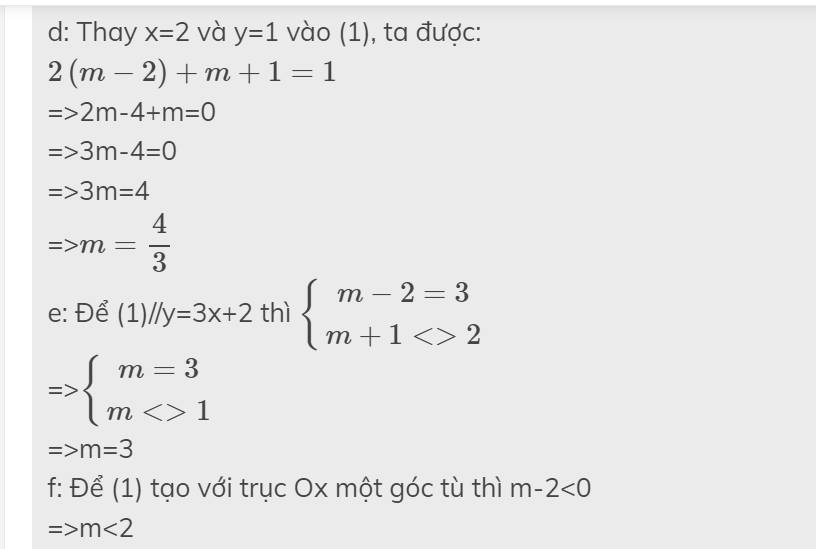
c: Để (d)//(d') thì \(\begin{cases}m^2-1=3\\ m-1<>1\end{cases}\Rightarrow\begin{cases}m^2=4\\ m<>2\end{cases}\)
=>m=-2


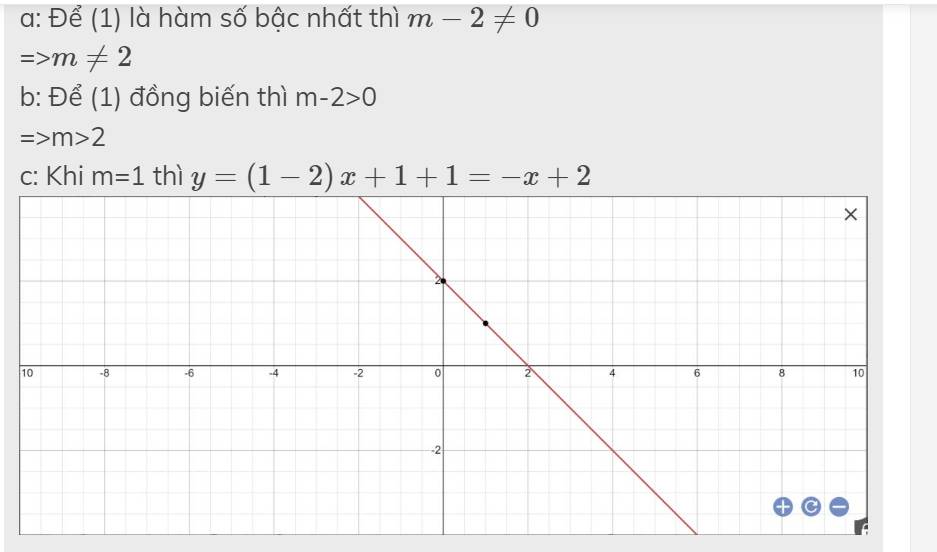
h: Khi m=3 thì \(y=\left(3-2\right)x+3+1=x+4\)
Gọi \(\alpha\) là góc tạo bởi đồ thị hàm số y=x+4 với trục Ox
\(tan\alpha=a=1\)
=>\(\alpha=45^0\)
y=x+4
=>x-y+4=0
Khoảng cách từ O(0;0) đến đường thẳng x-y+4=0 là:
\(\dfrac{\left|0\cdot1+0\cdot\left(-1\right)+4\right|}{\sqrt{1^2+\left(-1\right)^2}}=\dfrac{4}{\sqrt{2}}=2\sqrt{2}\)
Chọn C