


Các bạn làm giúp mình bài 4 , bài 5 và bài 6 nhé. Mai mình cần gấp rồi
Hãy nhập câu hỏi của bạn vào đây, nếu là tài khoản VIP, bạn sẽ được ưu tiên trả lời.

mk trả lời, bài này mk học qua rồi, cả cách trình bày nữa
61:
8 = 23; 16 = 42 hay 24; 27 = 33; 64 = 82 hay 26;
81 = 92 hay 34; 100 = 102 .
62: 102 = 100;
103 = 1000;
104 = 10000;
105 = 100000;
106 = 1000000;
b) 1000 = 103 ;
1 000 000 = 106 ;
1 tỉ = 1 000 000 000 = 109 ;
1000…00 = 1012 .
Sáng trăng em nghĩ tối trời
Em ngồi em kể sự đời em ra
Sự đời em bằng lá đa
Đen như mõm chó chém cha sự đời.
bà béo bán banh bèo bên bờ biển bị bọn bi bắn bể bụng bà
1 create $\rightarrow$ c. energy (tạo ra năng lượng)
2 drive $\rightarrow$ a. machinery (vận hành máy móc)
3 generate $\rightarrow$ e. electricity (phát/tạo ra điện)
4 turn $\rightarrow$ b. turbines (quay tua-bin)
5 heat $\rightarrow$ d. houses (sưởi ấm nhà cửa)
b
1 How many types of energy sources are mentioned in the text? What are they?
$\rightarrow$ Two types of energy sources are mentioned. They are renewable and non-renewable energy sources. (hoặc kể tên cụ thể: fossil fuels/coal/oil, hydro power, nuclear power, wind power, solar power)
2 What are the disadvantages of hydro and nuclear power?
$\rightarrow$ Hydro power is expensive to build dams, and nuclear power can be very dangerous.
3 Why do you think the wind and the sun are called alternative sources of energy?
$\rightarrow$ Because they are clean, renewable, and can be used instead of non-renewable sources (fossil fuels).
4 What types of energy does Viet Nam use most?
$\rightarrow$ Viet Nam uses hydro power and fossil fuels (coal, gas, oil) most.
5 What does the professor think Viet Nam will use more in the future?
$\rightarrow$ He thinks Viet Nam will use more renewable energy sources like solar and wind power in the future.
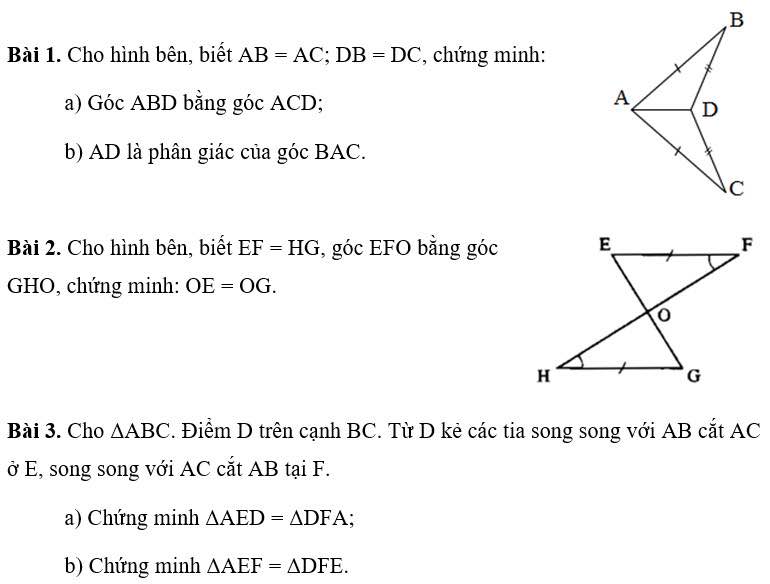
Bài 1 :
a,Có \(AD\) chung , mà \(AB=AC;DB=DC\)
\(\Rightarrow\Delta ABC=\Delta ADC\)
Do đó \(\widehat{ABD}=\widehat{ACD}\)
b,\(AD\) là cạnh chung của 2\(\Delta:\Delta ABD,\Delta ACD\)
\(\Rightarrow AD\) là phân giác của \(\widehat{BAC}\)
Bài 2:
Ta có : \(EF=HG,\widehat{EFO}=\widehat{GHO}\)
Theo TH thứ 2 của 2 tam giác bằng nhau ta có : cạnh - góc - cạnh
\(\Rightarrow OE=OG\)
Bài 3: Có hình ko bn ,mk dựa vào hình lm ko mk lười vẽ hình lắm =(((((((
BÀI 6
nfe= 0,1(mol)
Fe + 2HCl ➝ FeCl2 + H2
0,1➝ 0,2 ➝ 0,1 (mol)
a, VH2 = 0,1.22,4= 2,24(l)
b, CM HCl= \(\dfrac{0,2}{0,5}\)= 0,4M
BÀI 7
nAl = 0,1(mol)
nH2SO4= \(\dfrac{200.9,8\%}{100\%.98}\)= 0,2(mol)
2Al + 3H2SO4 ➝ Al2(SO4)3 + 3H2↑
0,07➝ 0,105 ➝ 0,035 (mol)
Vì hiệu suất = 70% => nAl phản ứng= \(\dfrac{70\%}{100\%}\).0,1=0,07(mol)
=> mAl2(SO4)3= 0,035.342= 11,97(g)
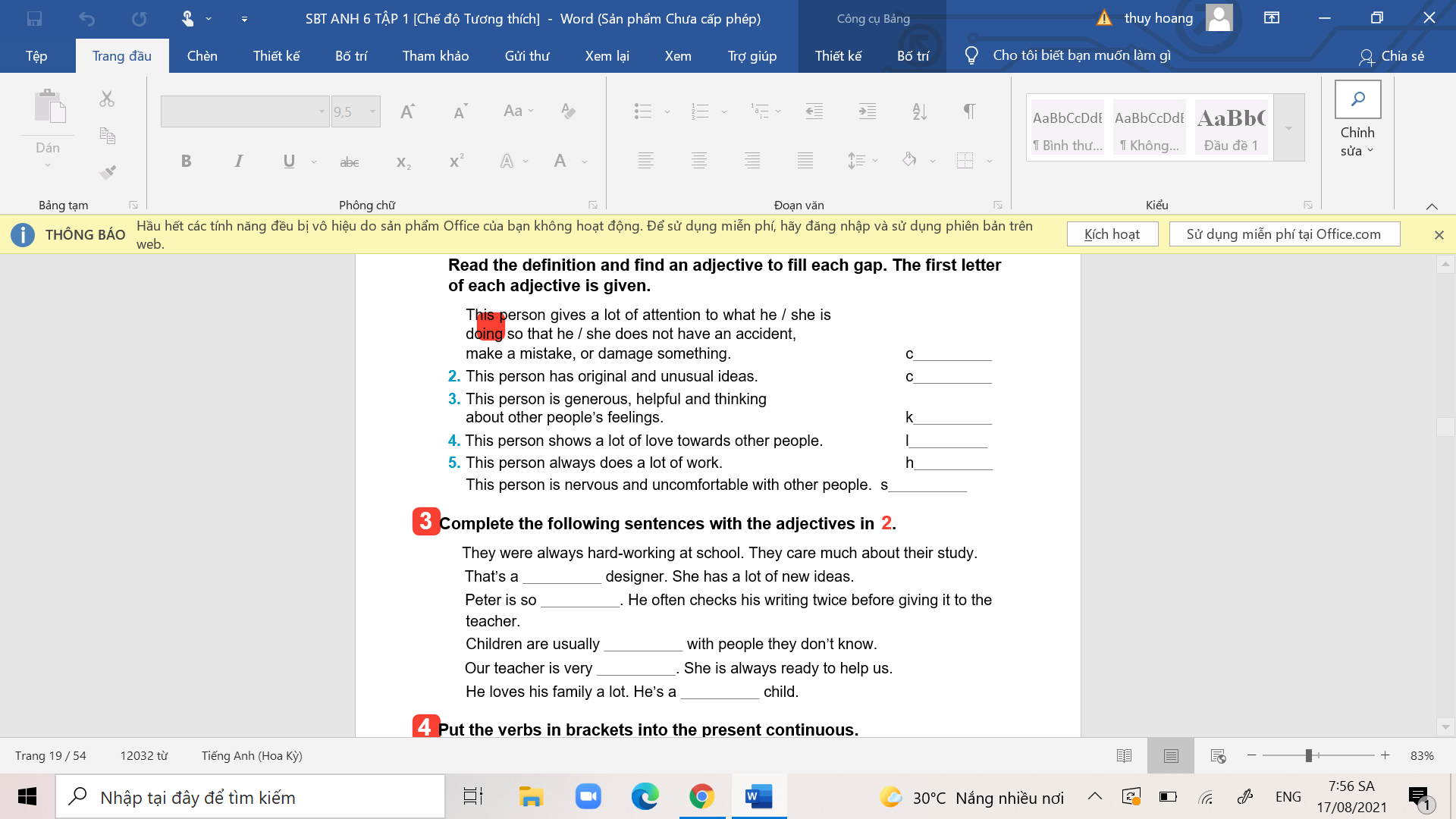 các bn giúp mình bài 2, bài 3.
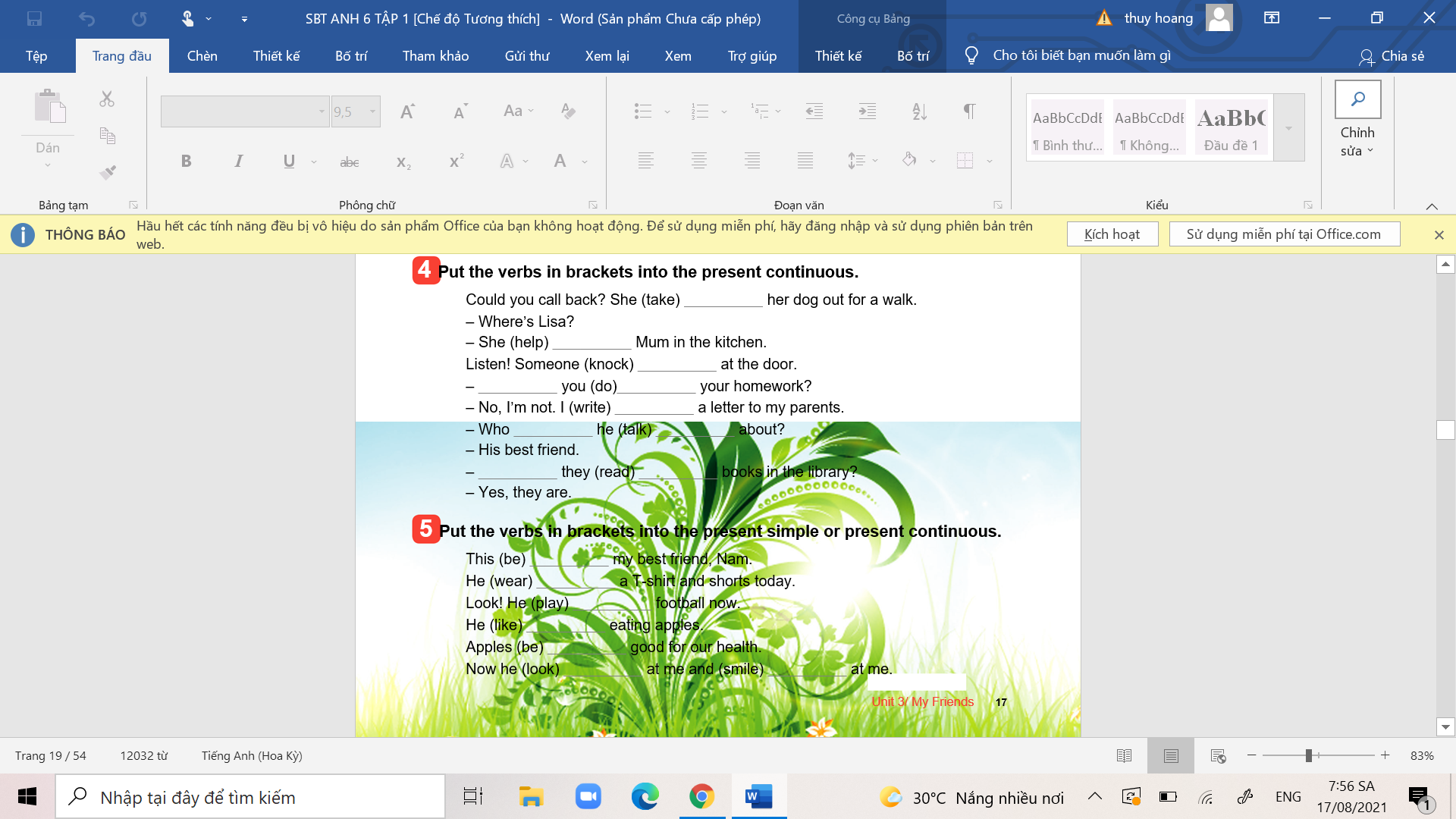 các bn giúp mình bài 4 và bài 5 nhé.
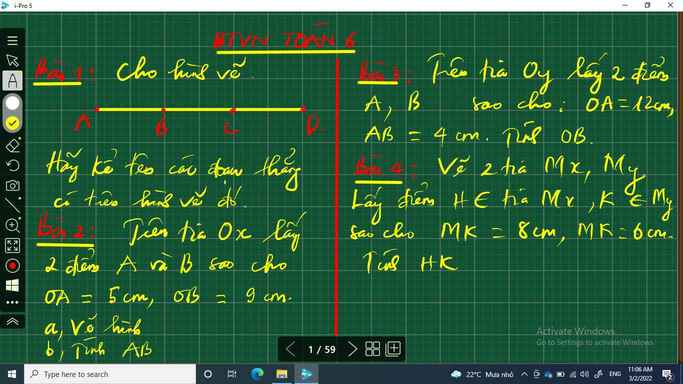

 Các bạn làm giúp mình mấy bài này gấp nhé chiều nay mình phải nộp rồi
 Làm ơn hãy giuap mình từ bài 6 đến bài 13 huhu mỗi bạn làm đueojc 1 bài cho mình là mình thấy quá tốt rồi hãy giúp mình nhé huhu cảm ơn các bạn rất nhiêud
4/Giả xử \(\dfrac{a}{b}+\dfrac{b}{a}>=2\) (1)
<=> \(\dfrac{a^2+b^2}{ab}\)>=2
<=>a2+b2 >= 2ab
<=> a2+b2 - 2ab >=0
<=> (a-b)2 >= 0 (2)
Vì bđt (2) đúng nên bđt (1) đúng
b/ Gỉa sử \(\left(\dfrac{a+b}{2}\right)^2>=ab\)(1)
<=> \(\dfrac{\left(a+b\right)^2}{4}\)>= ab
<=> a2+b2+2ab>= 4ab
<=> a2+b2+2ab -4ab >=0
<=> (a-b)2>=0 (2)
Vidbđt (2) đúng nên bddt (1) đúng
c/Gỉa sử (ax+by)2<= (a2+b2)(x2+y2) (1)
<=> (ax)2+ (by)2+2*ax*by<= (ax)2 +(ay)2+(bx)2+(by)2
<=> 2*ax*by <= (ay)2+(bx)2
<=> 0<= (ay+bx)2(2)
(2) đúng nên(1) đúng
tui giúp đc nhiu đây thôi
4a)Áp dụng Cô-si ra liền