Hãy nhập câu hỏi của bạn vào đây, nếu là tài khoản VIP, bạn sẽ được ưu tiên trả lời.


Chọn C
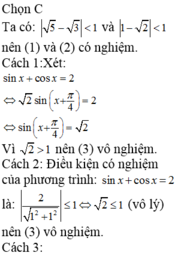
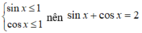
Ta có:
nên (1) và (2) có nghiệm.
Cách 1:
Xét: ![]()
nên (3) vô nghiệm.
Cách 2:
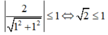
Điều kiện có nghiệm của phương trình: sin x + cos x = 2 là: 
(vô lý) nên (3) vô nghiệm.
Cách 3:
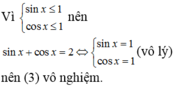
Vì 

nên (3) vô nghiệm.
\(\Leftrightarrow\frac{3^{\sin^2x}+3}{3^{\sin^2x}}-4=2^{2.\frac{x}{2}}+2^{2.\frac{-x}{2}}-2\)
\(\Leftrightarrow\frac{\left(3^{\sin^2x}-1\right)\left(3^{\sin^2x}-3\right)}{3^{\sin^2x}}=\left(2^{\frac{x}{2}}-2^{\frac{-x}{2}}\right)^2\)
Vì 0 \(\le\sin^2x\)\(\le1\) nên 1 \(\le3\sin^2x\)\(\le3\) . Suy ra Vế trái \(\le0\)\(\le\) vế phải và phương trình tương đương với hệ :
\(\begin{cases}\left(3^{\sin^2x}-1\right)\left(3^{\sin^2x}-3\right)=0\\2^{\frac{x}{2}}-2^{\frac{-x}{2}}=0\end{cases}\)
Từ phương trình thứ 2, dễ dàng suy ra x=0 (thỏa mãn). Vậy x=0 là nghiệm duy nhất của phương trình đã cho.
1.a/ \(\left\{{}\begin{matrix}3^{x+1}>0\\5^{x^2}>0\end{matrix}\right.\) \(\forall x\) \(\Rightarrow\) pt vô nghiệm
b/ Mình làm câu b, câu c bạn tự làm tương tự, 3 câu này cùng dạng
Lấy ln hai vế:
\(ln\left(3^{x^2-2}.4^{\dfrac{2x-3}{x}}\right)=ln18\Leftrightarrow ln3^{x^2-2}+ln4^{\dfrac{2x-3}{x}}-ln18=0\)
\(\Leftrightarrow\left(x^2-2\right)ln3+\dfrac{2x-3}{x}2ln2-ln\left(2.3^2\right)=0\)
\(\Leftrightarrow x^3ln3-2x.ln3+4x.ln2-6ln2-x.ln2-2x.ln3=0\)
\(\Leftrightarrow x^3ln3-4x.ln3+3x.ln2-6ln2=0\)
\(\Leftrightarrow x.ln3\left(x^2-4\right)+3ln2\left(x-2\right)=0\)
\(\Leftrightarrow\left(x-2\right)\left(x^2ln3+2x.ln3+3ln2\right)=0\)
\(\Rightarrow\left[{}\begin{matrix}x-2=0\Rightarrow x=2\\x^2ln3+2x.ln3+3ln2=0\left(1\right)\end{matrix}\right.\)
Xét (1): \(\left(x^2+2x\right)ln3=-3ln2\Leftrightarrow x^2+2x=\dfrac{-3ln2}{ln3}=-3log_32\)
\(\Leftrightarrow\left(x+1\right)^2=1-3log_32=log_33-log_38=log_3\dfrac{3}{8}< 0\)
\(\Rightarrow\left(1\right)\) vô nghiệm
\(\Rightarrow\) pt có nghiệm duy nhất \(x=2\)
2/ Pt đã cho tương đương:
\(2017^{sin^2x}-2017^{cos^2x}=cos^2x-sin^2x\)
\(\Leftrightarrow2017^{sin^2x}+sin^2x=2017^{cos^2x}+cos^2x\)
Xét hàm \(f\left(t\right)=2017^t+t\) (\(0\le t\le1\))
\(\Rightarrow f'\left(t\right)=2017^t.ln2017+1>0\) \(\forall t\) \(\Rightarrow f\left(t\right)\) đồng biến
\(\Rightarrow f\left(t_1\right)=f\left(t_2\right)\Leftrightarrow t_1=t_2\)
\(\Rightarrow sin^2x=cos^2x\Rightarrow cos^2x-sin^2x=0\Rightarrow cos2x=0\)
\(\Rightarrow x=\dfrac{\pi}{4}+\dfrac{k\pi}{2}\)
Thế k=0; k=1 ta được 2 nghiệm thuộc đoạn đã cho là \(x=\dfrac{\pi}{4};x=\dfrac{3\pi}{4}\)
\(\Rightarrow\) tổng nghiệm là \(T=\dfrac{\pi}{4}+\dfrac{3\pi}{4}=\pi\)
1)
Ta có \(P_1=\int \frac{\cos xdx}{2\sin x-7}=\int \frac{d(\sin x)}{3\sin x-7}\)
Đặt \(\sin x=t\Rightarrow P_1=\int \frac{dt}{3t-7}=\frac{1}{3}\int \frac{d(3t-7)}{3t-7}=\frac{1}{3}\ln |3t-7|+c\)
\(=\frac{1}{3}\ln |3\sin x-7|+c\)
2)
\(P_2=\int \sin xe^{2\cos x+3}dx\)
Đặt \(\cos x=t\)
\(P_2=-\int e^{2\cos x+3}d(\cos x)=-\int e^{2t+3}dt\)
\(=-\frac{1}{2}\int e^{2t+3}d(2t+3)=\frac{-1}{2}e^{2t+3}+c\)
\(=\frac{-e^{2\cos x+3}}{2}+c\)
3)
\(P_3=\int \frac{\sin x+x\cos x}{(x\sin x)^2}dx\)
Để ý rằng \((x\sin x)'=x'\sin x+x(\sin x)'=\sin x+x\cos x\)
Do đó: \(d(x\sin x)=(x\sin x)'dx=(\sin x+x\cos x)dx\)
Suy ra \(P_3=\int \frac{d(x\sin x)}{(x\sin x)^2}\)
Đặt \(x\sin x=t\Rightarrow P_3=\int \frac{dt}{t^2}=\frac{-1}{t}+c=\frac{-1}{x\sin x}+c\)
Tính \(I=\int_0^{\dfrac{\pi}{2}}\dfrac{cos^{2017}x}{sin^{2017}x+cos^{2017}}dx\left(1\right)\)
Đặt \(t=cosx\Rightarrow sinx=\sqrt{1-cos^2x}\)
\(\Rightarrow dt=-sinx.dx\)
\(\Rightarrow I=\int_0^1\dfrac{t^{2017}.}{\sqrt{1-t^2}.\left(\left(\sqrt{1-t^2}\right)^{2017}+t^{2017}\right)}dt\)
Đặt: \(t=siny\Rightarrow\sqrt{1-t^2}=cosy\)
\(\Rightarrow dt=cosy.dy\)
\(\Rightarrow I=\int_0^{\dfrac{\pi}{2}}\dfrac{sin^{2017}y.cosy}{cosy\left(cos^{2017}y+sin^{2017}y\right)}dy=\int_0^{\dfrac{\pi}{2}}\dfrac{sin^{2017}y}{\left(cos^{2017}y+sin^{2017}y\right)}\)
\(\Rightarrow I=\int_0^{\dfrac{\pi}{2}}\dfrac{sin^{2017}x}{\left(cos^{2017}x+sin^{2017}x\right)}\left(2\right)\)
Cộng (1) và (2) ta được
\(2I=\int_0^{\dfrac{\pi}{2}}\dfrac{sin^{2017}x+cos^{2017}x}{sin^{2017}x+cos^{2017}x}dx=\int_0^{\dfrac{\pi}{2}}1dx\)
\(=x|^{\dfrac{\pi}{2}}_0=\dfrac{\pi}{2}\)
\(\Rightarrow I=\dfrac{\pi}{4}\)
Thế lại bài toán ta được
\(\dfrac{\pi}{4}+t^2-6t+9-\dfrac{\pi}{4}=0\)
\(\Leftrightarrow t^2-6t+9=0\)
\(\Leftrightarrow t=3\)
Chọn đáp án C
mỗi trắc nghiệm thoy mà lm dài ntn s @@
chắc lên đó khó lắm ag