
Hãy nhập câu hỏi của bạn vào đây, nếu là tài khoản VIP, bạn sẽ được ưu tiên trả lời.

ĐKXĐ: \(cosx\ne-\dfrac{\sqrt{3}}{2}\) \(\Rightarrow\left[{}\begin{matrix}x\ne\dfrac{5\pi}{6}+k2\pi\\x\ne\dfrac{7\pi}{6}+k2\pi\end{matrix}\right.\)
\(pt\Rightarrow3-\left(1-2sin^2x\right)+2sinx.cosx-5sinx-cosx=0\)
\(\Leftrightarrow2sin^2x-5sinx+2+cosx\left(2sinx-1\right)=0\)
\(\Leftrightarrow\left(2sinx-1\right)\left(sinx-2\right)+cosx\left(2sinx-1\right)=0\)
\(\Leftrightarrow\left(2sinx-1\right)\left(sinx+cosx-2\right)=0\)
\(\Rightarrow\left[{}\begin{matrix}sinx=\dfrac{1}{2}\\sinx+cosx=2\left(vn\right)\end{matrix}\right.\)
\(\Rightarrow\left[{}\begin{matrix}x=\dfrac{\pi}{6}+k2\pi\\x=\dfrac{5\pi}{6}+k2\pi\end{matrix}\right.\)
Loại nghiệm
\(\Rightarrow x=\dfrac{\pi}{6}+k2\pi\)
\(0\le\dfrac{\pi}{6}+k2\pi\le2022\pi\Rightarrow0\le k\le1010\)
\(\Rightarrow\sum x=1011.\dfrac{\pi}{6}+2\pi\left(0+1+2+...+1010\right)=\dfrac{1011\pi}{6}+2\pi.\dfrac{1010.1011}{2}=...\)
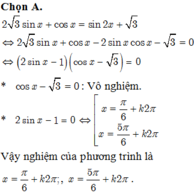
 Gọi S là tập hợp tất cả các giá trị thực của
thuộc đoạn
để phương trình có nghiệm. Tổng các phần tử của tập S bằng
Gọi S là tập hợp tất cả các giá trị thực của
thuộc đoạn
để phương trình có nghiệm. Tổng các phần tử của tập S bằng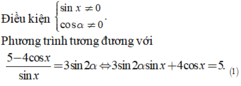
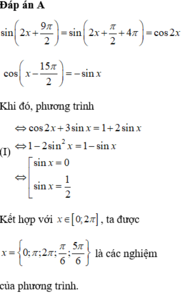
Bài 1: ĐKXĐ: cosx-1<>0
=>cosx<>1
=>\(x<>k2\pi\)
mà x∈[0;4pi]
nên x∉{0;2pi;4pi}
Ta có: \(\frac{\sin x}{cosx-1}=0\)
=>sin x=0
=>\(x=k\pi\)
mà \(x\in\left\lbrace0;4\pi\right\rbrace;x<>k2\pi\)
nên \(x\in\left\lbrace\pi;3\pi\right\rbrace\)
=>Tổng tất cả nghiệm là: \(\pi+3\pi=4\pi\)
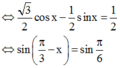
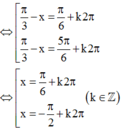
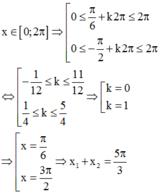
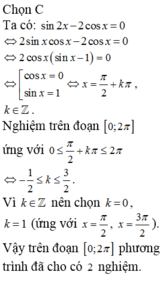
Đáp án B.
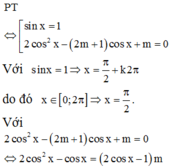
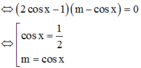
PT: cos x = 1 2 có 2 nghiệm thuộc trên đoạn 0 ; 2 π do đó để PT đã cho có 4 nghiệm thực thuộc đoạn 0 ; 2 π thì
TH1: m= cosx có 1 nghiệm thuộc đoạn 0 ; 2 π
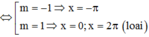
TH2: m= cosx có 2 nghiệm thuộc đoạn 0 ; 2 π trong đó có 1 nghiệm trùng
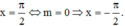
Vậy m= -1; m=0.
ĐKXĐ: cosx-1<>0
=>cos x <>1
=>x<>k2π
\(\frac{\sin2x}{cosx-1}=0\)
=>sin 2x=0
=>\(2x=k\pi\)
=>\(x=\frac{k\pi}{2}\)
mà x<>k2π và x∈[0;2π]
nên x∈{π/2;3π/2}
Tổng các nghiệm là: \(\frac{\pi}{2}+\frac{3\pi}{2}=\frac{4\pi}{2}=2\pi\)