
Hãy nhập câu hỏi của bạn vào đây, nếu là tài khoản VIP, bạn sẽ được ưu tiên trả lời.
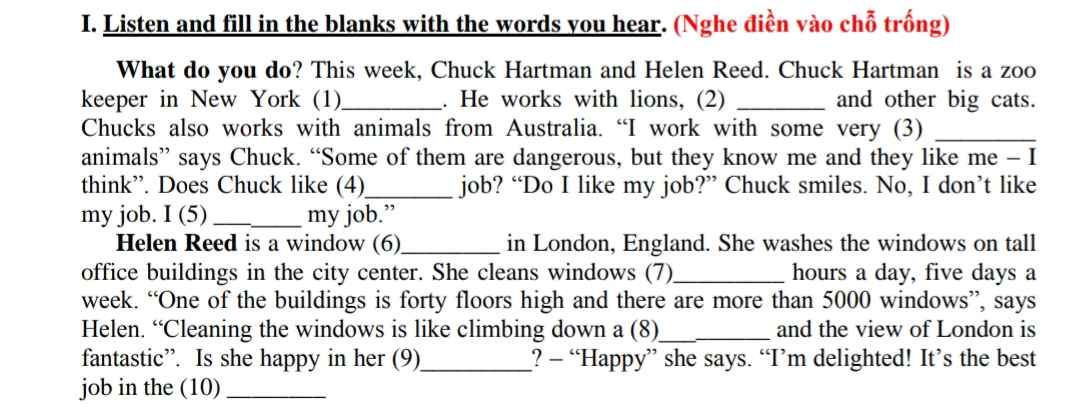


Passage 1: Read the following passage and mark the letter A, B, C, or D to choose the word or phrase that best fits each of the numbered blanks from 1 to 5.
Left-handers are the odd ones out. Sure, lefties (1) ______up about 10 percent of the population - but, frankly, it seems like society has forgotten about them. Just consider all of the right-handed gadgets, awkwardly designed desks, and cooking tools that fit comfortably only in your right hand. What (2) ______someone to become a lefthand? Scientists aren’t exactly sure, but research points to a complex (3) ______between genes and environment While no exact set of “leftie genes” have been discovered, people who dominantly use their left hands do have more left-handed family members. And researchers have found different brain wirings in righties vs. lefties. But no matter (4) ______it is that drives someone to use their antipodal paw, science has also uncovered a particular set of personality traits that left-handed people tend to have. So for all of you lefties, leftie-loving righties, and ambidextrous folks out there - it’s time to brush up on your left-handed knowledge and help (5) ______an end to leftie discrimination once and for all.
1: A. consist B. account C. hold D. make
2: A. causes B. makes C. gets D. does
3: A. collaborate B. collaboration C. collaborating D. collaborated
4: A. which B. who C. what D. that
5: A. put B. bring C. make D. take
Passage 2: Read the following passage and mark the letter A, B, C, or D to indicate the correct answer to each of the questions from 6 to 12.
Successful students often do the followings while studying. First, they have an overview before reading. Next, they look for important information and pay greater attention to it (which often needs jumping forward or backwards to process information). They also relate important points to one another. Also, they activate and use their prior knowledge. When they realize that their understanding is not good, they do not wait to change strategies. Last, they can monitor understanding and take action to correct or “fix up” mistakes incomprehension.
Conversely, students with low academic achievement often demonstrate ineffective study skills. They tend to assume a passive role, in learning and rely on others (e.g., teachers, parents) to monitor their studying, for example, low-achieving students often do not monitor their understanding of content; they may not be aware of the purpose of studying, and they show little evidence of looking back or employing “fix-up” strategies to fix understanding problems. Students who struggle with learning new information seem to be unaware that they must extent effort beyond simply reading the content to understand and remember it. Children with learning disabilities do not plan and judge the quality of their studying. Their studying may be disorganized. Students with learning problems face challenges with the personal organization as well. They often have difficulty keeping track of materials and assignments, following directions, and completing work on time. Unlike good studiers who employ a variety of study skills in a flexible yet purposeful manner, low-achieving students use a restricted range of study skills. They cannot explain why good study strategies are important for learning, and they tend to use the same, often ineffective study approach for all learning tasks, ignoring task content, structure or difficulty.
(Source: Adapted from Study Skills: Managing Your Learning — NUI Galway)
6: What is the topic of the passage?
A. Successful and low-academic achieving students
B. Successful learners and their learning strategies
C. Study skills for high school students
D. Effective and ineffective ways of learning
7: The word “prior” in the first paragraph is the closest meaning to ______?
A. important B. earlier C. forward D. good
8: According to the passage, what can be learnt about passive students?
A. They depend on other people to organize their learning
B. They are slow in their studying
C. They monitor their understanding
D. They know the purpose of studying
9: Which of the followings is NOT evidence of monitoring studying?
A. Being aware of the purpose of studying
B. Monitoring their understanding of content
C. Fixing up mistakes in understanding
D. Looking at their backs
10: According to the passage, to learn new information, low-achieving students do NOT______.
A. just understand it B. relate it to what they have known
C. simply remember it D. read it
11: In compared with low-achieving students, successful students use______.
A. aimless study techniques B. various study skills
C. restricted strategies D. inflexible study ways
12: The underlined pronoun “They” in the last sentence refers to______.
A. study strategies B. study skills
C. low-achieving students D. good studiers

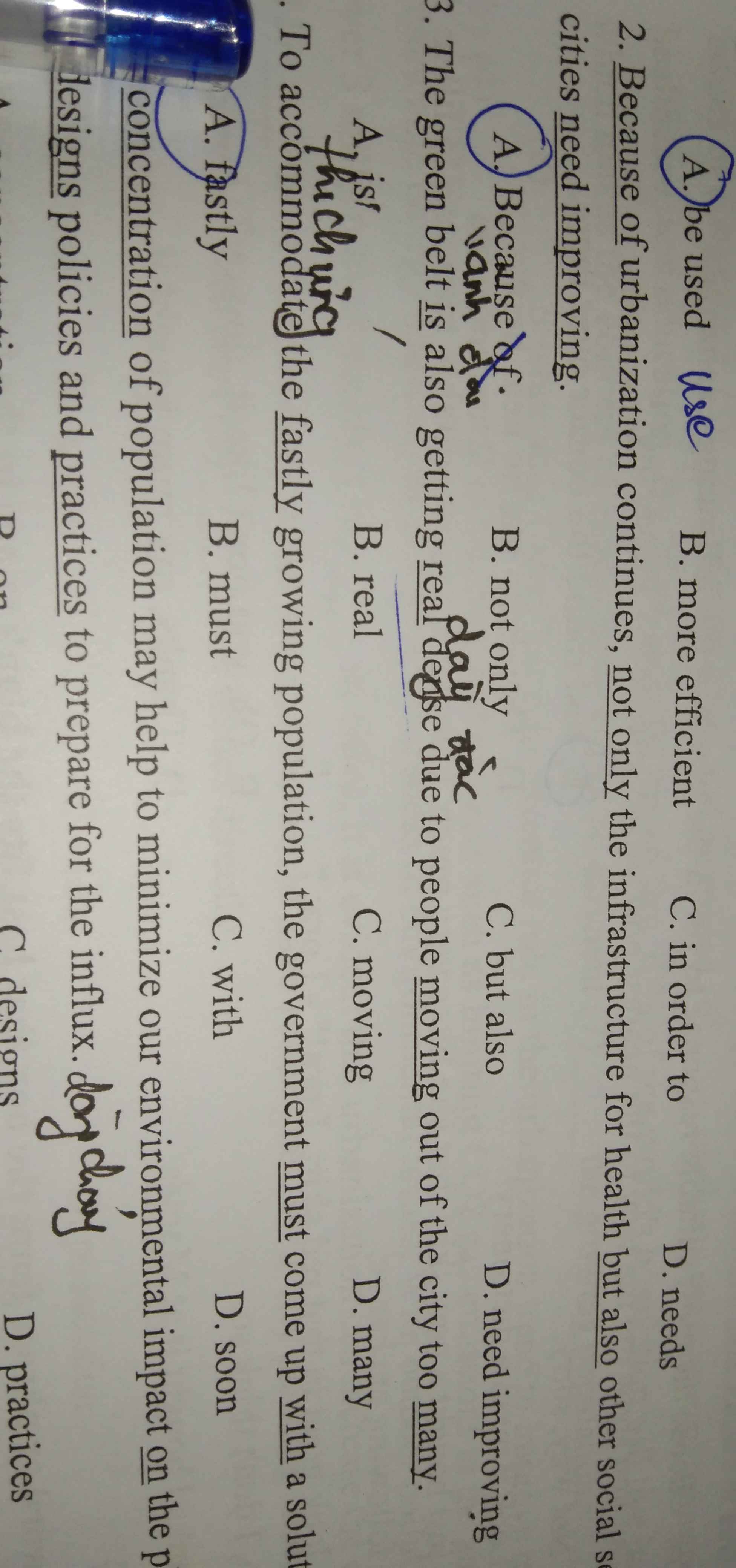
1, D mà mình chưa nghĩ ra từ nào đồng nghĩa với nó để thay thế vì dùng apply ở này thì không hợp lắm
2, making => made
3, in that => in which
4, mình không thấy rõ khúc sau nhưng sau used không có giới từ gì thì chắc là sai ở đó và sửa thành used to nhỉ?
5, than => as



Question 1: New sources of energy (A) have been looking (B) for as the number (C) of fossil fuels continues (D) to decrease.
B => been looked
Question 2: Vietnam exports (A) a lot of rice is grown (B) mainly in (C) the south of (D) the country.
B => grown
Question 3. He passed (A) the exam with (B) high scores, that (C) made his parents happy (D).
C => which
Question 4. To attract (A) someone’s attention, we can use (B) either verbal and non-verbal (C) forms of communication (D).
C => or non-verbal
Question 5. The doctor's records must be kept (A) thorough and (B) neatly (C) so as to insure (D) good book – keeping.
C => neat
Question 6. Rabbit and hares (A) look much (B) like and are often (C) mistaken for (D) each other.
like => alike
Question 7. In the United States (A) among 60 per cent (B) of the space on the pages of newspapers (C) is reserved for (D) advertising.
A => about
Question 8: My mother (A) reminded me (B) to remember (C) to water her (D) house plants.
B => bỏ
Question 9: Bill (A) is often late (B) for class, (C) which makes his teachers (D) angrily. angrily => angry |
Question 10: Mumps (A) are a very (B) common disease (C) which (D) usually affects children. A => is |

em thấy phần khó nhất là phần listening cô ạ
ở lớp kiểu nghe lúc được lúc không
xong mấy khi nghe được ko viết được(cay)
xong dứa nào cũng thế
cứ nghe xong là ngồi khóc hoặc quay lên quay xuống hỏi đáp án
Em đừng cố nghe từng từ một nhé, như vậy sẽ rất dễ bị mất ý chính. Khi nghe, em nên tập trung vào từ khóa quan trọng như chủ đề, thời gian, địa điểm hoặc cảm xúc của người nói.
Trước khi bật audio, hãy đọc nhanh câu hỏi và gạch chân từ khóa để đoán nội dung bài nghe. Lần nghe đầu chỉ cần hiểu ý chung, không cần cố làm đúng hết ngay. Đến lần nghe thứ hai thì mới tập trung nghe chi tiết hơn.
Ngoài ra, em nên luyện nghe tiếng Anh mỗi ngày một chút, ví dụ nghe podcast hoặc xem video ngắn có phụ đề để quen tốc độ nói nhé.