
Hãy nhập câu hỏi của bạn vào đây, nếu là tài khoản VIP, bạn sẽ được ưu tiên trả lời.




1 How was the lost man found by the police?
2 It was declared that she had won the competition
3 Has the window of the laboratory been changed?
4 Peter asked Janet if he could borrow her typwriter
5 My grandmother told me to feed her dog while she was away
6 My younger sister told me to lend her some more money
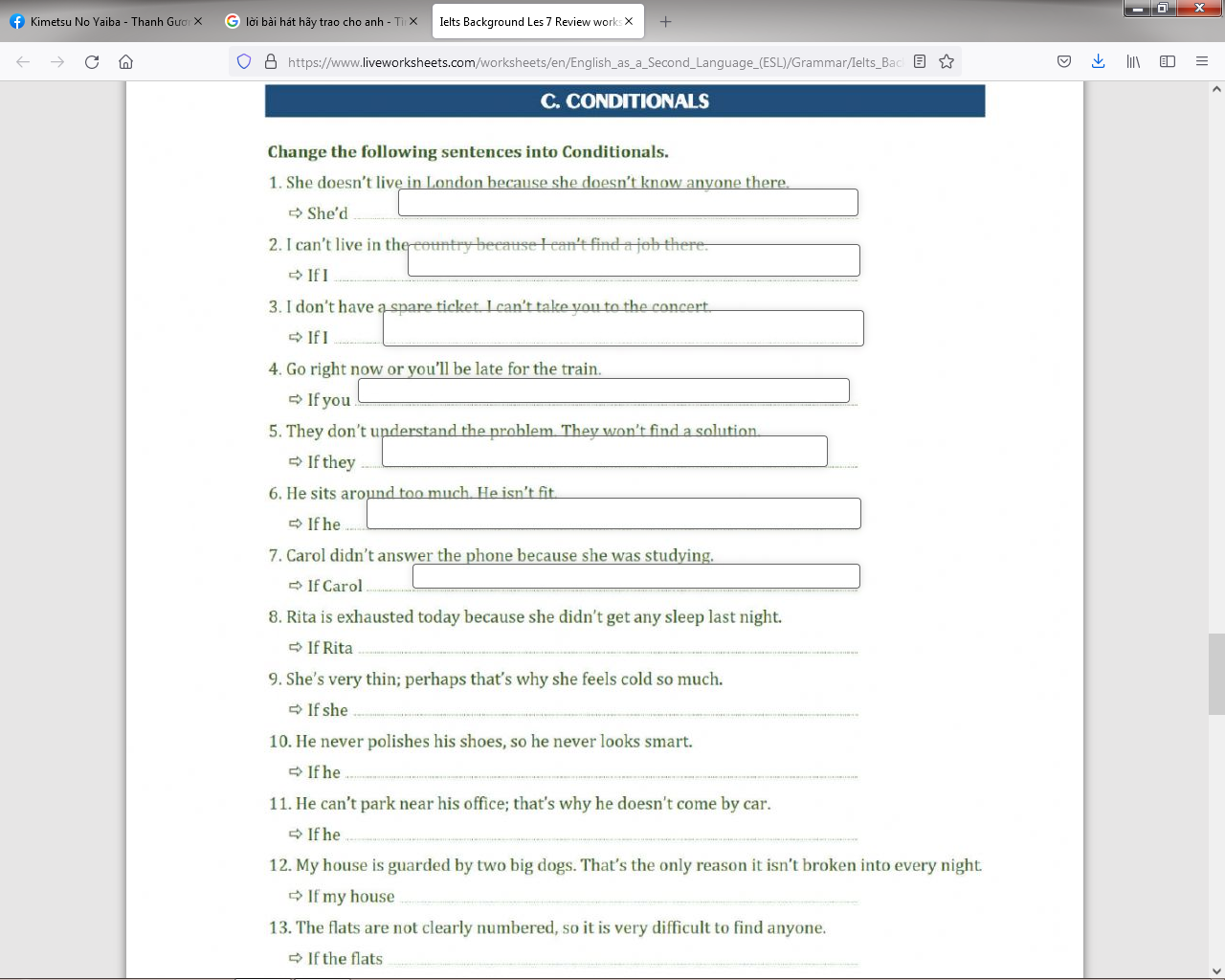
7 If I were tall enough,I would join the basketball team
8 If we don't hurry up, we will be late for the exam
9 If he hadn't gone out late last night, he wouldn't have been punished
10 I wish the weather hadn't been bad yesterday
 giúp mình bài này với. Mình cần gấp ấy, mik cảm ơn các bạn nhé.
Do you use solar energy in your home?
People won't use flying cars until the year 2050
We must always obey the traffic rules for our safety
The major cause of death for children living in the slums is malnutrition
Solar panels will be installed on the roof of our house next week
Veronica is a good friend of mine
Pollution is the most serious problem





Tham khảo:
China's tech giant Tencent has announced it will limit the time children play its top online games after its stock was decimated by home media lashings. water for the game industry.
4320.jpg
A child plays Tencent's flagship online mobile game Honor of Kings - Photo: Getty Images
In a social media post, Tencent announced a series of new measures after it said "relevant authorities" had asked for more protection of minors in gaming and for companies to the gaming industry fulfills their “social responsibility”.
Hours earlier, an article in the Economic Information Daily, which is affiliated with China's largest state news agency Xinhua, compared digital games to "electronic drugs". " and called for more restrictions on the industry to prevent game addiction from "spreading" among children.
Although it did not mention the name of China's largest video game and social network, the newspaper criticized Tencent's flagship game Honor of Kings. highest in the world for the past two years.
"No industry, no sport can be allowed to develop to the point where it can destroy an entire generation", the article reads, "Society has realized the harm caused by online games. and they are often referred to as "psychic opiates" or "electronic drugs".
The parents cited in the article talk about children playing video games 7 hours a day, skipping breakfast to pay for games, and having their school grades plummet.
This article helped wipe $60 billion, or nearly 11%, from Tencent's market capitalization as investors fear that the gaming market will become the latest target of a crackdown on Tencent. with China's largest technology companies. However, shares of Tencent rebounded and ended with a 6% drop after the article was deleted online without explanation just hours after publication.
Tencent is a multinational technology corporation that operates China's largest social network and video game network, along with e-commerce and online payment businesses. Despite the pandemic that has pushed tech companies in the US to new heights, Tencent's value has fallen by nearly $400 billion this year as investors spooked by moves by Chinese regulators. China to limit the power of China's largest technology companies.
The Economic Information Daily's article came a few hours after a separate opinion piece on the same topic by China News Service on their Weibo account. Taking a softer stance, they said "schools, game developers, parents and other parties need to work together".
The new restrictions, which will initially only apply to Honor of Kings, will prevent children under 12 from spending money in the game and reduce the amount of time they can play each day from 1 hour and a half to 1 hour, from 3 hours to 3 hours. 2 hours on holidays. The new restrictions are even harsher than the authorities are demanding.
Against that backdrop, a related hashtag on Weibo has garnered more than 13 million views. Some are in favor of the new measures, while others argue that such regulation should be up to parents, or that the existing redundancy regulations have too many loopholes. Comments on the original article were mixed. Some decry that video games are "ruining youth in China for huge profits", while others liken it to the state's advice to people to "please stop eating in case you get sick". suffocation".
In June, more than a third of the revenue of the top 10 games came from Honor of Kings and another Tencent title, PlayerUnknown's Battlegrounds mobile game. The company's biggest games are not designed for consoles, but for playing online or on mobile phones using Android and Apple devices.
Tencent also put forward proposals for the entire industry to consider including a ban on gaming for children under 12. Chinese authorities have sought to limit the amount of time minors play video games, including a temporary ban on new video game licenses in 2018.
NetEase and Tencent have enacted a number of safeguards against young players, including Tencent's facial recognition feature on smartphones, to ensure that gamers are adults.
cảm ơn bn nha
Ko có gì
đây là đề của một bài thuyết trình nên cần khá dài. mong các bạn giúp đỡ
In the digital age, technology has seamlessly integrated into the educational environment. While laptops and tablets have become essential tools for learning, they also bring an array of distractions—most notably, online games. Whether played on personal smartphones or school-provided laptops, gaming during school hours has sparked an ongoing debate among educators, parents, and students. While banning online games in schools seems like a straightforward solution to maintain academic discipline, a more nuanced approach focused on regulation and digital literacy is far more effective than an outright prohibition.
On the one hand, proponents of a total ban present strong arguments centered on academic focus and network infrastructure. The primary concern is distraction; when students play online games during class, their attention is diverted away from the teacher and core coursework, leading to reduced academic performance. Furthermore, competitive online multiplayer games can occasionally foster cyberbullying, toxic social interactions, or unhealthy peer pressure within the school environment. From an operational standpoint, gaming consumes immense bandwidth. High-bandwidth activities like online gaming can slow down school Wi-Fi networks, directly impeding teachers' ability to deliver digital lessons or students' access to research materials.
On the other hand, a blanket ban ignores the substantial educational and social benefits that gamification offers. Educational online games—such as Kahoot!, Quizizz, or Minecraft: Education Edition—have proven to be powerful tools for increasing student engagement, critical thinking, and teamwork. Gaming in an educational context can transform abstract concepts into interactive experiences, making learning more memorable and fun. Additionally, during designated break times or lunch hours, casual gaming can serve as a harmless stress reliever, allowing students to recharge and socialize with peers.
Rather than enforcing an absolute ban that is often difficult to implement—given that students frequently bypass restrictions using cellular data or VPNs—schools should adopt a managed access policy. First, educational institutions should implement network filters that block non-educational gaming platforms on school Wi-Fi during instructional hours while leaving approved educational tools accessible. Second, clear classroom guidelines regarding device usage should be established, restricting personal smartphone use during lessons. Finally, schools should focus on teaching digital responsibility, helping students develop self-regulation habits regarding screen time and technology use.
In conclusion, while unrestricted access to online games poses genuine challenges to learning and school infrastructure, a total ban is an overly simplistic remedy to a complex issue. By implementing targeted network management, clear classroom rules, and integrating educational gamification thoughtfully, schools can minimize distractions while still leveraging technology to enhance the learning experience. Preparing students for a tech-driven future requires teaching them how to manage digital distractions responsibly, rather than attempting to eliminate them entirely.