
Hãy nhập câu hỏi của bạn vào đây, nếu là tài khoản VIP, bạn sẽ được ưu tiên trả lời.

Many people (1) …are…….. attending the international robot show in Ho Chi Minh City today. Young people are very interested (2)……in…… home robots. These robots can cook, (3) …make…….. coffee and tea, make bed, do the washing up clean the floors and toilets and do the gardening.
The children like teaching robots. These robots can help students (4)……study.. Teaching robots (5)…can……..teach students mathematics, music and other subjects. They can help children speak, write, read and listen English (6)…songs…… Adults like worker robots (7)…because………they can build houses, big buildings and bridges and they can build cars, doctor robots can help to find oụt the diseases for sick people and space robots can build space stations (8)……on… the Moon.
I think another type of robot is entertainment robots. These robots can sing, dance and tell stories to make me happy.
(Tôi nghĩ một loại robot khác là robot giải trí. Những con robot này có thể hát, nhảy và kể chuyện để làm tôi vui.)
1. Read the text and choose the correct answer A, B or C for each of the questions.
(Đọc văn bản và chọn câu trả lời đúng A, B hoặc C cho mỗi câu hỏi.)
What will our houses in the future be like?
In the future, the places we live in and the ways we live will change a lot. Our houses will be more eco-friendly. We won't use electricity. We will use wind energy or solar energy instead. We will use our voices to control our houses. It'll make our lives more comfortable. There will be underground cities. There will be cities in the air and on other planets, too. We'll have to build cities there because there will be too many people and not enough land for houses or buildings.
1. Scientists predict where and how we live in the future _________.
A. will change a lot
B. will not change much
C. will change only a intthe
2. According to the text, which of the following is NOT true about future houses?
A. They'll be more eco-friendly.
B. They'll use electricity.
C. They'll use wind energy.
3. We will control our future houses _________.
A. with our voices
B. by clapping our hands
C. with mobile phones
4. There will be cities in the air, on other planets, and underground because _________.
A. we wont have enough land to build houses on
B. living there will be more comfortable
C. life on the Earth will become boring
1 - A. Scientists predict where and how we live in the future will change a lot.
(Các nhà khoa học dự đoán nơi và cách chúng ta sống trong tương lai sẽ thay đổi rất nhiều.)
2 - B. According to the text, which of the following is NOT true about future houses? - They'll use electricity.
(Theo văn bản, điều nào sau đây KHÔNG đúng về ngôi nhà trong tương lai? - Chúng sẽ sử dụng điện.)
3 - A. We will control our future houses with our voices.
(Chúng tôi sẽ kiểm soát ngôi nhà tương lai của mình bằng giọng nói của mình.)
4 - A. There will be cities in the air, on other planets, and underground because we won't have enough land to build houses on.
(Sẽ có những thành phố trên không, trên các hành tinh khác và dưới lòng đất vì chúng ta sẽ không có đủ đất để xây nhà.)
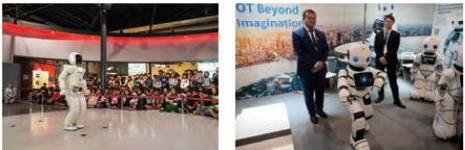
1. There are home robots, teacher robots and worker robots.
(Có rô bốt gia đình, rô bốt giáo viên và rô bốt công nhân.)
2. The children are interested in teacher robots.
(Trẻ em thích người máy giáo viên.)
Welcome to our company. We've made the (1) smartest robots in the world. it's the (2) smallest and the (3) lightest we've made but it can do many things in your house that can even fly to clean the ceilings. It can teach children all school subjects It's also the (4) strongest in our lab because it can move more than 200 kg. It's not difficult to own a robot like this because it's one of the (5) cheapest robots in the world.
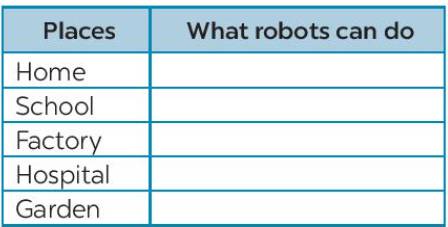
Places (Địa diểm) | What robots can do (Việc robot có thể làm) |
Home (Nhà) | do housework, take care of children (làm việc nhà, chăm sóc trẻ em) |
School (Trường học) | teach students, help students to do exercises (dạy học sinh, giúp học sinh làm bài tập) |
Factory (Nhà máy) | move heavy things, repair broken things (di chuyển vật nặng, sửa chữa đồ đạc hư hỏng) |
Hospital (Bệnh viện) | take care of patients, diagnose (chăm sóc bệnh nhân, chẩn đoán bệnh) |
Garden (Vườn) | plant trees, water plants (trồng cây, tưới cây) |

1. Cheese Rolling (lăn phô mai)
2. A Toe Wrestling (đấu ngón chân)
Tạm dịch:
1. Đó là một môn thể thao đơn giản. Các đối thủ lăn một miếng pho mát lớn hình tròn từ trên đỉnh đồi. Đối thủ cạnh tranh chạy theo và cố gắng bắt lấy nó. Rất ít người có thể bắt được nó vì nó đi rất nhanh, khoảng 112 km một giờ.
2. Đó là một môn thể thao phổ biến cho trẻ em. Trò chơi này bắt đầu ở Derbyshire ở miền Bắc nước Anh. Hai đứa trẻ khóa chặt các ngón chân lại và cố gắng đẩy chân của đứa kia xuống đất. Nó tương tự như vật tay.
A: What can a dishwasher help us to do?
(Máy rửa bát có thể giúp chúng ta làm gì?)
B: It can help us to wash and dry dishes.
(Nó có thể giúp chúng ta rửa và làm khô bát đĩa.)
A: What can a fridge help us to do?
(Tủ lạnh có thể giúp chúng ta làm gì?)
B: It can help us keep food fresh.
(Nó có thể giúp chúng tôi giữ thực phẩm tươi.)
1B
2C
3C
4C
Tạm dịch:
Hôm nay có một triển lãm robot quốc tế tại Hà Nội. Mọi người có thể thấy nhiều loại robot ở đó.
Robot gia đình rất hữu ích cho công việc nội trợ. Họ có thể làm hầu hết các công việc nhà: nấu ăn, dọn dẹp nhà cửa, giặt giũ, ủi quần áo.
Robot giáo viên là sự lựa chọn tốt nhất cho trẻ em. Họ có thể giúp họ học tập. Họ có thể dạy chúng tiếng Anh, văn học, toán học và các môn học khác. Họ cũng có thể giúp trẻ em cải thiện khả năng phát âm tiếng Anh của mình.
Mọi người cũng quan tâm đến các loại robot khác tại triển lãm. Robot công nhân có thể xây nhà và di chuyển những thứ nặng nhọc: robot bác sĩ có thể chăm sóc người bệnh và robot vũ trụ có thể xây dựng các trạm vũ trụ trên Mặt trăng và trên các hành tinh.