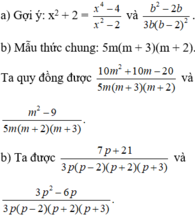
a)...">
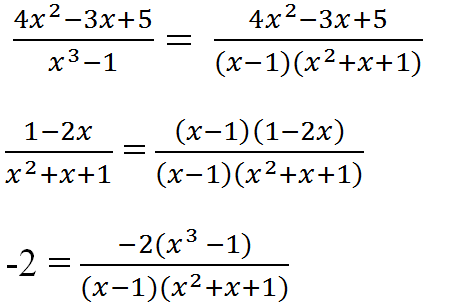
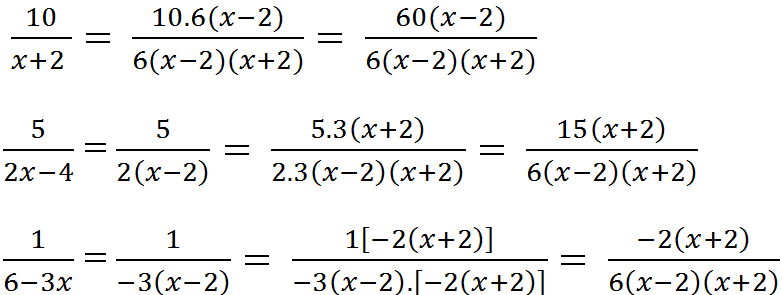
Hãy nhập câu hỏi của bạn vào đây, nếu là tài khoản VIP, bạn sẽ được ưu tiên trả lời. a) Tìm MTC: x3 – 1 = (x – 1)(x2 + x + 1) Nên MTC = (x – 1)(x2 + x + 1) Nhân tử phụ: (x3 – 1) : (x3 – 1) = 1 (x – 1)(x2 + x + 1) : (x2 + x + 1) = x – 1 (x – 1)(x2+ x + 1) : 1 = (x – 1)(x2 + x + 1) Qui đồng: b) Tìm MTC: x + 2 2x – 4 = 2(x – 2) 6 – 3x = 3(2 – x) MTC = 6(x – 2)(x + 2) Nhân tử phụ: 6(x – 2)(x + 2) : (x + 2) = 6(x – 2) 6(x – 2)(x + 2) : 2(x – 2) = 3(x + 2) 6(x – 2)(x + 2) : -3(x – 2) = -2(x + 2) Qui đồng: a, ĐKXĐ : \(x-1\ne0\) => \(x\ne1\) TH1 : \(x-2\ge0\left(x\ge2\right)\) => \(\left|x-2\right|=x-2=1\) => \(x=3\left(TM\right)\) - Thay x = 3 vào biểu thức P ta được : \(P=\frac{3+2}{3-1}=\frac{5}{2}\) TH2 : \(x-2< 0\left(x< 2\right)\) => \(\left|x-2\right|=2-x=1\) => \(x=1\left(KTM\right)\) Vậy giá trị của P là \(\frac{5}{2}\) . a) \(P=\frac{x+2}{x-1}\) \(\left(ĐKXĐ:x\ne1\right)\) Ta có: \(\left|x-2\right|=1\text{⇔}\left[{}\begin{matrix}x-2=1\\x-2=-1\end{matrix}\right.\text{⇔}\left[{}\begin{matrix}x=3\\x=1\end{matrix}\right.\) (loại x = 1 vì x ≠ 1) Thay \(x=3\) vào P, ta có: \(P=\frac{3+2}{3-2}=\frac{5}{1}=5\) Vậy P = 5 tại x = 3. b) \(Q=\frac{x-1}{x}+\frac{2x+1}{x^2+x}=\frac{x-1}{x}+\frac{2x+1}{x\left(x+1\right)}=\frac{x^2-1}{x\left(x+1\right)}+\frac{2x+1}{x\left(x+1\right)}\) (ĐKXĐ: x ≠ 0, x ≠ -1) \(=\frac{x^2+2x}{x\left(x+1\right)}=\frac{x\left(x+2\right)}{x\left(x+1\right)}=\frac{x+2}{x+1}\) a) Tìm MTC: x3 – 1 = (x – 1)(x2 + x + 1) Nên MTC = (x – 1)(x2 + x + 1) Nhân tử phụ: (x3 – 1) : (x3 – 1) = 1 (x – 1)(x2 + x + 1) : (x2 + x + 1) = x – 1 (x – 1)(x2+ x + 1) : 1 = (x – 1)(x2 + x + 1) Qui đồng: b) Tìm MTC: x + 2 2x – 4 = 2(x – 2) 6 – 3x = 3(2 – x) MTC = 6(x – 2)(x + 2) Nhân tử phụ: 6(x – 2)(x + 2) : (x + 2) = 6(x – 2) 6(x – 2)(x + 2) : 2(x – 2) = 3(x + 2) 6(x – 2)(x + 2) : -3(x – 2) = -2(x + 2) Qui đồng: a) \(\dfrac{3x}{2x+4}\) và \(\dfrac{x+3}{x^2-4}\) Phân tích các mẫu thức thành nhân tử : \(2x+4 = 2(x+2)\) \(x^2 - 4 = (x-2)(x+2)\) MTC : \(2(x+2)(x-2)\) Nhân tử phụ của mẫu thức : \(2x + 4\) là \((x - 2)\) \(x^2 - 4\) là \(2\) QĐ: \(\dfrac{3x}{2x+4}=\dfrac{3x}{2\left(x+2\right)}=\dfrac{3x\left(x-2\right)}{2\left(x+2\right)\left(x-2\right)}\) \(\dfrac{x+3}{x^2-4}=\dfrac{x+3}{\left(x+2\right)\left(x-2\right)}=\dfrac{2\left(x+3\right)}{2\left(x+2\right)\left(x-2\right)}\) b) \(\dfrac{x+5}{x^2+4x+4}\) và \(\dfrac{x}{3x+6}\) Phân tích các mẫu thức thành nhân tử : \(x^2+4x+4 = (x+2)^2\) \(3x + 6\) \(= 3(x+2)\) MTC : \(3(x+2)^2\) Nhân tử phụ của mẫu thức : \(x^2 + 4x +4 \) là \(3\) \(3x + 6\) là \((x+2)\) QĐ : \(\dfrac{x+5}{x^2+4x+4}=\dfrac{\left(x+5\right)}{\left(x+2\right)^2}=\dfrac{3\left(x+5\right)}{3\left(x+2\right)^2}\) \(\dfrac{x}{3x+6}=\dfrac{x}{3\left(x+2\right)}=\dfrac{x\left(x+2\right)}{3\left(x+2\right)^2}\) a, \(2x-x^2=x\left(2-x\right)\) \(MC=x\left(2-x\right)\left(x+2\right)\) \(\dfrac{1}{x+2}=\dfrac{x\left(2-x\right)}{x\left(2-x\right)\left(x+2\right)}\);\(\dfrac{8}{2x-x^2}=\dfrac{8\left(x+2\right)}{x\left(2-x\right)\left(x+2\right)}\) b, MC : \(x^2-1\) \(x^2+1=\dfrac{\left(x^2+1\right)\left(x^2-1\right)}{x^2-1}=\dfrac{x^4-1}{x^2-1}\) ; \(\dfrac{x^4}{x^2-1}\)