Hãy nhập câu hỏi của bạn vào đây, nếu là tài khoản VIP, bạn sẽ được ưu tiên trả lời.
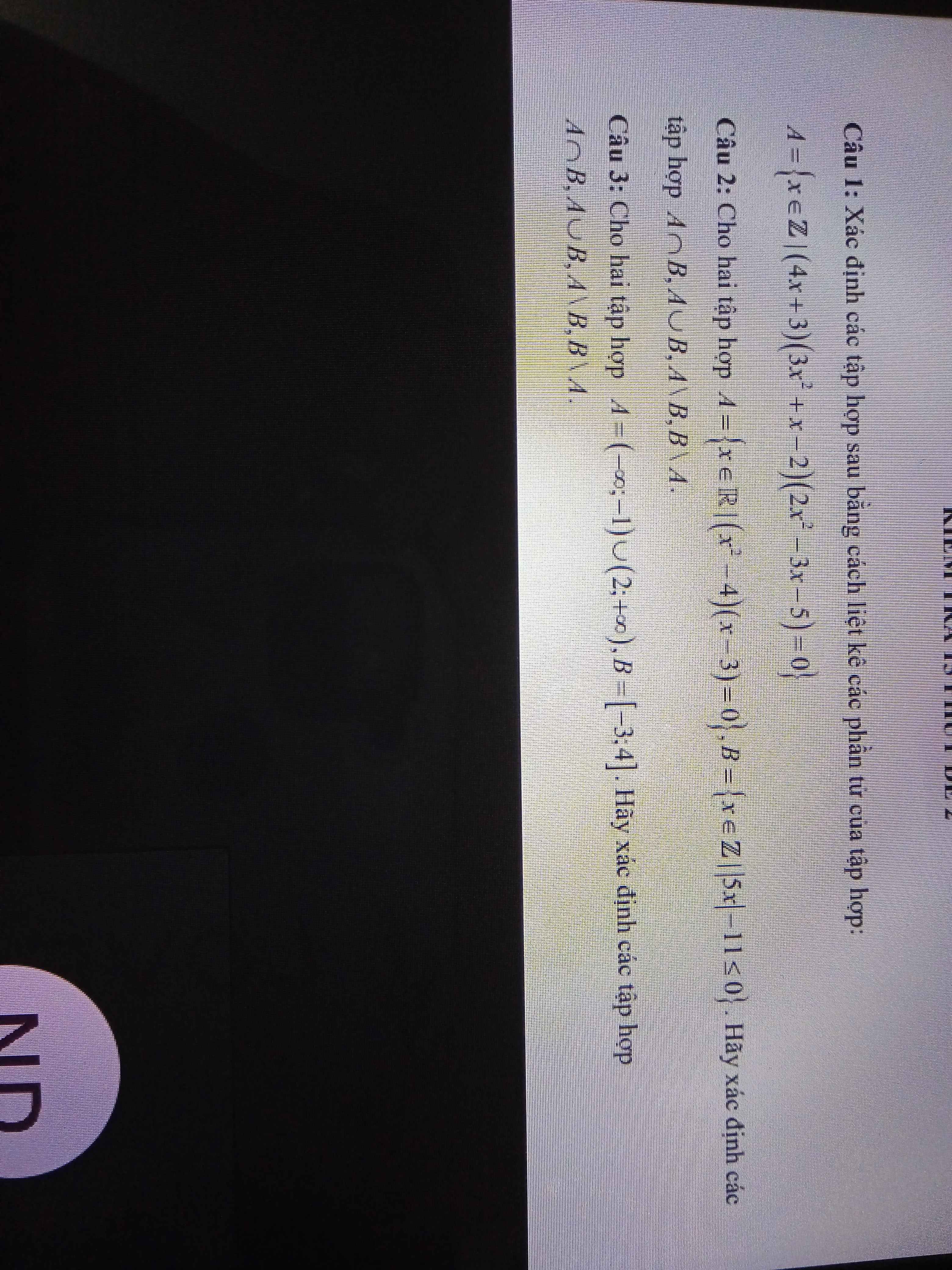
Câu 1:
\(\left(4x+3\right)\left(3x^2+x-2\right)\left(2x^2-3x-5\right)=0\\ \Leftrightarrow\left(4x+3\right)\left(3x-2\right)\left(x+1\right)\left(2x-5\right)\left(x+1\right)=0\\ \Leftrightarrow\left[{}\begin{matrix}x=-\dfrac{3}{4}\\x=-1\\x=\dfrac{2}{3}\\x=\dfrac{5}{2}\end{matrix}\right.\\ \Leftrightarrow A=\left\{-1;-\dfrac{3}{4};\dfrac{2}{3};\dfrac{5}{2}\right\}\)
Câu 2:
\(\left(x^2-4\right)\left(x-3\right)=0\Leftrightarrow\left[{}\begin{matrix}x=2\\x=-2\\x=3\end{matrix}\right.\Leftrightarrow A=\left\{-2;2;3\right\}\\ \left|5x\right|-11\le0\Leftrightarrow\left|5x\right|\le11\Leftrightarrow-11\le5x\le11\\ \Leftrightarrow-\dfrac{11}{5}\le x\le\dfrac{11}{5}\\ \Leftrightarrow B=\left[-\dfrac{11}{5};\dfrac{11}{5}\right]\)
\(\Leftrightarrow A\cap B=\left\{-2;2\right\}\\ A\cup B=\left[-\dfrac{11}{5};3\right]\\ A\B=\left\{3\right\}\)
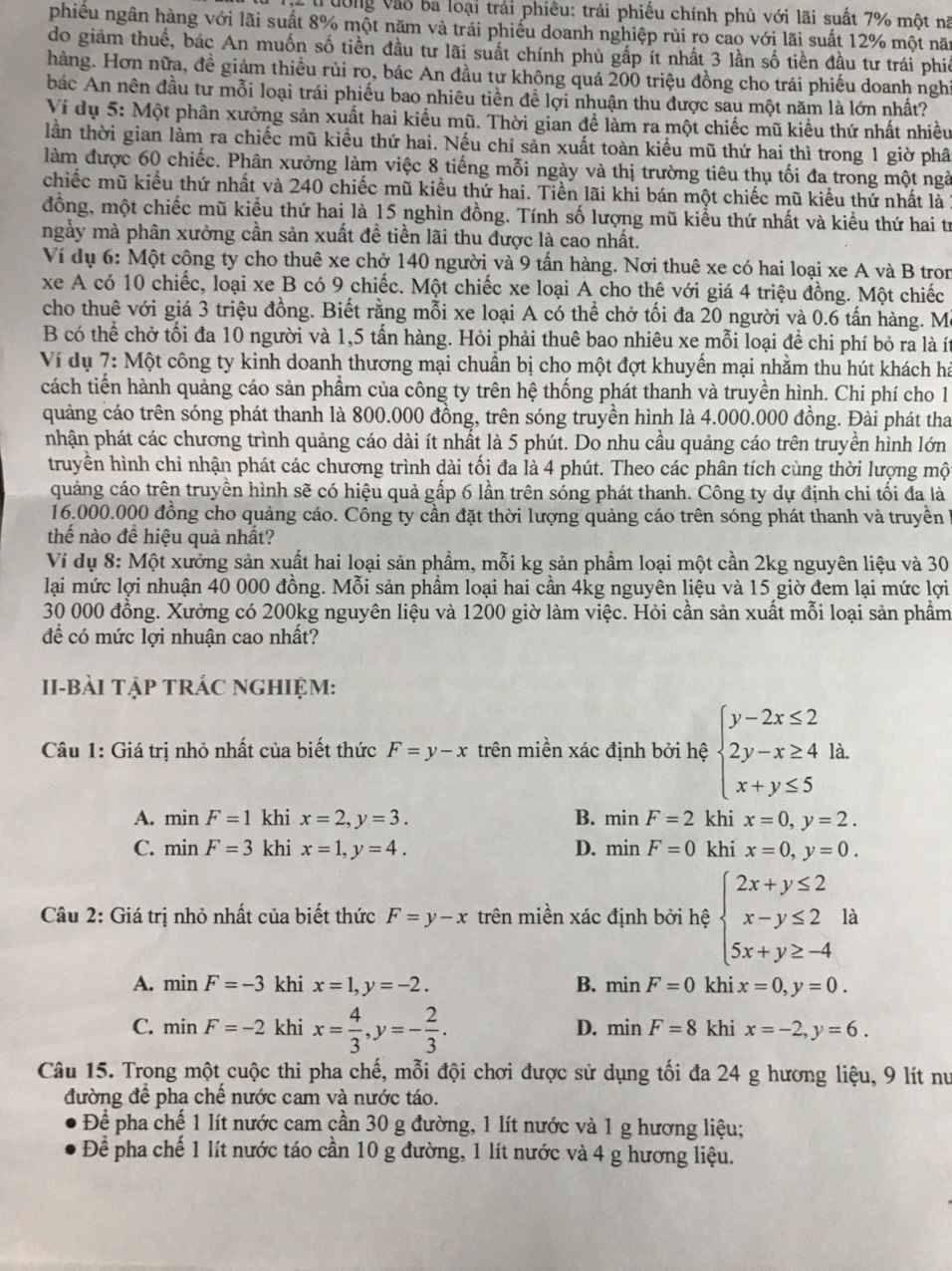
Câu 1:
\(\left\{{}\begin{matrix}y-2x< =2\\2y-x>=4\\x+y< =5\end{matrix}\right.\)
=>\(\left\{{}\begin{matrix}y< =2x+2\\2y>=x+4\\y< =-x+5\end{matrix}\right.\Leftrightarrow\left\{{}\begin{matrix}y< =2x+2\\y< =-x+5\\y>=\dfrac{1}{2}x+2\end{matrix}\right.\)
y<=2x+2
=>y-2x-2<=0
Vẽ đường thẳng y=2x+2
Khi x=0 và y=0 thì \(y-2x-2=0-0-2=-2< =0\)(đúng)
=>Miền nghiệm của BPT y<=2x+2 là nửa mặt phẳng vừa chứa biên vừa chứa điểm O(0;0)
y<=-x+5
=>x+y-5<=0
Khi x=0 và y=0 thì \(x+y-5=0+0-5< =0\)(đúng)
=>Miền nghiệm của BPT y<=-x+5 là nửa mặt phẳng vừa chứa biên vừa chứa điểm O(0;0)
y>=1/2x+2
=>\(-\dfrac{1}{2}x+y-2>=0\)
Khi x=0 và y=0 thì \(-\dfrac{1}{2}x+y-2=-\dfrac{1}{2}\cdot0+0-2=-2< 0\)
=>O(0;0) không thỏa mãn BPT \(-\dfrac{1}{2}x+y-2>=0\)
=>Miền nghiệm của BPT \(y>=\dfrac{1}{2}x+2\) là nửa mặt phẳng chứa biên nhưng không chứa điểm O(0;0)
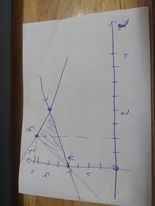
Vẽ đồ thị:

Theo hình vẽ, ta có: Miền nghiệm của hệ BPT sẽ là ΔABC, với A(0;2); B(1;4); C(2;3)
Khi x=0 và y=2 thì F=2-0=2
Khi x=1 và y=4 thì F=4-1=3
Khi x=2 và y=3 thì F=3-2=1
=>Chọn A
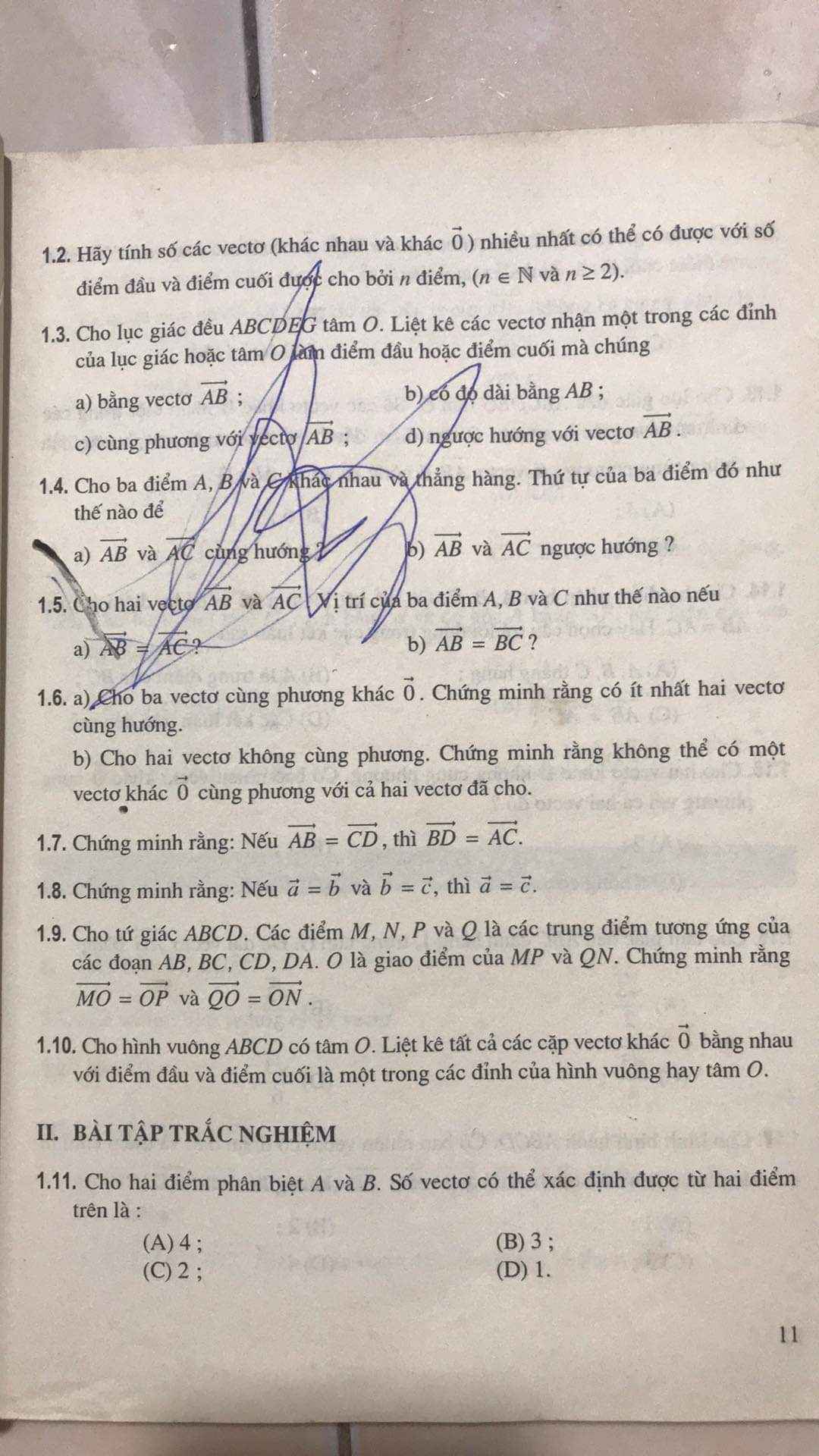
Bài 1.11: C
Bài 1.10: \(\overrightarrow{AB};\overrightarrow{BA};\overrightarrow{AC};\overrightarrow{CA};\overrightarrow{AD};\overrightarrow{DA};\overrightarrow{BC};\overrightarrow{CB};\overrightarrow{BD};\overrightarrow{DB};\overrightarrow{CD};\overrightarrow{DC}\)
\(\overrightarrow{AO};\overrightarrow{OA};\overrightarrow{BO};\overrightarrow{OB};\overrightarrow{CO};\overrightarrow{OC};\overrightarrow{DO};\overrightarrow{OD}\)
Bài 1.7: \(\overrightarrow{AB}=\overrightarrow{CD}\)
=>AB//CD và AB=CD
Xét tứ giác ABDC có
AB//DC
AB=DC
Do đó: ABDC là hình bình hành
=>\(\overrightarrow{BD}=\overrightarrow{AC}\)
hàm số tăng trên khoảng [1;+\(\infty\))
Hàm số giảm trên khoảng(-\(\infty\);-1)
5:
a: sin x=2*cosx
\(A=\dfrac{6cosx+2cosx-4\cdot8\cdot cos^3x}{cos^3x-2cosx}\)
\(=\dfrac{8-32cos^2x}{cos^2x-2}\)
b: VT=sin^4(pi/2-x)+cos^4(x+pi/2)+6*1/2*sin^22x+1/2*cos4x
=cos^4x+sin^4x+3*sin^2(2x)+1/2*(1-2*sin^2(2x))
=1-2*sin^2x*cos^2x+3*sin^2(2x)+1/2-sin^2(2x)
==3/2=VP
Câu 3: C
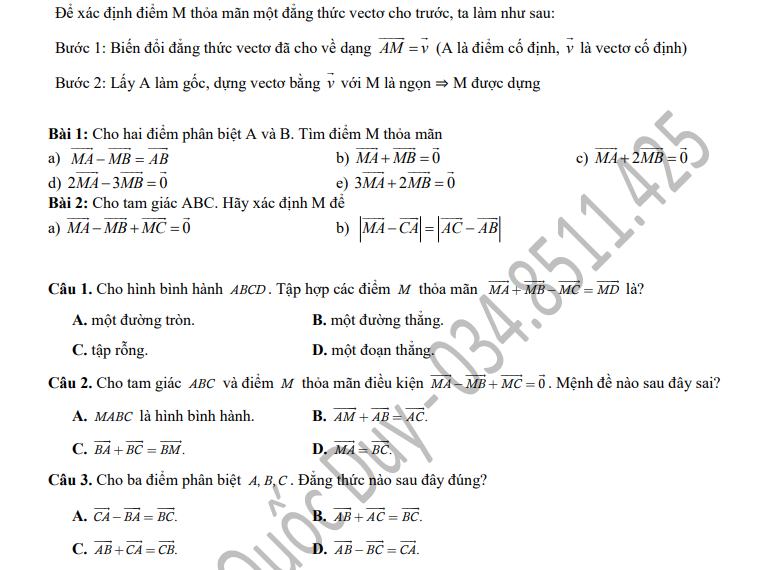
Câu 2: \(\overrightarrow{MA}-\overrightarrow{MB}+\overrightarrow{MC}=\overrightarrow{0}\)
=>\(\overrightarrow{BM}+\overrightarrow{MA}+\overrightarrow{MC}=\overrightarrow{0}\)
=>\(\overrightarrow{BA}=-\overrightarrow{MC}=\overrightarrow{CM}\)
=>\(\overrightarrow{AB}=\overrightarrow{MC}\)
=>ABCM là hình bình hành
=>Chọn D
Bài 1:
a: \(\overrightarrow{MA}-\overrightarrow{MB}=\overrightarrow{AB}\)
=>\(\overrightarrow{MA}+\overrightarrow{BM}=\overrightarrow{AB}\)
=>\(\overrightarrow{BA}=\overrightarrow{AB}\)
=>\(\overrightarrow{AB}=\overrightarrow{0}\) (vô lý)
=>Không có điểm M nào thỏa mãn
b: \(\overrightarrow{MA}+\overrightarrow{MB}=\overrightarrow{0}\)
=>\(\overrightarrow{MA}=-\overrightarrow{MB}=\overrightarrow{BM}\)
=>M nằm giữa A và B và MA=MB
=>M là trung điểm của AB
c: \(\overrightarrow{MA}+2\cdot\overrightarrow{MB}=\overrightarrow{0}\)
=>\(\overrightarrow{MA}=-2\cdot\overrightarrow{MB}\)
=>M nằm giữa A và B sao cho MA=2MB
d: \(2\cdot\overrightarrow{MA}-3\cdot\overrightarrow{MB}=\overrightarrow{0}\)
=>\(2\cdot\overrightarrow{MA}=3\cdot\overrightarrow{MB}\)
=>\(\overrightarrow{MA}=\frac32\cdot\overrightarrow{MB}\)
=>\(\overrightarrow{MB}=\frac23\cdot\overrightarrow{MA}\)
=>M nằm trên tia đối của tia BA sao cho MB=2/3MA
e: \(3\cdot\overrightarrow{MA}+2\cdot\overrightarrow{MB}=\overrightarrow{0}\)
=>\(3\cdot\overrightarrow{MA}=-2\cdot\overrightarrow{MB}\)
=>\(\overrightarrow{MA}=-\frac23\cdot\overrightarrow{MB}\)
=>M nằm giữa A và B sao cho MA=2/3MB


ai giúp em với ạ :<< em đang cần gấp lắm, giải hộ em 2 bài thì càng tốt ạ, em xin chân thành cám ơn