
Hãy nhập câu hỏi của bạn vào đây, nếu là tài khoản VIP, bạn sẽ được ưu tiên trả lời.

They talk about 2 inventions: crawling mop and Geeky jeans.
(Họ nói về 2 phát minh: cây lau nhà biết bò và quần jeans có gắn bàn phím đi động)
| 1. a | 2. a | 3. b | 4. b | 5. a |
1. a: What is their hobby? - building robots
(Sở thích của họ là gì? - chế tạo rô bốt)
2. a :Why do they like their hobby? - They love science.
(Tại sao họ thích sở thích của họ? - Họ yêu khoa học.)
3. b: How much money do they spend on their hobby? - 20 dollars a month
(Họ chi bao nhiêu tiền cho sở thích của mình? - 20 đô la một tháng)
4. b: How much time do they spend on their hobby? - 10 hours a week
(Họ dành bao nhiêu thời gian cho sở thích của mình? - 10 giờ một tuần)
5. a: What's the best thing about their hobby? - the robot battles
(Điều tuyệt vời nhất về sở thích của họ là gì? - các trận chiến robot)

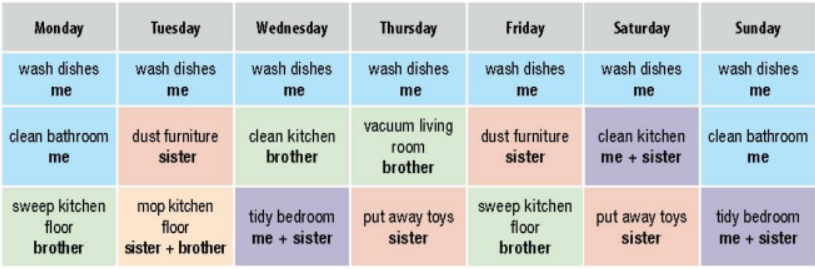
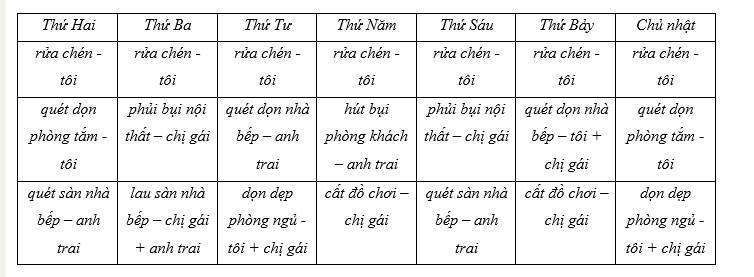
A: What chores does your brother do?
(Anh trai của bạn làm những việc nhà gì?)
B: He cleans the kitchen, vacuums the living room, mops the kitchen floor, and sweeps the kitchen floor.
(Anh ấy quét dọn nhà bếp, hút bụi phòng khách, lau sàn nhà bếp, và quét sàn nhà bếp.)
A: How often does he clean the kitchen?
(Anh ấy quét dọn nhà bếp bao lâu một lần?)
B: He does it once a week, on Wednesdays.
(Anh ấy làm việc đó mỗi tuần một lần, vào các ngày thứ Tư.)
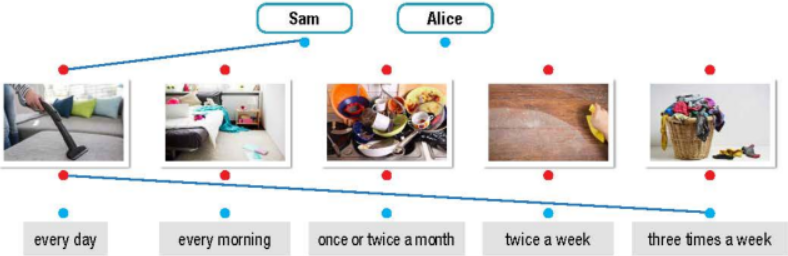
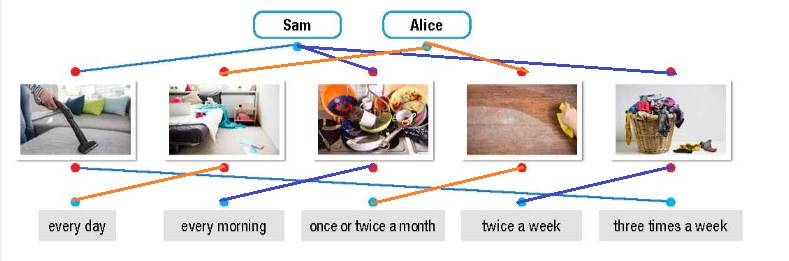
Tạm dịch:
Sam
+ hút bụi phòng khách - 3 lần 1 tuần
+ rửa bát - mỗi buổi sáng
+ cất quần áo - 2 lần 1 tuần
Alice
+ dọn dẹp phòng ngủ - mỗi ngày
+ phủi bụi đồ đạc - 1 hoặc 2 lần 1 tháng
Thông tin:
Sam: I vacuum the living room, and I do the dishes.
(Tôi hút bụi phòng khách và rửa bát.)
Lisa: How often do you vacuum the living room?
(Bạn thường hút bụi phòng khách bao lâu 1 lần?)
Sam: Three times a week.
(Ba lần một tuần.)
Lisa: And how often do you do the dishes?
(Và bạn thường rửa bát bao lâu 1 lần?)
Sam: Every morning, after breakfast.
(Mỗi sáng, sau khi ăn sáng.)
Lisa: Do you do anything else?
(Bạn còn làm gì nữa không?)
Sam: Oh, yeah. I put away my clothes when my mom does the laundry. That's twice a week on Wednesdays and Saturdays.
(Ồ, vâng. Tôi cất quần áo khi mẹ tôi giặt giũ. Việc này thì hai lần một tuần vào thứ Tư và thứ Bảy.)
Sam: Alice tidies her bedroom every day. She's very messy.
(Alice dọn dẹp phòng ngủ mỗi ngày. Em ấy rất bừa bộn.)
Lisa: Oh, is that all?
(Ồ, vậy thôi à?)
Sam: Well, sometimes she dusts the furniture. Maybe once or twice a month. She hates doing chores.
Refer
There are several things that we should do to reduce the negative impact of travelling on the environment. First of all, we should reduce our carbon footprint during the trip. We should only fly when the trip is long and choose environmentally-friendly means of transport such as cycling or public transport. The next thing is that wherever we go, we should always protect our environment. By keeping it clean and safe, we can reduce the negative impact of travelling on the environment. In addition, we had better choose activities that are good for local people and the environment. These will not only help us understand but also respect the nature more and stop doing things that harm the environment and local area as well
Picture 1: a person is watching an interview.
(Bức tranh 1: 1 người đang xem một cuộc phỏng vấn.)
Picture 2: a person is dealing with puzzels.
(Bức tranh 2: 1 người đang chơi xếp hình.)
1. Hoi An villages are well - known for their beautiful vegetable and herb gardens.
2. Tourists can spend the morning on a local farm
3. Tourists recommended to buy handmade products to help local businesses.
Đáp án: 2. Why more people choose to go on eco vacations.
(Tại sao nhiều người chọn đi nghỉ sinh thái hơn.)
Đáp án: at their school (ở trường của họ)