
Hãy nhập câu hỏi của bạn vào đây, nếu là tài khoản VIP, bạn sẽ được ưu tiên trả lời.

thay \(n=5\)vào phương trình trên => \(log_3\left(2u_5-63\right)=2log_4\left(u_5-32\right)=t\) => \(\left\{{}\begin{matrix}2u_5-63=3^t\\u_5-32=2^t\end{matrix}\right.\)
=> \(\left\{{}\begin{matrix}2u_5-63=3^t\\2u_5+32=2.2^t\end{matrix}\right.\)=>\(1+2.2^t=2^t\Leftrightarrow\dfrac{1}{3^t}+2.\left(\dfrac{2}{3}\right)^t=1\)(1)
Vì \(y=\dfrac{1}{3^t}+2.\left(\dfrac{2}{3}\right)^t\) là hàm nghịch biến trên R nên (1) có nghiệm duy nhất t=2 => \(u_5=36\). Thay vào pt ban đầu: \(log_3\left(2.36-63\right)=2log_4\left(u_n-8n+8\right)\)\(\Leftrightarrow u_n=8n-4=4+8\left(n-1\right)\)
=> \(S_n=\dfrac{n\left(8+8\left(n-1\right)\right)}{2}=4n^2\)
=> \(\dfrac{u_n.S_{2n}}{u_{2n}.S_n}=\dfrac{\left(8n-4\right)\left(16n^2\right)}{\left(16n-4\right).4n^2}=\dfrac{4\left(2n-1\right)}{\left(4n-1\right)}< \dfrac{148}{75}\)
=> \(n< 19\)\(\Rightarrow n_{max}=18\)
Đặt log2x = 6t \(\Rightarrow\) x=26t
Thay vào phương trình ta có:
3log3(1+23t+22t)=2log2(23t) = 6t
\(\Leftrightarrow\) log3(1+23t+22t)= 2t
\(\Leftrightarrow\) 1+23t+22t = 32t
\(\Leftrightarrow\) \(\left(\frac{1}{9}\right)^t+\left(\frac{8}{9}\right)^t+\left(\frac{4}{9}\right)^t\) = 1 (chia cả 2 vế cho 32t)
Xét hàm số f(t)=\(\left(\frac{1}{9}\right)^t+\left(\frac{8}{9}\right)^t+\left(\frac{4}{9}\right)^t\) -1 ; nhận thấy f(2)=0
vì f(t) là hàm nghịch biến nên phương trình f(t)=0 có 1 nghiệm duy nhất
suy ra t=2 là nghiệm duy nhất
(từ đó tìm ra x=4096)
bài 1 mk o bt lm ; nên mk lm câu 2 thôi nha .
bài 2) ta có : \(\log_x\left(x-\dfrac{1}{4}\right)\ge2\Leftrightarrow x-\dfrac{1}{4}\ge x^2\Leftrightarrow x^2-x+\dfrac{1}{4}\le0\)
\(\Leftrightarrow\left(x-\dfrac{1}{2}\right)^2\le0\)
mà ta có : \(\left(x-\dfrac{1}{2}\right)^2\ge0\forall x\)
\(\Rightarrow0\le\left(x-\dfrac{1}{2}\right)^2\le0\Leftrightarrow\left(x-\dfrac{1}{2}\right)^2=0\) \(\Leftrightarrow x=\dfrac{1}{2}\)
vậy \(x=\dfrac{1}{2}\)

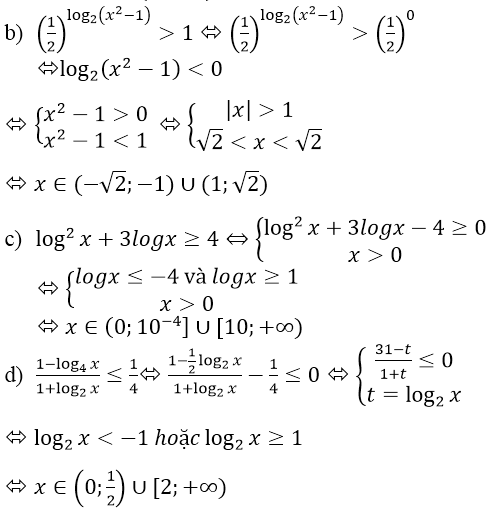

Lời giải:
Ta có:
\(\log_2(x+4)+2\log_4(x+2)=2\log_{\frac{1}{2}}\frac{1}{8}=6\)
\(\Leftrightarrow 2\log_4(x+4)+2\log_4(x+2)=6\)
\(\Leftrightarrow \log_4(x+4)+\log_4(x+2)=3\)
\(\Leftrightarrow \log_4[(x+2)(x+4)]=3\)
\(\Leftrightarrow (x+2)(x+4)=4^3=64\)
\(\Leftrightarrow x^2+6x-56=0\)
\(\Leftrightarrow x=-3\pm \sqrt{65}\)
Kết hợp với ĐKXĐ ta suy ra \(x=-3+\sqrt{65}\) là nghiệm của pt
bạn ơi mình hỏi tí, sao log\(^{\left(x+4\right)}_2=2log^{\left(x+4\right)}_4\)
Cái đó bạn có thể tự suy ra mà
\(\log_2(x+4)=t\Rightarrow x+4=2^t=4^{\frac{t}{2}}\Rightarrow \log_4(x+4)=\frac{t}{2}=\frac{\log_2(x+4)}{2}\)