PN
0

Hãy nhập câu hỏi của bạn vào đây, nếu là tài khoản VIP, bạn sẽ được ưu tiên trả lời.
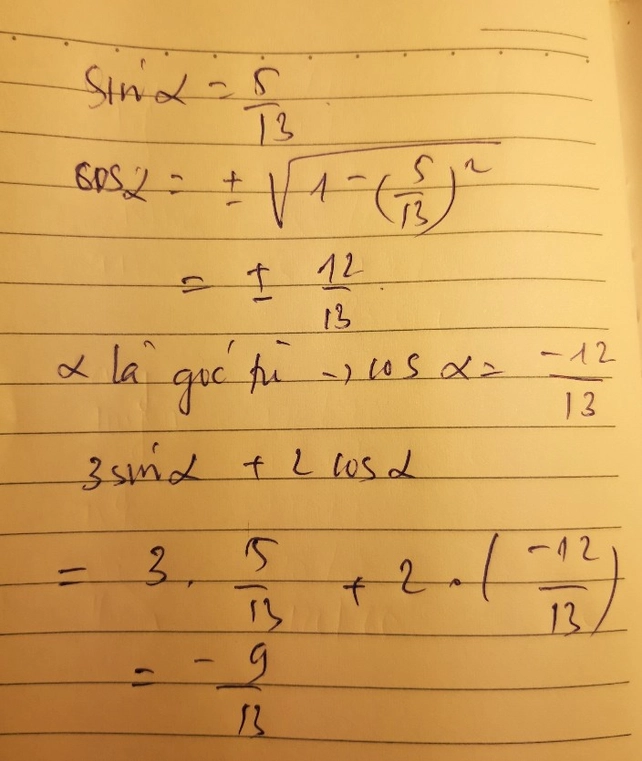
\(tan\alpha=3\)
\(1+tan^2\alpha=\dfrac{1}{cos^2\alpha}\)
\(\Rightarrow cos\alpha=\pm\sqrt{\dfrac{1}{1+tan^2\alpha}}=\pm\sqrt{\dfrac{1}{1+3^2}}=\pm\dfrac{\sqrt{10}}{10}\)
\(\Rightarrow A\)
`tan a =3 <=> (sina)/(cosa) =3 <=> sina=3cosa`
Có: `sin^2a+cos^2a =1`
`<=> (3cosa)^2 + cos^2a =1`
`<=> 10cos^2a =1`
`<=> cosa = \pm \sqrt10/10`
`=>` A.
3.
\(\overrightarrow{AB}=\left(4;2\right)=2\left(2;1\right)\)
Do đó đường thẳng AB nhận \(\left(-1;2\right)\) là 1 vtpt
4.
\(\overrightarrow{AB}=\left(-a;b\right)\)
\(\Rightarrow\) Đường thẳng AB nhận (b;a) là 1 vtpt
tan a=3
=>\(\sin a=3\cdot cosa\)
\(Y=\frac{\sin^2a-2\cdot cosa-\sin a}{cos^2a-\sin^2a}\)
\(=\frac{\left(3\cdot cosa\right)^2-2\cdot cosa-3\cdot cosa}{cos^2a-\left(3\cdot cosa\right)^2}=\frac{9\cdot cos^2a-5\cdot cosa}{-8\cdot cos^2a}=-\frac98+\frac{5}{8\cdot cosa}\)
Ta có: \(1+\tan^2a=\frac{1}{cos^2a}\)
=>\(\frac{1}{cos^2a}=1+3^2=10\)
=>\(cos^2a=\frac{1}{10}\)
=>\(cosa=\frac{1}{\sqrt{10}};cosa=-\frac{1}{\sqrt{10}}\)
TH1: \(cosa=\frac{1}{\sqrt{10}}\)
Ta có: \(Y=-\frac98+\frac{5}{8\cdot cosa}\)
\(=-\frac98+\frac{5}{8\cdot\frac{1}{\sqrt{10}}}=-\frac98+\frac{5\sqrt{10}}{8}=\frac{-9+5\sqrt{10}}{8}\)
TH2: \(cosa=-\frac{1}{\sqrt{10}}\)
Ta có: \(Y=-\frac98+\frac{5}{8\cdot cosa}\)
\(=-\frac98+\frac{5}{8\cdot\frac{-1}{\sqrt{10}}}=-\frac98-\frac{5\sqrt{10}}{8}=\frac{-9-5\sqrt{10}}{8}\)
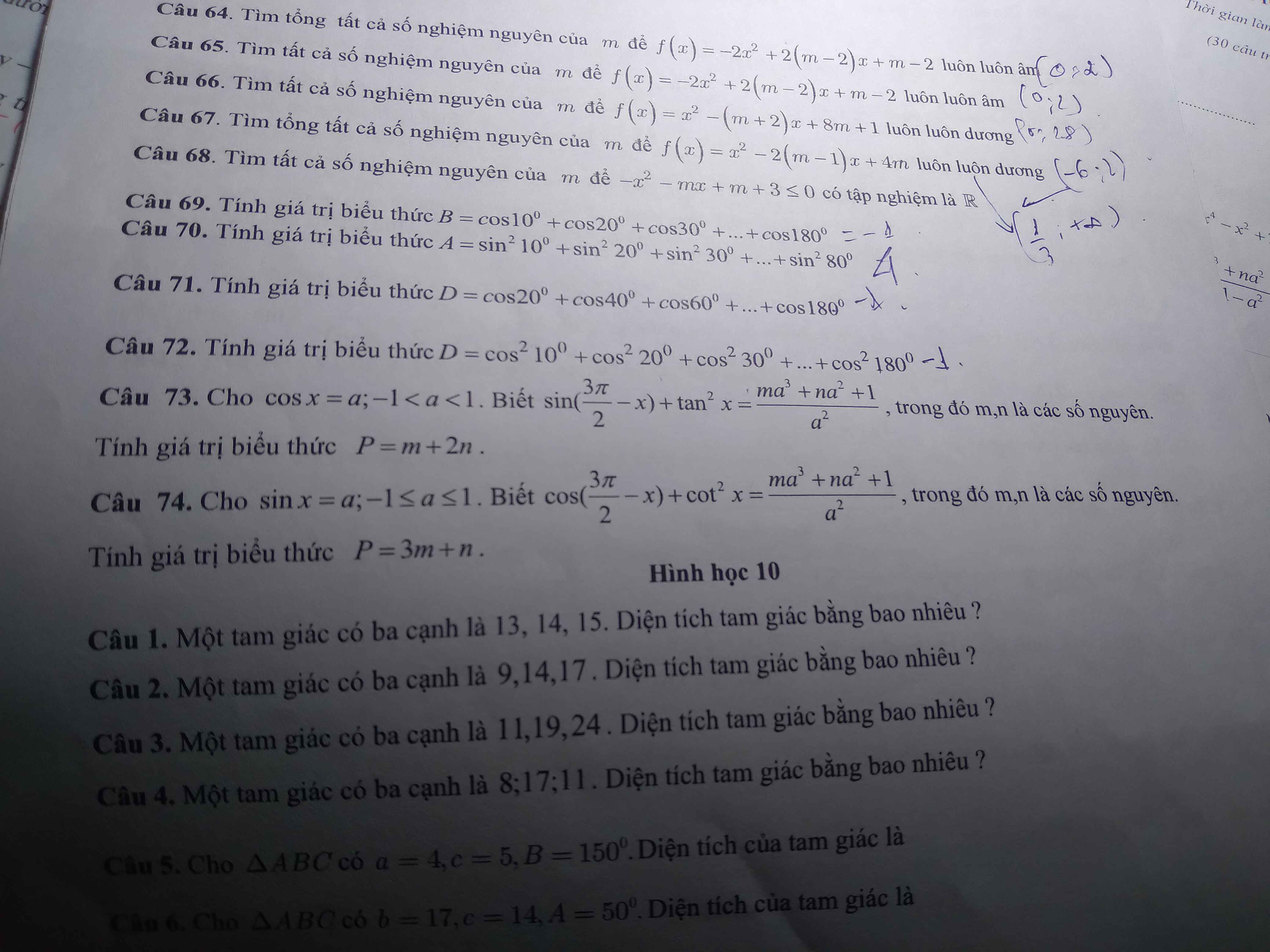
\(sin\left(\dfrac{3\pi}{2}-x\right)+tan^2x=sin\left(\pi+\dfrac{\pi}{2}-x\right)+\dfrac{sin^2x}{cos^2x}=-sin\left(\dfrac{\pi}{2}-x\right)+\dfrac{1-cos^2x}{cos^2x}\)
\(=-cosx+\dfrac{1-cos^2x}{cos^2x}=-a+\dfrac{1-a^2}{a^2}=\dfrac{-a^3-a^2+1}{a^2}\)
\(\Rightarrow\left\{{}\begin{matrix}m=-1\\n=-1\end{matrix}\right.\)
74.
\(cos\left(\dfrac{3\pi}{2}-x\right)+cot^2x=cos\left(\pi+\dfrac{\pi}{2}-x\right)+\dfrac{cos^2x}{sin^2x}=-cos\left(\dfrac{\pi}{2}-x\right)+\dfrac{1-sin^2x}{sin^2x}\)
\(=-sinx+\dfrac{1-sin^2x}{sin^2x}=-a+\dfrac{1-a^2}{a^2}=\dfrac{-a^3-a^2+1}{a^2}\)
\(\Rightarrow m=n=-1\)
`(x^2+1)/((3-x)(x+2))>=0(x ne -2,3)`
Vì `x^2+1>0`
`=>(3-x)(x+2)>0`
`=>(x-3)(x+2)<0`
`=>-2<x<3`
Ủa thì chọn gì?
Ta có: \(\begin{cases}3\left(x-6\right)<-3\\ \frac{5x+m}{2}>7\end{cases}\)
=>x-6<-1 và 5x+m>14
=>x<5 và 5x>14-m
=>x<5 và \(x>\frac{14-m}{5}\)
=>Để hệ có nghiệm thì \(\frac{14-m}{5}<5\)
=>14-m<25
=>-m<11
=>m>-11
47: \(\Delta_1:\frac{x}{\sqrt2-1}+\frac{y}{\sqrt2}+\sqrt2=0\)
=>vecto pháp tuyến là \(\overrightarrow{a}=\left(\frac{1}{\sqrt2-1};\frac{1}{\sqrt2}\right)=\left(\sqrt2+1;\frac{\sqrt2}{2}\right)\)
\(\Delta_2:\sqrt2\cdot x-2\left(\sqrt2+1\right)y=0\)
=>vecto pháp tuyến là \(\overrightarrow{b}=\left(\sqrt2;-2\sqrt2-2\right)\)
\(\overrightarrow{a}\cdot\overrightarrow{b}=\sqrt2\left(\sqrt2+1\right)+\frac{\sqrt2}{2}\cdot\left(-2\right)\left(\sqrt2+1\right)=\sqrt2\left(\sqrt2+1\right)-\sqrt2\left(\sqrt2+1\right)=0\)
=>Δ1⊥Δ2
=>Chọn D
Câu 48: A
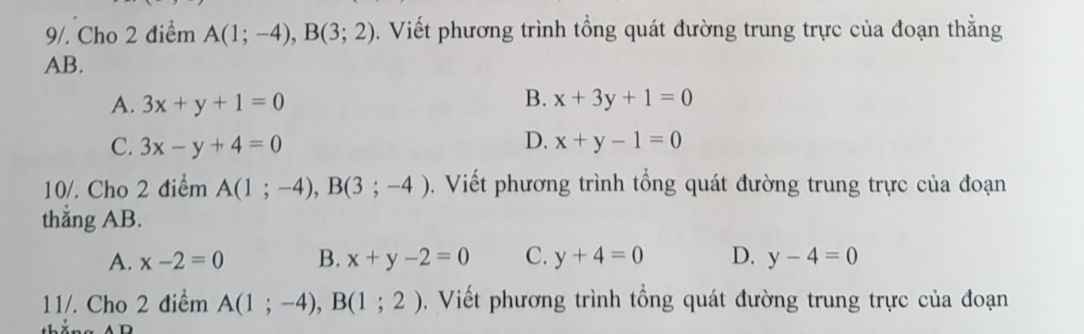
9.
Phương trình đường thẳng AB: \(3x-y-7=0\)
Trung điểm đoạn thẳng AB: \(I=\left(2;-1\right)\)
Trung trực đoạn AB vuông góc với AB có phương trình dạng: \(\left(\Delta\right):x+3y+m=0\)
Mà I thuộc \(I\in\Delta\Rightarrow2-3+m=0\Leftrightarrow m=1\)
\(\Rightarrow\Delta:x+3y+1=0\)
10.
Phương trình đường thẳng AB: \(y+4=0\)
Trung điểm đoạn thẳng AB: \(I=\left(2;-4\right)\)
Trung trực đoạn AB vuông góc với AB có phương trình dạng: \(\left(\Delta\right):x+m=0\)
Mà I thuộc \(I\in\Delta\Rightarrow2+m=0=0\Leftrightarrow m=-2\)
\(\Rightarrow\Delta:x-2=0\)