
TD

8

Hãy nhập câu hỏi của bạn vào đây, nếu là tài khoản VIP, bạn sẽ được ưu tiên trả lời.
a) \(23,3\) phút; \(540^0;27,6^0C\)
b) Khi lấy số trung bình làm đại diện cho các số liệu thống kê về quy mô và độ lớn, có thể xem rằng mỗi ngày bạn A đi từ nhà đến trường đều mất 23,3 phút.
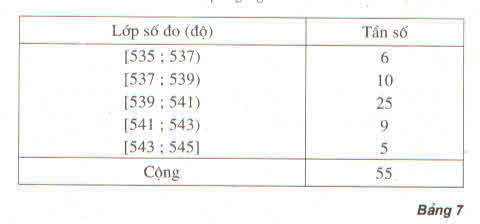
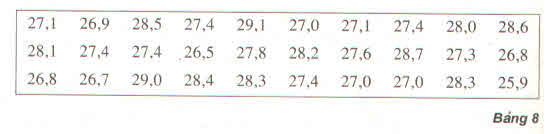
Tương tự, nêu ý nghĩa số trung bình của các số liệu thống kê cho ở bảng 7 và bảng 8.
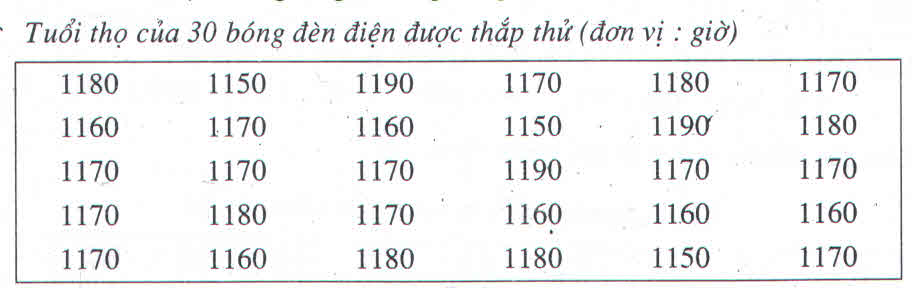
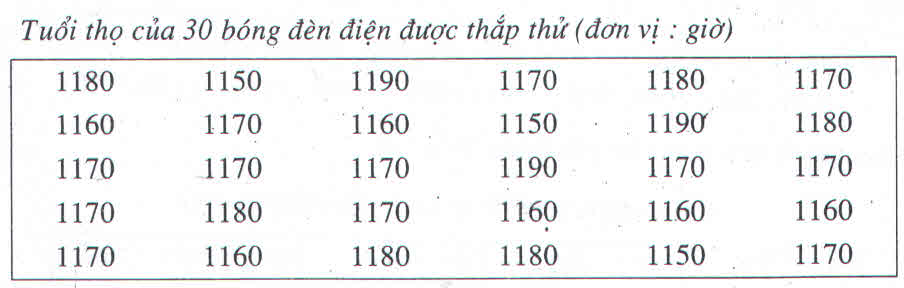
a) Bảng phân bố tần số (về tuổi thọ bóng đèn điện) có thể viết dưới dạng như sau:

Số trung bình về tuổi thọ của bóng đèn trong bảng phân bố trên là:
.(3x1150 + 6x1160 + 12x1170 + 6x1180 + 3x1190)
= 1170.
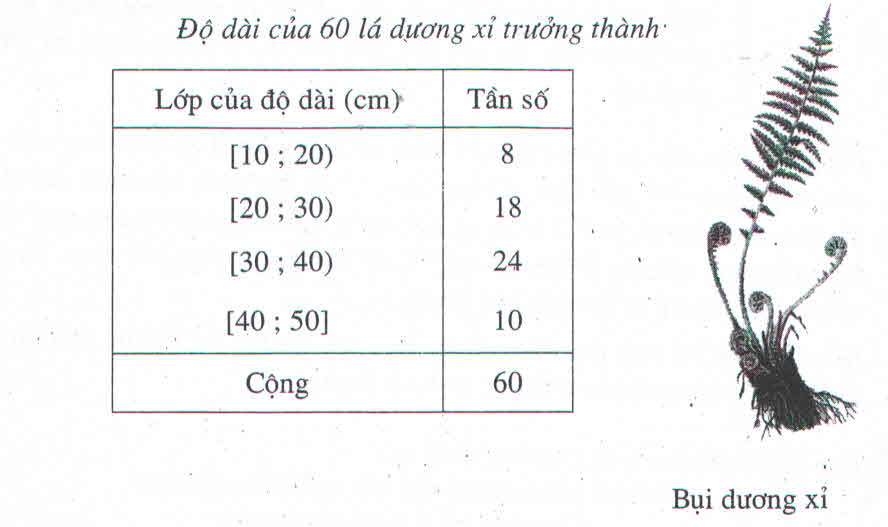
b) Số trung bình về chiều dài lá cây dương xỉ trong bài tập 2 trong là:
.(8x15 + 18x25 + 24x35 + 10x45) = 31 (cm).
a) Phương sai và độ lệch chuẩn trong bài tập 1. Bảng phân bố tần số viết lại là

Số trung bình: \(\overline{x} = 1170\)
Phương sai: \(S_{x}^{2}=\frac{1}{30}(3x1150^{2}+6x1160^{2}+12x1170^{2}+6x1180^{2}+3x1190^{2})-1170^{2} = 120\)
Độ lệch chuẩn: Sx.= \(\sqrt{S_{x}^{2}}=\sqrt{120} ≈ 10,9545\)
b) Phương sai và độ lệch chuẩn, bảng thống kê trong bài tập 2 \(\S 1.\)
\(S_{x}^{2}=\frac{1}{60}(8x15^{2}+18x25^{2}+24x35^{2}+10x45^{2}) - 312 = 84 \)
Sx ≈ 9,165.
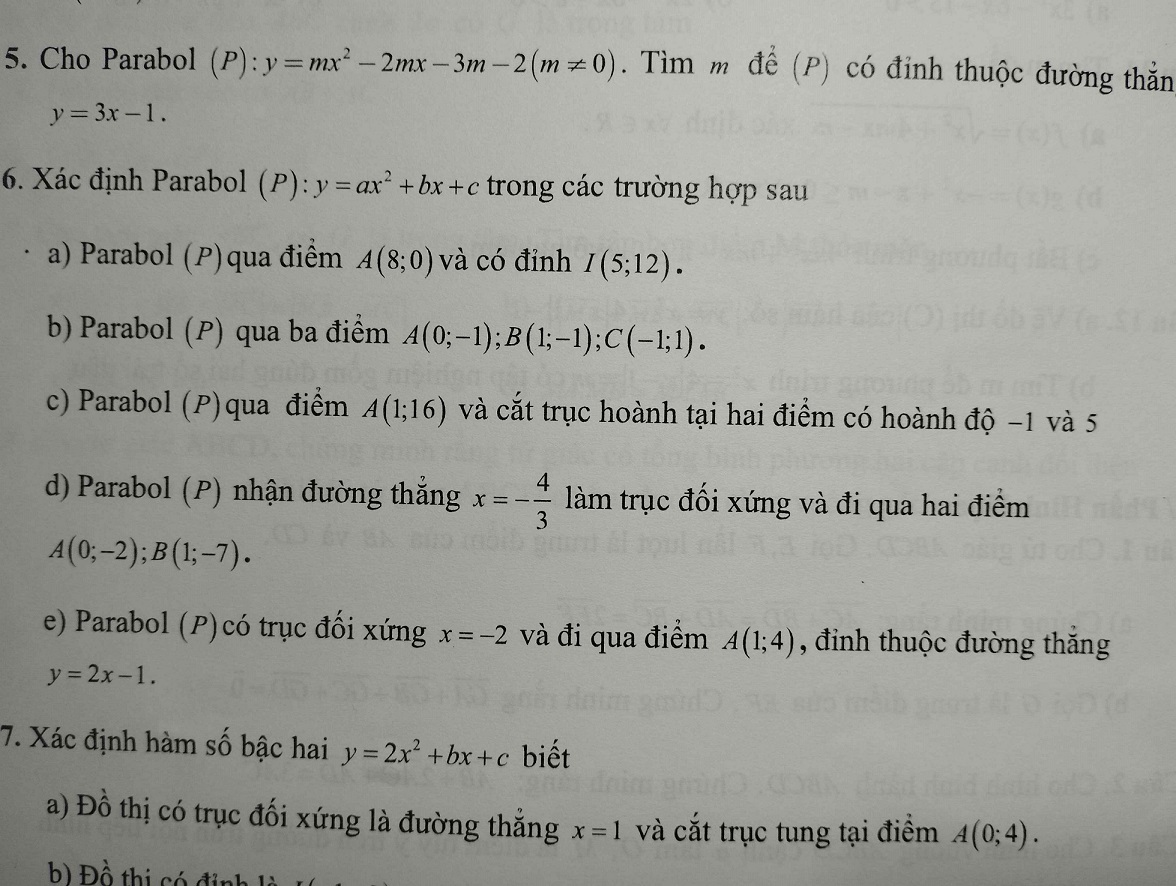
5.
Tọa độ dỉnh của (P) là: \(I\left(-\dfrac{b}{2a};\dfrac{-\Delta}{4a}\right)\Rightarrow I\left(1;-4m-2\right)\)
Để I thuộc \(y=3x-1\)
\(\Rightarrow-4m-2=3.1-1\)
\(\Rightarrow m=-1\)
6.a.
Với \(a\ne0\)
\(\left\{{}\begin{matrix}64a+8b+c=0\\-\dfrac{b}{2a}=5\\\dfrac{4ac-b^2}{4a}=12\end{matrix}\right.\) \(\Leftrightarrow\left\{{}\begin{matrix}64a+8b+c=0\\b=-10a\\4ac-b^2=48a\end{matrix}\right.\)
\(\Leftrightarrow\left\{{}\begin{matrix}c=-64a-8b=-64a-8\left(-10a\right)=16a\\b=-10a\\4ac-b^2=48a\end{matrix}\right.\)
\(\Rightarrow4a.16a-\left(-10a\right)^2=48a\)
\(\Rightarrow a=-\dfrac{4}{3}\Rightarrow b=\dfrac{40}{3}\Rightarrow c=-\dfrac{64}{3}\)
Hay pt (P): \(y=-\dfrac{4}{3}x^2+\dfrac{40}{3}x-\dfrac{64}{3}\)
b.
Thay tọa độ 3 điểm vào pt (P) ta được:
\(\left\{{}\begin{matrix}c=-1\\a+b+c=-1\\a-b+c=1\end{matrix}\right.\) \(\Rightarrow\left\{{}\begin{matrix}a=1\\b=-1\\c=-1\end{matrix}\right.\)
Pt (P): \(y=x^2-x-1\)
c.
Do (P) đi qua 3 điểm có tọa độ (1;16); (-1;0); (5;0) nên ta có:
\(\left\{{}\begin{matrix}a+b+c=16\\a-b+c=0\\25a+5b+c=0\end{matrix}\right.\) \(\Rightarrow\left\{{}\begin{matrix}a=-2\\b=8\\c=10\end{matrix}\right.\)
hay pt (P) có dạng: \(y=-2x^2+8x+10\)
Đường thẳng y = ax + b đi qua A( -1; 2) và B( 2; -3)
Nên có hpt: \(\left\{{}\begin{matrix}-a+b=2\\2a+b=-3\end{matrix}\right.\)\(\Leftrightarrow\left\{{}\begin{matrix}a=-\dfrac{5}{3}\\b=\dfrac{1}{3}\end{matrix}\right.\)
Vậy \(y=-\dfrac{5}{3}x+\dfrac{1}{3}\)
-> Chon B
Câu 9: ĐKXĐ: \(3-2x\ge0\)
\(\Leftrightarrow x\le\dfrac{3}{2}\)
-> Chọn B
Câu 10: Bấm máy là ra.
giao điểm (d1) ;và (d2) thỏa he :\(\left\{{}\begin{matrix}2x+my+m+1=0\\\left(m+1\right)x+y+2m=0\end{matrix}\right.\)(I)
\(\Rightarrow\)(I) có nghiệm khi \(m^2+m-2\ne0\Leftrightarrow m\ne1;m\ne-2\)(\(\circledast\))
nghiệm của(I) \(\left\{{}\begin{matrix}x=\dfrac{2m+1}{m+2}=2-\dfrac{3}{m+2}\left(1\right)\\y=\dfrac{m-1}{m+2}=1-\dfrac{3}{m+2}\left(2\right)\end{matrix}\right.\)
lấy về trừ theo về cửa (1) chờ (2) tá dược: x-y = 1
vậy giao điểm của d1 va d2 luôn di động trên đường thẳng : x -y -1 = 0


 , có môn gì cũng được mọi người ạ!!!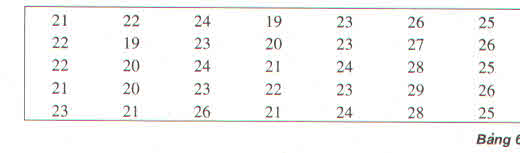




 MONG CÁC ANH CHỊ GIẢI NHANH GIÚP EM
10.
\(\dfrac{sin3x-cos3x}{sinx+cosx}=\dfrac{3sinx-4sin^3x-\left(4cos^3x-3cosx\right)}{sinx+cosx}\)
\(=\dfrac{3\left(sinx+cosx\right)-4\left(sin^3x+cos^3x\right)}{sinx+cosx}\)
\(=\dfrac{3\left(sinx+cosx\right)-4\left(sinx+cosx\right)\left(sin^2x+cos^2x-sinx.cosx\right)}{sinx+cosx}\)
\(=\dfrac{3\left(sinx+cosx\right)-4\left(sinx+cosx\right)\left(1-sinx.cosx\right)}{sinx+cosx}\)
\(=\dfrac{\left(sinx+cosx\right)\left(3-4+4sinx.cosx\right)}{sinx+cosx}\)
\(=-1+4sinx.cosx\)
\(=2sin2x-1\)
11.
\(tan\left(\dfrac{\pi}{4}+\dfrac{x}{2}\right)\dfrac{1+cos\left(\dfrac{\pi}{2}+x\right)}{sin\left(\dfrac{\pi}{2}+x\right)}=tan\left(\dfrac{\pi}{4}+\dfrac{x}{2}\right).\dfrac{1+sin\left(-x\right)}{cos\left(-x\right)}\)
\(=tan\left(\dfrac{\pi}{4}+\dfrac{x}{2}\right).\dfrac{1-sinx}{cosx}=tan\left(\dfrac{\pi}{4}+\dfrac{x}{2}\right)\dfrac{sin^2\dfrac{x}{2}+cos^2\dfrac{x}{2}-2sin\dfrac{x}{2}cos\dfrac{x}{2}}{cos^2\dfrac{x}{2}-sin^2\dfrac{x}{2}}\)
\(=tan\left(\dfrac{\pi}{4}+\dfrac{x}{2}\right).\dfrac{\left(cos\dfrac{x}{2}-sin\dfrac{x}{2}\right)^2}{\left(cos\dfrac{x}{2}-sin\dfrac{x}{2}\right)\left(cos\dfrac{x}{2}+sin\dfrac{x}{2}\right)}\)
\(=tan\left(\dfrac{\pi}{4}+\dfrac{x}{2}\right).\dfrac{cos\dfrac{x}{2}-sin\dfrac{x}{2}}{cos\dfrac{x}{2}+sin\dfrac{x}{2}}\)
\(=tan\left(\dfrac{\pi}{4}+\dfrac{x}{2}\right).\dfrac{cos\left(\dfrac{x}{2}+\dfrac{\pi}{4}\right)}{sin\left(\dfrac{x}{2}+\dfrac{\pi}{4}\right)}\)
\(=tan\left(\dfrac{\pi}{4}+\dfrac{x}{2}\right).cot\left(\dfrac{\pi}{4}+\dfrac{x}{2}\right)\)
\(=1\)
12.
\(cot2x+\dfrac{1}{sin2x}+tanx=\dfrac{cos2x}{sin2x}+\dfrac{1}{sin2x}+tanx\)
\(=\dfrac{cos2x+1}{sin2x}+\dfrac{sinx}{cosx}=\dfrac{2cos^2x-1+1}{2sinx.cosx}+\dfrac{sinx}{cosx}\)
\(=\dfrac{2cos^2x}{2sinx.cosx}+\dfrac{sinx}{cosx}=\dfrac{cosx}{sinx}+\dfrac{sinx}{cosx}\)
\(=\dfrac{sin^2x+cos^2x}{sinx.cosx}=\dfrac{1}{sinx.cosx}\)
\(=\dfrac{2}{2sinx.cosx}=\dfrac{2}{sin2x}\)
13.
\(\dfrac{1-cos2x+sin2x}{1+cos2x+sin2x}.cotx=\dfrac{1-\left(1-2sin^2x\right)+2sinx.cosx}{1+2cos^2x-1+2sinx.cosx}.cotx\)
\(=\dfrac{2sin^2x+2sinx.cosx}{2cos^2x+2sinx.cosx}.cotx\)
\(=\dfrac{2sinx\left(sinx+cosx\right)}{2cosx\left(sinx+cosx\right)}.cotx\)
\(=\dfrac{sinx}{cosx}.cotx=tanx.cotx\)
\(=1\)
14.
\(\dfrac{2\left(sin2x+2cos^2x-1\right)}{cosx-sinx-cos3x+sin3x}=\dfrac{2\left(sin2x+cos2x\right)}{\left(cosx-cos3x\right)+\left(sin3x-sinx\right)}\)
\(=\dfrac{2\left(sin2x+cos2x\right)}{2sin2x.sinx+2cos2x.sinx}\)
\(=\dfrac{2\left(sin2x+cos2x\right)}{2sinx\left(sin2x+cos2x\right)}\)
\(=\dfrac{1}{sinx}\)
15.
\(\dfrac{1}{sin2x}+\dfrac{1}{sin4x}+\dfrac{1}{sin8x}+cot8x=\dfrac{1}{sin2x}+\dfrac{1}{sin4x}+\dfrac{1}{sin8x}+\dfrac{cos8x}{sin8x}\)
\(=\dfrac{1}{sin2x}+\dfrac{1}{sin4x}+\dfrac{1+2cos^24x-1}{2sin4x.cos4x}\)
\(=\dfrac{1}{sin2x}+\dfrac{1}{sin4x}+\dfrac{2cos^24x}{2sin4x.cos4x}\)
\(=\dfrac{1}{sin2x}+\dfrac{1}{sin4x}+\dfrac{cos4x}{sin4x}\)
\(=\dfrac{1}{sin2x}+\dfrac{1+cos4x}{sin4x}=\dfrac{1}{sin2x}+\dfrac{1+2cos^22x-1}{2sin2x.cos2x}\)
\(=\dfrac{1}{sin2x}+\dfrac{cos2x}{sin2x}\)
\(=\dfrac{1+cos2x}{sin2x}=\dfrac{1+2cos^2x-1}{2sinx.cosx}\)
\(=\dfrac{cosx}{sinx}=cotx\)
16.
\(-\dfrac{\pi}{4}< x< \dfrac{\pi}{4}\Rightarrow\left\{{}\begin{matrix}sinx+cosx>0\\sinx-cosx< 0\end{matrix}\right.\)
\(\sqrt{1-sin2x}+\sqrt{1+sin2x}\)
\(=\sqrt{sin^2x+cos^2x-2sinx.cosx}+\sqrt{sin^2x+cos^2x-2sinx.cosx}\)
\(=\sqrt{\left(sinx-cosx\right)^2}+\sqrt{\left(sinx+cosx\right)^2}\)
\(=\left|sinx-cosx\right|+\left|sinx+cosx\right|\)
\(=cosx-sinx+sinx+cosx\)
\(=2cosx\)
17.
\(0< x< \dfrac{\pi}{4}\Rightarrow\left\{{}\begin{matrix}sin\dfrac{x}{2}+cos\dfrac{x}{2}>0\\sin\dfrac{x}{2}-cos\dfrac{x}{2}< 0\end{matrix}\right.\)
\(\sqrt{1+sinx}+\sqrt{1-sinx}\)
\(=\sqrt{sin^2\dfrac{x}{2}+cos^2\dfrac{x}{2}+2sin\dfrac{x}{2}cos\dfrac{x}{2}}+\sqrt{sin^2\dfrac{x}{2}+cos^2\dfrac{x}{2}-2sin\dfrac{x}{2}cos\dfrac{x}{2}}\)
\(=\sqrt{\left(sin\dfrac{x}{2}+cos\dfrac{x}{2}\right)^2}+\sqrt{\left(sin\dfrac{x}{2}-cos\dfrac{x}{2}\right)^2}\)
\(=\left|sin\dfrac{x}{2}+cos\dfrac{x}{2}\right|+\left|sin\dfrac{x}{2}-cos\dfrac{x}{2}\right|\)
\(=sin\dfrac{x}{2}+cos\dfrac{x}{2}+cos\dfrac{x}{2}-sin\dfrac{x}{2}\)
\(=2cos\dfrac{x}{2}\)