
Hãy nhập câu hỏi của bạn vào đây, nếu là tài khoản VIP, bạn sẽ được ưu tiên trả lời.

b:
ĐKXĐ: \(\left\{{}\begin{matrix}cosx< >0\\sinx< >0\end{matrix}\right.\)
=>\(\left\{{}\begin{matrix}x< >\dfrac{\Omega}{2}+k\Omega\\x\ne k\Omega\end{matrix}\right.\)
=>\(x\ne\dfrac{\Omega}{2}+\dfrac{k\Omega}{2}\)
\(\dfrac{1}{cosx}+\dfrac{\sqrt{3}}{sinx}=2\cdot sin\left(x+\dfrac{\Omega}{3}\right)\)
=>\(\dfrac{sinx+\sqrt{3}\cdot cosx}{cosx\cdot sinx}=2\cdot sin\left(x+\dfrac{\Omega}{3}\right)\)
=>\(\dfrac{sinx+\sqrt{3}\cdot cosx}{cosx\cdot sinx}=2\cdot\left[sinx\cdot\cos\dfrac{\Omega}{3}+sin\left(\dfrac{\Omega}{3}\right)\cdot cosx\right]\)
=>\(\dfrac{sinx+\sqrt{3}\cdot cosx}{cosx\cdot sinx}=2\cdot\left(\dfrac{1}{2}\cdot sinx+\dfrac{\sqrt{3}}{2}\cdot cosx\right)\)
=>\(\left(sinx+\sqrt{3}\cdot cosx\right)\left(\dfrac{1}{cosx\cdot sinx}-1\right)=0\)
=>\(2\cdot\left(sinx\cdot\dfrac{1}{2}+\dfrac{\sqrt{3}}{2}\cdot cosx\right)\cdot\left(\dfrac{2}{2\cdot sinx\cdot cosx}-1\right)=0\)
=>\(2\cdot sin\left(x+\dfrac{\Omega}{3}\right)\cdot\left(\dfrac{2}{sin2x}-1\right)=0\)
=>\(\left[{}\begin{matrix}sin\left(x+\dfrac{\Omega}{3}\right)=0\\\dfrac{2}{sin2x}-1=0\end{matrix}\right.\Leftrightarrow\left[{}\begin{matrix}x+\dfrac{\Omega}{3}=k\Omega\\sin2x=2\left(loại\right)\end{matrix}\right.\)
=>\(x=-\dfrac{\Omega}{3}+k\Omega\)
Bài 1:
1: \(y=\frac{\sin x+2\cdot cosx+1}{2\cdot\sin x+cosx+3}\)
=>\(2y\cdot\sin x+y\cdot cosx+3y=\sin x+2\cdot cosx+1\)
=>\(\left(2y-1\right)\cdot\sin x+cosx\cdot\left(y-2\right)=1-3y\)
Để phương trình có nghiệm thì \(\left(2y-1\right)^2+\left(y-2\right)^2>=\left(1-3y\right)^2\)
=>\(4y^2-4y+1+y^2-4y+4\ge9y^2-6y+1\)
=>\(5y^2-8y+5-9y^2+6y-1\ge0\)
=>\(-4y^2-2y+4\ge0\)
=>\(y^2+\frac12y-1\le0\)
=>\(y^2+2\cdot y\cdot\frac14+\frac{1}{16}-\frac{17}{16}\le0\)
=>\(\left(y+\frac14\right)^2\le\frac{17}{16}\)
=>\(-\frac{\sqrt{17}}{4}\le y+\frac14\le\frac{\sqrt{17}}{4}\)
=>\(\frac{-\sqrt{17}-1}{4}\le y\le\frac{\sqrt{17}-1}{4}\)
=>\(y_{\min}=\frac{-\sqrt{17}-1}{4}\) và \(y_{\max}=\frac{\sqrt{17}-1}{4}\)
2: \(y=2\cdot\sin^2x-3\cdot\sin x\cdot cosx+cos^2x\)
\(=2\cdot\frac{1-cos2x}{2}-3\cdot\frac12\cdot\sin2x+\frac{1+cos2x}{2}\)
\(=1-cos2x-\frac32\cdot\sin2x+\frac12+\frac12\cdot cos2x\)
\(=-\frac32\cdot\sin2x-\frac12\cdot cos2x+\frac32=-\frac12\left(3\cdot\sin2x+cos2x-3\right)\)
\(=-\frac{\sqrt{10}}{2}\left(\frac{3}{\sqrt{10}}\cdot\sin2x+\frac{1}{\sqrt{10}}\cdot cos2x-\frac{3}{\sqrt{10}}\right)\)
\(=-\frac{\sqrt{10}}{2}\cdot\left\lbrack\sin\left(2x+\alpha\right)-\frac{3}{\sqrt{10}}\right\rbrack\) , với \(cosa=\frac{3}{\sqrt{10}};\sin a=\frac{1}{\sqrt{10}}\)
\(=-\frac{\sqrt{10}}{2}\cdot\sin\left(2x+\alpha\right)+\frac32\)
Ta có: \(-1\le\sin\left(2x+a\right)\le1\)
=>\(-1\cdot\frac{-\sqrt{10}}{2}\ge\frac{-\sqrt{10}}{2}\sin\left(2x+a\right)\ge1\cdot\frac{-\sqrt{10}}{2}\)
=>\(\frac{-\sqrt{10}}{2}\le\frac{-\sqrt{10}}{2}\cdot\sin\left(2x+a\right)\le\frac{\sqrt{10}}{2}\)
=>\(\frac{-\sqrt{10}}{2}+\frac32\le\frac{-\sqrt{10}}{2}\cdot\sin\left(2x+a\right)+\frac32\le\frac{\sqrt{10}}{2}+\frac32\)
=>\(y_{\min}=\frac{-\sqrt{10}+3}{2};y_{\max}=\frac{\sqrt{10}+3}{2}\)
Lời giải:
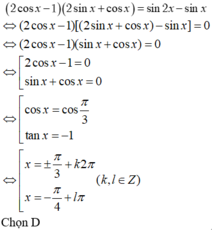
PT $\Leftrightarrow (2\cos x-1)(2\sin x+\cos x)=2\sin x\cos x-\sin x$
$\Leftrightarrow (2\cos x-1)(2\sin x+\cos x)=\sin x(2\cos x-1)$
$\Leftrightarrow (2\cos x-1)(\sin x+\cos x)=0$
$\Rightarrow 2\cos x=1$ hoặc $\sin x=-\cos x=\cos (\pi -x)=\sin (x-\frac{\pi}{2})$
Đến đây thì đơn giản rồi.
Nkjuiopmli Sv5: Bạn chuyển vế sin x(2cos x-1) sang vế trái thì vế phải còn 0 đó.
c/
\(\Leftrightarrow2cos4x.sin3x=cos4x\)
\(\Leftrightarrow\left[{}\begin{matrix}cos4x=0\\2sin3x=1\end{matrix}\right.\) \(\Leftrightarrow\left[{}\begin{matrix}cos4x=0\\sin3x=\frac{1}{2}\end{matrix}\right.\)
\(\Leftrightarrow\left[{}\begin{matrix}4x=\frac{\pi}{2}+k\pi\\3x=\frac{\pi}{6}+k2\pi\\3x=\frac{5\pi}{6}+k2\pi\end{matrix}\right.\)
\(\Leftrightarrow\left[{}\begin{matrix}x=\frac{\pi}{8}+\frac{k\pi}{4}\\x=\frac{\pi}{18}+\frac{k2\pi}{3}\\x=\frac{5\pi}{18}+\frac{k2\pi}{3}\end{matrix}\right.\)
d/
\(\Leftrightarrow6sinx+3cosx+3=sinx-2cosx+3\)
\(\Leftrightarrow sinx+cosx=0\)
\(\Leftrightarrow sin\left(x+\frac{\pi}{4}\right)=0\Leftrightarrow x=-\frac{\pi}{4}+k\pi\)
a/
\(\Leftrightarrow\frac{\sqrt{3}}{2}cosx-\frac{1}{2}sinx=sin4x\)
\(\Leftrightarrow sin\left(\frac{\pi}{3}-x\right)=sin4x\)
\(\Leftrightarrow\left[{}\begin{matrix}4x=\frac{\pi}{3}-x+k2\pi\\4x=\frac{2\pi}{3}+x+k2\pi\end{matrix}\right.\)
\(\Leftrightarrow\left[{}\begin{matrix}x=\frac{\pi}{15}+\frac{k2\pi}{5}\\x=\frac{2\pi}{9}+\frac{k2\pi}{3}\end{matrix}\right.\)
b/
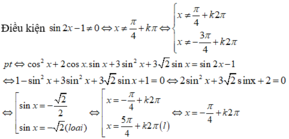
\(\Leftrightarrow2sinx.cosx+4sinx.cos^2x-2sinx=0\)
\(\Leftrightarrow2sinx\left(cosx+2cos^2x-1\right)=0\)
\(\Leftrightarrow\left[{}\begin{matrix}sinx=0\\2cos^2x+cosx-1=0\end{matrix}\right.\)
\(\Leftrightarrow\left[{}\begin{matrix}sinx=0\\cosx=-1\\cosx=\frac{1}{2}\end{matrix}\right.\)
\(\Leftrightarrow\left[{}\begin{matrix}x=k\pi\\x=\pm\frac{\pi}{3}+k2\pi\end{matrix}\right.\)
1.
a, Phương trình có nghiệm khi:
\(\left(m+2\right)^2+m^2\ge4\)
\(\Leftrightarrow m^2+4m+4+m^2\ge4\)
\(\Leftrightarrow2m^2+4m\ge0\)
\(\Leftrightarrow\left[{}\begin{matrix}m\ge0\\m\le-2\end{matrix}\right.\)
b, Phương trình có nghiệm khi:
\(m^2+\left(m-1\right)^2\ge\left(2m+1\right)^2\)
\(\Leftrightarrow2m^2+6m\le0\)
\(\Leftrightarrow-3\le m\le0\)
2.
a, Phương trình vô nghiệm khi:
\(\left(2m-1\right)^2+\left(m-1\right)^2< \left(m-3\right)^2\)
\(\Leftrightarrow4m^2-4m+1+m^2-2m+1< m^2-6m+9\)
\(\Leftrightarrow4m^2-7< 0\)
\(\Leftrightarrow-\dfrac{\sqrt{7}}{2}< m< \dfrac{\sqrt{7}}{2}\)
b, \(2sinx+cosx=m\left(sinx-2cosx+3\right)\)
\(\Leftrightarrow\left(m-2\right)sinx-\left(2m+1\right)cosx=-3m\)
Phương trình vô nghiệm khi:
\(\left(m-2\right)^2+\left(2m+1\right)^2< 9m^2\)
\(\Leftrightarrow m^2-4m+4+4m^2+4m+1< 9m^2\)
\(\Leftrightarrow m^2-1>0\)
\(\Leftrightarrow\left[{}\begin{matrix}m>1\\m< -1\end{matrix}\right.\)