

K
Khách
Hãy nhập câu hỏi của bạn vào đây, nếu là tài khoản VIP, bạn sẽ được ưu tiên trả lời.
Các câu hỏi dưới đây có thể giống với câu hỏi trên
4 tháng 5 2017
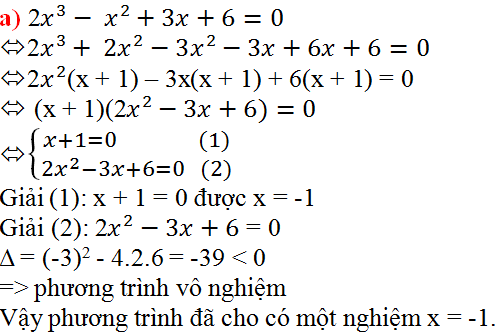
a. \(2x^3-x^2+3x+6=0\)
\(\Leftrightarrow2x^3+2x^2-3x^2-3x+6x+6=0\)
\(\Leftrightarrow2x^2\left(x+1\right)-3x\left(x+1\right)+6\left(x+1\right)=0\)
\(\Leftrightarrow\left(x+1\right)\left(2x^2-3x+6\right)=0\)
\(\Leftrightarrow x+1=0\) ( vì \(2x^2-3x+6\) > 0 với mọi x)
\(\Leftrightarrow x=-1\)
Vậy tập nghiệm của pt là \(S=\left\{-1\right\}\).
b. \(x\left(x+1\right)\left(x+4\right)\left(x+5\right)=12\)
\(\Leftrightarrow\left(x^2+5x\right)\left(x^2+5x+4\right)=12\)(1)
Đặt \(x^2+5x=a\) . Khi đó pt (1) trở thành :
\(a\left(a+4\right)=12\)
\(\Leftrightarrow a^2+4a-12=0\)
\(\Leftrightarrow\left(a-2\right)\left(a+6\right)=0\)
\(\Leftrightarrow\left[{}\begin{matrix}a-2=0\\a+6=0\end{matrix}\right.\Leftrightarrow\left[{}\begin{matrix}a=2\\a=-6\end{matrix}\right.\)
* Với a = 2 thì \(x^2+5x=2\Leftrightarrow x^2+5x-2=0\) \(\Leftrightarrow\left[{}\begin{matrix}x=\dfrac{-5+\sqrt{33}}{2}\\x=\dfrac{-5-\sqrt{33}}{2}\end{matrix}\right.\)
* Với a = -6 thì \(x^2+5x=-6\Leftrightarrow x^2+5x+6=0\Leftrightarrow\left(x+2\right)\left(x+3\right)=0\)
\(\Leftrightarrow\left[{}\begin{matrix}x+2=0\\x+3=0\end{matrix}\right.\Leftrightarrow\left[{}\begin{matrix}x=-2\\x=-3\end{matrix}\right.\)
Vậy tập nghiệm của pt là \(S=\left\{\dfrac{-5+\sqrt{33}}{2};\dfrac{-5-\sqrt{33}}{2};-2;-3\right\}\)
BH
20 tháng 9 2019
\(a,\sqrt{x-2}\left(1-3\sqrt{x+2}\right)=0\)
\(\Rightarrow\orbr{\begin{cases}x=2\\\sqrt{x+2}=\frac{1}{3}\end{cases}\Rightarrow}\orbr{\begin{cases}x=2\\x=-\frac{17}{9}\left(l\right)\end{cases}}\)
\(b,\Leftrightarrow\left(5\sqrt{x}-12\right)\left(\sqrt{x}+1\right)=0\)
Bạn giải nốt nhá
NL
Nguyễn Lê Phước Thịnh
CTVHS
29 tháng 9 2025
a: \(5x^2-8x=0\)
=>x(5x-8)=0
=>\(\left[\begin{array}{l}x=0\\ 5x-8=0\end{array}\right.\Rightarrow\left[\begin{array}{l}x=0\\ 5x=8\end{array}\right.\Rightarrow\left[\begin{array}{l}x=0\\ x=\frac85\end{array}\right.\)
b: \(-3x^2-6x=0\)
=>-3x(x+2)=0
=>x(x+2)=0
=>\(\left[\begin{array}{l}x=0\\ x+2=0\end{array}\right.\Rightarrow\left[\begin{array}{l}x=0\\ x=-2\end{array}\right.\)
c: 2x(x-3)=x-3
=>2x(x-3)-(x-3)=0
=>(x-3)(2x-1)=0
=>\(\left[\begin{array}{l}x-3=0\\ 2x-1=0\end{array}\right.\Rightarrow\left[\begin{array}{l}x=3\\ x=\frac12\end{array}\right.\)
d: 2x(x-3)+5x-15=0
=>2x(x-3)+5(x-3)=0
=>(x-3)(2x+5)=0
=>\(\left[\begin{array}{l}x-3=0\\ 2x+5=0\end{array}\right.\Rightarrow\left[\begin{array}{l}x=3\\ x=-\frac52\end{array}\right.\)
e: \(\left(1+x\right)^2-\left(x-1\right)^2=0\)
=>(1+x-x+1)(1+x+x-1)=0
=>2*2x=0
=>4x=0
=>x=0
f: \(\left(x-2\right)^2=\left(3x+5\right)^2\)
=>\(\left(3x+5\right)^2-\left(x-2\right)^2=0\)
=>(3x+5+x-2)(3x+5-x+2)=0
=>(4x+3)(2x+7)=0
=>\(\left[\begin{array}{l}4x+3=0\\ 2x+7=0\end{array}\right.\Rightarrow\left[\begin{array}{l}x=-\frac34\\ x=-\frac72\end{array}\right.\)
g: \(\left(6-9x\right)^2=\left(5x-7\right)^2\)
=>\(\left(9x-6\right)^2-\left(5x-7\right)^2=0\)
=>(9x-6-5x+7)(9x-6+5x-7)=0
=>(4x+1)(14x-13)=0
=>\(\left[\begin{array}{l}4x+1=0\\ 14x-13=0\end{array}\right.\Rightarrow\left[\begin{array}{l}x=-\frac14\\ x=\frac{13}{14}\end{array}\right.\)
h: \(\left(x+1\right)^2\cdot\left(x+2\right)=0\)
=>\(\left[\begin{array}{l}x+1=0\\ x+2=0\end{array}\right.\Rightarrow\left[\begin{array}{l}x=-1\\ x=-2\end{array}\right.\)
i: \(\left(3x-1\right)\cdot\left(3-x\right)^2=0\)
=>\(\left[\begin{array}{l}3x-1=0\\ \left(3-x\right)^2=0\end{array}\right.\Rightarrow\left[\begin{array}{l}3x=1\\ 3-x=0\end{array}\right.\Rightarrow\left[\begin{array}{l}x=\frac13\\ x=3\end{array}\right.\)
4 tháng 4 2017
a) (3x2 - 7x – 10)[2x2 + (1 - √5)x + √5 – 3] = 0
=> hoặc (3x2 - 7x – 10) = 0 (1)
hoặc 2x2 + (1 - √5)x + √5 – 3 = 0 (2)
Giải (1): phương trình a - b + c = 3 + 7 - 10 = 0
nên
x1 = - 1, x2 = =
Giải (2): phương trình có a + b + c = 2 + (1 - √5) + √5 - 3 = 0
nên
x3 = 1, x4 =
b) x3 + 3x2– 2x – 6 = 0 ⇔ x2(x + 3) – 2(x + 3) = 0 ⇔ (x + 3)(x2 - 2) = 0
=> hoặc x + 3 = 0
hoặc x2 - 2 = 0
Giải ra x1 = -3, x2 = -√2, x3 = √2
c) (x2 - 1)(0,6x + 1) = 0,6x2 + x ⇔ (0,6x + 1)(x2 – x – 1) = 0
=> hoặc 0,6x + 1 = 0 (1)
hoặc x2 – x – 1 = 0 (2)
(1) ⇔ 0,6x + 1 = 0
⇔ x2 = =
(2): ∆ = (-1)2 – 4 . 1 . (-1) = 1 + 4 = 5, √∆ = √5
x3 = , x4 =
Vậy phương trình có ba nghiệm:
x1 = , x2 =
, x3 =
,
d) (x2 + 2x – 5)2 = ( x2 – x + 5)2 ⇔ (x2 + 2x – 5)2 - ( x2 – x + 5)2 = 0
⇔ (x2 + 2x – 5 + x2 – x + 5)( x2 + 2x – 5 - x2 + x - 5) = 0
⇔ (2x2 + x)(3x – 10) = 0
⇔ x(2x + 1)(3x – 10) = 0
Hoặc x = 0, x = , x =
Vậy phương trình có 3 nghiệm:
x1 = 0, x2 = , x3 =
b) x.(x+1). ( x+ 4). (x+ 5) = 12
⇔ [ x. (x + 5)]. [(x+1). (x+ 4)] = 12
⇔ x 2 + 5 x ⋅ x 2 + 4 x + x + 4 − 12 = 0 ⇔ x 2 + 5 x ⋅ x 2 + 5 x + 4 − 12 = 0 ( * )
Đặt t = x 2 + 5 x + 2
= > x 2 + 5 x = t – 2 v à x 2 + 5 x + 4 = t + 2
Khi đó phương trình (*) trở thành:
( t – 2). (t+ 2) - 12 = 0
⇔ t 2 - 4 - 12 = 0 ⇔ t 2 - 16 = 0 ⇔ t 2 = 16 ⇔ t = ± 4
+ Với t = 4 ta có: x 2 + 5 x + 2 = 4
⇔ x2 +5x – 2 = 0 (**)
Có a= 1, b = 5, c = - 2 và ∆ = 5 2 – 4 . 1 . ( - 2 ) = 33 > 0
Nên (**) có 2 nghiệm phân biệt là:
* Với t = - 4 ta có: x 2 + 5 x + 2 = - 4
⇔ x 2 + 5 x + 6 = 0 ( * * * )
Có a= 1, b = 5, c= 6 và ∆ = 5 2 – 4 . 1 . 6 = 1 > 0
Phương trình (***) có 2 nghiệm là:
Vậy tập nghiệm của phương trình đã cho là: