
Hãy nhập câu hỏi của bạn vào đây, nếu là tài khoản VIP, bạn sẽ được ưu tiên trả lời.

a: Ta có: M là trung điểm của BC
=>\(\overrightarrow{MB}=\overrightarrow{CM}\)
\(\overrightarrow{AB}+\overrightarrow{MC}=\overrightarrow{AB}+\overrightarrow{BM}=\overrightarrow{AM}\)
\(\overrightarrow{AC}+\overrightarrow{MB}=\overrightarrow{AC}+\overrightarrow{CM}=\overrightarrow{AM}\)
Do đó: \(\overrightarrow{AB}+\overrightarrow{MC}=\overrightarrow{AC}+\overrightarrow{MB}\)
b:
ΔABC cân tại A
=>\(\hat{ABC}=\hat{ACB}=\frac{180^0-\hat{BAC}}{2}=\frac{180^0-120^0}{2}=30^0\)
ΔABC cân tại A
mà AM là đường trung tuyến
nên AM⊥BC
Xét ΔAMB vuông tại M có \(\sin B=\frac{AM}{AB}\)
=>\(\frac{AM}{6}=\sin30=\frac12\)
=>AM=3(cm)
\(\left|\overrightarrow{AB}-\overrightarrow{CM}\right|=\left|\overrightarrow{AB}+\overrightarrow{MC}\right|\)
\(=\left|\overrightarrow{AB}+\overrightarrow{BM}\right|=\left|\overrightarrow{AM}\right|=AM\) =3(cm)
Sửa đề: Chứng minh \(\overrightarrow{AB}+\overrightarrow{MC}=\overrightarrow{AC}+\overrightarrow{MB}\)
\(\overrightarrow{AB}-\overrightarrow{MB}=\overrightarrow{AB}+\overrightarrow{BM}=\overrightarrow{AM}\)
\(\overrightarrow{AC}-\overrightarrow{MC}=\overrightarrow{AC}+\overrightarrow{CM}=\overrightarrow{AC}\)
Do đó: \(\overrightarrow{AB}-\overrightarrow{MB}=\overrightarrow{AC}-\overrightarrow{MC}\)
=>\(\overrightarrow{AB}+\overrightarrow{MC}=\overrightarrow{AC}+\overrightarrow{MB}\)
Câu 4:
Áp dụng định lý Pytago
\(BC^2=AB^2+AC^2\Rightarrow BC=2\)
Ta có:
\(\overrightarrow{CA}.\overrightarrow{BC}=-\overrightarrow{CA}.\overrightarrow{CB}=-\dfrac{CA^2+CB^2-AB^2}{2}=-\dfrac{2+4-2}{2}=-2\)
Câu 5:
Gọi M là trung điểm BC
\(\overrightarrow{AM}=\dfrac{1}{2}\left(\overrightarrow{AB}+\overrightarrow{AC}\right)\)
Mà: \(\overrightarrow{AG}=\dfrac{2}{3}\overrightarrow{AM}=\dfrac{1}{3}\left(\overrightarrow{AB}+\overrightarrow{AC}\right)\)
Câu 6:
\(\left|\overrightarrow{a}-\overrightarrow{b}\right|=3\)
\(a^2+b^2-2\overrightarrow{a}.\overrightarrow{b}=9\)
\(\overrightarrow{a}.\overrightarrow{b}=\dfrac{1^2+2^2-9}{2}=-2\)
Câu 7:
\(\left|\overrightarrow{AB}-\overrightarrow{AD}+\overrightarrow{CD}\right|=\left|\overrightarrow{DB}+\overrightarrow{CD}\right|\)
\(=\left|\overrightarrow{DB}-\overrightarrow{DC}\right|=\left|\overrightarrow{CB}\right|=BC=a\)
\(\overrightarrow{AB}.\overrightarrow{AC}=AB.AC.cos\widehat{BAC}=10.12.cos120^0=-60\)
ΔBAC vuông tại B
=>\(BA^2+BC^2=AC^2\)
=>\(BC^2=\left(\sqrt3\right)^2-1^2=3-1=2\)
=>\(BC=\sqrt2\)
Xét ΔBAC vuông tại B có
\(cosA=\frac{AB}{AC}=\frac{1}{\sqrt3};cosC=\frac{CB}{CA}=\frac{\sqrt2}{\sqrt3}\)
\(\left(2\cdot\overrightarrow{AB}-\overrightarrow{AC}\right)\left(\overrightarrow{AB}+\overrightarrow{AC}\right)\)
\(=2\cdot AB^2+2\cdot\overrightarrow{AB}\cdot\overrightarrow{AC}-\overrightarrow{AB}\cdot\overrightarrow{AC}-AC^2\)
\(=2\cdot AB^2+\overrightarrow{AB}\cdot\overrightarrow{AC}-AC^2\)
\(=2\cdot1^2+AB\cdot AC\cdot cosA-3=2-3+1\cdot\sqrt3\cdot\frac{1}{\sqrt3}=0\)
=>\(\left(2\cdot\overrightarrow{AB}-\overrightarrow{AC}\right)\) ⊥\(\left(\overrightarrow{AB}+\overrightarrow{AC}\right)\)
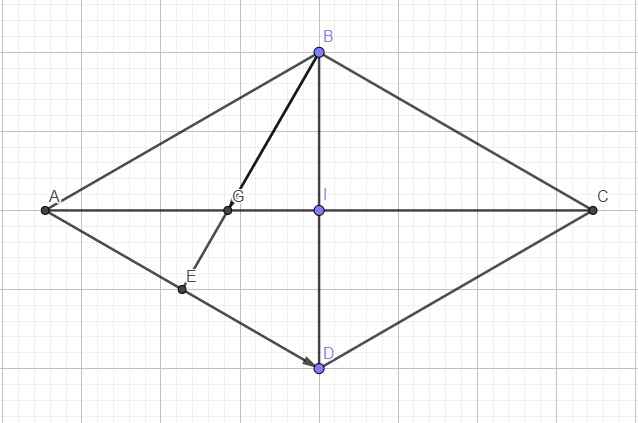
\(\widehat{ABC}=120^0\Rightarrow\widehat{DAB}=180^0-120^0=60^0\)
\(\Rightarrow\Delta ABD\) đều
Gọi E là trung điểm AD \(\Rightarrow\overrightarrow{BE}=\dfrac{1}{2}\overrightarrow{BD}+\dfrac{1}{2}\overrightarrow{BA}\)
\(\Rightarrow\overrightarrow{BG}=\dfrac{2}{3}\overrightarrow{BE}=\dfrac{1}{3}\overrightarrow{BD}+\dfrac{1}{3}\overrightarrow{BA}\)
\(\Rightarrow\overrightarrow{BG}+\overrightarrow{AD}=\dfrac{1}{3}\overrightarrow{BD}+\dfrac{1}{3}\overrightarrow{BA}+\overrightarrow{AD}=\dfrac{1}{3}\left(\overrightarrow{BA}+\overrightarrow{AD}\right)+\dfrac{1}{3}\overrightarrow{BA}+\overrightarrow{AD}\)
\(=\dfrac{2}{3}\overrightarrow{BA}+\dfrac{4}{3}\overrightarrow{AD}=-\dfrac{2}{3}\overrightarrow{AB}+\dfrac{4}{3}\overrightarrow{AD}\)
Đặt \(\overrightarrow{u}=\overrightarrow{BG}+\overrightarrow{AD}\Rightarrow\left|\overrightarrow{u}\right|^2=\left(-\dfrac{2}{3}\overrightarrow{AB}+\dfrac{4}{3}\overrightarrow{AD}\right)=\dfrac{4}{9}AB^2+\dfrac{16}{9}AD^2-\dfrac{16}{9}\overrightarrow{AB}.\overrightarrow{AD}\)
\(=\dfrac{4}{9}.4a^2+\dfrac{16}{9}4a^2-\dfrac{16}{9}.2a.2a.cos60^0=\dfrac{16}{3}a^2\)
\(\Rightarrow\left|\overrightarrow{u}\right|=\dfrac{4a\sqrt{3}}{3}\)
Theo giả thiết ta có :
\(\left(\overrightarrow{AB}+\overrightarrow{AC}\right)\left(\overrightarrow{AB}+\overrightarrow{CA}\right)=0\)
\(\Leftrightarrow\left(\overrightarrow{AB}+\overrightarrow{AC}\right)\left(\overrightarrow{AB}-\overrightarrow{AC}\right)=0\)
\(\Leftrightarrow\overrightarrow{AB}^2-\overrightarrow{AC}^2=0\)
Ta suy ra ABC là tam giác có \(AB=AC\) (Tam giác cân tại A)
Lời giải:
\(\cos (\overrightarrow{AB}, \overrightarrow{CA})=\frac{\overrightarrow{AB}.\overrightarrow{CA}}{|\overrightarrow{AB}||\overrightarrow{CA}|}=\frac{-\overrightarrow{AB}.\overrightarrow{AC}}{|\overrightarrow{AB}||\overrightarrow{AC}|}=-\cos (\overrightarrow{AB}, \overrightarrow{AC})=-\cos (120^0)=\frac{1}{2}\)
\(\Rightarrow \angle (\overrightarrow{AB}, \overrightarrow{CA})=60^0\)